
Peptides
October 16, 2026
Thymosin beta-4 after a heart attack: what animal and human studies show
On this page
A heart attack interrupts blood supply to part of the heart muscle. Reopening the affected artery can save tissue, but some people still develop lasting damage and reduced pumping function. That is why researchers investigate treatments that might protect heart muscle alongside emergency care. Thymosin beta-4 is one candidate, with a history of cell and animal experiments and, more recently, a small randomized human study.
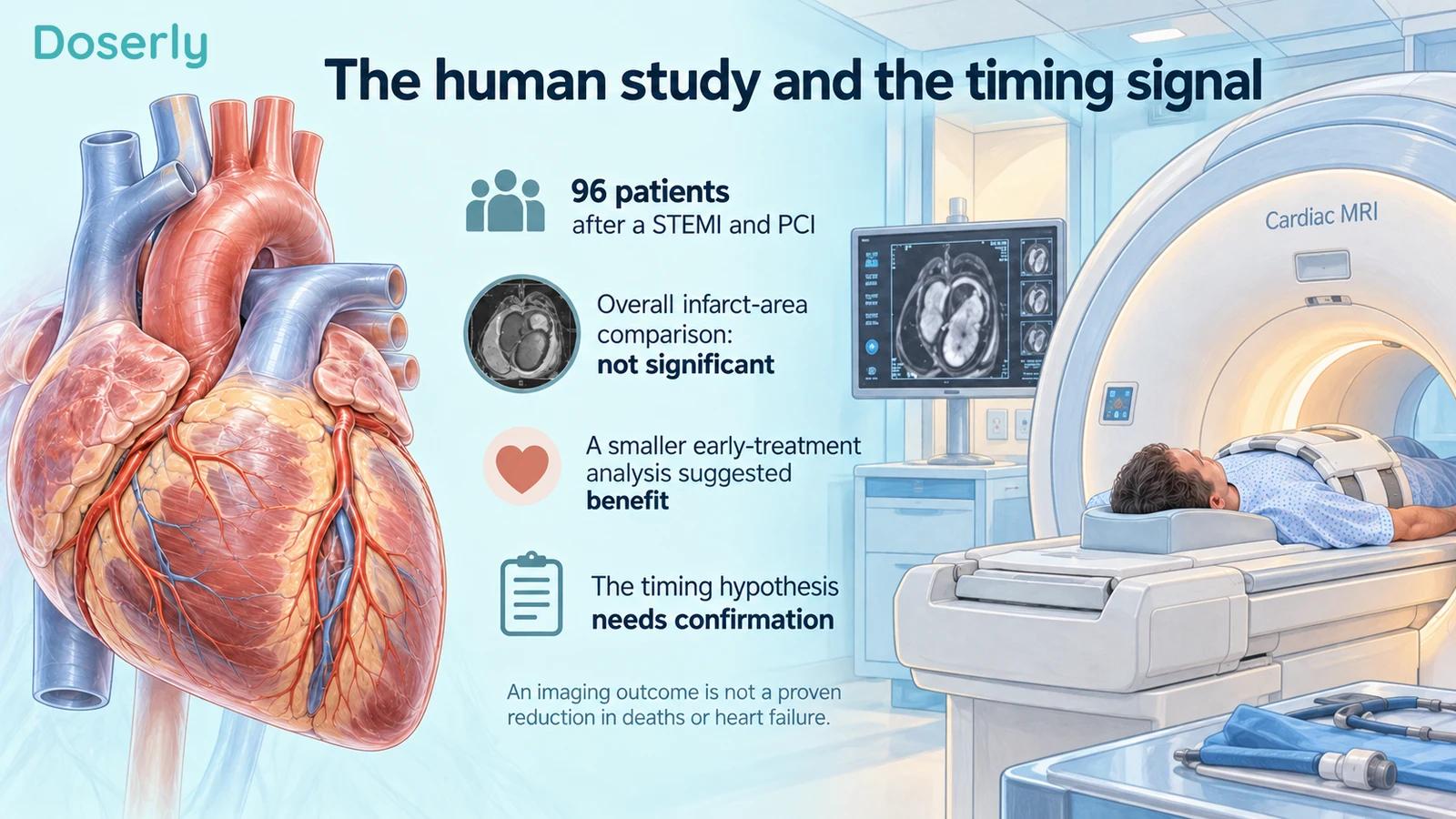
The evidence is more developed than “only mice,” but less conclusive than “repairs the human heart.” A publication involving 96 patients with ST-segment elevation myocardial infarction, or STEMI, reported no significant overall difference in infarcted area between recombinant thymosin beta-4 and placebo. A smaller analysis involving earlier treatment suggested a possible benefit. Human and mouse study.
This article explains the biological rationale, the human findings and what remains to be tested. It does not describe an emergency treatment option. If you suspect a heart attack, call emergency services immediately; experimental peptide research is not a reason to delay care. NHLBI heart-attack symptoms.
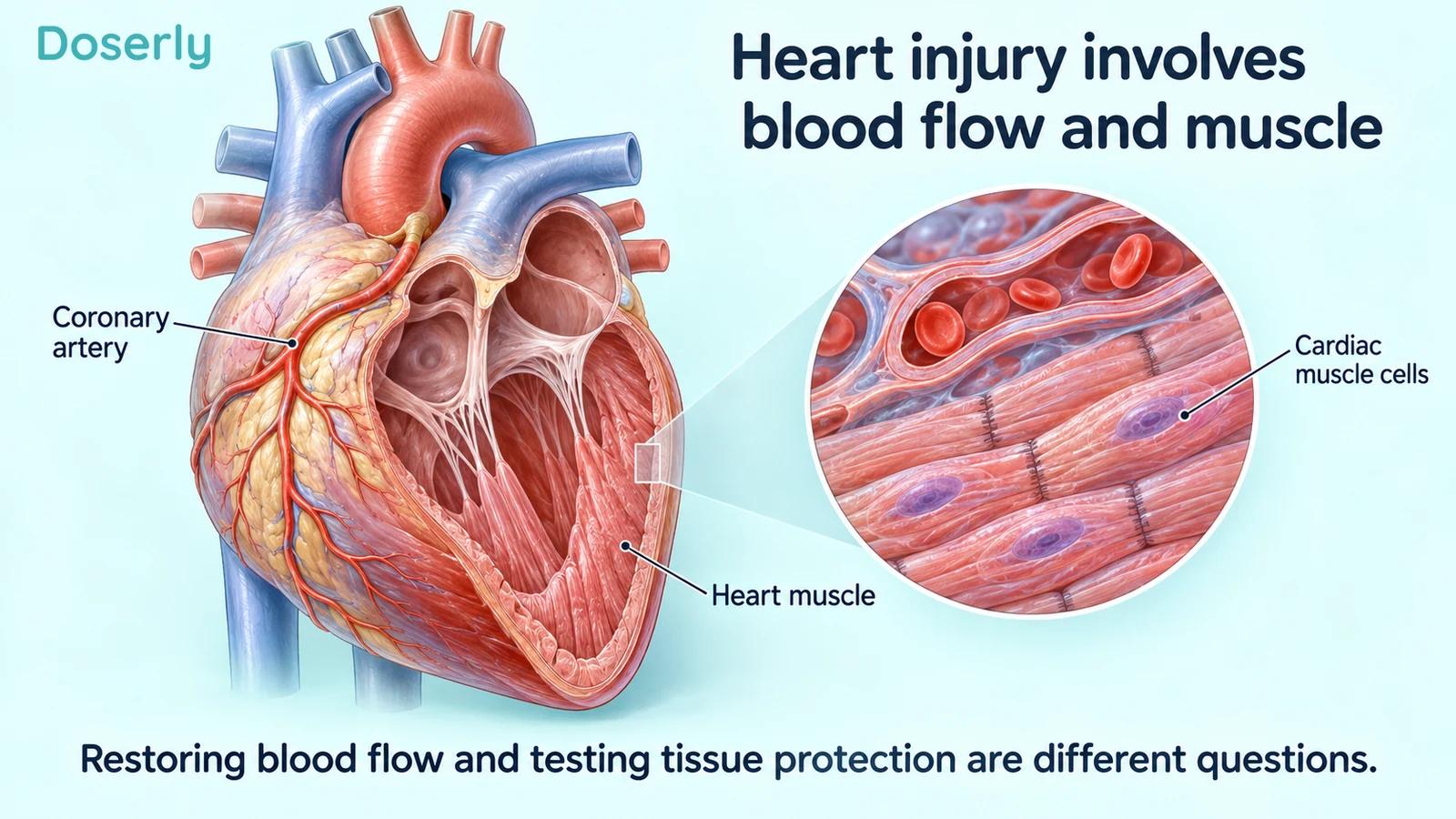
What happens when heart muscle loses its blood supply?
Heart muscle needs a continuous supply of oxygen and nutrients. Ischemia means that supply is inadequate. An infarction is tissue injury and death associated with prolonged loss of blood supply. After a heart attack, the amount and location of injured muscle influence recovery.
Percutaneous coronary intervention, or PCI, is a catheter-based procedure used to open a narrowed or blocked coronary artery. It can involve a balloon and a stent. Re-establishing blood flow is called reperfusion. Early treatment can limit damage and improve the chance of survival. NHLBI treatment explanation.
Restoring flow does not mean every injured cell recovers. Researchers study changes during and after reperfusion, including inflammation, cell death and later remodeling. Remodeling describes structural changes in the heart following injury; it can include changes in chamber size, scar and pumping function.
This creates a specific research question: does an additional treatment improve recovery when given alongside successful reperfusion and the rest of standard care? That differs from asking whether a compound can improve a laboratory injury model or whether it is tolerated by healthy volunteers.
Why thymosin beta-4 interested cardiac researchers
Thymosin beta-4 is a small protein associated with actin, part of the cell's internal structure. Actin-related processes contribute to movement and changes in cell shape. Researchers have investigated whether the peptide also influences pathways involved in cell survival after injury.
A 2004 study reported that thymosin beta-4 promoted migration and survival of cardiac cells in experimental systems. The investigators described a complex involving PINCH and integrin-linked kinase, or ILK, with activation of Akt, a signaling protein involved in cell survival. In mice with a coronary artery surgically tied off, treatment was associated with better early muscle-cell survival and cardiac function. Bock-Marquette and colleagues.
That finding helped establish a reason to investigate the peptide. It did not show that a person recovering from a heart attack would benefit from an injection. The experiment's timing, injury method, exposure and outcome measurements were all part of the result.
A cellular pathway can be relevant without being sufficient to produce a useful medicine. A treatment must reach the right tissue at a suitable exposure, produce enough benefit and avoid unacceptable harm. Those steps become especially important after a heart attack, when patients receive multiple treatments and may be physiologically unstable.
For broader information about the molecule and its other clinical settings, see our thymosin beta-4 guide.
Why the type of animal heart injury matters
A permanently tied coronary artery and a temporarily blocked artery that is reopened represent different situations. The first produces continuing ischemia; the second models ischemia followed by reperfusion. Modern human STEMI care often involves rapid restoration of flow, so a therapy intended for use after PCI needs evidence relevant to that setting.
The newer translational study examined both approaches in mice. In an ischemia/reperfusion model, a seven-day course of recombinant human thymosin beta-4 was associated with improved later cardiac function and less fibrosis, the buildup of scar-like tissue. The paper also reported benefits in a permanent-ligation model. Experimental results.
Its mechanistic experiments implicated an ErbB2/Raf1 signaling pathway. Inhibiting ErbB2 abolished the reported protective effects in the mouse reperfusion model. That supports involvement of the pathway under those experimental conditions; it does not establish that the same mechanism explains a clinical benefit in people.
The pathway also should not be collapsed into the earlier ILK/Akt findings as though every experiment measured the same sequence of events. Different models can reveal different aspects of a molecule's biology. The task for clinical development is to determine which effects matter in patients and whether changing them improves outcomes.
What the 96-patient randomized study found
The human component enrolled patients with STEMI after PCI and compared recombinant human thymosin beta-4 with placebo in a randomized, double-blind design. The published abstract reports assessment of infarcted area at 90 days.
The crucial result is that the overall infarct-area difference between the treatment and placebo groups was not statistically significant. The abstract also describes a favorable analysis involving treatment started within eight hours after PCI. That is an interesting timing signal, but it does not convert the overall comparison into a positive trial. Primary publication abstract.
The accessible abstract does not provide enough arm-level numerical information to calculate a reliable absolute benefit or determine all details of the timing analysis. It also does not establish from the abstract alone whether that analysis was prespecified. We therefore should not attach a precise expected benefit, a proven treatment window or a subgroup cure rate to it.
It is reasonable to hypothesize that a tissue-protection treatment might work differently depending on when it is given. A smaller timing-defined comparison can also be affected by chance or differences among patients. The useful next step is to test the timing hypothesis prospectively, with the intended window and primary analysis chosen in advance.
Infarct size, pumping function and survival are different outcomes
An imaging measurement of infarct size can help describe how much heart muscle has been injured. It is not the same outcome as surviving longer, avoiding another heart attack or staying out of hospital with heart failure. A convincing effect on one measurement needs to be connected to the benefits patients ultimately care about.
Left ventricular ejection fraction, or LVEF, describes the proportion of blood ejected from the left ventricle with a beat. It measures one aspect of pumping function. Chamber volumes, symptoms, exercise tolerance and clinical events provide other information. A person can improve in one domain while still needing treatment in another.
The newer trial registration makes these distinctions explicit. It lists cardiac MRI infarct-size measurements as primary outcomes, with additional assessments of ventricular function, blood markers, safety, quality of life and cardiovascular events. Those are planned measurements, not reported successes. NL005 phase 2 trial registry.
When reading a headline about “heart repair,” ask which outcome is underneath it. An improved molecular signal in mice, a smaller imaging abnormality in a subgroup and fewer heart-failure admissions are different claims. Only the outcome actually measured can be attributed to the study.
What the newer registered trial can and cannot tell us
The registry for NCT07586865 describes a planned randomized, placebo-controlled study of 189 participants after STEMI and primary PCI. It specifies early intravenous administration and day-90 cardiac MRI measurements of absolute and relative infarct size.
At the research check on October 15, 2026, the latest public record still listed the study as not yet recruiting, with estimated future completion dates. An estimated start date in a registry does not prove that recruitment has started, and the record supplies no treatment results. Current registry record.
The design shows that investigators are pursuing a focused clinical question rather than assuming that animal findings are enough. Whether the trial ultimately confirms benefit will depend on its completed results, adherence to its analysis plan, missing data and safety findings.
Even if a future study is positive in the immediate post-PCI setting, it would not automatically establish benefit for longstanding heart failure, an old scar, stable angina or general cardiovascular prevention. The time since injury and background care are central parts of the intervention being studied.
What do we know about safety in people?
A phase 1 study of recombinant NL005 included 54 healthy volunteers in its single-dose portion and 30 in its multiple-dose portion. The latter involved ten days of intravenous administration and observation through day 28. No serious adverse events or dose-limiting toxicities were reported, although mild and moderate events occurred. Phase 1 study.
That was useful early safety information. Healthy volunteers are not equivalent to patients just treated for a heart attack, and short follow-up cannot resolve uncommon or delayed risks. The study also did not test the safety of an unverified commercial preparation, a fragment sold as TB-500 or a self-directed subcutaneous schedule.
For a cardiac treatment, the practical safety questions include how it behaves alongside established medicines and whether the benefit exceeds any added risk. Those answers require controlled patient data. A short volunteer study and a plausible survival pathway do not supply them by themselves.
What matters now for someone recovering from a heart attack?
Recovery care already addresses several goals: reducing the chance of another event, supporting heart function, rebuilding activity safely and managing the emotional effects of a major illness. Cardiac rehabilitation combines supervised exercise, education and support tailored to the person's condition. NHLBI recovery guidance.
If you are interested in experimental research, discuss it with the cardiology team managing your recovery. Useful questions include whether a trial is actually open, whether your type and timing of heart attack match its eligibility, what background care continues and which outcomes it is designed to improve.
Keeping a dated list of medicines, symptoms and follow-up measurements can help those conversations. It is especially useful to distinguish breathlessness, chest symptoms and exercise tolerance from a single scan number. Medication changes and return to activity should follow your care team's plan.
Thymosin beta-4 has a credible experimental rationale and an early human research signal that deserves careful follow-up. The present clinical result remains limited: the 96-patient overall infarct-area comparison was not significant, and the timing observation needs confirmation. That is a reason to study the candidate more carefully, not a basis for claiming established heart regeneration.
Sources
- Bock-Marquette and colleagues, 2004: cardiac cells and mouse injury models.
- Zhang and colleagues: recombinant thymosin beta-4 in mice and 96 STEMI patients.
- NL005 healthy-volunteer phase 1 study, 2021.
- NL005 acute myocardial infarction trial, NCT07586865.
- NHLBI: heart-attack treatment.
- NHLBI: heart-attack recovery.
- NHLBI: heart-attack symptoms and emergency care.