
Peptides
October 16, 2026
Thymosin alpha-1 is not the same as a thymus extract
On this page
A paper mentions thymosin, a product label mentions thymus, and a search result calls both an immune-support peptide. It is easy to assume the names describe different versions of the same thing. They can describe substantially different materials.
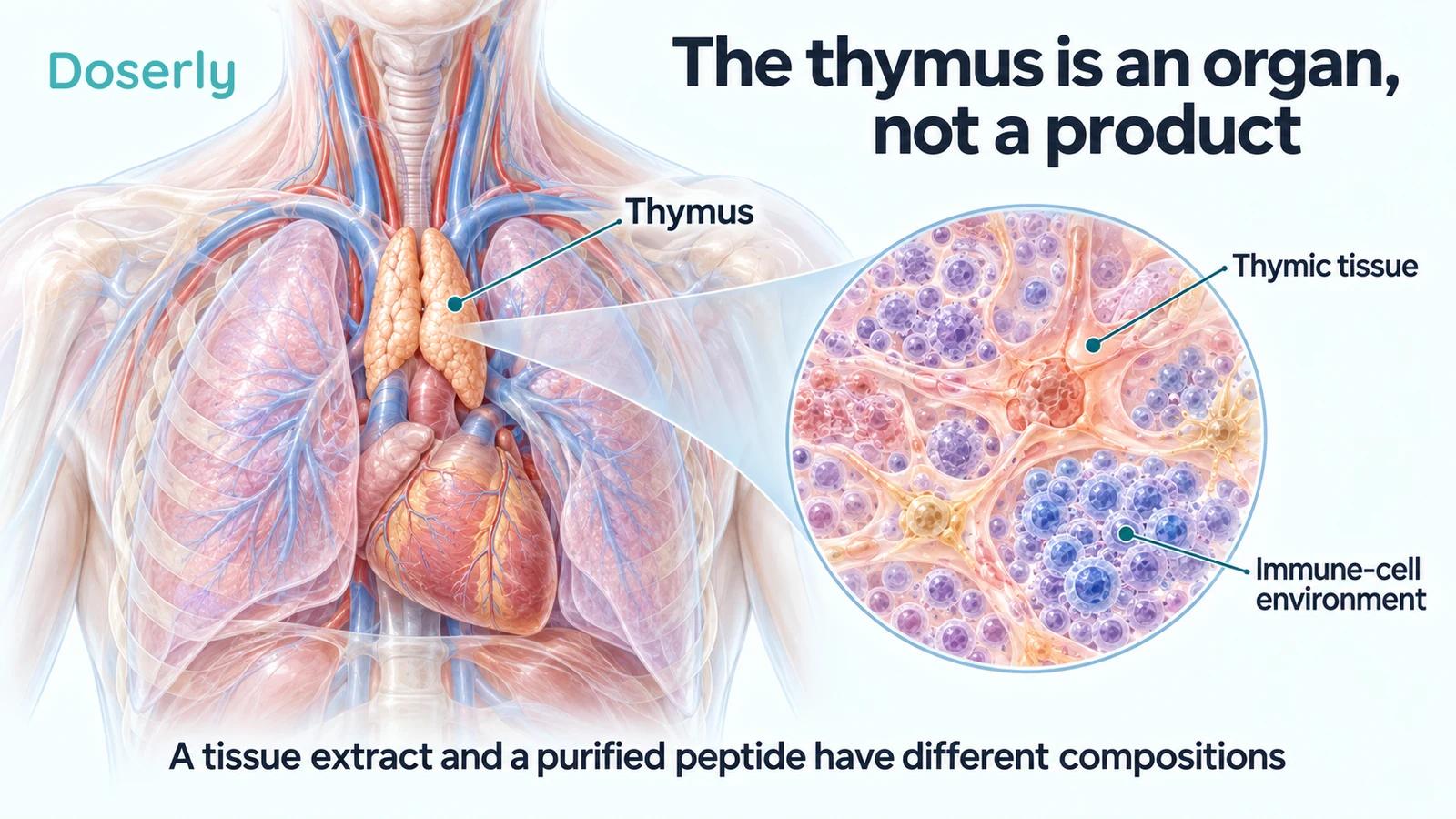
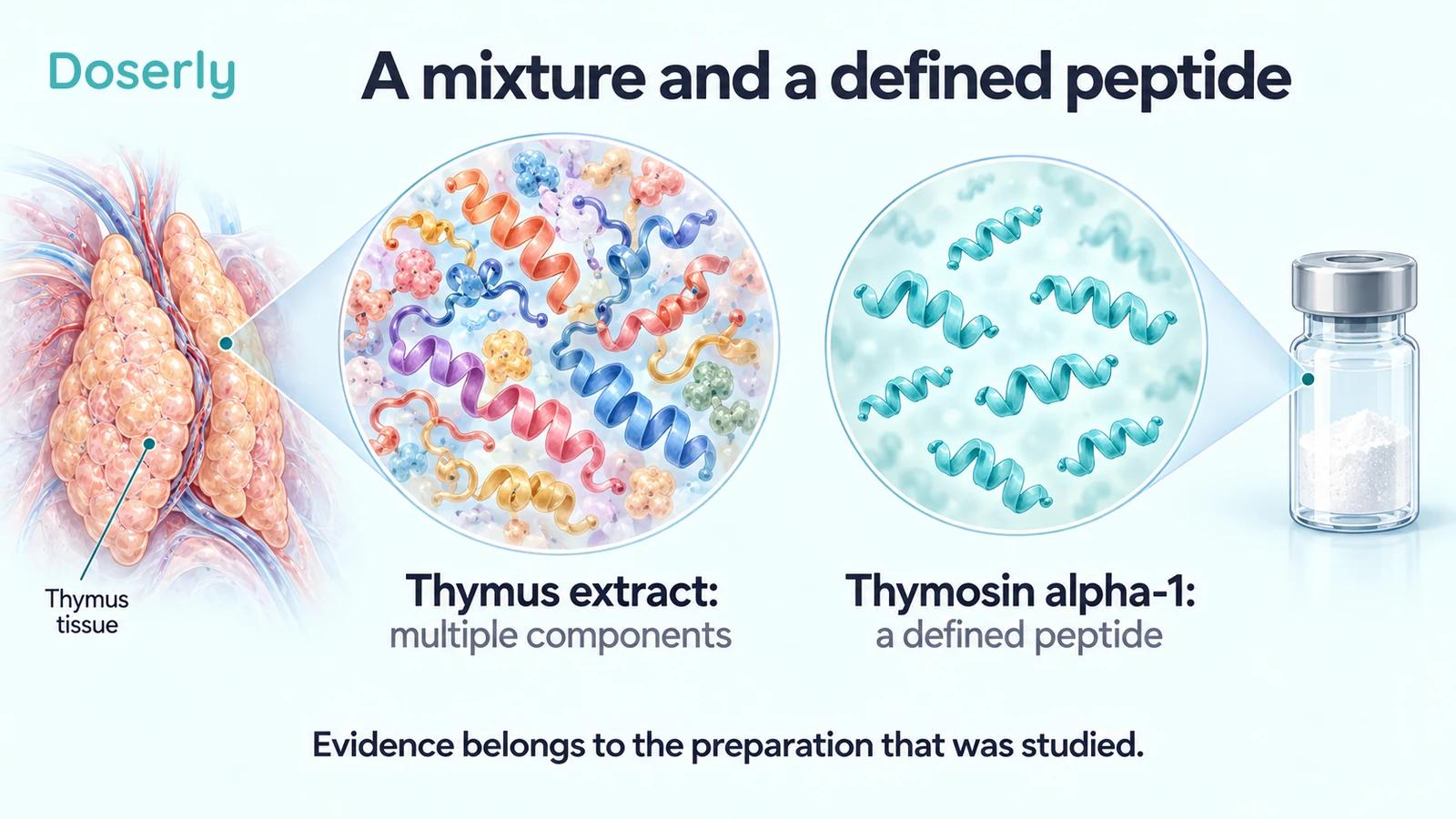
Thymosin alpha-1 is a defined peptide: a particular sequence of 28 amino acids. A thymus extract is material obtained from tissue and may contain multiple components. Thymosin fraction 5, a preparation used in early research, was itself a mixture. A modern finished medicine containing synthetic thymosin alpha-1 adds another layer: its formulation, manufacturing controls and clinical evidence belong to that product.
This distinction matters before discussing benefits. A study cannot tell you how an unnamed substitute performs simply because both products share a historical connection to the thymus. The useful question is whether the substance, preparation and route match what researchers actually tested.
How one name came out of a mixture
The origin of the terminology explains some of the confusion. In a 1977 isolation and sequence study, researchers identified thymosin alpha-1 in material from calf thymus. They described a peptide with 28 amino-acid residues and placed it among several peptides present in thymosin fraction 5.
That was a chemical identification, not a declaration that the mixture and its component were interchangeable. Separating and naming a molecule allows researchers to ask more precise questions than they can ask about an incompletely characterized mixture. It does not transfer every property of the original material to the isolated substance, or every later finding about the substance back to the mixture.
Think of the distinction as a change in the object being studied. “Thymus” names a tissue source. “Thymosin fraction 5” names a historical preparation. “Thymosin alpha-1” identifies a particular peptide. Those names provide different amounts of information, even when they appear in the same paragraph.
What thymalfasin and Zadaxin add to the picture
Thymalfasin is the pharmaceutical name associated with synthetic thymosin alpha-1. Zadaxin is a trade name for a finished medicinal product. Neither term means a general glandular extract.
The Indonesian regulator’s Zadaxin product information, for example, describes a lyophilized injectable product and its supplied diluent, with a stated amount of thymalfasin per vial. It also specifies an indication and product precautions. That is much more information than the phrase “thymus support.” It describes what the manufacturer intends clinicians to use and how that particular preparation is presented.
The label is jurisdiction-specific. A label from one country does not establish authorization in another country, nor does it validate a similarly named product from a different supplier. It is useful here because it shows what a defined medicine looks like on paper: active ingredient, strength, dosage form, route and manufacturer information are connected.
Even when two labels name the same peptide, the finished preparations still need to be assessed. A research vial, a compounded preparation and a registered medicine are not made equivalent by putting the same molecule name on the front. The name begins the comparison; it does not complete it.
Why an older hepatitis trial needs careful reading
Historical clinical papers sometimes use “thymosin” as an umbrella term. A 1991 placebo-controlled hepatitis B pilot illustrates why the methods matter more than a shortened headline.
The study involved 12 people. Seven received thymosin fraction 5 or thymosin alpha-1, while five received placebo. The reported active-treatment results therefore combined people given different preparations. The abstract described encouraging virologic and biochemical findings, but the small, mixed active group cannot establish that fraction 5 and alpha-1 are equivalent.
It also cannot identify which component of an extract explains an effect. That would require a design capable of separating those possibilities. A trial comparing a mixture with placebo asks a different question from a trial comparing a purified peptide with placebo, and both differ from a direct comparison of the two preparations.
This is a practical reading habit: when an article summarizes an old “thymosin trial,” look for the actual intervention. If the source used multiple products, the summary should preserve that fact. Otherwise a reader can walk away believing there is direct evidence for a product that was never evaluated on its own.
Defined chemistry makes research clearer, not automatically positive
A precisely identified substance is easier to study. Researchers can specify what was administered, reproduce the intervention and compare results. But precise identity is not evidence that an intervention improves a particular illness.
The large TESTS sepsis trial tested thymosin alpha-1 against placebo in critically ill adults and did not establish a reduction in 28-day mortality. The publication later received a data correction, which updated analyses without turning the primary result into a demonstrated survival benefit.
That example answers two different questions. The study concerns a specified peptide intervention, so it should not be used as a trial of arbitrary thymus extracts. At the same time, the fact that the intervention was specified does not make its result favorable. Product identity and clinical effectiveness are separate requirements.
A precise label can help prevent a mistaken comparison. It cannot supply a missing clinical outcome. This is especially relevant when marketing moves from “this is the studied molecule” to “therefore it works for immune support.” The second statement still needs an indication, a relevant population and meaningful human results.
Mixtures create additional questions about composition
An extract can contain several substances in varying proportions. To understand a particular extract, a reader needs more than its source tissue. What processing was used? Which components were measured? How consistently are they present? Does the clinical paper describe the same preparation?
These questions do not mean that every mixture is ineffective. They mean that evidence for a mixture depends on how well that mixture is defined. If the product is poorly characterized, it becomes difficult to know whether a later preparation reproduces the earlier one.
The same reasoning applies in the opposite direction. Finding one recognizable peptide within a mixture does not establish that the mixture delivers the same amount, exposure or biological effect as a purified formulation. Other components may matter, and the amount of the named peptide may not be established at all.
For a reader comparing two products, the most useful information may therefore be missing from a bold front-label claim. A detailed ingredient identity and manufacturing specification can answer a composition question. A clinical trial answers an outcome question. Neither document substitutes for the other.
A purity percentage does not answer every quality question
The FDA’s 2024 scientific review of thymosin alpha-1-related bulk substances discusses more than amino-acid sequence. It considers salt forms, peptide-related impurities, aggregation and the challenges of characterizing the material used to make a preparation.
These issues explain why a single “purity” number can be an incomplete description. A chemical assay may answer how much of a measured sample resembles the intended molecule under that assay. It does not, by itself, answer every question about sterility, endotoxin, stability or the finished product delivered to a patient.
Peptide identity and product quality belong in the same discussion, but they are not synonyms. A sample can be correctly named while still requiring additional quality evidence. Conversely, a well-documented manufacturing process does not establish a clinical benefit that has not been demonstrated.
The FDA document is a scientific briefing from 2024, not a statement that every named preparation is currently authorized. Its value for this question is narrower: it shows why characterizing a peptide product involves multiple properties rather than one marketing term.
Route and formulation belong in the comparison
A study of an injected finished medicine does not establish the effects of an oral glandular product. A tissue-source name cannot bridge that gap. The route determines how the preparation is encountered by the body, so matching the ingredient name alone leaves an essential part of the intervention unspecified.
Formulation also matters when reading safety statements. “No serious adverse events were reported” describes what was observed in a particular group under a particular protocol. It is not a blanket certificate for every product sharing a keyword.
The FDA’s compounding explanation makes another distinction: compounded drugs are not FDA-approved, and the agency does not review each compounded drug for safety, effectiveness and quality before it reaches patients. Compounding can meet an individual medical need, but it should not be confused with approval of a finished product.
For any proposed preparation, a clinician or pharmacist can help connect the identity, route, source and reason for use. That conversation is more informative than deciding whether “natural” or “synthetic” sounds preferable. Those adjectives do not tell you whether the preparation matches the evidence.
How to read a product claim without getting lost in the names
Start with the exact active ingredient. If the label says only “thymus,” ask whether it means tissue material, an extract, a standardized preparation or a defined peptide. If it says thymosin, look for the full name rather than assuming alpha-1.
Next, compare the product with the cited research. The paper should identify what was administered and by which route. A citation about a different preparation may explain background biology, but it cannot directly establish the advertised product’s effectiveness.
Then ask what the study measured. A change in an immune-cell marker, a virologic response and a reduction in serious illness answer different questions. None becomes more clinically meaningful because a product has a sophisticated chemical name.
Finally, keep a usable record. If a preparation is part of clinician-supervised care, recording its exact name, manufacturer or dispensing pharmacy, formulation and dates gives the care team something concrete to review. Writing only “immune peptide” can obscure differences that become important later. A tracking tool can preserve those details; it cannot determine that two preparations are interchangeable.
The Doserly thymosin alpha-1 guide provides the broader research context. For this specific comparison, the central point is straightforward: a tissue extract, a defined peptide and a finished medicine are different descriptions of what is being used. Evidence becomes useful only after that identity is clear.
Explore the research
- Original isolation and sequence report, 1977.
- Mixed-preparation hepatitis B pilot, 1991.
- Zadaxin product information from Indonesia’s regulator.
- TESTS randomized sepsis trial, 2025, and its published correction.
- FDA scientific review of thymosin alpha-1-related substances, 2024.
- FDA explanation of compounded drugs.