
Peptides
October 16, 2026
Thymosin alpha-1 is not a generic immune booster
On this page
“Immune booster” sounds reassuring because it makes the goal seem obvious: stronger immunity must be better. But thymosin alpha-1 research does not support treating immunity as a single quantity that everyone should increase. A laboratory change in a particular illness, a clinical benefit in that illness and a benefit for a healthy person are three different claims.
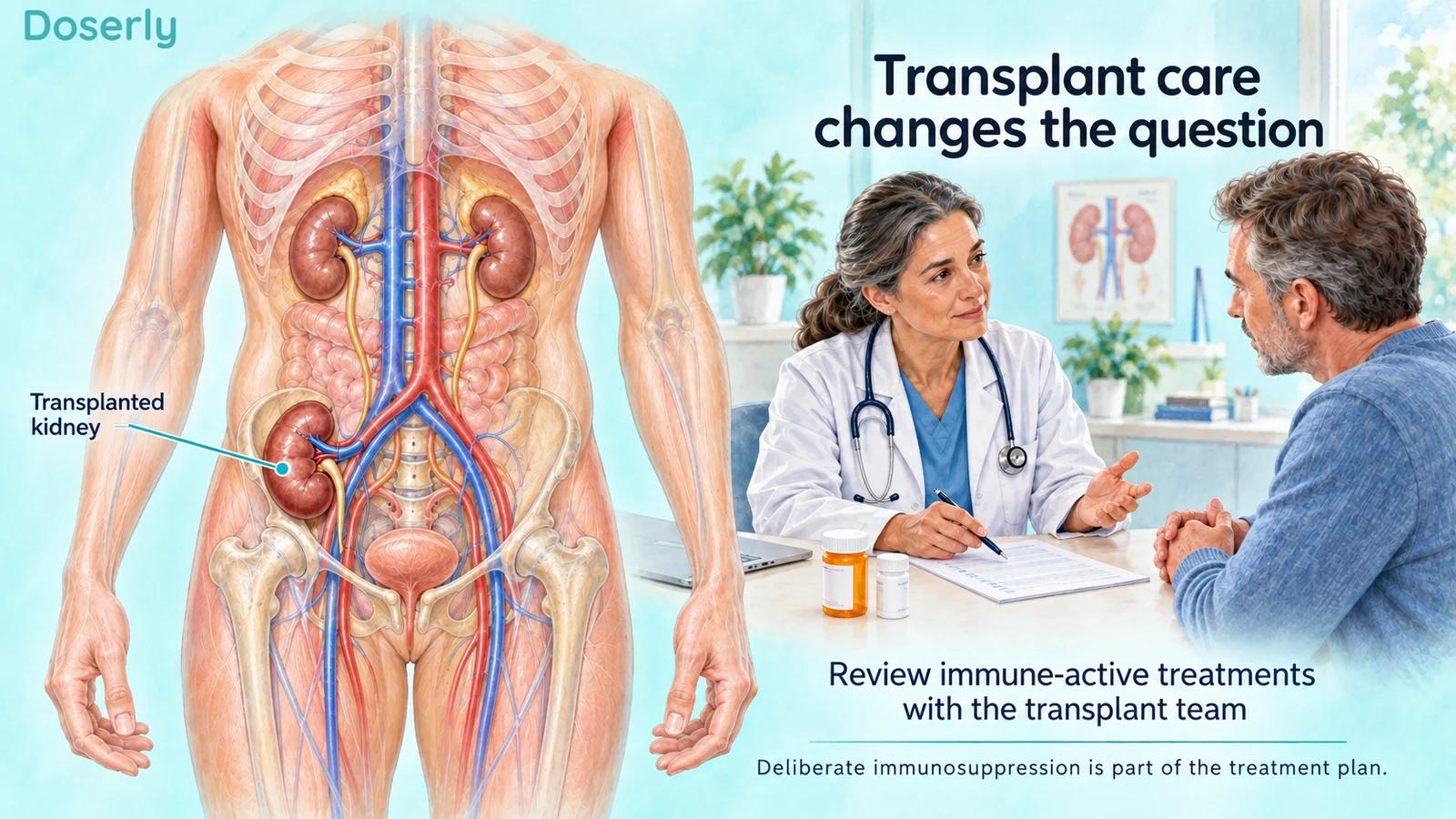
The distinction becomes especially important when someone is receiving treatment that deliberately suppresses immune activity. For a transplant recipient, that suppression has a purpose. An additional product promoted as enhancing immunity cannot be assessed without considering the treatment plan it might complicate.
Thymosin alpha-1 deserves to be evaluated through specific evidence: who received it, what else they were taking, what was measured and whether the outcome improved. Our thymosin alpha-1 guide covers the compound more broadly. Here, the focus is why a generic promise of immune support leaves out the details that determine whether a treatment makes sense.
Immunity has several jobs, not one strength setting
The immune system includes interacting cells, molecules and organs. Its innate and adaptive components respond differently, and immune tolerance helps prevent inappropriate responses against the body's own tissues. NIAID describes both protective immune functions and the diseases that can arise when tolerance is lost. NIAID immunology overview.
This creates a problem for the word “boost.” It does not identify which response should change, where it should change or how much change would be desirable. A more useful claim would specify the biological problem and the outcome the treatment is intended to improve.
That does not mean immune-modulating therapies are inherently unhelpful. It means their value depends on context. A finding that matters in a person with a defined immune abnormality cannot automatically be carried over to someone with a different condition or no diagnosed abnormality at all.
The same discipline applies to the word “balance.” Calling a product an immune balancer may sound more sophisticated, but it still requires evidence. Unless the claim identifies what is being corrected and shows a meaningful improvement, it has replaced one vague promise with another.

What the small HIV study actually measured
A 2024 prospective study examined thymosin alpha-1 in people living with HIV whose immune recovery remained incomplete despite antiretroviral therapy. Twenty participants received treatment, 17 completed the protocol and antiretroviral therapy continued. This was a single-arm study, meaning there was no concurrent untreated or placebo group. Original HIV study.
The researchers assessed immune-cell populations and related laboratory markers over 24 weeks. Some cell proportions and PD-1 expression changed. However, the absolute CD4 cell count and the thymic-output marker sjTREC were not significantly different at week 24 compared with baseline. The pattern is more specific than a headline saying the immune system was restored. Original HIV study.
Three distinctions help interpret this kind of result. First, a proportion is not an absolute count. A cell type can make up a larger share of a group without its absolute number increasing by the same amount. The denominator matters whenever a report uses percentages.
Second, a change across several time points is not necessarily the same as a significant difference at the intended endpoint. If an article reports both, readers should keep both. Selecting whichever analysis sounds more encouraging would obscure the actual pattern.
Third, a laboratory marker associated with a biological process is not itself proof of a clinical improvement. Changes in markers used to study immune exhaustion or thymic output do not automatically demonstrate fewer infections, fewer hospitalizations or longer survival. Those outcomes require their own measurements and an appropriate study design.
Why a single-arm result cannot establish a treatment effect
Following people before and after treatment can be informative, particularly in early research. It shows what happened in those participants and can help design a larger study. But it does not show what would have happened to comparable people over the same period without the added treatment.
In the HIV study, participants continued their existing therapy. Without a concurrent comparison, a reader cannot confidently separate the added drug's effect from time, ongoing care, measurement variation or other influences. This is a limitation of the design, not an accusation that the reported measurements were meaningless.
The small sample also limits precision and generalizability. Nineteen of the 20 treated participants were men, and all were selected for a particular clinical situation. The study was not a test of routine use among healthy adults seeking to avoid colds or improve energy. Original HIV study.
A reasonable next research question would retain the defined population, include an appropriate comparison and establish which clinical outcomes matter. It would also specify the laboratory analyses in advance. That would make a positive result more interpretable and reduce the temptation to build a broad claim from whichever marker changed most favorably.
The study can therefore support interest in further investigation while remaining insufficient to support a general immune-enhancement promise. Those two conclusions fit together: preliminary evidence is useful precisely because it helps identify what still needs testing.
Clinical guidance asks whether people benefit
The NIH guideline on suboptimal CD4 recovery discusses thymosin alpha-1 among investigated immune-modulating approaches. It does not recommend adjunct therapies to improve immune recovery outside a clinical trial because clinical efficacy has not been established. Its focus is reducing illness and death, not simply producing a more attractive laboratory result. NIH guideline on suboptimal CD4 recovery.
This is an important distinction for someone worried about a persistently low result. A marker can be clinically important without every intervention that changes it producing benefit. The usefulness of the measurement and the usefulness of a proposed treatment are separate questions.
The guideline also emphasizes preventive care and management of contributing conditions. That makes the practical discussion broader than choosing an additional peptide. A clinician needs to consider the person's existing treatment, other medicines and health problems, as well as the meaning of the laboratory trend. NIH guideline on suboptimal CD4 recovery.
For readers, the implication is not to ignore immune measurements or alter prescribed therapy independently. It is to ask what action has evidence for improving the outcome they care about. “This number is associated with risk” and “this product reduces that risk” should never be treated as the same statement.
Sepsis shows why mechanism and outcome can diverge
The earlier ETASS sepsis trial reported changes in a monocyte immune marker and an encouraging mortality pattern, although the statistical interpretation of 28-day mortality differed between analyses. It was a reason to investigate further, not proof of universal immune benefit. ETASS trial.
The larger TESTS trial subsequently compared thymosin alpha-1 with placebo alongside standard care. Among 1,089 analyzed adults with sepsis, 28-day mortality was 23.4% versus 24.1%. The corrected hazard ratio was 0.97, with a 95% confidence interval of 0.76 to 1.24; the trial did not demonstrate a survival benefit. Corrected TESTS report.
A published correction updated the original estimate, so older summaries may still show a slightly different number. The correction did not turn the result into a positive survival trial. TESTS correction.
Sepsis is very different from the clinical situation in the HIV marker study. Combining both under the phrase “supports immunity” hides that difference. The trials asked different questions, enrolled different people and used different endpoints. Evidence cannot be made more persuasive by removing the details that determine what it means.
Nor does a negative sepsis result prove thymosin alpha-1 has no possible use in any setting. The appropriate conclusion is narrower: a specific clinical benefit must be demonstrated for the proposed indication. A mechanism does not supply that demonstration, and neither does a positive-sounding finding from another disease.
Transplant recipients face a different treatment goal
For a kidney transplant recipient, preventing the immune system from rejecting the donated organ is part of ongoing care. NIDDK explains that anti-rejection medicines suppress immune activity and require continued monitoring; this treatment can also increase susceptibility to infection. The clinical task involves managing both concerns. NIDDK kidney transplant information.
The Singapore National Drug Formulary's Zadaxin product information makes the thymosin alpha-1 boundary explicit. It says the product should be considered contraindicated in people being deliberately immunosuppressed, such as organ transplant recipients, unless potential benefits clearly outweigh potential risks. It also lists hypersensitivity to the drug or an injection component as a contraindication. Official Singapore product information.
The exception in that wording is a specialist benefit-risk judgment. It is not permission to assume an immune-enhancing product will offset the disadvantages of immunosuppressive treatment. A person can reasonably want fewer infections while still needing the protection that anti-rejection therapy provides.
This warning also should not be exaggerated into a claim that every exposure necessarily causes rejection. The label identifies a serious clinical concern and the need for an individualized assessment; it does not supply a universal event rate. Accurate communication preserves both the warning and its limits.
Someone receiving deliberate immunosuppression should discuss an immune-active product with the team responsible for that treatment before adding it. Prescribed medicines should not be reduced or stopped to make room for a peptide experiment. The relevant team needs to assess the whole regimen, not just one product in isolation.
A product indication is not a wellness endorsement
The same Singapore product information describes prescription use for specific chronic hepatitis indications. That is country- and product-specific information. It does not establish a general indication for healthy people, worldwide regulatory approval or a reason to replace current care for hepatitis with a self-selected product. Official Singapore product information.
When someone says a peptide is “used medically,” the next question is therefore essential: used for what, where and in which formulation? A genuine medical use can coexist with unsupported claims about other uses. Removing the indication from the sentence makes the evidence sound broader than it is.
Likewise, the name on a product does not by itself show that it matches a studied formulation or was evaluated in the same way. A treatment claim needs both an appropriate evidence base and a clear description of what is actually being proposed. The research question cannot be answered by the label “peptide” alone.
Turn an immune-support claim into answerable questions
Before accepting a claim, ask what it would look like if it were true. Would a defined group experience fewer diagnosed infections, less severe illness or a better response to an established treatment? Over what period? Compared with what? Those details turn an appealing phrase into something research can test.
A useful conversation with a clinician can start with five questions:
- What diagnosed problem is the proposed treatment intended to address?
- Were people with my condition and existing medicines actually studied?
- Was the reported benefit a laboratory change or a meaningful clinical outcome?
- Was there a suitable comparison group, and how uncertain was the result?
- Does the proposal conflict with a treatment that deliberately suppresses immune activity?
These questions also expose the limits of personal tracking. Recording medicines, symptoms and laboratory dates can help a clinician understand the timeline. Feeling better after starting a product, however, does not isolate its effect from other changes. A record can improve a clinical discussion without serving as a controlled trial.
Thymosin alpha-1 research contains specific biological findings and specific unanswered questions. “Generic immune booster” compresses those distinctions into a promise the evidence does not support. The more useful goal is an appropriate response to a defined problem, measured by an outcome that matters to the person receiving treatment.
Sources
- NIAID overview of immunology and transplantation
- Thymosin alpha-1 in immunological nonresponders living with HIV, 2024
- NIH guideline: suboptimal CD4 recovery despite viral suppression
- ETASS sepsis trial, 2013
- TESTS corrected trial report, 2025
- TESTS correction, 2025
- Zadaxin official Singapore product information, updated October 2026
- NIDDK kidney transplant information