
Peptides
October 16, 2026
Thymosin alpha-1 and long COVID: what the studies actually tested
On this page
Thymosin alpha-1 is a small peptide studied for its effects on immune cells. That makes it an understandable subject of interest for people living with long COVID, especially when fatigue, difficulty thinking or repeated symptom flares persist long after the original infection. If immune changes are involved, could a medicine that influences immune cells help?
The research gives us reasons to investigate that question, but it has not yet supplied a reliable treatment answer. Studies in people hospitalized with acute COVID concern a different stage of illness. A paper specifically involving post-COVID patients exposed diluted blood samples to thymosin alpha-1 outside the body, rather than administering it to treat their symptoms. Those distinctions change what the findings mean for someone considering treatment now.
This article separates those studies and explains what a useful long-COVID trial would need to measure. The purpose is to make the clinical question more specific: can this particular intervention help a defined group of patients feel and function better, with acceptable risks?
What thymosin alpha-1 is
A peptide is a chain of amino acids, the building blocks of proteins. Thymosin alpha-1 contains 28 amino acids; the manufactured medicine is also called thymalfasin. Its name reflects its original isolation from thymus tissue. The thymus is involved in the development of T cells, an important group of immune cells. This history does not mean an injection replaces a failing thymus or corrects a known deficiency in everyone with persistent symptoms. FDA scientific evaluation
Product names also need care. Zadaxin is a finished medicinal product, not a synonym for every vial sold under the peptide's name. Singapore's official formulary lists Zadaxin for chronic hepatitis B in specified patients. That listing concerns another illness and a particular product; it is not a long-COVID indication. Singapore National Drug Formulary
For a broader introduction, our thymosin alpha-1 guide covers the compound and its research across different conditions. Here, the central issue is whether the evidence actually follows people with persistent post-COVID symptoms after they receive treatment.
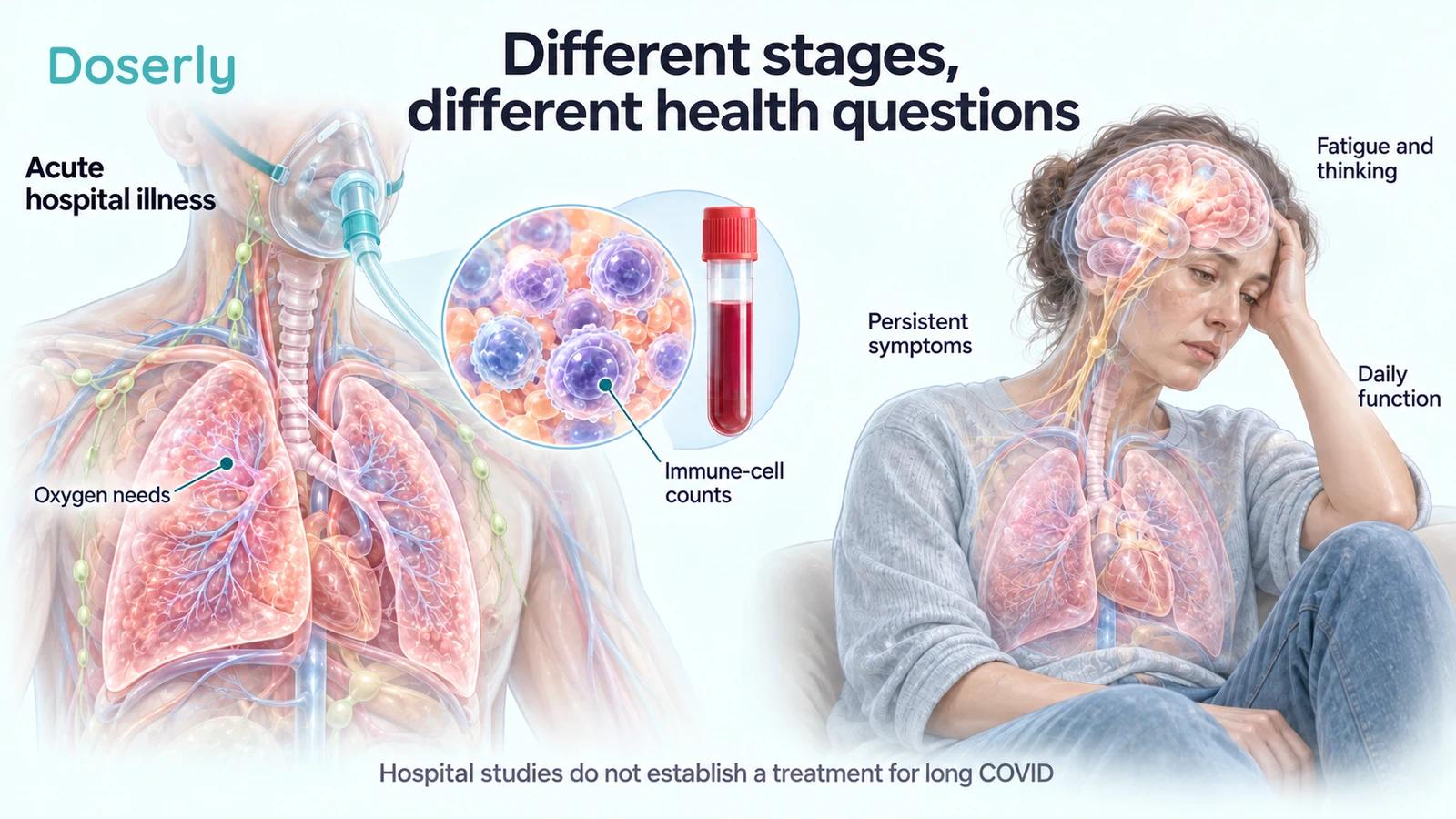
Acute COVID and long COVID ask different questions
Acute hospital studies may ask whether a patient survives, comes off oxygen or leaves hospital sooner. A person with long COVID may instead want to read without cognitive exhaustion, tolerate a shower without prolonged worsening, or regain the ability to work. Improvement in one setting cannot be assumed to predict improvement in the other.
CDC describes long COVID as an infection-associated chronic condition affecting one or more organ systems. Its current clinical overview uses persistence for at least three months and recognizes continuous, relapsing or progressive illness. A previous hospital admission is not what defines the condition. CDC clinical overview
The comparison group matters too. Hospital patients receiving an additional therapy are being compared within an acute-care setting. For established long COVID, the relevant comparison would involve people with similar ongoing symptoms and similar background care. Otherwise, differences in illness duration, recovery patterns or other treatments can be mistaken for a drug effect.
Why the early hospital results attracted attention
An early retrospective study examined 76 severe COVID cases at two hospitals in Wuhan. Deaths occurred in 4 of 36 people who received thymosin alpha-1 and 12 of 40 who did not: approximately 11.1% versus 30.0%. Researchers also examined immune-cell measurements. Liu and colleagues, 2020
Those numbers were encouraging, but treatment was not randomly assigned. Clinicians' reasons for selecting treatment, differences in care and patients' underlying condition could influence the comparison. An association with fewer deaths in a small retrospective group cannot establish how much benefit the peptide caused.
It also cannot tell us whether treatment months after infection improves fatigue or thinking. The participants were severely ill during acute infection, and the main clinical question involved survival. Using the mortality percentages to advertise a long-COVID recovery rate would change both the population and the outcome.
A larger five-hospital cohort illustrates why the early result did not settle even the acute-care question. It included 2,282 patients, of whom 306 received thymosin alpha-1. Treated patients had worse crude outcomes. An adjusted model associated treatment with higher odds of non-recovery, but the association was no longer statistically clear after including maximum organ-failure severity in another model. Multicentre cohort, 2021
That does not prove the medicine caused harm. Sicker people may have been more likely to receive it, and statistical adjustment cannot guarantee that such differences have been resolved. Together, the studies show how much the apparent result can depend on patient selection and analysis. They provide an uncertain foundation for claims about acute COVID, and an indirect foundation for long COVID.
What happened in a randomized hospital pilot?
A prospective, open-label randomized pilot compared thymalfasin with standard care in hospitalized patients with low blood oxygen and low lymphocyte counts. Its analysis included 49 patients. Clinical recovery estimates favored treatment numerically in both oxygen-support groups, but neither comparison was statistically significant. For the low-flow oxygen group, the recovery subdistribution hazard ratio was 1.48, with a wide 95% confidence interval of 0.68–3.25. Shehadeh and colleagues, 2023
That interval includes no benefit and substantially different possible effects. The trial therefore did not establish faster clinical recovery. It did identify a difference in CD4 T-cell recovery in the low-flow oxygen subgroup, which is a biological observation rather than proof of symptom improvement.
Randomization improves the comparison, but a small pilot remains imprecise. Open-label treatment also means participants and clinicians knew which treatment was given. Most importantly for this article, these were acutely hospitalized patients. The study did not test a treatment course for established long COVID.
The long-COVID paper studied blood outside the body
A 2023 paper by Minutolo and colleagues did involve people with post-acute sequelae of SARS-CoV-2 infection, often abbreviated PASC. Researchers exposed diluted blood samples to thymosin alpha-1, then analyzed immune cells and inflammatory signals. Red blood cells were removed during the later flow-cytometry preparation, not before the experimental exposure. This is called an ex vivo experiment: the material comes from people, but the experimental treatment occurs outside their bodies. Original PASC study
The authors reported changes in cell differentiation, markers associated with exhaustion and cytokine expression. Cytokines are signals that cells use to communicate. These findings help explain why researchers might consider a patient trial. They do not show that administering the peptide improved participants' fatigue, cognition, activity tolerance or quality of life.
A culture dish does not reproduce absorption, distribution, breakdown or exposure in different tissues. Nor can it show whether a laboratory change persists after treatment stops. Even a clear change in cells studied outside the body leaves the practical question unanswered: would a person experience a worthwhile improvement?
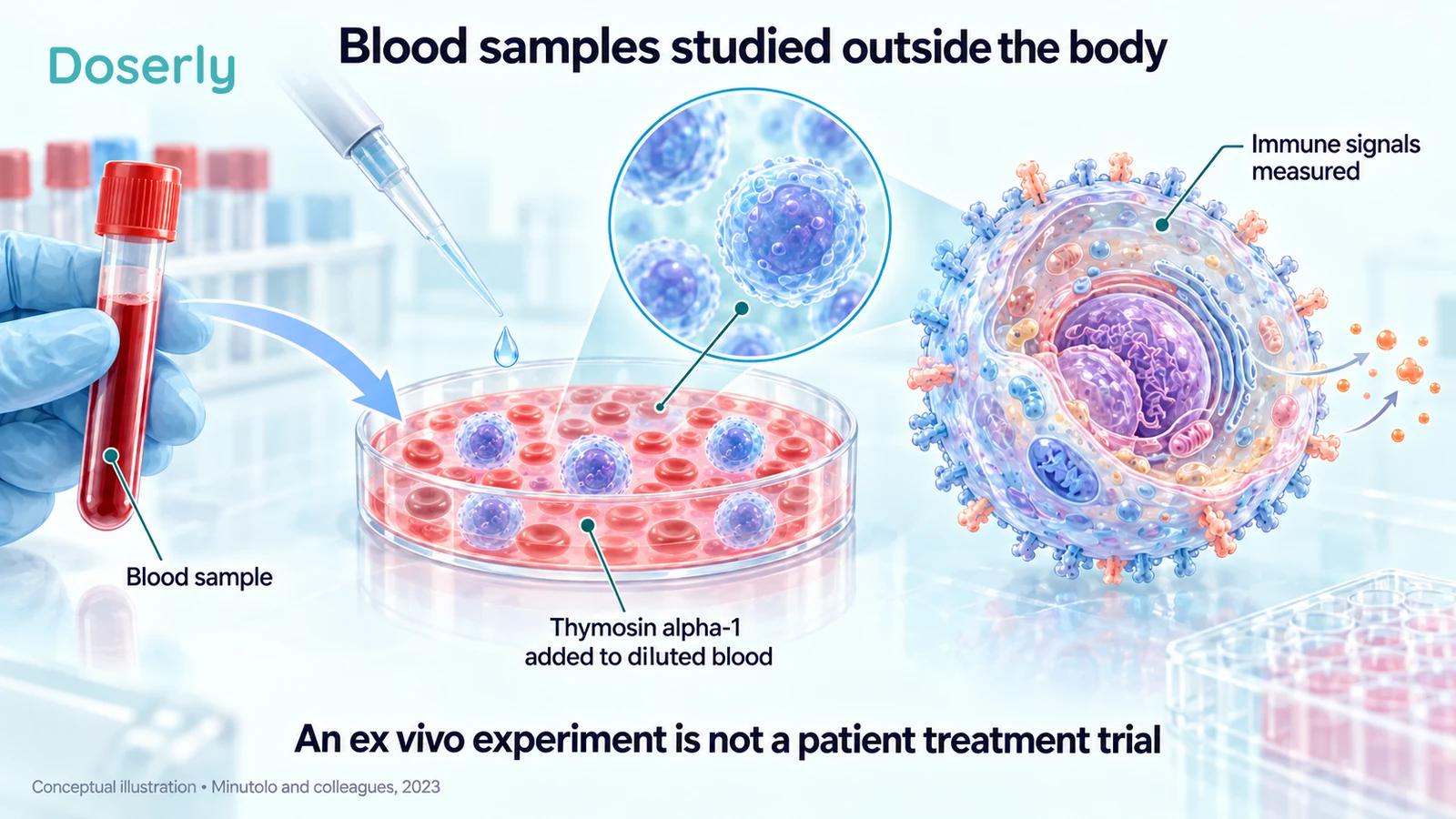
Image sources: Minutolo and colleagues
An immune result is not a personal treatment target
It is tempting to interpret an abnormal immune measurement as a direct instruction: find what is low and raise it, or find what is high and lower it. That approach is too simple for the question being asked. A measurement can accompany illness without being the cause that treatment must correct. It can also change while the person's symptoms remain unchanged.
Imagine a trial in which a laboratory marker improves but participants remain unable to manage their ordinary activities. That would be useful biological information, yet disappointing treatment evidence. Now imagine the reverse: people consistently report better daily function while the chosen marker barely changes. The treatment result could still matter, while the proposed explanation would need revision. These examples explain why a symptom trial and a mechanism experiment should be designed together but interpreted separately.
A normal routine test does not mean symptoms are unreal. CDC emphasizes that no single laboratory test definitively diagnoses or excludes long COVID, and that objective findings should not be the sole measure of a patient's well-being. CDC clinical guidance
That is also why a commercial immune panel should not automatically become the deciding test for buying a peptide. A research marker requires validation for the particular decision it is supposed to guide. The reviewed studies do not establish a test threshold that identifies likely long-COVID responders to thymosin alpha-1.
What would a useful treatment trial look like?
First, it would define the patients clearly. Illness duration, dominant symptoms, previous acute severity and background treatments would all need recording. A trial focused on people with disabling fatigue could give a more interpretable answer than one combining many unrelated symptoms into an undefined claim of “immune improvement.”
Second, it would compare a specified medicinal formulation with an appropriate control, usually on top of comparable supportive care. Random allocation and blinding would help separate the treatment effect from expectations and differences in clinical attention. A registered protocol would state the main outcome before researchers inspected the results.
Third, the outcome would need to reflect the intended benefit. If the goal is better daily function, investigators should measure daily function. If it is fewer post-exertional crashes, their frequency, severity and duration should be captured. Immune assays could help explore mechanisms, but should not replace the patient outcome.
Fourth, researchers would need follow-up beyond an immediate laboratory response. Persistent benefit after treatment, discontinuations, worsening symptoms and adverse events belong in the same report. Counting only participants who finish treatment and feel better would give an incomplete picture.
Finally, any promising subgroup would need confirmation. If a benefit appeared only after splitting a small trial into many symptom categories, chance becomes a plausible explanation. A subsequent trial could test that particular group directly. This is a proposed research approach, not an established treatment protocol or a reason to self-experiment.
What is useful to discuss with a clinician now?
Start with the limitation you most want help with and its pattern over time. A dated record of symptoms, medication changes, activity and delayed worsening can help make the consultation more concrete. The record is useful for describing experience; it cannot by itself establish what caused a change.
Post-exertional malaise deserves particular attention. CDC describes symptom worsening after even minor physical or mental exertion, often delayed by 12–48 hours and lasting days or longer. Assessment and activity planning should take that pattern into account. CDC symptom-management guidance
If thymosin alpha-1 is proposed, ask which study supports the expected benefit in someone with your symptoms. Clarify whether the answer concerns acute hospital care, blood-sample experiments, or an actual long-COVID treatment comparison. Also ask what product would be used, how adverse effects would be assessed and what finding would lead to changing the plan.
Product quality is part of that discussion. FDA's 2024 evaluation raised concerns about injectable peptide impurities, aggregation and immune reactions; it did not treat experience with one finished product as proof that every compounded preparation is equivalent. FDA evaluation
The available research supports a focused hypothesis worth testing. It does not yet provide a reliable estimate of long-COVID symptom benefit or a validated treatment schedule. Care for persistent symptoms can proceed while that research question remains open.
Explore the research
- Liu and colleagues, 2020: retrospective severe acute-COVID study, 76 patients.
- Multicentre COVID cohort, 2021: 2,282 patients; associations varied with adjustment.
- Shehadeh and colleagues, 2023: randomized open-label hospital pilot, 49 patients analyzed.
- Minutolo and colleagues, 2023: ex vivo immune-cell experiments involving PASC samples.
- CDC clinical overview: current definition and clinical context.
- CDC clinical guidance: assessment, symptoms and patient-centered management.
- FDA scientific briefing, December 2024: molecular identity, formulation and clinical-evidence assessment.
- Singapore National Drug Formulary: Zadaxin product record and indication.