
Peptides
October 16, 2026
Thymosin alpha-1 in cancer care: what immune activation can tell us
On this page
Thymosin alpha-1 is being studied in cancer because immune cells influence how tumors are recognized and how patients respond to treatment. The hope is that modifying those responses might help established cancer treatments work better. For someone receiving chemotherapy or immunotherapy, that is an appealing possibility—but “more immune activity” is not a sufficiently specific treatment goal.
A useful benefit could mean longer survival, less recurrence, a better chance of successful surgery or fewer treatment complications. Changing a blood-cell count does not automatically deliver any of those outcomes. Nor does evidence that a peptide did not stimulate particular cells in a laboratory establish that it is safe alongside every cancer regimen.
There is human research to discuss, including an older randomized melanoma trial and a 2026 gastric-cancer combination study. There is also newer mechanistic work that helps explain why researchers remain interested. The key is to keep the actual treatment comparisons visible while exploring that biology.
Why immune cells matter around a tumor
The immune system can recognize abnormal cells, but cancer can evade or alter that response. Different immunotherapies address different parts of the process. Checkpoint inhibitors, for example, interfere with signals that restrain immune responses; other treatments use different strategies. They are not interchangeable simply because they all involve immunity. National Cancer Institute overview
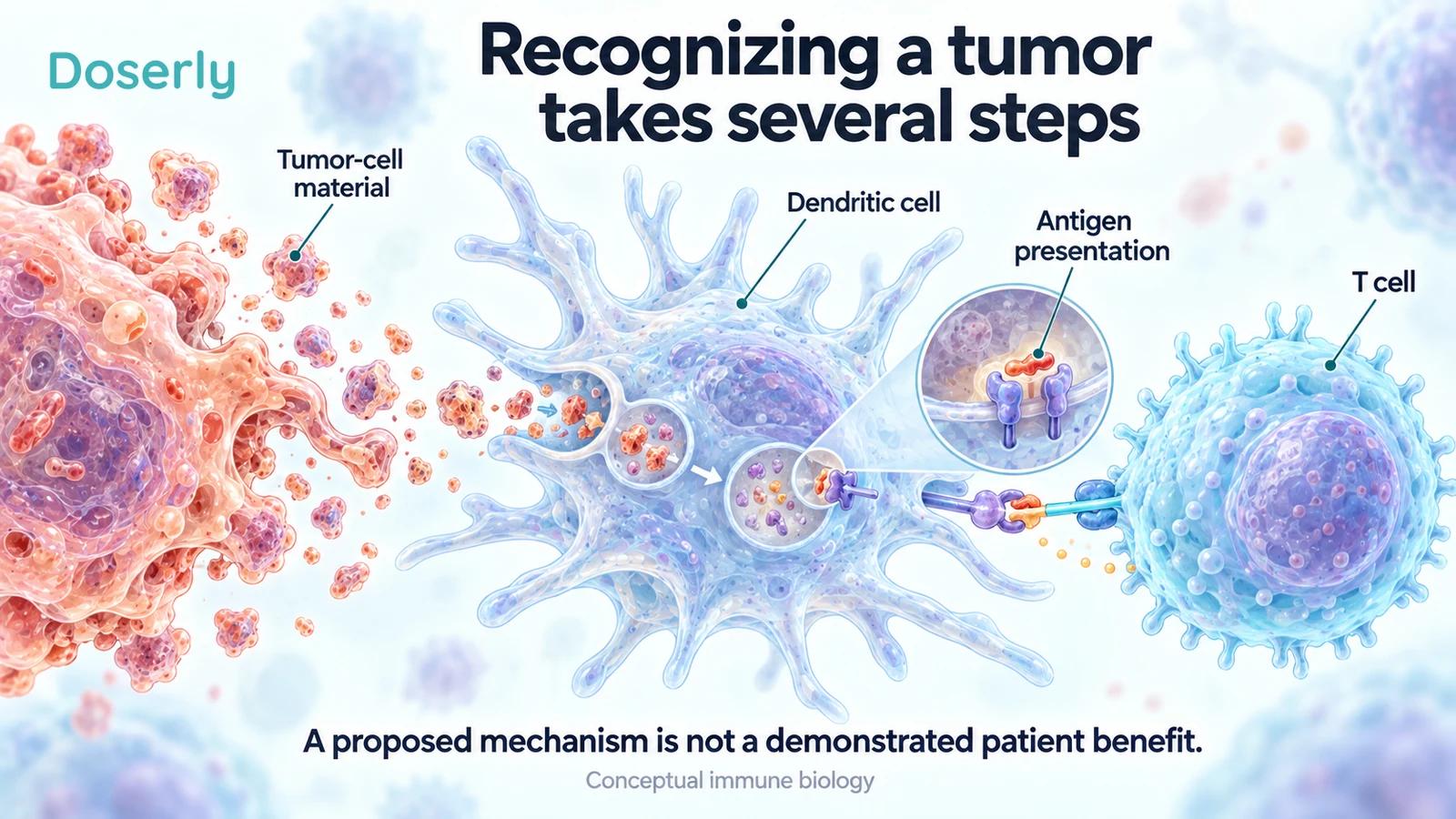
One relevant cell is the dendritic cell. It takes up material and presents antigens—recognizable molecular fragments—to other immune cells. A T cell may then respond to the presented information. Whether that response helps control a tumor depends on more than the number of T cells present in a blood sample.
Thymosin alpha-1, also called thymalfasin when manufactured as a medicine, is investigated as an immune modulator. That describes a possible action, not a universal clinical effect. Our thymosin alpha-1 guide provides background on the peptide across several research areas; this article focuses on decisions during cancer care.
What the 2026 mechanism paper actually established
A 2026 Cancer Research paper measured lower circulating thymosin alpha-1 after chemotherapy in patients with several cancer types and in tumor-bearing mice. Its experimental work investigated how the peptide interacts with material released by dying tumor cells. Wei and colleagues
The researchers described a role in protecting a microRNA signal inside dendritic cells. MicroRNAs are small RNA molecules; the signal studied could activate TLR7, a cellular sensing protein. In mice with the relevant tumor characteristics, thymosin alpha-1 supplementation enhanced tumor control with chemotherapy.
That is a mechanistic reason to investigate a treatment strategy. The human measurements and mouse interventions are different parts of the paper. It did not establish that replacing a low blood level improves survival in people, and it did not validate a blood-test threshold for choosing patients.
A low measurement after chemotherapy could lead to several research questions: is it part of the treatment response, a marker of illness, or a change that contributes to impaired immunity? A clinical trial is needed to determine whether acting on it helps. Calling it a “deficiency” that every patient should correct would go beyond these findings.
The randomized melanoma study: promising activity, uncertain survival
A large study published in 2010 randomized 488 people with metastatic melanoma among five groups. The regimens involved dacarbazine chemotherapy, interferon alfa and different thymosin alpha-1 combinations. Its primary endpoint was best overall tumor response at 12 months, with follow-up extending to 24 months. Original Journal of Clinical Oncology report
The study identified activity in some thymosin-containing groups. Across patients given thymosin alpha-1, median overall survival was 9.4 months versus 6.6 months in the control group. However, the survival comparison was not statistically significant: hazard ratio 0.80, P=0.08. The progression-free survival comparison also fell short of conventional significance, with P=0.06.
Those results justify the authors' interest in further evaluation. They should not be described as proof that the peptide extended life. A favorable median does not remove uncertainty in the comparison, and this trial did not test addition to today's checkpoint-inhibitor regimens.
For a patient, the treatment era matters because the control defines the question. An intervention's added value alongside dacarbazine and interferon may differ from its value alongside a modern regimen. It also cannot establish benefit in a different cancer simply because immune cells participate in both diseases.
What the new gastric-cancer study adds
A prospective phase II study published in February 2026 enrolled 30 patients with stage III gastric or gastroesophageal-junction adenocarcinoma. They received serplulimab, an anti-PD-1 medicine, SOX chemotherapy—S-1 and oxaliplatin—and thymalfasin before surgery. Neoadjuvant means treatment given before the planned operation. Xu and colleagues
Nine of the 30 participants had a pathological complete response, or 30%. This means no viable tumor was identified under the study's pathological response criteria in the assessed surgical material. Grade 3 or higher adverse events occurred in 8 of 30 patients, and immune-related adverse events in 7 of 30.
The important limitation is the absence of a randomized comparison group receiving the same regimen without thymalfasin. These are results for a combination. They do not isolate the peptide's contribution or show that it reduced toxicity. The investigators called for larger randomized trials.
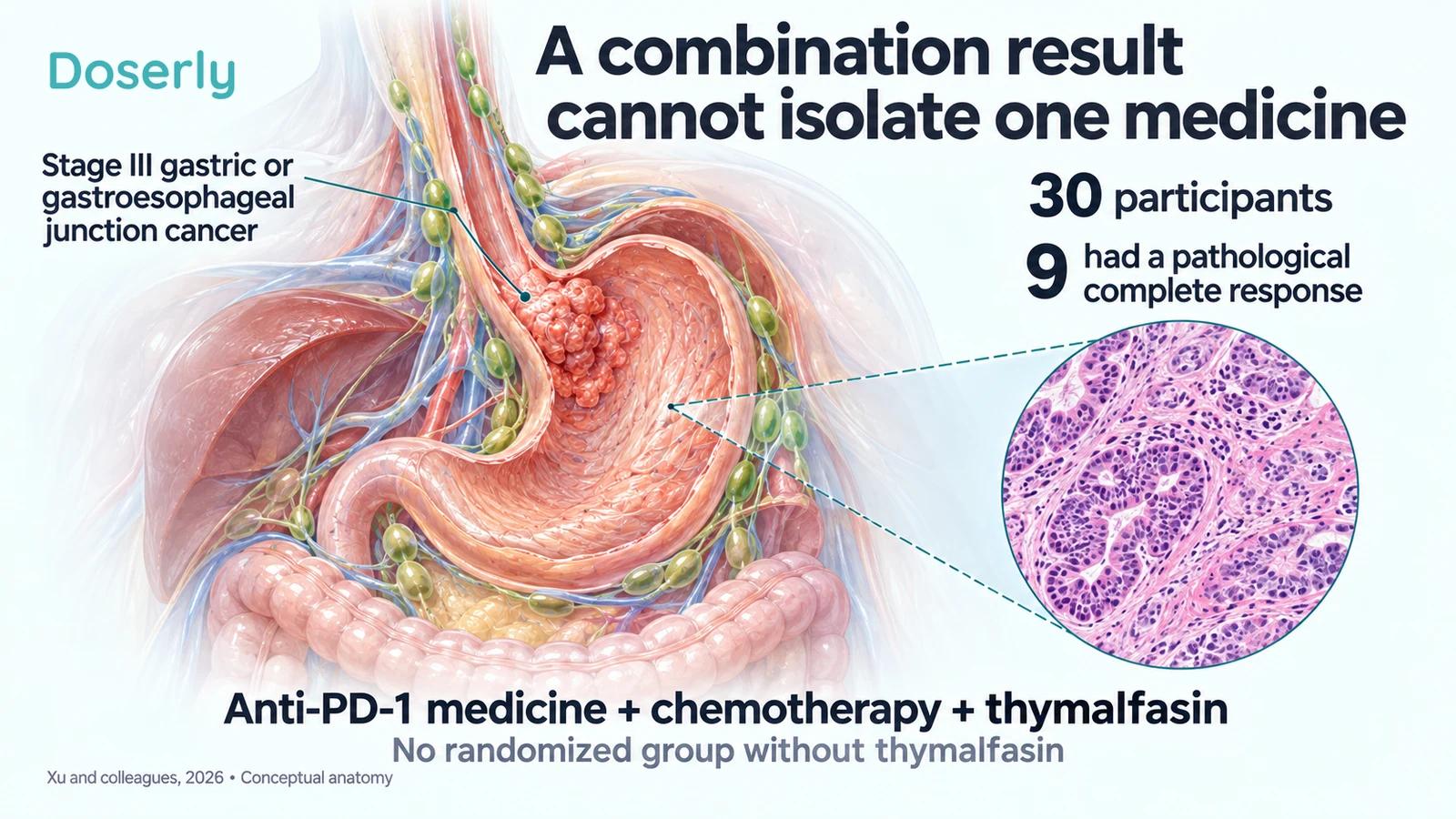
Image sources: Xu and colleagues
Pathological response is useful information, but it is not synonymous with lifelong cure. The tissue is assessed at a particular point in care. Patients still need subsequent treatment decisions and follow-up. Likewise, a small study with encouraging early outcomes cannot reliably quantify uncommon adverse reactions or long-term recurrence risk.
Could thymosin alpha-1 make immunotherapy safer?
That remains a hypothesis requiring a direct comparison. It is possible to investigate both improved tumor response and reduced toxicity, but success on one should not be assumed to establish the other. A trial would need to record adverse events consistently in comparable groups, including treatment interruptions and discontinuations.
Comparing a new single-arm study with a different published trial can suggest questions, but differences in patients, drugs, dose intensity and event reporting make causal conclusions difficult. If one group appears to have fewer immune-related events, the peptide may be one possible explanation; it is not the only one.
NCI explains that cancer immunotherapies can also affect healthy tissue. Side effects vary by the treatment and patient and may occur during or after therapy. That is a reason to evaluate an added immune intervention carefully, rather than assuming all immune stimulation is beneficial. It is not evidence that thymosin alpha-1 necessarily causes the same adverse effects as a checkpoint inhibitor. NCI immunotherapy side effects
The distinction matters when someone advertises the peptide as both an immune booster and a way to suppress excessive inflammation. Either effect could be desirable in a specific situation. The claim still needs a defined patient population and an outcome showing that the balance improves care.
Does the older cell-growth study prove cancer safety?
A 1996 experimental paper examined whether thymosin alpha-1 promoted growth or malignant transformation in the tested cell systems. It found no growth-promoting effect from externally added peptide, and modified NIH-3T3 cells expressing the precursor did not show the tested features of transformation. Naylor and colleagues
That result addresses a particular laboratory concern. It does not establish that all tumors respond identically, that long-term exposure is harmless in every patient, or that combinations with current anticancer medicines have no interaction risks. It also does not show that the peptide treats cancer.
Safety claims should match the evidence just as closely as efficacy claims. “No growth promotion in these experiments” is a defensible description. “Cannot affect cancer growth” would be much broader. The study is useful precisely when its scope is retained.
A patient's safety question is usually more specific: could this added product interfere with the planned treatment, complicate interpretation of symptoms or create a new reaction? A cell-growth experiment cannot answer that whole clinical question.
Transplant medicines and deliberate immune suppression are different contexts
Some patients need immune activity suppressed for a medical reason. The Indonesian Zadaxin label lists contraindication in deliberately immunosuppressed patients, giving organ transplantation as an example, unless the expected benefit is judged to outweigh the risks. It also addresses hypersensitivity and limitations of the available interaction information. Official product label
That label is product- and jurisdiction-specific. It nevertheless shows why “supports immunity” cannot be treated as automatically compatible with every treatment plan. Cancer patients may also have transplantation histories, autoimmune conditions or medicines that intentionally modify immune activity.
The practical step is to involve the treating team before adding a peptide. Do not stop a steroid, transplant medicine or cancer treatment to make room for an immune intervention. These medicines may be controlling a serious competing risk, including treatment-related inflammation.
What information makes an oncology discussion useful?
Bring the exact product name and any proposed treatment schedule, along with the source of the recommendation. A study citation is more useful than a general statement that a peptide is “used in cancer.” Your oncologist can then compare the cancer type, stage and accompanying regimen with your own situation.
Clarify the goal. Is the proposal meant to improve tumor response, reduce infections during treatment, preserve blood counts, reduce side effects or improve symptoms? These are separate outcomes. A study supporting one cannot simply be reused to promise the others.
Ask how benefit would be recognized without delaying effective care. Tumor imaging, pathology, clinical symptoms and laboratory tests answer different questions and operate on different timescales. An added intervention should not make it harder to understand which treatment caused a change.
Keep a dated record of symptoms and all products taken, and follow your oncology team's instructions about urgent symptoms. NCI recommends discussing which inflammatory problems require prompt assessment and keeping treatment names and contact information available for other clinicians. NCI organ-related inflammation guidance
Where the research leaves the treatment question
Thymosin alpha-1 has a biologically interesting role and clinical signals worth investigating. The newer gastric-cancer study is more relevant to modern combination treatment than an isolated cell experiment, but its design cannot determine the added benefit of thymalfasin. The older melanoma trial supplies a randomized comparison, yet it did not establish a survival advantage and used a different treatment background.
The next useful evidence would compare otherwise equivalent contemporary regimens with and without the peptide, in a clearly defined cancer population. Patient outcomes and adverse effects would need to be assessed together. Until then, “immune activation” describes part of the scientific rationale; it is not a stand-alone reason to add treatment.
Explore the research
- Wei and colleagues, 2026: human measurements plus cellular and mouse mechanistic work.
- Randomized metastatic melanoma study, 2010: 488 participants; tumor response and survival analyses.
- Xu and colleagues, 2026: 30-patient gastric-cancer combination study.
- Naylor and colleagues, 1996: laboratory growth and transformation experiments.
- NCI immunotherapy overview.
- NCI immunotherapy side effects.
- NCI organ-related inflammation guidance.
- Indonesian Zadaxin product label.