
Peptides
October 16, 2026
Thymosin beta-4 for dry eye: what the trial’s main results showed
On this page
Dry eye can make reading, driving and working at a screen uncomfortable. The problem involves the tear film and the surface of the eye, so a treatment might need to do more than briefly relieve a gritty sensation. Researchers have investigated thymosin beta-4 eye drops because the peptide has biological roles related to cell movement, inflammation and wound responses. The practical question is whether those properties translate into healthier, more comfortable eyes.
One frequently cited study offers a mixed answer. In a randomized trial of 72 people with moderate to severe dry eye, thymosin beta-4 drops did not significantly outperform placebo on either of the two main outcomes selected for the study. Other analyses suggested possible benefits. Understanding which measurements improved, and when, gives a more useful picture than either calling the trial a success or dismissing every observation. Original trial report.
This article focuses on that trial and what later findings add. For an introduction to the molecule and its different formulations, see our thymosin beta-4 guide.
Why comfort and the eye examination can tell different stories
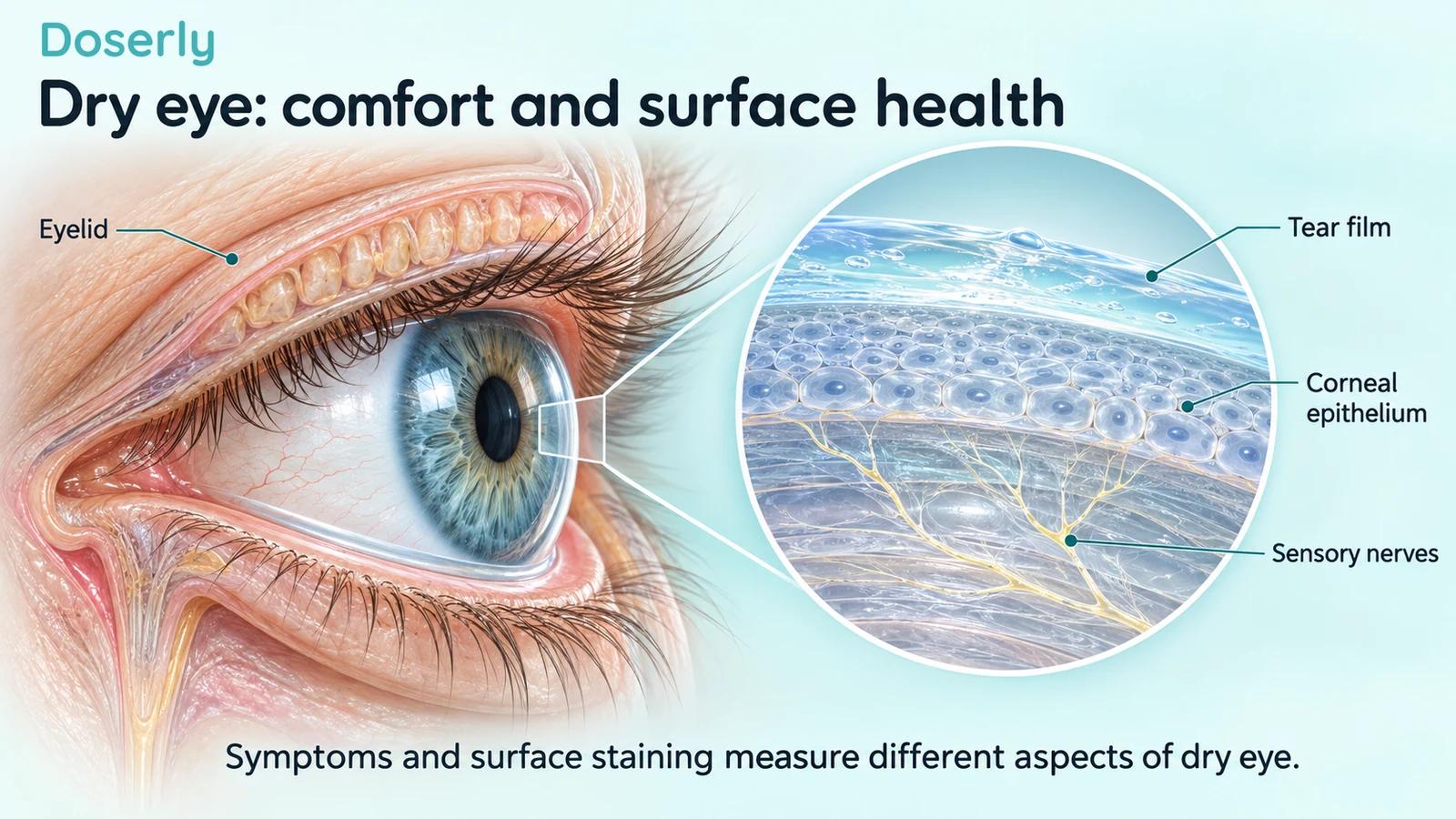
Dry eye occurs when there aren't enough tears or the tears don't work effectively. Burning, scratchiness, redness and blurred vision can follow. An eye examination may investigate tear quantity, how quickly the tear film breaks up and the condition of the eyelids. These observations help identify what is contributing to the problem. National Eye Institute.
A symptom is something a person experiences, such as discomfort. A sign is something an examiner measures or observes. In dry-eye research, one sign is corneal fluorescein staining: an examiner uses dye and illumination to assess abnormalities on the eye's surface. The staining score describes a clinical appearance; it is not a direct measurement of how uncomfortable someone feels.
Those distinctions matter when you read that a treatment “improved dry eye.” Did it reduce the symptoms that interrupt someone's day? Did the surface look healthier? Did the effect last outside the examination room? Each is worthwhile, but the answer to one cannot stand in for all the others. The trial registration specifically identifies staining in the lower corneal region as a main measurement. Study registry.
Think of someone who reports less burning but still has substantial staining. Their symptom improvement deserves attention, while their surface findings still need follow-up. Conversely, an improved examination does not mean someone is imagining persistent discomfort. A treatment study needs to make both experiences visible rather than combine them into an undefined claim of “healing.”
What exactly did the 72-person study test?
The 2015 publication described a single-center, randomized, double-masked phase 2 trial. Participants received either 0.1% thymosin beta-4 ophthalmic solution, called RGN-259, or matching vehicle drops for 28 days. There were 36 participants in each group. Double masking meant that treatment assignment was concealed from participants and investigators.
The vehicle contained the formulation's other ingredients without thymosin beta-4. That comparison matters: a drop without the experimental peptide may still wet the surface and affect symptoms. The trial therefore asked whether adding the peptide produced an advantage over the matching drop, not whether putting any liquid in the eye was better than doing nothing.
Participants also underwent a controlled adverse environment, or CAE, challenge. This deliberately standardized conditions that worsen dry-eye signs and symptoms. To qualify, people had to show the required response to that environment. The design made the testing conditions more consistent, but selected a particular study population. Its results are not automatically representative of every person who occasionally has dry eyes.
The main assessment was on day 29, after the day-28 challenge. For efficacy, researchers analyzed one designated “worst eye” per person. Treating two eyes in one person does not create two independent participants. That detail is especially important when comparing this study with smaller publications that report eye counts. Methods and analysis plan.
The two primary endpoints did not show a significant benefit
A primary endpoint is a main outcome defined to answer the trial's central question. Here there were two: inferior corneal staining and ocular discomfort at the day-29 visit. “Inferior” means the lower region of the cornea, not a less important measurement.
The published results were:
Day-29 outcome
Mean inferior corneal staining score
- Thymosin beta-4
- 2.08
- Vehicle
- 1.90
- Reported comparison
- P=0.2586
Day-29 outcome
Mean ocular discomfort score
- Thymosin beta-4
- 1.6
- Vehicle
- 1.3
- Reported comparison
- P=0.2210
Higher scores indicated worse findings. Neither comparison showed a statistically significant treatment advantage; the point estimates were slightly higher in the active-treatment group. Baseline-adjusted analyses of these primary measurements also did not show a significant difference. Primary results.
That does not prove the treatments have identical effects. A small study can miss a modest benefit, and its estimates have uncertainty. It does mean the study did not establish the benefit it was designed to demonstrate. It would be inaccurate to describe the primary results as showing that these drops reduced discomfort or lower-cornea staining.
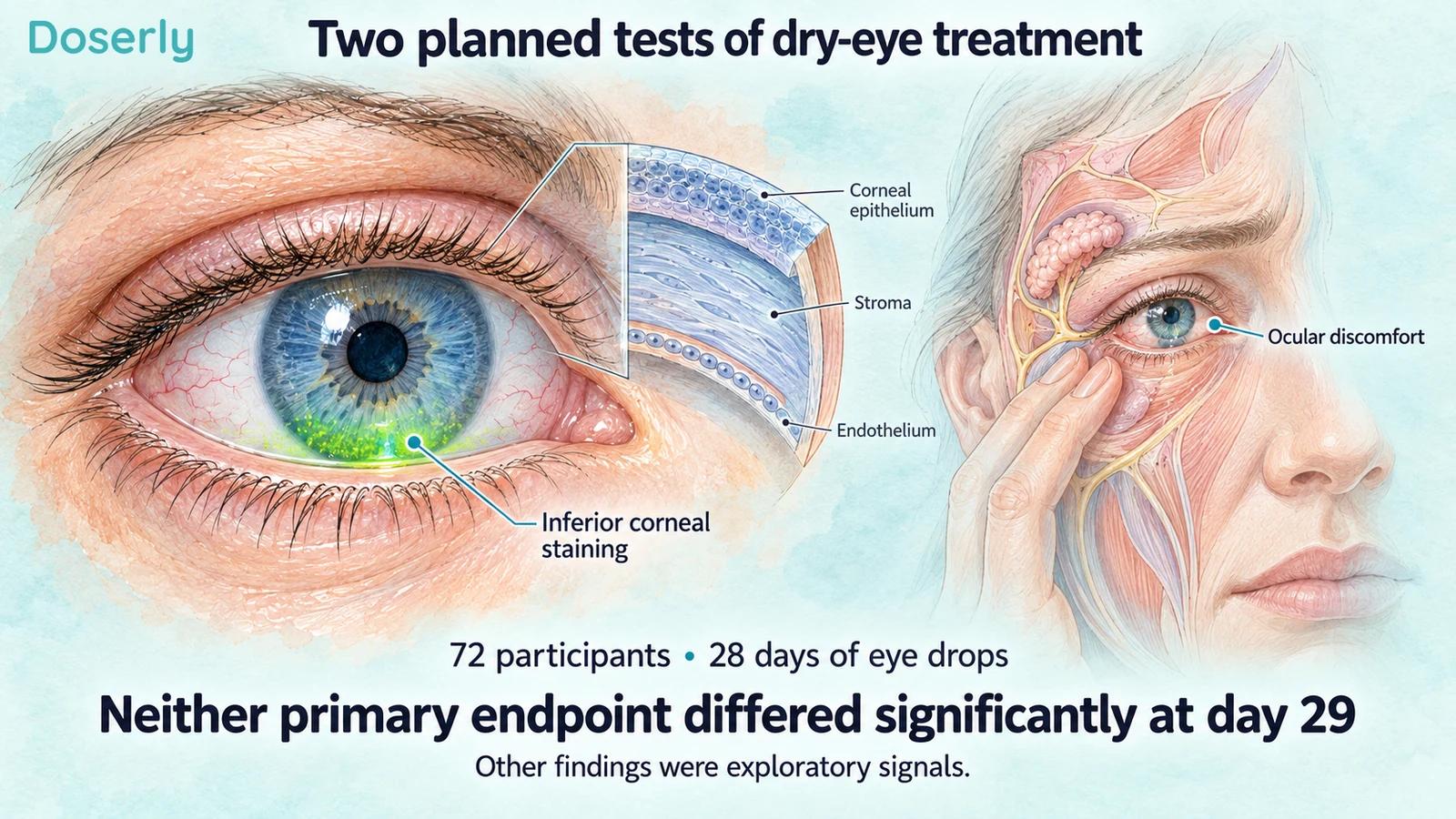
Image sources: Source
Why did the abstract still sound positive?
The publication also reported favorable findings in other corneal regions and during the environmental challenge. Central and superior staining analyses, and an analysis of discomfort during the day-28 challenge, suggested possible treatment effects. Those observations are part of the study and shouldn't disappear from an honest explanation.
But the full results section describes several baseline-adjusted analyses as ad hoc, meaning additional analyses undertaken outside the main planned comparison. The highlighted discomfort finding concerned the increase in discomfort during the challenge. It was not the same measurement at the same time as day-29 discomfort. The two treatment groups also began the challenge with different average discomfort scores. Full results and discussion.
This is why a sentence such as “discomfort fell by 27%” needs context. It can sound as though every patient became substantially more comfortable in daily life. The actual finding concerned a specific comparison under controlled challenge conditions. It doesn't mean 27% of patients were cured, or that average everyday symptoms improved by that percentage for a month.
The authors interpreted their results optimistically and called for future studies. Readers can acknowledge that interpretation while separating the favorable exploratory findings from the missed main tests. The most useful conclusion is that the trial identified signals worth investigating while leaving its central efficacy question unresolved.
Why choosing the main question in advance matters
A dry-eye trial can measure multiple symptoms, multiple corneal regions and multiple visits. Each may be clinically interesting. The difficulty arises when the most favorable result is selected after all those comparisons have been examined.
With many statistical tests, apparently positive findings can occur by chance even when a treatment has no true effect. FDA guidance explains how ordering endpoints and controlling for multiple comparisons helps limit false conclusions. A secondary endpoint can be prespecified and still require appropriate statistical handling before it supports a confirmatory claim. FDA guidance on multiple endpoints.
That principle does not make secondary outcomes unimportant. A signal in a specific symptom may suggest a better target for the next trial. Researchers can then select that outcome in advance, choose a suitable population and test it directly. Repeating the finding under those conditions would be more persuasive than continuing to explore the same dataset.
For a patient, the distinction has a concrete consequence. If you mainly want relief during ordinary daily activities, a positive result under a particular chamber challenge is a reason to ask about everyday symptoms. It isn't yet an answer to that question. A scientifically interesting measurement becomes clinically useful when it matches the problem you need treatment to solve.
Was there another positive dry-eye trial?
Yes. A separate 2015 randomized study involved nine people with severe dry eye, including disease associated with graft-versus-host disease. It used 0.1% RGN-259 or vehicle for 28 days, followed by another 28 days of observation. At day 56, the abstract reported favorable symptom and staining comparisons. It described 12 treated eyes and six vehicle-treated eyes. Nine-patient study.
Those are encouraging early findings, but nine people provide limited precision. Eighteen eyes do not turn the study into an 18-person trial. The population, schedule and assessments also differed from the 72-person study. It is more accurate to describe two small trials with different results than to merge them into a single claim that thymosin beta-4 has proven dry-eye efficacy.
The later ARISE-3 trial adds another important distinction. RegeneRx's March 2021 announcement said that ARISE-3 did not meet its primary outcome measures, while reporting improvement in ocular grittiness, a secondary symptom endpoint. This was a sponsor announcement, not a peer-reviewed full trial report. Original announcement filed with the SEC.
The sponsor subsequently discussed additional analyses and pooled data. These can help generate hypotheses, but combining or reanalyzing studies does not erase the original outcome of an individual trial. A patient deciding whether a result is relevant needs the original population, main endpoint and comparison alongside any later analysis.
Does corneal wound healing settle the dry-eye question?
Another RGN-259 study examined neurotrophic keratopathy, a condition involving impaired corneal nerve function and persistent surface defects. In that randomized study, six of ten treated participants and one of eight placebo participants had complete healing after four weeks; the reported primary comparison had P=0.0656. Later assessments were more favorable. Neurotrophic keratopathy trial.
That study asked about closure of persistent epithelial defects in a different disease. It doesn't establish that ordinary dry-eye symptoms improve, and the small numbers leave substantial uncertainty even for its own population. A surface defect closing and a discomfort score changing are different outcomes. Our guide's human-research section helps place the eye studies alongside the other formulations studied.
What can we say about safety?
The full 72-person paper reports at least one ocular treatment-emergent adverse event in two active-treatment participants and five placebo participants. Events in the active group were classified as mild. The detailed results are more informative than the abstract's broad wording that no adverse events were observed. The authors did not identify a clinically significant safety problem during the study. Safety results.
Short-term tolerability in a controlled trial is useful information. It does not establish long-term safety, detect every uncommon reaction or validate a different product. These were sterile ophthalmic formulations. The findings do not provide instructions for putting a research preparation into the eye or substituting an injection for an eye drop.
Bringing the findings into a care conversation
If dry eye is affecting your day, describe the situations that trigger symptoms, what they prevent you from doing and which treatments you've tried. NEI emphasizes that treatment depends on the cause and may include lubricating drops, prescription treatment or measures addressing the environment and tear drainage. NEI treatment overview.
When discussing an experimental option, ask which result is expected to improve: comfort, surface staining, a persistent wound or another measurement. Ask how that expectation relates to the actual trial population and formulation. Keeping a dated symptom record can help describe your experience, especially when several treatments change, but an improvement in a diary cannot by itself identify which treatment caused it.
Thymosin beta-4 remains an interesting subject for ocular-surface research. The dry-eye trial's most dependable message is specific: its two planned main tests did not demonstrate a significant benefit, while other findings suggested questions for further study. That gives you a clearer starting point for a clinical discussion than an unqualified promise of eye repair.
Sources
- Sosne and Ousler, 2015: 72-person controlled-environment trial.
- ClinicalTrials.gov: NCT01387347.
- Sosne and colleagues, 2015: nine-patient severe dry-eye trial.
- RegeneRx, 2021: ARISE-3 topline announcement.
- Sosne and colleagues, 2022: neurotrophic keratopathy trial.
- FDA, 2022: multiple-endpoint guidance.
- National Eye Institute: dry eye.