
Peptides
October 16, 2026
Is GHRP-6 natural? The molecule, the pathway and the safety question
On this page
GHRP-6 can stimulate the release of a hormone your body makes. That does not mean your body makes GHRP-6, or that using it recreates normal physiology.
The distinction matters because “natural alternative” can suggest several reassuring things at once: that a compound occurs naturally, that it only restores a deficiency, that the body controls every effect, or that it is safer than another treatment. Those are separate claims. GHRP-6's ability to stimulate growth hormone does not establish all—or even most—of them.
GHRP-6 is a synthetic six-amino-acid peptide. It acts within a signaling system that also responds to the naturally occurring hormone ghrelin. Understanding that relationship gives a more useful answer than simply calling the compound natural or unnatural. GHRP-6 substance identity, original ghrelin discovery.
Three molecules that should not be confused
Growth hormone, often abbreviated GH, is released by the pituitary gland. Ghrelin is a different hormone, identified as a naturally occurring activator of the growth-hormone secretagogue receptor. GHRP-6 is a synthetic compound that can activate this system and stimulate growth-hormone release.
The 1999 ghrelin discovery paper described a 28-amino-acid peptide purified from rat stomach, with a fatty-acid modification needed for its GH-releasing activity. The investigators also identified the closely related human molecule. That discovery explained an endogenous signal for a receptor that synthetic secretagogues were already helping researchers investigate. Kojima and colleagues.
GHRP-6 is not the 28-amino-acid ghrelin molecule. Its registry entry lists the six-residue sequence His–D-Trp–Ala–Trp–D-Phe–Lys-NH2. The D designations specify the stereochemical form of particular amino acids, and the terminal notation describes the molecule's chemical structure. These details identify a particular manufactured compound; they are not decorative scientific wording on a label. NCATS substance record.
A shared receptor therefore does not make GHRP-6 identical to ghrelin. Nor does the growth hormone released after stimulation become GHRP-6. Keeping the stimulus, receptor and downstream hormone separate prevents a common advertising shortcut: describing the natural origin of one part of the system as though it applies to every part.
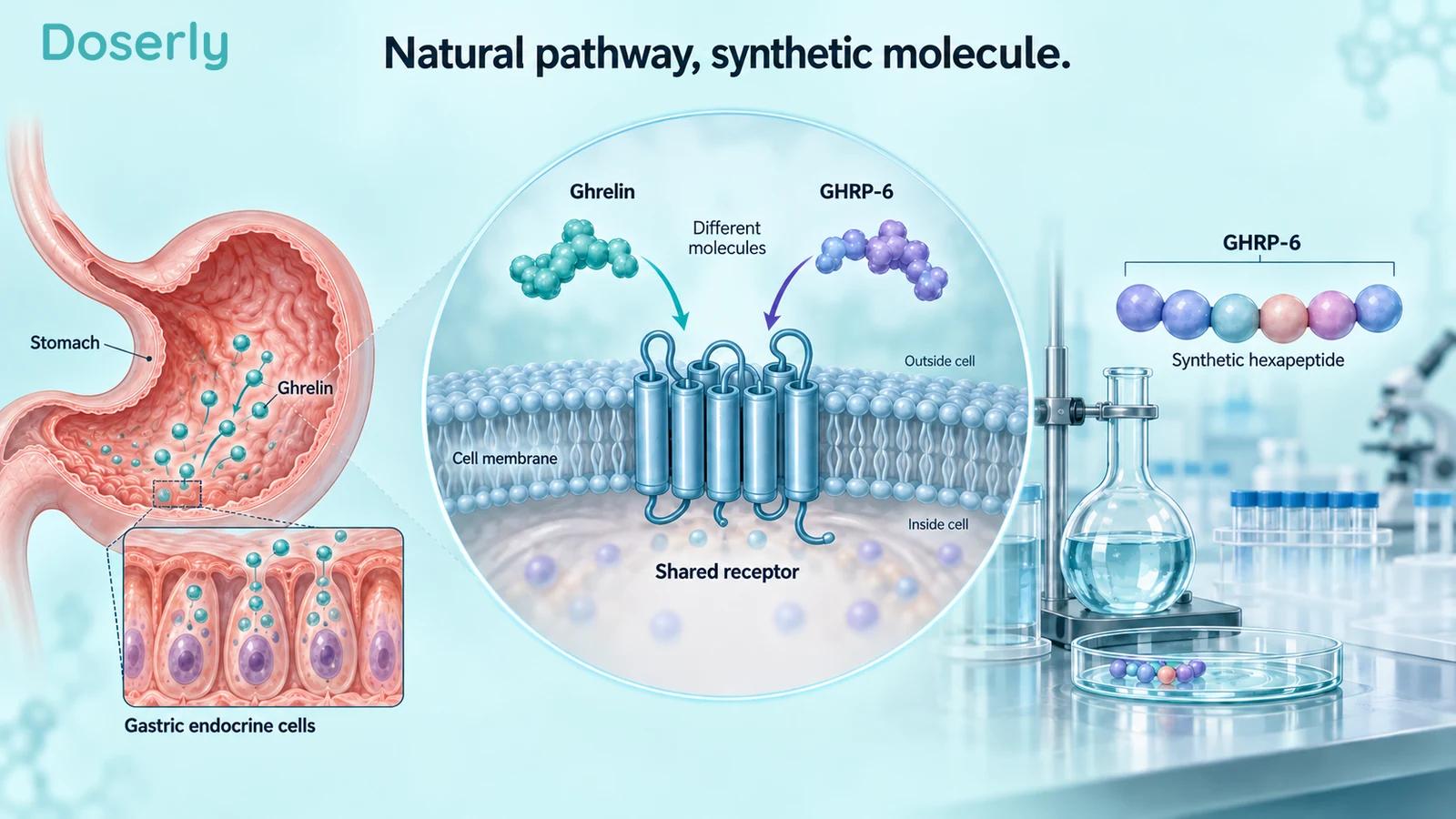
“Your own growth hormone” describes the source of the response
There is a real pharmacological difference between administering growth hormone and administering a substance that stimulates its release. GHRP-6 belongs to the second category: a secretagogue. The word means that it promotes secretion.
An early study in 18 healthy men showed a dose-related growth-hormone response after intravenous GHRP-6. At the highest tested dose, prolactin and cortisol also increased. The experiment demonstrated biological activity and helped characterize its endocrine effects. It was not a long-term comparison showing that GHRP-6 was safer or more useful than prescribed growth hormone. Human dose-response study.
Calling the resulting GH “your own” is accurate in the limited sense that the pituitary released it. But a hormone's source does not, by itself, tell us whether its amount, timing or associated effects are appropriate for a particular person. The relevant exposure includes the administered stimulus and the body's response.
This is similar to the difference between describing a mechanism and making a treatment decision. “Stimulates GH secretion” identifies an action. “Improves recovery safely” would require evidence about people, outcomes and harms. The first statement cannot serve as a substitute for the second.
The Doserly GHRP-6 guide provides the broader mechanism and evidence context. For the natural-alternative claim, the key point is narrower: endogenous hormone release is not equivalent to an endogenous drug.
Feedback remains involved, but it is not a safety certificate
Growth-hormone regulation involves signals that promote secretion, signals that inhibit it and feedback from growth hormone and IGF-1. Secretion is pulsatile rather than a constant flow, and age, sleep, nutrition and metabolic state influence the system. A single blood measurement is therefore only a small part of the physiological picture. Endotext physiology reference.
Human experiments show that GHRP-6 does not operate independently of this background. In a study of nine men, blocking endogenous growth-hormone-releasing hormone substantially reduced the GH response to GHRP-6. The study supported an important role for the body's own GHRH signaling in the response. GHRH-antagonist experiment.
That finding is sometimes stretched into a much broader claim: because physiological regulation is involved, excessive or unwanted effects cannot happen. The experiment did not test that proposition. It measured a hormone response under receptor-blockade conditions, not every possible adverse effect of repeated use.
Feedback describes how a system regulates itself. It does not establish an approved indication, define a safe regimen or guarantee that every other endocrine pathway is unaffected. An intervention can interact with normal regulation and still create a clinically relevant change.
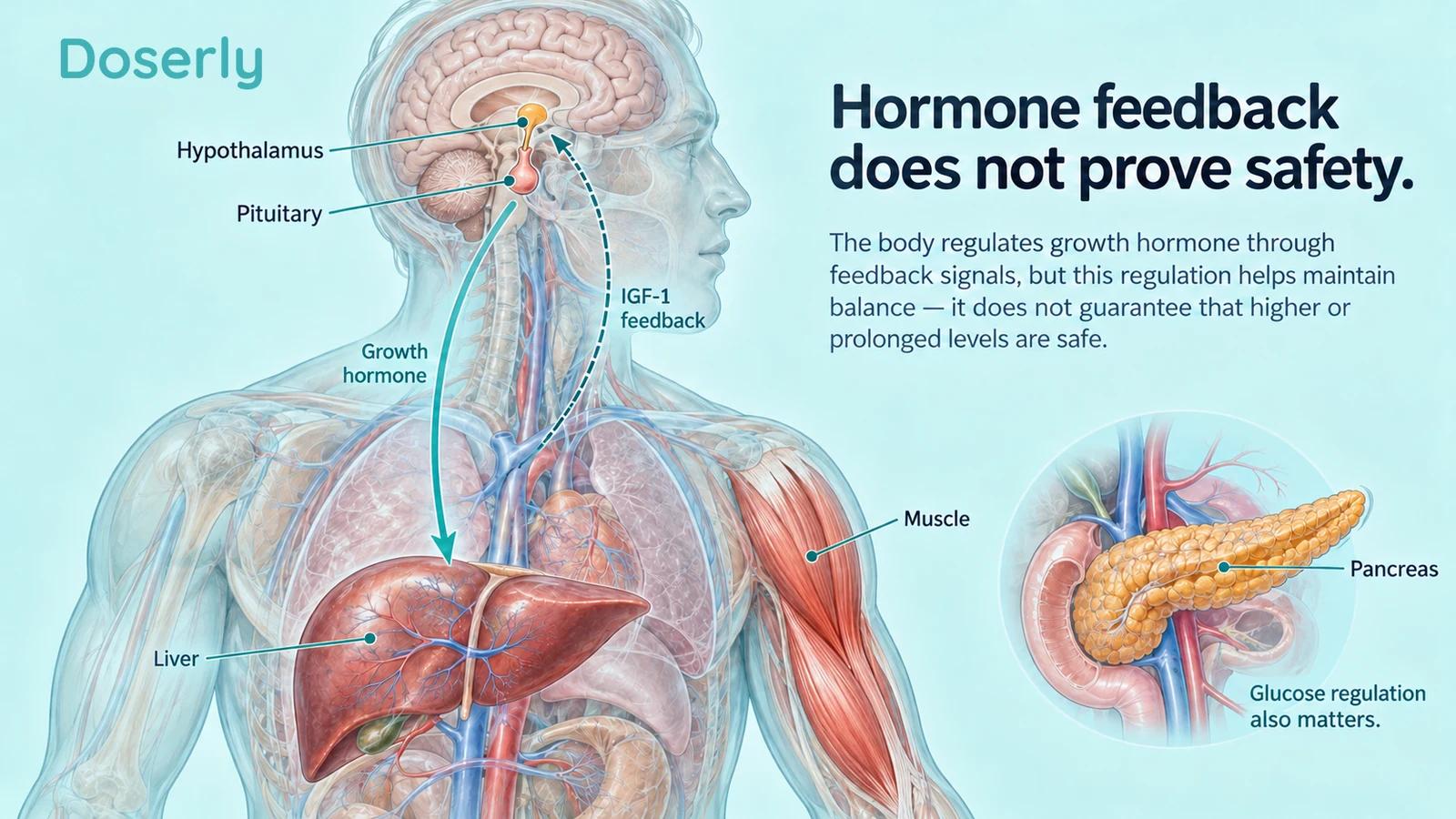
A natural pathway can have several effects at once
People often encounter GHRP-6 through a desired effect such as appetite or growth-hormone release. The safety assessment has to consider effects beyond the one being sought.
FDA's GHRP-6 entry identifies potential concerns involving increased cortisol, reduced insulin sensitivity and increased blood glucose. It also discusses potential immunogenicity related to peptide aggregation and impurities, and limitations in the available safety information. These are specific pharmacological and product-quality questions. The description “natural alternative” does not answer them. FDA safety information.
This does not mean every user will experience each listed problem. The agency entry is not an incidence table, and it does not provide a personal probability of harm. It does mean that a reassuring label should not replace an assessment of the actual compound, formulation, health context and evidence.
There is also no reason to assume that feeling a familiar physiological effect demonstrates safety. Hunger, for example, is a normal sensation. A drug-induced change in hunger does not verify the identity of a product, measure insulin sensitivity or show that a long-term treatment goal has been achieved.
The useful question is therefore not whether an effect resembles something the body normally does. It is whether the intervention produces a worthwhile benefit with acceptable risks in the population and circumstances being considered.
Synthetic does not mean ineffective or inherently unsafe
Rejecting the natural label should not reverse the reasoning error. A synthetic molecule is not automatically dangerous, just as an endogenous molecule is not automatically harmless when administered as a treatment.
Chemistry identifies what a substance is. Clinical studies help establish what a particular exposure does. Regulation evaluates particular products and uses. These questions interact, but none can be replaced by a simple natural-versus-synthetic ranking.
For GHRP-6, the human physiology literature gives evidence of endocrine activity. That is valuable scientific information. It does not establish a general recovery, anti-aging or performance indication, and calling the molecule synthetic does not erase the research that exists.
A careful comparison with another therapy would need a defined reason for treatment and relevant head-to-head evidence. Otherwise, the word “alternative” can imply equivalence without specifying what is being replaced. An alternative to treatment for confirmed hormone deficiency is a different claim from an alternative to improving sleep or addressing inadequate nutrition.
A designation is not an approval
Another source of confusion is the historical FDA orphan-drug record. The record for the GHRP-6 sequence lists a designation dated May 23, 1990, for long-term treatment of children with growth failure due to inadequate endogenous growth-hormone secretion. Its current status shows that the designation was withdrawn or revoked, and that it is not FDA-approved for that orphan indication. FDA orphan-drug record.
That record documents a development history. It does not establish that a currently marketed GHRP-6 product is approved, that adult wellness use was evaluated or that a regulator endorsed a natural-alternative claim.
The wording matters because a screenshot containing an FDA identifier can look more reassuring than the underlying record warrants. Read the indication and approval field together. A substance registry number also identifies a chemical entity; it is not an efficacy rating.
The same care applies to a statement that a peptide has been “studied in humans.” Human research includes brief hormone challenges, safety studies and treatment trials. Those categories answer different questions. A short endocrine experiment cannot be repackaged as decades of demonstrated safety for repeated consumer use.
Normal aging and diagnosed deficiency are different situations
A person concerned about fatigue, body composition or slower recovery may reasonably wonder whether growth hormone is involved. Those concerns do not establish growth-hormone deficiency on their own.
The Endocrine Society's adult GH-deficiency guideline places diagnosis in a clinical context, including pituitary disease and appropriate testing. In many situations, stimulation testing is needed; treatment decisions are not based simply on a desire for a higher GH reading. The guideline addresses diagnosed deficiency and growth-hormone replacement, not GHRP-6 as a general wellness substitute. Endocrine Society guideline.
That distinction protects the clinical question from being reduced to a product choice. If a symptom needs evaluation, the first task is to understand its cause and the person's overall health. Deciding that “more natural GH” must be the answer skips that work.
It also clarifies why a normal feedback system is not itself an indication for stimulation. Having a functioning pathway shows that the pathway exists; it does not show that increasing its output will solve the problem being experienced.
Better questions than “Is it natural?”
A more informative conversation begins with the exact goal and the evidence needed to support it. What health problem is being treated? Was the relevant benefit demonstrated in people similar to you? Did the study examine GHRP-6 itself, a related compound or a combination containing several ingredients?
Ask which formulation and route were studied, what was measured and how long participants were observed. A rise in GH or IGF-1 may be relevant to the mechanism, but it is not interchangeable with better function, fewer symptoms or improved quality of life.
Then separate compound-level uncertainty from product-level uncertainty. A paper about a defined investigational preparation does not authenticate another product. The GHRP-6 risk discussion gives context for those distinctions without assuming that every source has the same quality.
If you already use a product, accurate records of its identity, timing, other medicines and symptoms can support a clinician's assessment. Such records are useful information, but they cannot establish purity or convert an untested regimen into a validated treatment.
GHRP-6's relationship to a natural signaling system is scientifically interesting. The most accurate description is a synthetic peptide that stimulates an endogenous endocrine pathway. Whether that action is useful and acceptably safe for a specific health goal remains a separate question—one answered by relevant clinical evidence, not by the word natural.
Explore the research
- NCATS GHRP-6/Hexapeptide-2 substance record.
- Original discovery of ghrelin.
- Human GHRP-6 hormone dose-response study.
- GHRH blockade and the GHRP-6 response.
- Growth-hormone physiology reference.
- FDA GHRP-6 safety entry.
- FDA orphan designation and approval status.
- Adult growth-hormone deficiency guideline.