
Peptides
October 16, 2026
CJC-1295 studies were short: what remains unknown about longer use?
On this page
CJC-1295 was developed to extend stimulation of the growth hormone system. Its early human studies showed that the long-acting molecule could affect hormone levels for days. That finding established biological activity, but it left a different question open: what happens when exposure continues over months or years?
The distinction matters because people often encounter CJC-1295 in conversations about ongoing recovery, body composition or healthy aging. Those goals imply repeated use and durable outcomes, while the best-known published human experiments examined limited exposures in healthy volunteers.
Short-term tolerability is not a long-term safety result. That does not make an early study useless or prove that a delayed harm will occur. It tells us what the study was capable of observing. Here we examine the human time frames, the longer-exposure animal findings and what would be needed to answer the clinical question more reliably. Our CJC-1295 guide explains the compound's broader development history.
What did the original human program measure?
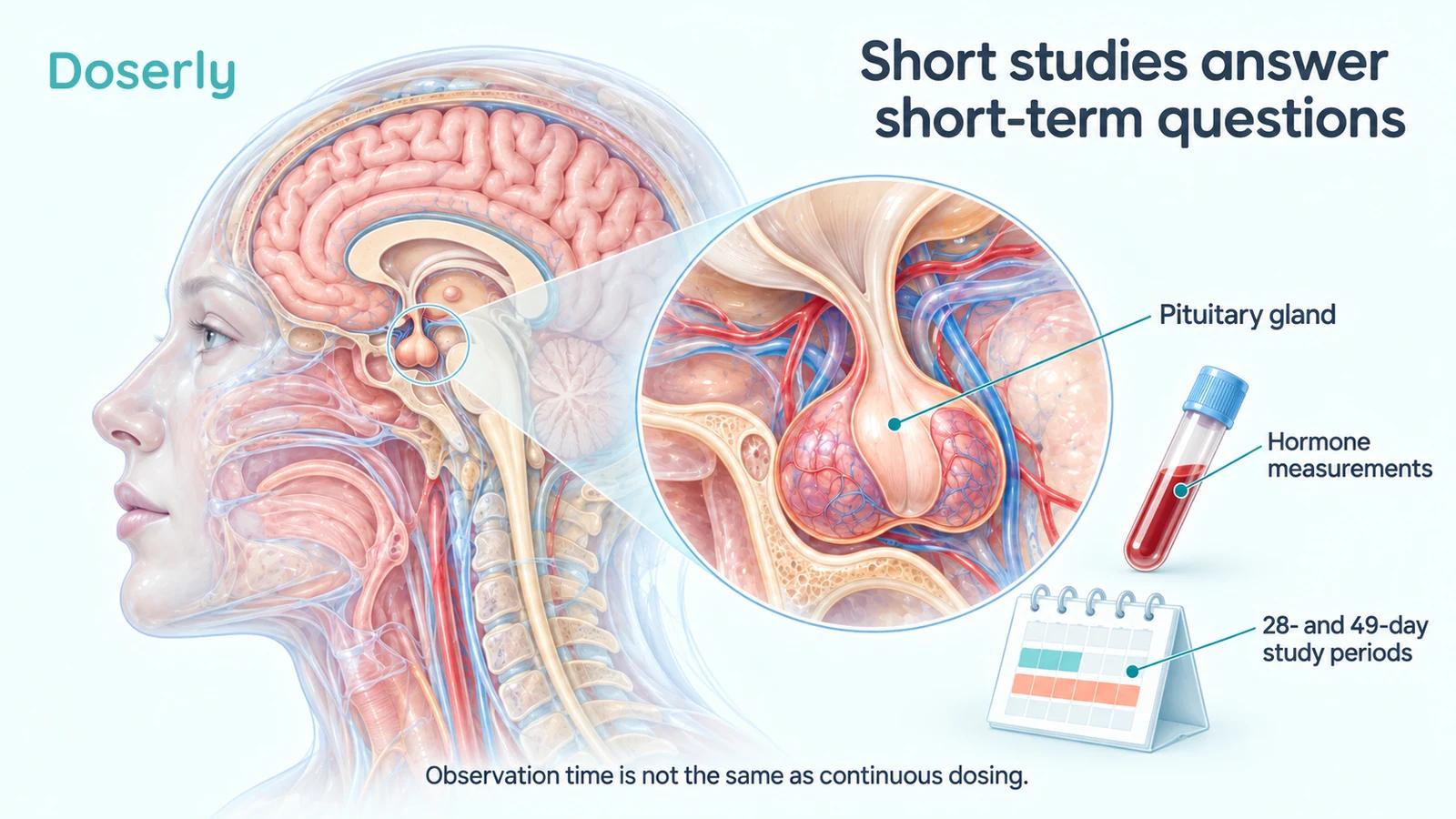
Teichman and colleagues published two randomized, placebo-controlled, double-blind dose-escalation studies in healthy adults aged 21–61. Their observation periods were 28 and 49 days. Participants received a single injection in one study or limited repeated administrations in the other; they were not treated continuously every day throughout those observation periods. Teichman and colleagues, 2006.
The central measurements were drug exposure, growth hormone, or GH, and insulin-like growth factor 1, or IGF-1. The long-acting molecule had an estimated half-life of 5.8–8.1 days, and hormone concentrations remained elevated for days after administration. The investigators reported no serious adverse reactions in those trials.
These results are informative about early pharmacology and the short exposures studied. They do not establish whether repeated use preserves a benefit, changes glucose regulation over longer periods, leads to immune reactions, or affects tissues after prolonged stimulation. Nor did the experiments demonstrate improvements in the wellness outcomes commonly discussed today.
A study can be well designed for its development stage and still be unable to answer those later questions. The error is not conducting a short trial; it is interpreting the short trial as if it followed participants through years of use.
Why study duration and dosing duration differ
An observation period may include time before treatment, the interval during which doses are given, and follow-up after the last administration. Those phases answer different questions. Follow-up can reveal how a hormone response declines, but it is not equivalent to exposing someone repeatedly for the entire period.
This is especially relevant for a long-acting compound. Measuring a persistent effect after limited dosing shows persistence. It does not demonstrate what happens when exposures accumulate across a much longer course.
Similarly, a result measured one week after an injection does not tell us whether the same result would still occur after months of use. Repeated stimulation may raise questions about changes in responsiveness, tolerability, product-specific immune reactions or other tissue effects. Those possibilities require measurement rather than assumption.
When reading a study, look for both the exposure history and the last follow-up assessment. A single phrase such as “seven-week study” can otherwise sound like seven weeks of an everyday regimen when the actual design was different.
What did the later human papers add?
Ionescu and Frohman examined GH pulsatility in healthy men before and one week after a single CJC-1295 administration. Blood was collected every 20 minutes during a 12-hour overnight assessment. The study found preserved pulses with substantially increased trough GH. It described secretion patterns, not long-term clinical outcomes. Ionescu and Frohman, 2006.
Sackmann-Sala and colleagues subsequently analyzed serum proteins in 11 men before and one week after exposure. The goal was to identify possible biomarkers of GH or IGF-1 action. The biological significance of the protein changes remained uncertain. Sackmann-Sala and colleagues, 2009.
FDA's review identifies those 11 men as a subset of the earlier pulse-study cohort. Consequently, the later publication should not be counted as 11 entirely new people providing independent treatment-safety experience. More papers can mean more analyses of the same participants rather than a larger exposed population. FDA CJC-1295 briefing.
The studies add useful details about the hormone system. They do not supply a missing months-long randomized trial simply because their publication dates span several years. Publication time and participant follow-up are different timelines.
Was a longer patient trial attempted?
ClinicalTrials.gov lists a phase 2 study of CJC-1295 in people with HIV-associated visceral obesity. Its official title describes planned administration for 12 weeks. The registry status is terminated, and the record has no posted results. NCT00267527.
This record is important context because it shows that development moved beyond an initial healthy-volunteer question. It is not evidence that the planned course successfully improved body composition or demonstrated safety. A protocol title describes intention; a completed analysis describes findings.
FDA's review discusses reports surrounding termination and emphasizes the limited available clinical information. Without a full published outcome and safety dataset, it is not possible to reconstruct a reliable treatment effect or adverse-event rate from the registry alone. The appropriate interpretation is an unresolved development record, not a positive trial hidden behind an incomplete summary.
That gap also prevents a confident extrapolation from healthy volunteers to patients with other conditions. The clinical setting, background medicines and baseline risk can all affect what a trial needs to evaluate.
What has longer exposure shown in mice?
A 2020 investigation by Ben-Shlomo and colleagues examined links between pituitary hormone secretion and DNA damage. The paper included human pituitary-tumor analyses as well as separate cell and mouse experiments. The human tissue findings should not be described as outcomes in people given CJC-1295. Original JCI paper.
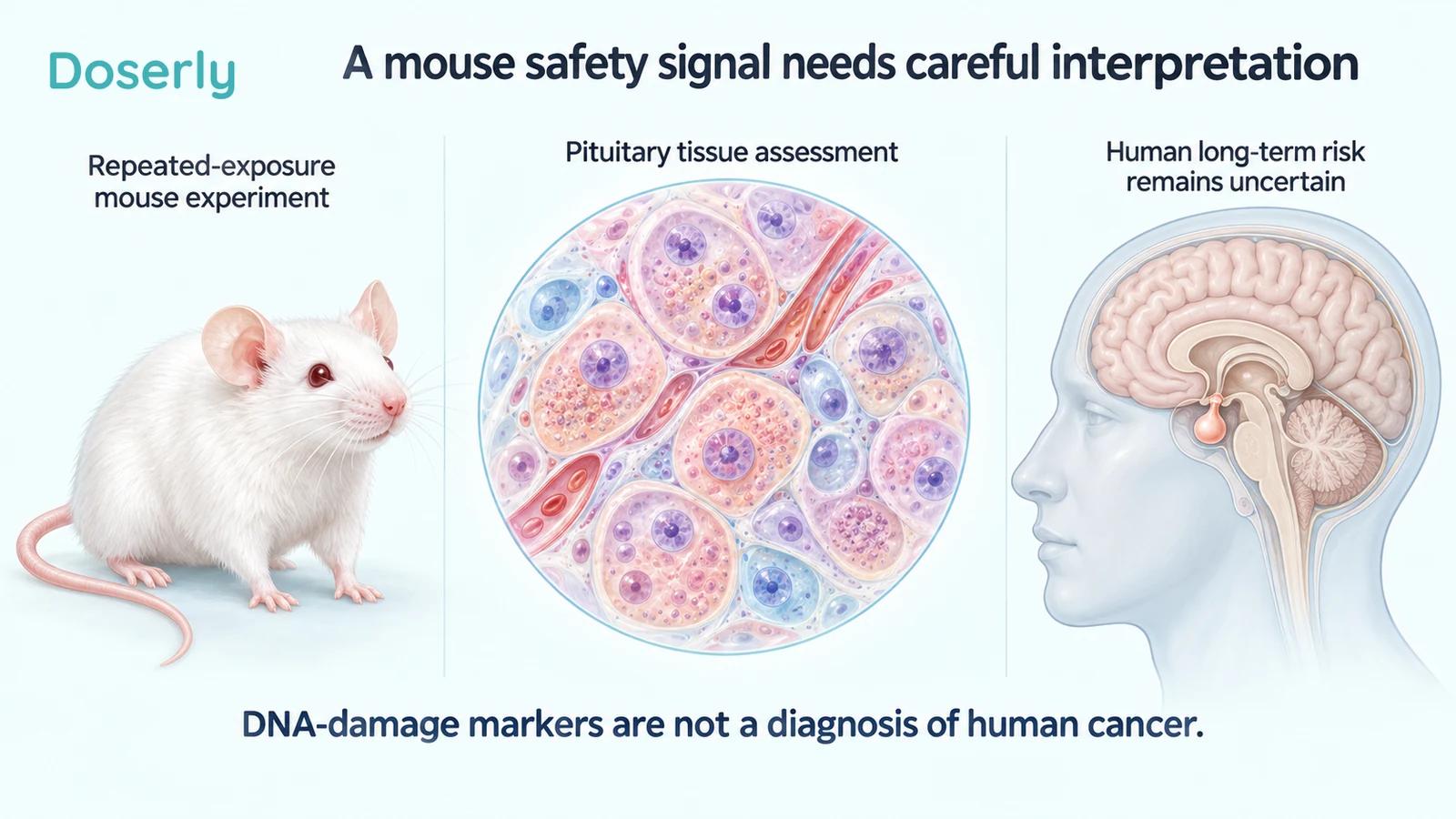
In the repeated-exposure experiment, four-month-old male mice received CJC-1295 or control injections three times weekly for eight weeks. There were 16 animals in the treated group and 15 controls, although individual assays used subsets. Pituitary weight was 47% higher in the treated group on the reported comparison, and investigators found increased DNA-damage markers.
These findings identify a biological safety question. They do not measure the incidence of cancer in human users. A DNA-damage marker is a laboratory observation, not a diagnosis of a tumor, and a difference in gland weight is not automatically malignant growth. The experiment also used a particular species, exposure and observation period.
The correct response is neither to dismiss the findings because they involved mice nor to announce that the same outcome is established in people. They give researchers a reason to examine prolonged pituitary stimulation carefully.
What does a growth-deficient mouse tell us?
Another experiment used young mice lacking the gene for GHRH. Researchers administered CJC-1295 over five weeks and examined growth, body composition and pituitary-related measurements. Daily administration normalized body weight and length in that specific deficiency model, while less frequent treatment produced different results. Alba and colleagues, 2006.
The study demonstrates how strongly the starting condition matters. Restoring a missing signal during growth in a genetically altered mouse is not the same intervention as increasing signaling in a healthy adult human. It also is not a veterinary treatment recommendation.
The paper reported changes consistent with increased GH-producing pituitary cells. That adds to the biological rationale for examining the gland during development of a prolonged GHRH stimulus. It does not establish whether a comparable change occurs, helps or harms people using CJC-1295 for an unrelated goal.
Animal experiments can reveal mechanisms that a short blood-sampling study cannot. Translating them requires attention to disease model, age, species and exposure, rather than copying either the favorable or unfavorable headline into a human claim.
What did FDA identify as unresolved?
FDA's CJC-1295 review discusses uncertainty about prolonged pituitary stimulation and the absence of an adequate long-term carcinogenicity assessment. It also reviews local and systemic findings from nonclinical work and limited human safety observations. These are reasons for further investigation, not a quantified prediction for a particular person. FDA briefing.
The agency's current compounding-risk page separately identifies serious adverse events associated with CJC-1295, including increased heart rate and systemic vasodilatory reactions, alongside immunogenicity and characterization concerns. FDA risk information.
Those reports should be described with causal restraint. An event occurring after exposure is not automatically caused by it, and brief trials may classify events differently from later regulatory reviews. Conversely, an early abstract saying no serious adverse reactions occurred does not erase the broader record or resolve longer-term uncertainty.
Why uncommon harms are hard to exclude
A small study can observe common, immediate reactions while missing uncommon events simply because too few people were exposed. A short study can also miss a delayed event even if its participants are monitored carefully during the available period.
The relevant amount of safety information therefore depends on both the number of people and the time and pattern of exposure. Several analyses from one cohort do not multiply that experience. Nor do many unverified anecdotes provide the same information as a systematically followed group with a known product and comparison.
The denominator matters. “No serious event was observed” is incomplete without knowing among how many participants, for how long, and under which conditions. It can be accurate and reassuring within that narrow context while still leaving substantial uncertainty about broader use.
This is particularly important when a proposed benefit is itself unproven. A risk-benefit assessment cannot rely on assumed long-term advantages while treating unobserved harms as established absences.
What would informative longer-term research include?
A useful study would begin with a clear clinical purpose and a fully characterized formulation. It would distinguish the original DAC-containing molecule from non-DAC products and mixtures. The benefit outcome would need to match that purpose, rather than relying solely on higher IGF-1.
Repeated-exposure follow-up would document changes over time, adverse events, reasons people stop, and what happens after the final administration. Clinically relevant testing would be selected in advance. If investigators were concerned about a particular tissue effect, they would need an appropriate assessment rather than assuming routine blood tests cover it.
The comparison group matters as well. Health changes occur with aging, underlying disease and other treatment, so simply observing a change over months does not establish its cause. Longer observation improves opportunity to detect events, but careful design is still needed to interpret them.
What this means for a treatment discussion
If someone proposes ongoing CJC-1295 use, ask which study supports that duration and which outcome it improved. Clarify whether the evidence concerns the same molecule and a similar patient population. A plan for monitoring is useful, but it is not a substitute for evidence that the treatment provides worthwhile benefit.
If you have already been exposed, a clear history of the product, dates, other medicines, symptoms and laboratory results can help a clinician assess the situation. It does not require assuming either that harm occurred or that an uneventful early period proves future safety.
The original CJC-1295 studies established sustained hormone activity over a limited observation period. The animal findings identify questions that deserve careful follow-up. Neither body of evidence supports a confident claim about years of benefit without important risk; that requires a different scale of human research.
Explore the research
- Teichman et al., 2006: early 28- and 49-day pharmacology studies.
- Ionescu and Frohman, 2006: before/one-week hormone sampling.
- Sackmann-Sala et al., 2009: exploratory protein analysis in a subset of participants.
- ClinicalTrials.gov NCT00267527: terminated patient trial, no posted results.
- Ben-Shlomo et al., 2020: pituitary-tissue investigation and separate mouse CJC-1295 experiments.
- Alba et al., 2006: GHRH-knockout mouse study.
- FDA CJC-1295 briefing: clinical and nonclinical safety assessment.
- FDA risk information: current safety concerns.