
TRT
October 16, 2026
The mood promise of TRT: what improvement would actually look like
On this page
“I want to feel like myself again” is an understandable treatment goal. It is also a difficult outcome to measure. It might mean enjoying a conversation, getting through work without exhaustion, sleeping more soundly, feeling less irritable, or recovering interest in things that once mattered. Those experiences can travel together, but they are not one symptom with one inevitable cause.
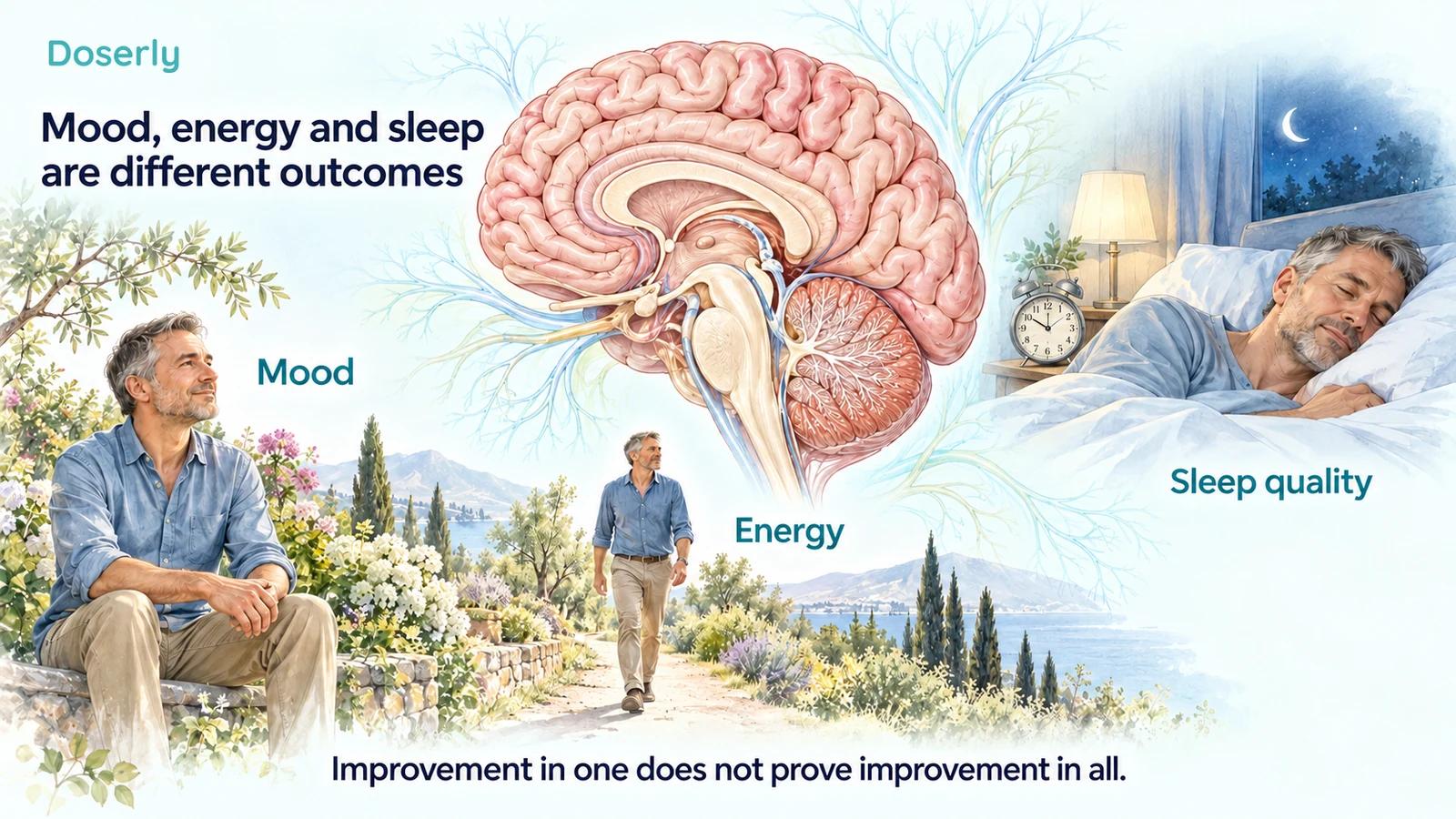
Testosterone treatment has produced small average improvements in mood and energy in some men with confirmed hypogonadism. That is a more limited finding than the promise that TRT treats depression, restores motivation, or clears every form of “brain fog.” In the large TRAVERSE analysis, benefits in mood and energy did not extend to cognition or sleep quality. TRAVERSE depressive-syndromes study
The useful question is therefore not simply whether testosterone can affect mood. It is which symptoms improved, in whom, by how much, and whether that improvement changes daily life enough to matter. Understanding those distinctions helps preserve realistic hope without allowing a hormone explanation to delay other care.
Low mood, fatigue, and depression are not interchangeable
Low mood describes an experience. Depression is a clinical assessment that considers the pattern, duration, severity, and effect of symptoms. Persistent loss of interest or pleasure, changes in sleep or appetite, difficulty concentrating, and hopelessness may be part of that assessment. A blood testosterone result cannot establish or exclude a depressive disorder. NIMH describes depression as involving symptoms most of the day, nearly every day, for at least two weeks, with depressed mood or loss of interest among them. People with fewer symptoms can still benefit from help. NIMH depression resource
Fatigue creates another ambiguity. “I have no energy” might describe physical exhaustion, falling asleep unintentionally, difficulty starting tasks, or a lack of emotional interest. Asking what happens during a typical day can be more revealing than asking whether energy is “low.” Someone who wants to meet friends but cannot stay awake is describing something different from someone who is awake but no longer finds the idea enjoyable.
These distinctions are not an instruction to diagnose yourself. They are a way to bring a clearer account to an appointment. You can say, for example, “I am sleeping seven hours but dozing during meetings,” or “I am less tired, but I still do not enjoy anything.” Those are illustrative descriptions. Neither one proves a particular diagnosis, and each gives a clinician a better starting point than a single overall wellness score.
What TRAVERSE contributes
TRAVERSE included men aged 45–80 with symptoms, two fasting testosterone levels below 300 ng/dL, and cardiovascular disease or increased cardiovascular risk. Its mood analysis examined several groups rather than treating all depressive symptoms as the same condition. Of 5,204 randomized men, 2,643 had a PHQ-9 score above 4. This questionnaire threshold identified depressive symptoms; it did not mean that half the trial had a confirmed major depressive disorder.
In that symptomatic group and in the full randomized population, testosterone gel produced modestly greater improvements in mood and energy than placebo. Investigators also examined rigorously defined, late-onset, low-grade persistent depressive disorder. Only 49 men met those criteria, and no significant treatment difference was found in that small subgroup. The authors noted its limited statistical power. TRAVERSE depressive-syndromes study
The distinction between the large symptom group and the small diagnostic subgroup is crucial. It would be misleading to turn the study into either “testosterone cures depression” or “testosterone has no mood benefit.” The evidence supports a small average symptom benefit in the studied population, while leaving important questions about particular depressive disorders unresolved.
A small average benefit is not meaningless. A person can value a modest improvement. But statistical evidence that a group changed more than another group does not tell you whether any particular person's work, relationships, enjoyment, or ability to care for themselves improved enough. That requires an individual assessment alongside the trial evidence.
The earlier Testosterone Trials add perspective
The Testosterone Trials assigned 790 symptomatic men aged at least 65 with testosterone below 275 ng/dL to testosterone gel or placebo for one year. Treatment produced some benefit in mood and depressive symptoms, but it did not meet the primary vitality outcome measured using a fatigue questionnaire. Testosterone Trials main report
That matters because promotional descriptions often combine mood, fatigue, motivation, and vitality into a single promise of renewed energy. A study can find a change in one questionnaire while failing its predefined main outcome in another domain. Selecting only the positive measure can make the overall result sound much larger and more consistent than it was.
The lesson is also useful for personal follow-up. Suppose you feel less irritable but still cannot manage your usual activities. It is reasonable to acknowledge the mood change without calling the fatigue resolved. Conversely, being able to do more during the day does not mean persistent sadness or loss of pleasure should be ignored. Treatment review should preserve both observations.
Neither trial was a test of testosterone as a universal performance enhancer. Their results belong to men with specified low testosterone levels and symptoms, under a monitored treatment protocol. Applying them to someone with normal hormone levels, or to escalating treatment beyond the prescribed goal, adds an assumption the trials did not establish.
Trials in depressive disorders have not given one simple answer
A small six-week randomized trial in men with major depressive disorder and low testosterone found similar reductions in depression scores with testosterone and placebo. Thirty men were randomized. Testosterone normalized their hormone levels, but the antidepressant effect could not be distinguished from placebo. This was a short, small study, so it cannot settle every clinical question; it does show that correcting a hormone measurement does not automatically resolve a depressive disorder. Seidman and colleagues' trial
Another small trial studied testosterone gel as an addition to existing antidepressant treatment in men with refractory depression and low or borderline testosterone. Twenty-two men were randomized for eight weeks. Some clinician-rated measures improved more with testosterone, but the Beck Depression Inventory did not show a significant between-group difference. The authors described the findings as preliminary. Pope and colleagues' trial
These studies asked different questions: replacement in a depressive disorder versus supplementation alongside an existing regimen, with different samples and measures. They cannot be combined into a simple instruction to replace an antidepressant with TRT. They also illustrate why it matters whether a headline describes a main result, one of several rating scales, or a small early study needing confirmation.
For someone who has both hypogonadism and depression, the two conditions can require coordinated care. Treating one does not erase the need to assess the other. A meaningful conversation can include the clinician managing testosterone and the professional managing mental-health treatment, with a shared understanding of symptoms and medications.
Make room for other explanations
Testosterone deficiency requires more than fatigue or a low mood. The Endocrine Society guideline recommends diagnosing hypogonadism in men who have compatible symptoms and unequivocally, consistently low testosterone, with repeat morning testing and further evaluation of the cause. It also recommends assessing treatment response and adverse effects after treatment begins. Endocrine Society clinical guideline
Sleep is one example of a parallel issue worth describing. Sleep apnea can cause daytime sleepiness, tiredness, difficulty concentrating, and disrupted breathing during sleep. Snoring or breathing pauses reported by someone else may provide information that a hormone test cannot. These symptoms warrant assessment; they are not proof that testosterone treatment is inadequate. NIH sleep-apnea resource
Similarly, a clinician may need to consider the overall medical and medication history when assessing depressive symptoms. This is not a competition to find whether hormones or mental health are the “real” issue. A complete explanation may involve more than one contributor, and the care plan can address more than one problem.
Doserly's TRT beginner guide provides context for diagnosis and treatment planning. The blood-work guide can help organize the laboratory discussion. Neither a symptom tracker nor a laboratory trend is sufficient on its own to decide why a person feels unwell.

Define improvement before the next laboratory result
Choose a few concrete experiences you would recognize as progress. “Better mood” could mean fewer days when you withdraw from people, more enjoyment during a familiar activity, or less irritability that disrupts ordinary conversations. “More energy” might mean finishing a routine task without having to stop. These are examples for describing your priorities, not validated clinical endpoints or predictions of what TRT will do.
Then establish a baseline in ordinary language. How often does the problem happen? What does it prevent? Has it changed recently? Record major treatment or medication changes, but avoid interpreting every good or difficult day as a direct drug effect. The purpose is to make the history easier to recall, not to assign causation from a diary.
It can help to separate three observations at follow-up: what improved, what stayed the same, and what became worse. A higher testosterone result belongs alongside those observations. If the number changes but daily function does not, that discrepancy is important information for the prescriber. It is not a reason to keep raising a dose on your own until a desired feeling appears.
Ask the clinician what interval and measures make sense for review. A validated symptom questionnaire can help when used as intended, while a short personal note explains the practical meaning of the score. A one-point change on a home-made scale should not be compared with a result from a research instrument that measures something different.
Also distinguish improvement from remission. Feeling somewhat less low can be worthwhile while substantial symptoms remain. The next decision should account for the remaining burden, treatment adverse effects, and the person's priorities—not just whether the change can be described as positive. This helps avoid accepting an incomplete response as the end of the conversation.
Persistent symptoms should not wait for a perfect hormone number
NIMH describes psychotherapy, medication, and other approaches as options for treating depression, with care chosen for the individual's needs. Do not stop mental-health treatment because a hormone explanation seems appealing or because one laboratory result improves. Persistent or worsening symptoms deserve clinical attention in their own right. NIMH depression resource
If you are thinking about suicide or feel unable to stay safe, seek urgent help now rather than waiting for a TRT follow-up. In the United States, call or text 988; call emergency services for an immediate life-threatening situation. Elsewhere, use your local crisis service or emergency number. NIMH depression resource
For everyday follow-up, a useful question is: “If my testosterone is adequately treated and this symptom remains, what is our next step?” It leaves room for TRT to provide a benefit while making clear that unresolved distress still matters. The best evidence supports measured expectations: some men experience small improvements in mood or energy, but feeling like yourself again is a broader goal than normalizing a single hormone result.
Sources
- TRAVERSE depressive-syndromes study
- Testosterone Trials main report
- Testosterone replacement in men with major depressive disorder
- Testosterone gel added to treatment for refractory depression
- Endocrine Society clinical guideline
- NIMH: depression
- NIH: sleep apnea