
Supplements
October 16, 2026
Vitamin K2 and coronary calcium: what the 2026 trials actually show
On this page
Vitamin K helps activate proteins involved in blood clotting and other processes, including regulation of mineral deposition. That biology has encouraged a familiar claim about vitamin K2: that it can keep calcium out of arteries. The human question is more demanding. Does taking a defined supplement change arterial disease, and does that change help people avoid heart attacks?
Two randomized trials published in 2026 provide new evidence about coronary artery calcium, or CAC, measured on heart scans. Both reported slower progression under their study conditions. Neither result should be translated into a claim that K2 cleared the arteries or established protection from heart attacks. VitaK-CAC, DANCODE.
To understand why, it helps to separate the supplement’s biological role, the scan measurement and the clinical outcome a person ultimately cares about.
What does a coronary calcium scan measure?
The coronary arteries supply blood to heart muscle. Calcium can be present within atherosclerotic plaque in their walls. A noncontrast CT scan detects this calcification and produces a score, commonly expressed in Agatston units.
A higher score generally signals a greater burden of calcified coronary disease and can help clinicians assess future risk. The American Heart Association describes CAC testing as useful in selected situations when preventive treatment decisions remain uncertain. It is not the appropriate test for every person or every symptom. AHA explanation.
The score is not a percentage blockage. A value of 200 does not mean an artery is 200% blocked, nor does a change of 20 units mean that blood flow changed by 20%. It is an imaging measurement with its own scale.
A scan also cannot answer every question about plaque. Calcium, noncalcified tissue, total plaque volume and the tendency of a plaque to cause an event are related features, but they are not interchangeable.
Why vitamin K2 was a plausible candidate
Vitamin K is involved in activating proteins through a chemical process called carboxylation. One relevant protein is matrix Gla protein, which participates in regulating calcification. This provides a biological reason to test vitamin K supplementation, rather than proof that supplementation will improve cardiovascular outcomes. ODS vitamin K reference.
“K2” is also a family of compounds. Menaquinone-7, or MK-7, is the form used in the main trials discussed here. It should not be treated as interchangeable with every vitamin K preparation or with a combination product containing other ingredients.
The Doserly vitamin K2 guide explains the wider nutritional background. For the coronary-calcium question, the form and study population need to remain attached to the finding.
Who took part in VitaK-CAC?
VitaK-CAC randomized 180 adults with symptomatic coronary artery disease and calcium scores between 50 and 400 to MK-7 or matching placebo for two years. The daily research exposure was 360 micrograms. The report describes 85 people receiving MK-7 and 82 receiving placebo after randomization. Primary trial.
Researchers measured calcium score and calcium mass at one and two years, with additional CT angiography. This was a study of imaging progression in people who already had coronary disease, not a prevention trial in healthy young adults.
The distinction matters for someone encountering a general “artery health” advertisement. The participants were selected partly by their existing scan findings. A result in this group does not establish what would happen in a person with no detectable calcium or a substantially different disease burden.
Slower progression still meant an increasing score
The reported median calcium score in the MK-7 group rose from 135 at baseline to 184 after two years. In the placebo group, the median rose from 145 to 214. The analysis of progression found a significant between-group difference, with P=0.02. VitaK-CAC results.
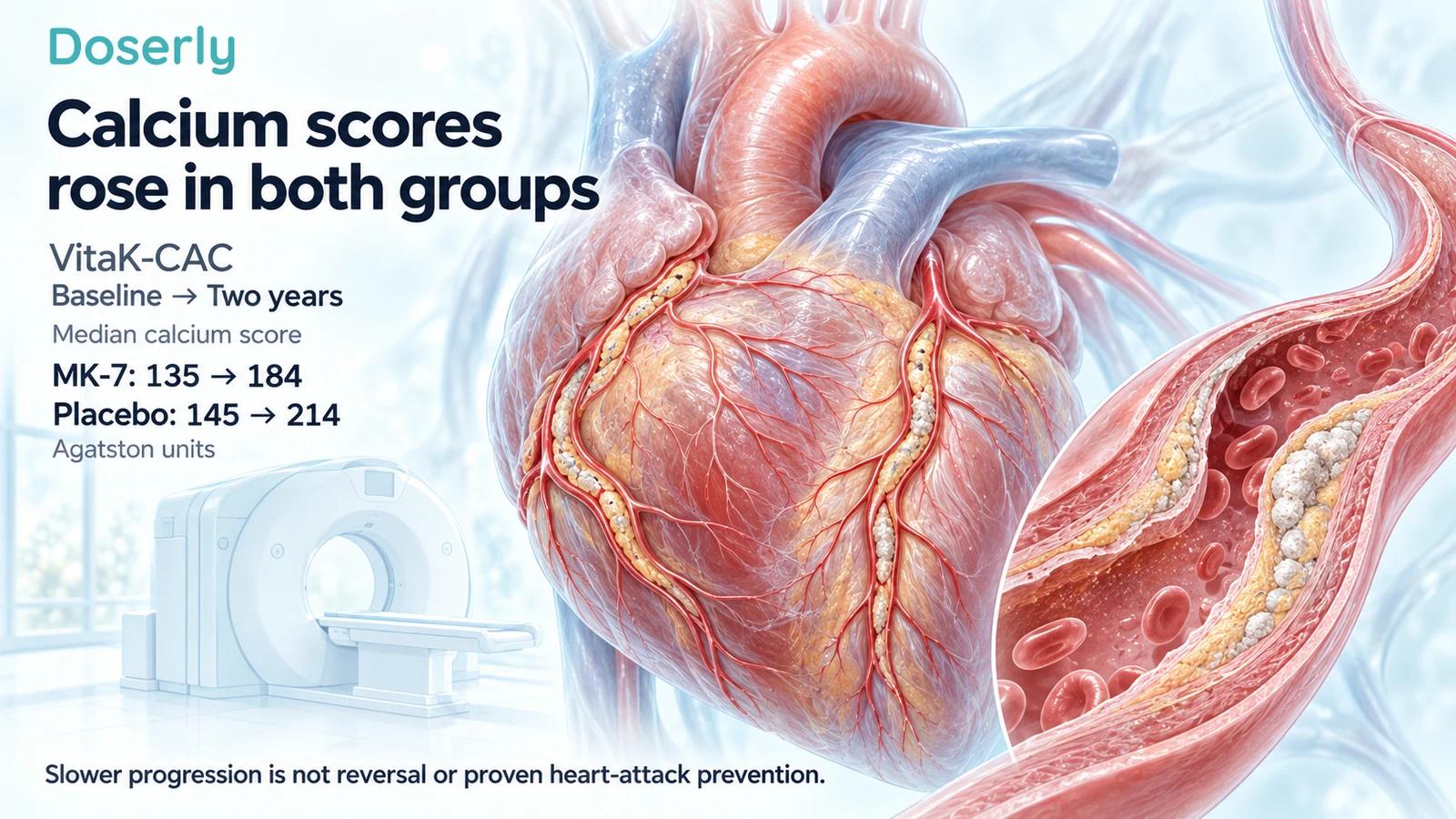
Both medians increased. That is why “slower progression” is the appropriate description and “reversal” is not.
The medians also should not be used to invent a precise treatment percentage. A difference between group medians at two time points is not automatically the same as the trial’s adjusted effect estimate. It does not provide an individual forecast or a heart-attack risk reduction.
Another way to read these results is to keep three comparisons separate. The baseline-to-follow-up change asks how a group evolved over time. The randomized comparison asks whether evolution differed between assigned treatments. The clinical question asks whether that difference translated into better health. Only the second is the main treatment comparison reported here; the first does not establish causation, and the third remains unanswered.
A group median is also a summary rather than a typical individual trajectory. Subtracting two medians does not necessarily give the median of participants’ individual changes. That is why a reader should preserve the published analysis instead of constructing a new effect estimate from the headline numbers. A precise-looking homemade percentage can conceal rather than clarify what the investigators actually tested.
DANCODE studied more extensive calcification
The 2026 DANCODE trial randomized 400 people with CAC scores of at least 400; 398 were included in the reported analysis. Participants received 720 micrograms of K2 plus 25 micrograms of D3 daily, or placebo, for 24 months. Median age was 71, and 30% were women. DANCODE primary report.
Mean calcium-score increases were 196 units with the vitamins and 248 with placebo. The between-group difference was −52 units, with a 95% confidence interval from −79 to −24.
This strengthens the evidence that an intervention containing K2 can affect calcification progression in selected patients. It still tested a combination. The design cannot determine how much of the result belongs to K2 alone, D3 alone or their combination.
In a 143-person angiography subset, total plaque volume increased similarly between groups, while progression of calcified plaque volume was attenuated. That does not describe disappearance of atherosclerosis. It highlights why plaque composition and total disease burden need separate measurements.
Why a calcium result does not settle heart-attack prevention
A surrogate outcome is a measurement used to study a process that may relate to a clinical outcome. Calcium progression is informative, but the outcome people usually care about is avoiding a heart attack, disabling symptoms or premature death.
A marker can predict risk without being a fully validated substitute for treatment benefit. People with higher calcium scores may be at greater risk, yet changing the score with a particular intervention does not automatically establish how that intervention changes their event risk.
There are several reasons. A treatment could influence plaque composition without changing total burden. It could have other effects, helpful or harmful, that the scan does not capture. The relationship between a marker and risk may also differ once treatment begins.
This does not make the 2026 findings unimportant. It means they answer an intermediate question and identify a reason to pursue clinical-outcome research. A study designed around heart attacks and other important events would be needed to establish those benefits directly.
Calcium density makes the interpretation less simple
A 2021 observational study examined serial coronary CT angiography in 857 patients. Statin use was associated with less low-attenuation and fatty plaque and greater progression toward dense calcium. The investigators interpreted the pattern as consistent with plaque stabilization. Primary cohort report.
This was not a randomized comparison of statins and K2. It does not prove that increasing calcium is always beneficial or that slowing calcium progression is harmful.
It does show why “less calcium is always better” is too simple once treatments affect plaque biology. A calcium score combines information about calcified tissue; it does not capture every property that determines whether plaque is dangerous.
For someone already taking a prescribed statin, the K2 findings are not a reason to stop it or judge its success solely by repeat calcium scans. The scan needs to be interpreted alongside the treatment’s established purpose and the person’s overall risk.
Why an earlier valve trial was negative
The aortic valve controls blood leaving the heart. Calcium in valve leaflets is anatomically and clinically different from calcium within coronary artery plaque.
A 2022 randomized trial enrolled 365 older men with aortic-valve calcification. It compared MK-7 plus vitamin D with placebo for two years. The primary valve-calcification outcome did not improve significantly, even though a vitamin K-related biomarker changed. AVADEC trial.
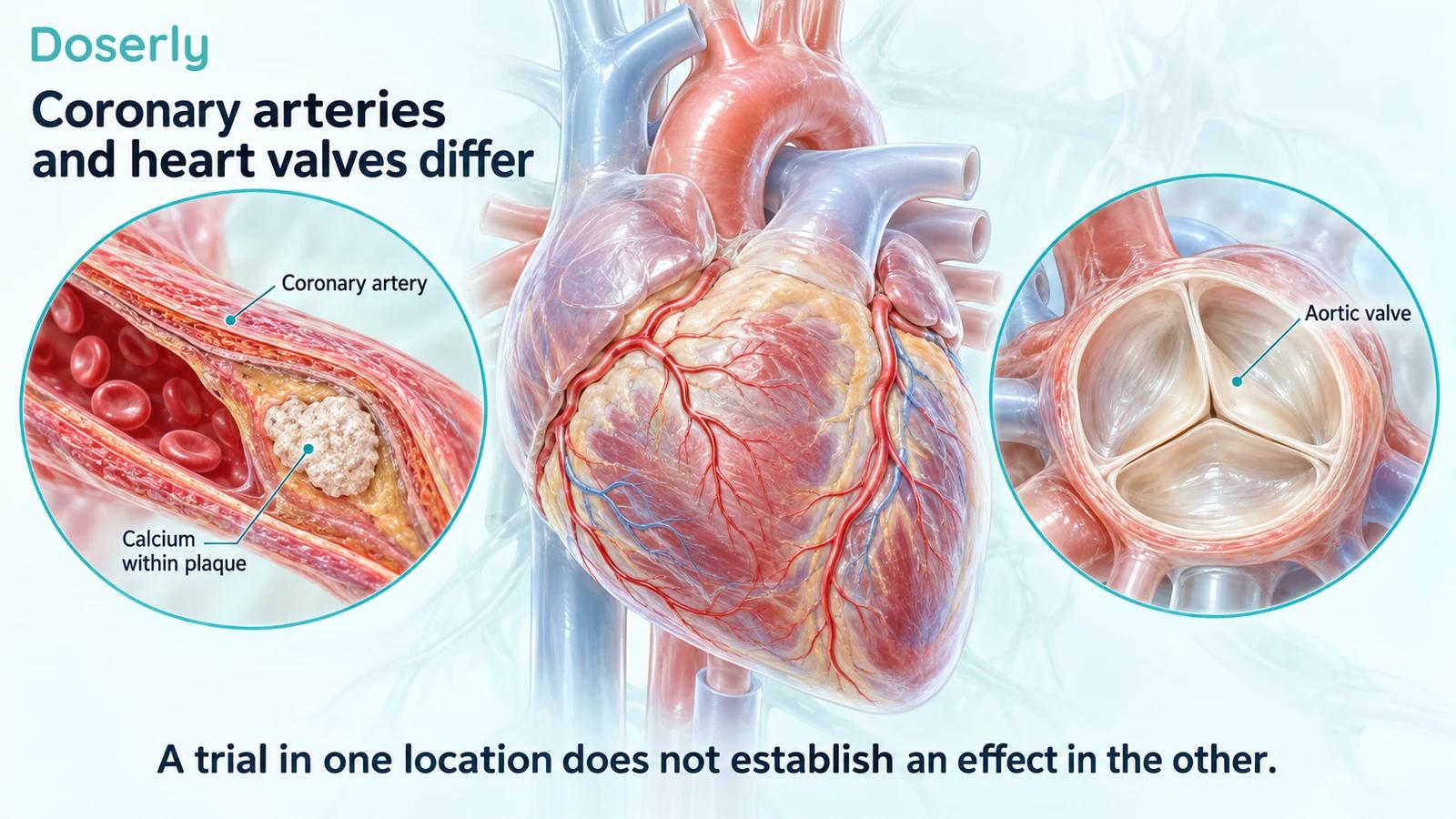
That result makes two useful points. First, a biochemical response does not guarantee an imaging response. Second, the newer coronary results should not be repackaged as evidence that K2 treats valve narrowing.
Someone with known valve disease needs follow-up directed at the valve’s function and their symptoms. The supplement trials do not replace that assessment.
What the older K1 trial contributes
An earlier three-year trial examined vitamin K1, or phylloquinone, in older adults. Among 388 people with the relevant baseline and follow-up scans, the intention-to-treat analysis did not find a significant overall difference in CAC progression. Analyses restricted to adherent participants and those with preexisting calcium were more favorable. 2009 trial.
An intention-to-treat analysis preserves the comparison based on assignment. Restricting analysis to people who closely followed treatment can answer a useful question, but also selects a subgroup that may differ in other ways.
The older study therefore supplies context, not a simple additional “positive K2 trial.” It tested a different vitamin K form, and its overall and subgroup findings differed. Keeping those details visible is more informative than counting every paper with “vitamin K” in the title as confirmation.
Does a high score mean you should start K2?
The trials provide evidence to discuss, but not a universal instruction. Your clinician needs to consider why the scan was performed, whether you have symptoms, your existing disease and treatments, and which outcome you are trying to improve.
The AHA notes that CAC testing is less useful when a treatment plan is already clear or when symptoms require other kinds of testing. It also involves radiation. Repeated scanning solely to evaluate a self-directed supplement experiment is not an approach established by these trials. AHA testing guidance.
A productive question is, “Would this finding change my care?” If the answer is uncertain, ask what evidence would be needed. That keeps the discussion centered on decisions that affect health rather than pursuing a more reassuring number in isolation.
The interaction that deserves particular attention
Vitamin K can interact importantly with warfarin and other vitamin K antagonists. Consistency of vitamin K intake matters during this treatment, and starting or stopping a supplement can alter anticoagulation. Any proposed change should be reviewed by the clinician managing it. ODS interaction information.
The microgram quantities used in trials are descriptions of research exposure, not recommended routines for every reader. Combination products also add other nutrients, so the full label matters.
Record the exact product and any change in use. That is especially useful when several clinicians are involved, because a nutrient supplement may otherwise be omitted from a medication list.
The 2026 studies make the coronary-calcium discussion more concrete. They support further investigation of slower imaging progression in defined groups. They do not yet establish artery clearing, treatment of valve disease or fewer heart attacks.
Sources
- Two Years of Menaquinone-7 Supplementation and Coronary Artery Calcification: A Randomized Clinical Trial (2026)
- Vitamin K2 and D3 Supplementation in Patients With Severe Coronary Artery Calcification: The DANCODE Trial (2026)
- Vitamin K2 and D in Patients With Aortic Valve Calcification: A Randomized Double-Blinded Clinical Trial (2022)
- Association of Statin Treatment With Progression of Coronary Atherosclerotic Plaque Composition (2021)
- Vitamin K: Fact Sheet for Health Professionals
- Coronary Artery Calcium Test (2026)
- Vitamin K supplementation and progression of coronary artery calcium in older men and women (2009)