
TRT
October 16, 2026
The 2026 testosterone label debate: what actually changed?
On this page
Testosterone helps maintain sexual function, bone, muscle and red-cell production. When the body cannot produce enough of it, replacement can be a useful medical treatment. The difficult question is what to do when an older man feels unwell, has a low result, and has no clearly identified disease of the testes or the brain structures that regulate them.
That question is at the center of the 2026 US labeling debate. On June 18, federal officials requested revisions concerning age-related hypogonadism and prostate safety. The announcement matters, but it is a request to change prescribing information, not a new trial showing that every tired older man benefits from treatment. The relevant documents also describe different stages of the process. HHS announcement
For someone considering testosterone replacement therapy, or TRT, the useful questions are practical: what evidence changed, what remains uncertain, and does any of it change the reason a clinician might recommend treatment for you?
Why the cause of low testosterone still matters
Most testosterone in men is produced in the testes. Signals from the hypothalamus and pituitary, structures in the brain, help regulate production. A problem can occur in the testes themselves or in the signals reaching them. Those different causes can lead to a similar laboratory result, yet require different investigations. FDA's current information page continues to describe testosterone treatment in the context of low levels accompanied by a medical condition. FDA testosterone information
This is why a clinician asks about more than age. A result obtained during illness, symptoms that began after a medication change, and a history of testicular injury describe different situations. The number is part of the assessment; it does not explain its own cause.
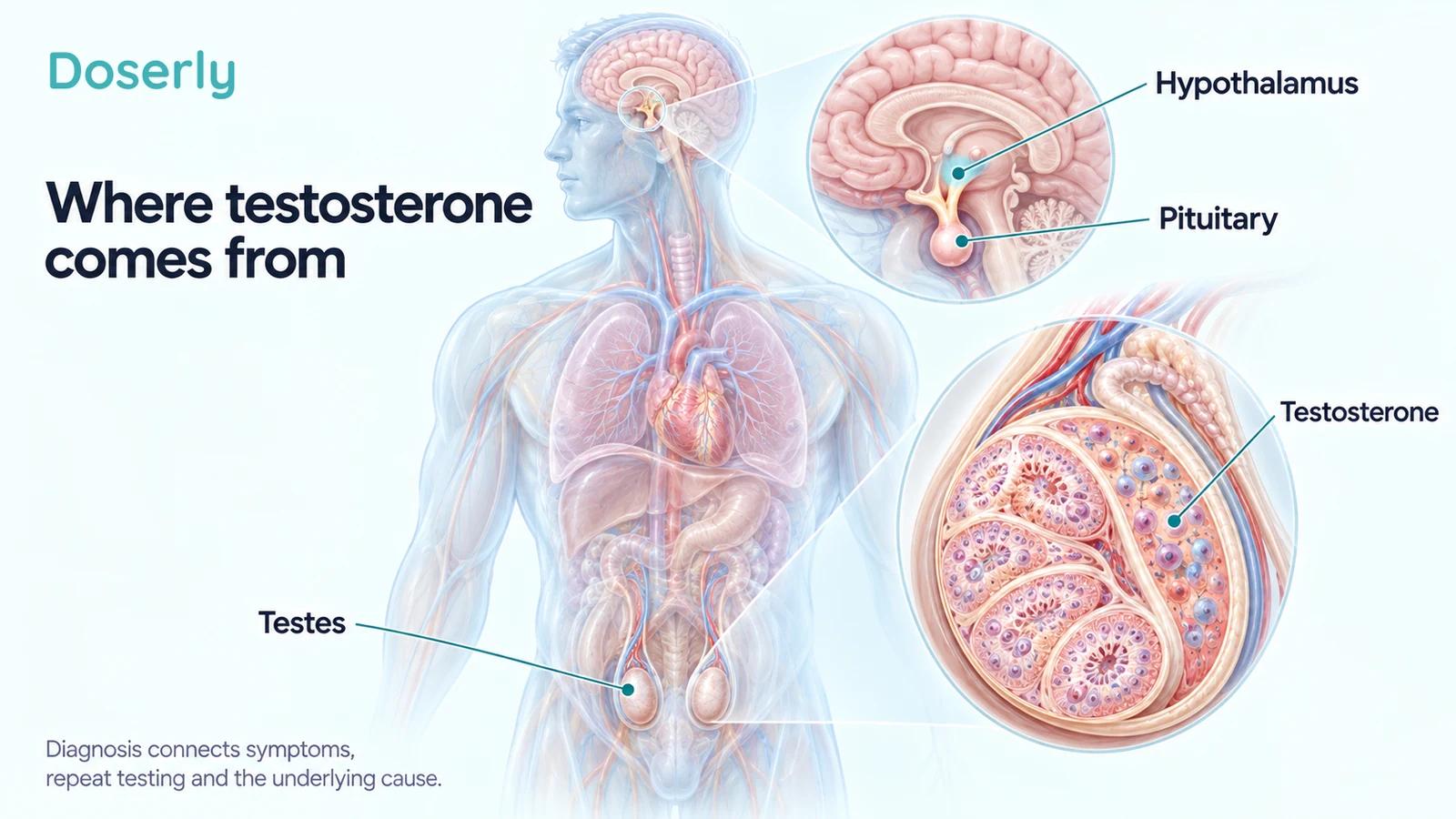
The term hypogonadism describes a clinical condition involving inadequate gonadal function. In testosterone practice, diagnosis combines relevant symptoms or signs with consistently low, appropriately measured hormone levels. “Age-related” does not tell you whether those criteria are satisfied, whether a reversible contributor is present, or which symptom would improve. Our TRT introduction provides background for that first assessment.
The 2025 and 2026 announcements addressed different issues
The February 28, 2025 FDA communication followed two streams of evidence. TRAVERSE informed the cardiovascular warning, while separate ambulatory blood-pressure studies informed a blood-pressure warning. FDA called for removal of boxed-warning language about increased adverse cardiovascular outcomes and for additional blood-pressure information. At that point it explicitly retained the age-related limitation. FDA's 2025 communication
The June 2026 request went further. It proposed removing the statement that safety and effectiveness were unestablished in age-related hypogonadism. It also proposed revisions concerning prostate cancer and benign prostatic hyperplasia, the noncancerous enlargement of the prostate. The requested prostate-cancer contraindication would be narrowed to metastatic disease, while assessment and monitoring would continue. HHS acknowledged that existing studies cannot resolve every long-term prostate question. June 2026 requested revisions
These developments should not be collapsed into one claim that “the warnings were removed.” A warning about one outcome can be revised while another becomes more prominent. Nor does removing a limitation create a measured benefit for every possible reason someone might want testosterone.
For example, a man concerned about fatigue needs evidence about fatigue. A man with diagnosed deficiency and troublesome loss of sexual desire has a different treatment goal. The same regulatory announcement can be relevant to both conversations without answering either one completely.
Read the treatment claim separately from the safety claim
A useful way to read a clinic announcement is to separate its sentences. “A cardiovascular warning changed” describes a regulatory response to safety evidence. “This treatment will improve your fatigue” is a claim about effectiveness for a symptom. The first sentence does not supply the evidence for the second. Ask which study measured the benefit being offered and whether its participants resemble the person considering treatment.
The same distinction applies to a removed contraindication. A narrower restriction may change which cases a prescriber can consider, but it does not establish that every newly considered case has a favorable balance of benefit and risk. That balance still depends on the clinical details and the evidence relevant to them.
What TRAVERSE contributed
TRAVERSE randomized 5,246 men aged 45–80 who had symptoms, two fasting testosterone measurements below 300 ng/dL, and established cardiovascular disease or elevated cardiovascular risk. They received daily 1.62% testosterone gel or placebo gel. Mean treatment duration was 21.7 months and mean follow-up was 33 months. The main safety outcome combined cardiovascular death, nonfatal heart attack and nonfatal stroke. Primary TRAVERSE report
Those events occurred in 7.0% of testosterone participants and 7.3% of placebo participants. The hazard ratio was 0.96, with a 95% confidence interval of 0.78–1.17. The trial met its prespecified noninferiority criterion: within the design's margin, testosterone was not unacceptably worse than placebo for that outcome. More atrial fibrillation, acute kidney injury and pulmonary embolism events were observed with testosterone. TRAVERSE results
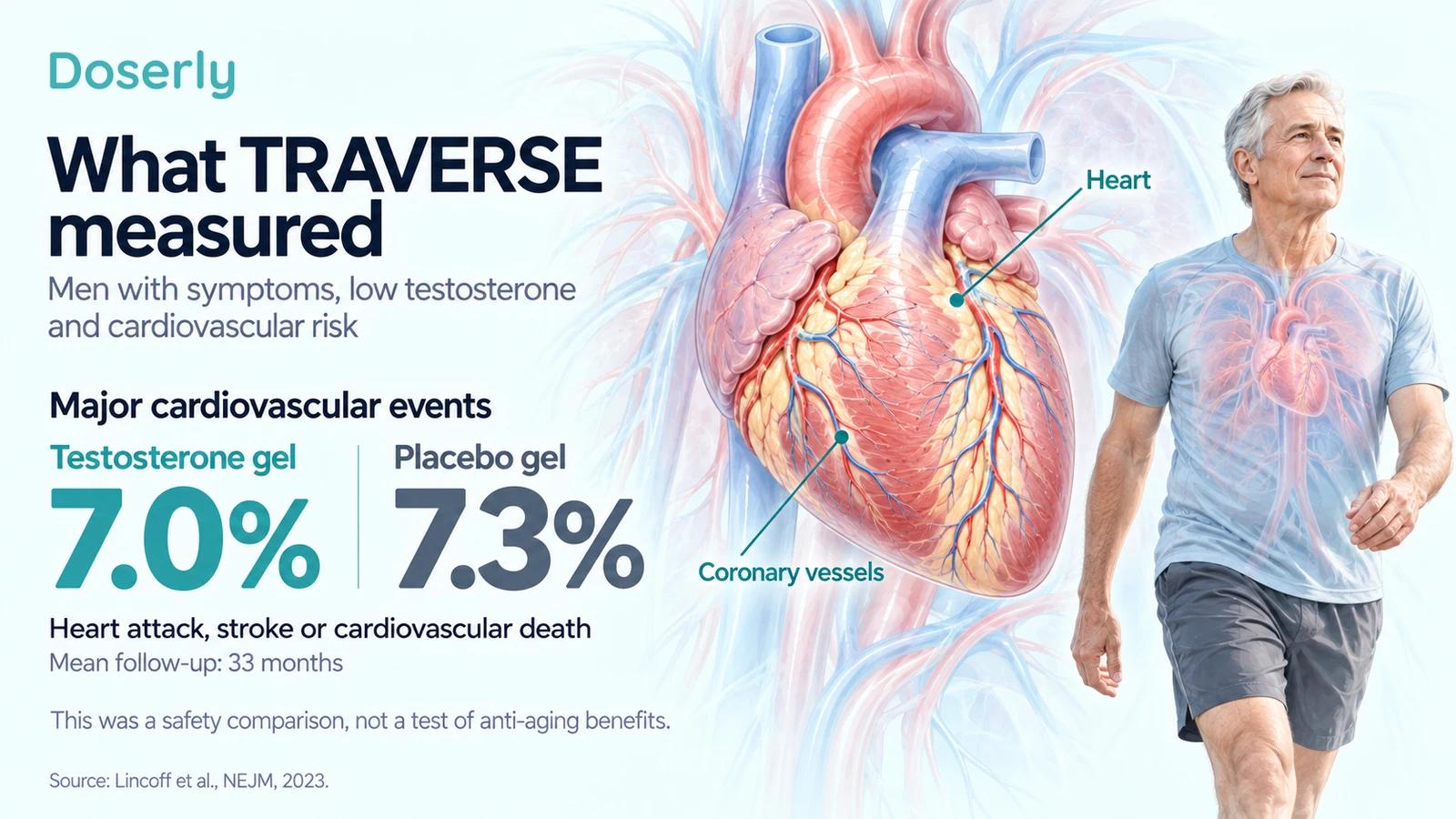
Image sources: TRAVERSE
A safety trial can reduce uncertainty about a feared complication without proving that treatment is worthwhile for someone who lacks the condition being treated. Consider an everyday decision: even if a medicine's risk is lower than previously suspected, you still need a reason to take it. The expected benefit, inconvenience, monitoring and alternative explanations for symptoms remain relevant.
TRAVERSE also tested a specific treatment approach. It did not compare all injectable, oral, compounded and topical regimens, and it did not test bodybuilding exposure or lifetime use. Its population and follow-up set the boundaries of the reassurance it offers.
Requested wording and a product's actual label are separate documents
A press release tells you what an agency is asking manufacturers to do. A product's prescribing information tells you what that particular document currently says. During a transition, they may differ.
For example, the AndroGel 1.62% DailyMed record retrieved for this article includes a July 2025 labeling revision and still states that safety and efficacy in age-related hypogonadism have not been established. It also includes blood-pressure warnings. That is evidence about the retrieved record, not proof that every testosterone label remained identical on October 15, 2026. Retrieved AndroGel prescribing information
If a treatment decision turns on a label change, the prescriber or pharmacist should check the current information for the exact product. A gel and an injection may share an active hormone but have different administration instructions and product-specific information. An old screenshot, search snippet or clinic advertisement cannot establish the current wording.
This is also a US regulatory discussion. It should not be read as an announcement that Canadian or other national product monographs have automatically changed. The source, jurisdiction, product and revision date need to travel together when discussing a label.
Why professional recommendations still emphasize diagnosis
In its July 16, 2026 statement, the Endocrine Society emphasized accurate diagnosis, symptoms together with consistently low measurements, and consideration of reversible contributors such as obesity and certain medicines. It did not recommend population screening of men without symptoms. It also distinguished established hypogonadism from broad promises about aging. Endocrine Society's 2026 statement
The Society's clinical guideline recommends confirming a low result with a repeat morning fasting measurement, using reliable testing, and evaluating the cause. It recommends against starting testosterone in men planning fertility in the near term and identifies other situations requiring caution or avoidance. Clinical guideline resources
These recommendations address the clinical decision, not just the wording permitted in a product document. They help answer whether the person's findings fit a treatable deficiency, whether an underlying problem needs attention, and what follow-up is appropriate.
Suppose someone has reduced libido and repeatedly low results. A careful assessment may support treatment after discussing likely benefits and risks. Suppose another person has a single mildly low result after disrupted sleep, with fatigue as the only concern. The same headline does not make those cases equivalent. These are illustrative situations, not diagnostic rules; their point is that the details of the presentation matter.
What benefits should an older patient reasonably discuss?
The Testosterone Trials offer a useful example. Researchers assigned 790 symptomatic men aged at least 65, with testosterone below 275 ng/dL, to testosterone or placebo gel for one year. Sexual-function measures improved. The primary vitality outcome did not show a significant benefit, and the primary walking response in the Physical Function Trial was not significantly improved, although some broader analyses were favorable. Mood and depressive symptoms showed small improvements. Testosterone Trials primary report
That pattern matters more than a generic promise to “feel younger.” Different outcomes responded differently. If the main goal is greater sexual interest, evidence about sexual interest belongs in the discussion. If the goal is to reverse persistent exhaustion, a sexual-function result cannot substitute for a vitality result.
A useful treatment goal should be concrete enough to reassess. “I want more energy” can become a description of which activities have become difficult, how often that happens, and whether sleep, mood, breathlessness or pain is involved. This gives the clinician a clearer starting point and gives you something more meaningful to revisit than a hormone number alone.
What the prostate findings can tell us
The TRAVERSE prostate analysis studied men screened to exclude important prostate risks, including PSA above 3 ng/mL and severe urinary symptoms by the trial's score. High-grade prostate cancer occurred in five testosterone participants and three placebo participants; the difference was not statistically significant. The confidence interval around the hazard ratio was wide. Other assessed prostate events also did not differ significantly. Primary prostate-safety report
This supports a measured discussion with appropriately selected patients. It does not establish long-term safety for every man with prostate cancer, or show that a man excluded from the trial would have the same experience. Screening is part of the evidence's meaning.
If you already have a prostate diagnosis, the important next step is a discussion involving the clinician managing it. A proposed regulatory change is not a reason to alter treatment independently. The question is how your disease history, current status and treatment goals fit the available evidence.
How to use the news at your next visit
Bring the exact product name if you already receive TRT, together with recent laboratory results and a description of the symptom you are trying to improve. If you are considering starting, ask what supports the diagnosis and whether additional investigation would change the decision.
Three questions help keep the conversation focused:
- What changed for my situation? Ask whether the new information changes a previous risk estimate, the product's current labeling, or the expected benefit for your particular symptom.
- What will we reassess? Agree on the symptoms, measurements and adverse effects that would lead to continuing, adjusting or reconsidering treatment.
- Which uncertainties remain relevant to me? Fertility plans, prostate history, cardiovascular health and the treatment formulation can change the discussion.
Our blood-work guide explains the role of follow-up measurements. A dated record of symptoms, medication use and results can make reassessment more productive, especially when more than one part of your care changes.
The 2026 debate provides a reason to update an informed conversation. It does not remove the need to establish what is being treated, what improvement would matter, and how the person receiving treatment is actually doing.
Sources
- HHS, June 18, 2026 requested label revisions.
- FDA, current testosterone information.
- FDA, February 2025 cardiovascular and blood-pressure labeling changes.
- Lincoff and colleagues, TRAVERSE cardiovascular trial, 2023.
- AndroGel 1.62%, retrieved DailyMed prescribing information.
- Endocrine Society, July 2026 statement.
- Endocrine Society, clinical guideline resources, 2018.
- Snyder and colleagues, Testosterone Trials, 2016.
- Bhasin and colleagues, TRAVERSE prostate safety, 2023.