
Peptides
October 16, 2026
The 2026 TB-500 compounding debate: which substance was reviewed?
On this page
A discussion about whether a pharmacy can compound a substance can sound like a discussion about whether that substance has been proved to work. These are related questions, but they are not the same. For TB-500, there is an additional complication: the name has been used for chemically different products.
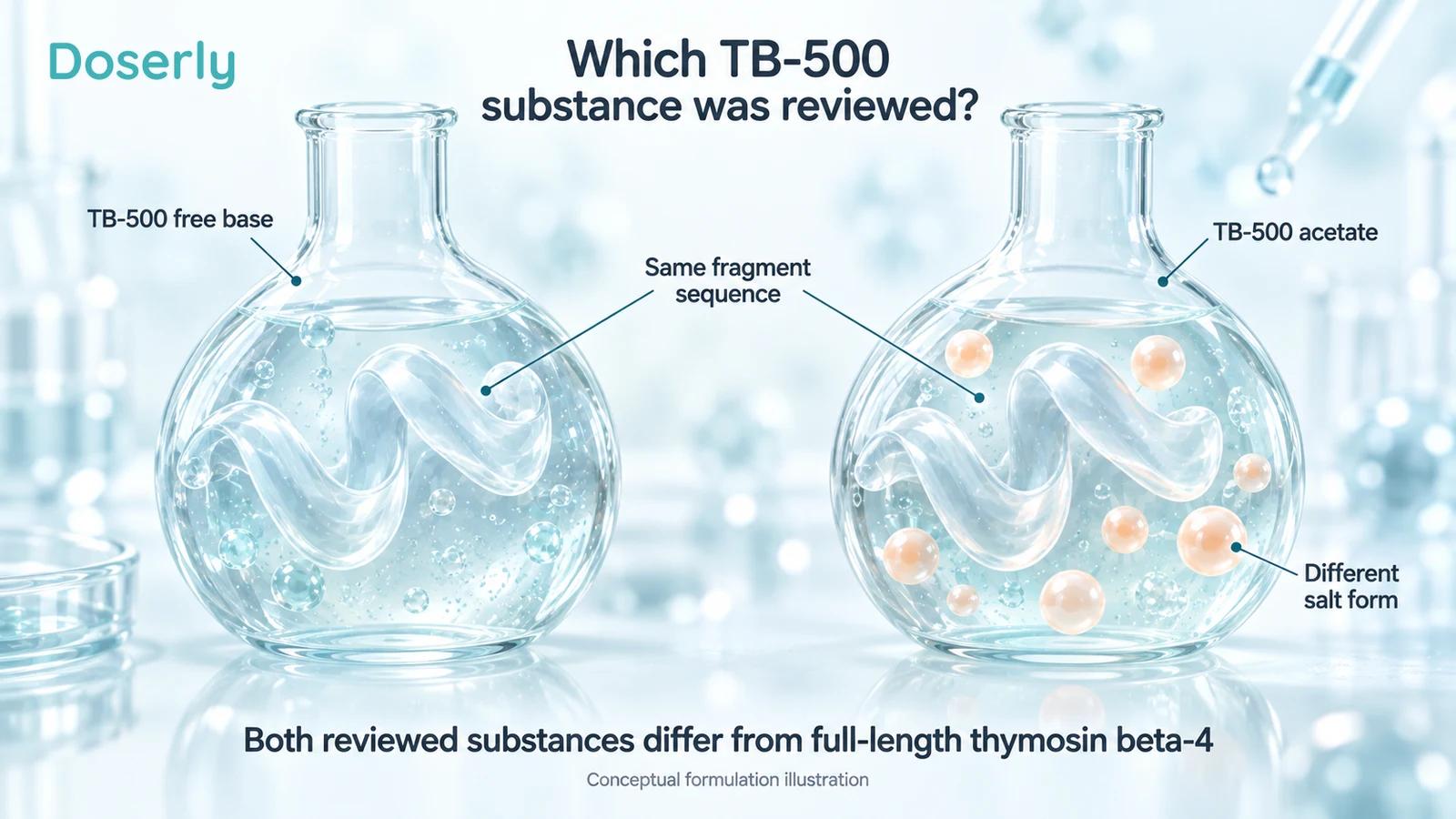
FDA's materials for the July 23–24, 2026 Pharmacy Compounding Advisory Committee meeting evaluated TB-500 free base and TB-500 acetate for wound healing. The briefing identified the relevant peptide as a seven-amino-acid, N-acetylated fragment of thymosin beta-4. It did not treat that fragment as interchangeable with the full-length peptide. FDA meeting page.
That identity matters when interpreting the debate. A favorable statement about access would not establish recovery benefits, and a staff concern about the fragment would not mean that all research on full-length thymosin beta-4 had disappeared. This article explains the scope of the primary documents, not the legality of a particular prescription or a prediction of future FDA action.
What exactly did the FDA briefing evaluate?
The briefing says the nomination contained inconsistent information about whether free base or acetate was intended. Although the nomination was withdrawn, FDA proceeded with its own evaluation of both substances. The proposed routes were intramuscular and subcutaneous administration, and the use evaluated was wound healing. FDA TB-500 briefing.
The agency described TB-500 as Ac-LKKTETQ, a fragment corresponding to amino acids 17–23 of thymosin beta-4. Full-length thymosin beta-4 contains 43 amino acids. The distinction is therefore more substantial than two names for the same bottle.
The briefing also noted that TB-500 is a common name rather than a standardized adopted drug name and that inconsistent naming complicates chemical characterization. That creates a practical problem: if a prescription, supplier document and laboratory reference standard use the same label for different material, they may appear to agree when they do not.
For readers, the first question is what the proposed preparation actually contains. Our TB-500 identity guide explains how the full peptide and fragment differ.
Acetylation is different from an acetate salt
The similarity of the words can be confusing. An N-terminal acetyl group is attached to the peptide chain. An acetate salt refers to the form in which the peptide is associated with a counterion. A peptide can have the first feature while being discussed in different salt forms.
This distinction matters because “free base” in the briefing does not mean that the fragment lacks its N-terminal acetyl group. Nor does “acetate” identify the full-length thymosin beta-4 molecule. The sequence, attached modifications and salt form are separate parts of the description.
The same care is needed when reading a study. An experiment with unacetylated LKKTETQ should be identified as such. A study with the larger thymosin beta-4 peptide should retain that identity. Neither can be silently reassigned to the substance in the nomination merely because all three appear in search results for TB-500.
This is a scientific distinction before it is a regulatory one. If the identity is unclear, the reader cannot reliably connect the product to its pharmacology, analytical methods or safety record.
What is a bulk-drug-substance review?
A bulk drug substance is an active ingredient used to make a finished preparation. Section 503A provides a framework under which certain compounded drugs may qualify for exemptions from particular federal requirements when applicable conditions are met. FDA describes conditions involving applicable pharmacopeial standards, components of approved drugs and the agency's bulk-substances list. FDA explanation of compounding provisions.
A review for that list asks whether a substance should be available within that framework. It is not the same process as approval of a finished medicine with a specified formulation and indication. The distinction remains important even if a substance receives a favorable advisory recommendation.
A patient may reasonably care about both access and evidence. Access determines whether a preparation can be supplied under relevant rules. Evidence helps determine whether it is likely to provide a worthwhile benefit for the patient's condition. One question does not answer the other automatically.
This article does not convert the July briefing into a current legal authorization. A pharmacist or prescriber needs to check the operative requirements for the particular substance and setting at the time of care.
Staff analysis, committee advice and FDA action are different records
The TB-500 briefing presents the staff evaluation prepared for the meeting. Its conclusion proposed against adding the evaluated substances to the 503A list. That is the staff recommendation in that document, not a substitute for a final agency determination. FDA briefing.
The meeting page explains that advisory committees provide nonbinding advice. FDA may consider that advice along with other information before deciding what action to take. The page reviewed for this article did not provide a final determination resolving the TB-500 question. Official meeting page.
Accordingly, a headline about a committee vote should not be rewritten as “FDA approved TB-500.” Nor should a pre-meeting staff recommendation be presented as though no subsequent advisory discussion occurred. Each document needs its date and role.
The distinction is especially important in a changing regulatory debate. If a clinic cites a recent change, ask for the operative agency action and the exact substances it covers. A meeting announcement, slide deck, nomination and final rule do different jobs.
What evidence was missing for the reviewed fragment?
FDA's review did not identify human clinical studies administering the evaluated TB-500 substances for wound healing or another condition. It also identified substantial gaps in human exposure and safety information. The nominator's references to thymosin beta-4 did not establish clinical effectiveness of the fragment. FDA briefing.
That conclusion has a defined scope. It does not mean that no thymosin-related substance has ever been studied in people. A 2021 phase 1 study, for example, investigated intravenous recombinant human thymosin beta-4, NL005, in healthy volunteers. Its purpose included tolerability and pharmacokinetics, not validation of an injected TB-500 fragment for wound healing. Primary NL005 trial.
The apparent contradiction disappears when the interventions are named precisely. Human data for one preparation can be informative for that development program without filling the gap for another preparation. The same principle applies to positive results, adverse events and dosing assumptions.
For someone with a wound, the clinical diagnosis also matters. Different wounds have different causes and care needs. A broad nomination for wound healing cannot establish one benefit estimate for every skin injury, postoperative wound or tendon problem.
Why quality concerns are part of the discussion
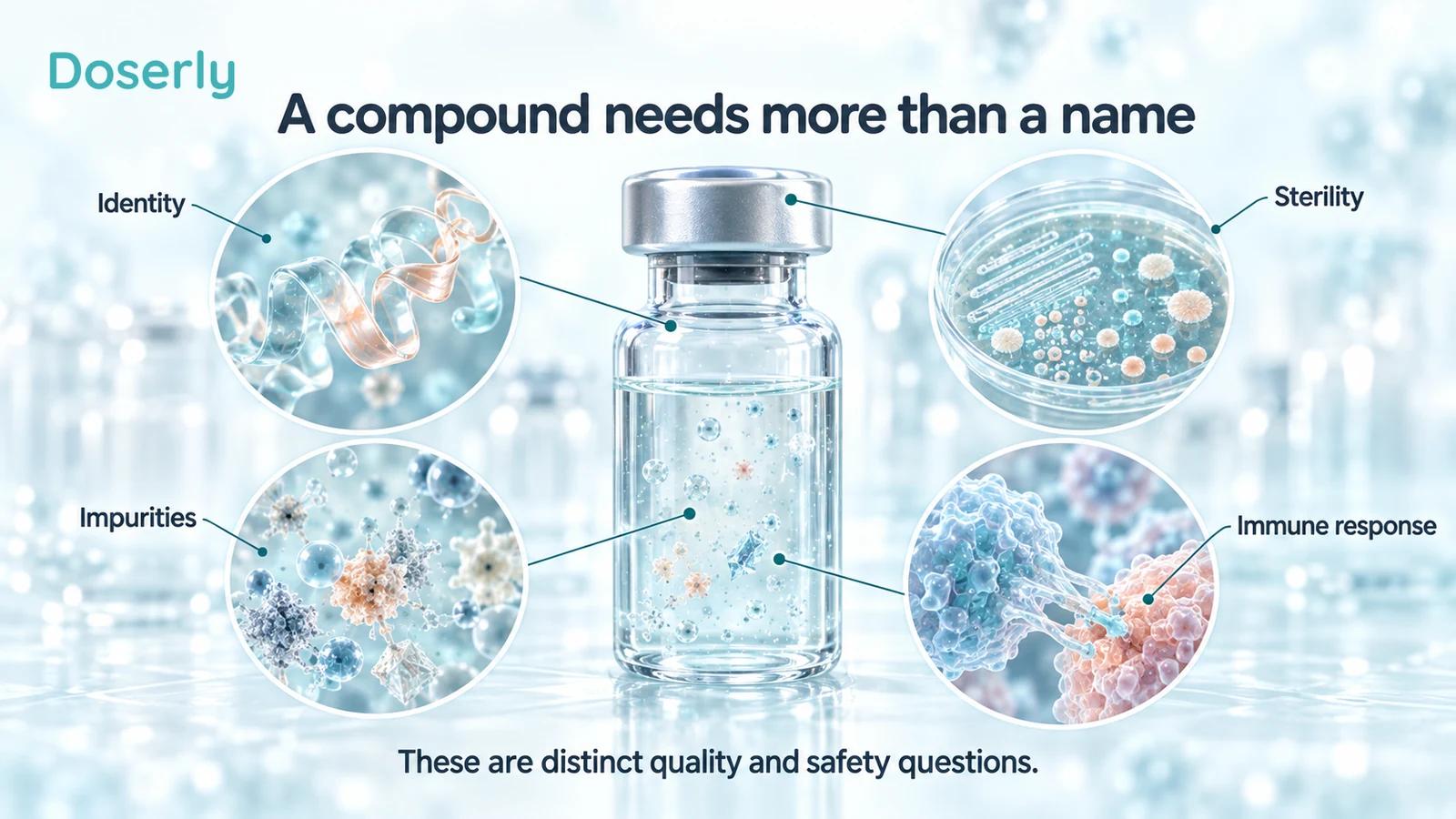
The briefing raised concerns about characterization, impurities, aggregation and microbiological quality. Aggregation means that peptide molecules associate into larger assemblies. Immunogenicity concerns the possibility of provoking an immune response. Manufacturing and formulation can influence these properties. FDA briefing.
These are not all measured by one purity percentage. An identity test asks what the substance is. A content assay asks how much is present. A related-substances assay examines certain chemical impurities. Microbiological and endotoxin assessments address other potential problems. They answer complementary questions.
A primary analytical report on online TB500/TB1000 products found inconsistencies between sampled contents and prior descriptions. It does not tell us the prevalence of mislabeling across the entire market, but it demonstrates why a common name cannot replace characterization. Primary product-analysis report.
For a finished preparation, the manufacturing process, container, storage and handling also matter. Testing a raw ingredient does not necessarily characterize everything that happens before a patient receives the final product. This is why the scientific quality questions remain relevant even when the policy discussion focuses on access.
Does compounding mean the finished medicine is FDA-approved?
No. FDA states that compounded drugs are not FDA-approved and that the agency does not review them for safety, effectiveness and quality before marketing in the way it reviews approved drugs. Compounding can serve legitimate patient needs, such as producing a preparation without an unsuitable ingredient or in a needed dosage form. FDA compounding questions and answers.
These points should be held together. Recognizing a role for compounding does not justify describing every compounded product as clinically validated. Recognizing uncertainty about an experimental peptide does not mean all compounding lacks a legitimate purpose.
For TB-500, the relevant questions are specific: which substance, which preparation, which clinical need, what evidence, and which current regulatory basis? A broad label such as “pharmacy grade” cannot answer all of them.
The availability of a prescription also does not turn a mechanistic theory into a measured treatment effect. The benefit still needs to be discussed in terms of the actual clinical evidence, including when that evidence is missing.
What patients can take from the debate
Ask the clinician or pharmacist to identify the molecule and salt form in ordinary language and in the product documentation. If a human study is cited, ask whether it used that same substance and route for a comparable condition. These questions are especially useful when the supporting paper concerns full-length thymosin beta-4 rather than the fragment.
Ask what outcome the proposed treatment is intended to change and how that outcome will be assessed. For a wound, less discomfort, surface closure and durable recovery are not identical. For an injury, symptom improvement does not by itself establish restored tissue strength.
Finally, ask which current agency document supports any claim that the regulatory situation has changed. A dated primary document is more useful than an undifferentiated claim that a peptide is now “approved.” This article's research was checked on October 15, 2026; it does not certify an individual product's legal status.
The central lesson from the July materials is concrete: the review concerned specific forms of a seven-amino-acid fragment, with unresolved human-evidence and characterization questions. Our TB-500 research guide explains the broader science without treating the regulatory debate as a clinical trial result.
Explore the research
- FDA TB-500 briefing, 2026: exact substances, nominated use, evidence assessment and staff recommendation.
- Official July 23–24 meeting page: meeting scope and nonbinding advisory role.
- FDA compounding provisions: section 503A framework.
- FDA compounding questions and answers: compounded products and drug approval.
- NL005 phase 1 study: a distinct recombinant thymosin beta-4 product.
- TB500/TB1000 analytical study: identity concerns in sampled online products.