
HRT
October 16, 2026
The 2026 HRT label changes: what changed, and what still matters
On this page
Menopausal hormone therapy can help with symptoms that disrupt sleep, work and everyday comfort. Estrogen treatment can reduce hot flashes and night sweats; local vaginal products address a different set of symptoms. Yet for many people, the first thing they notice about a hormone prescription is the warning printed at the top of its information leaflet.
On February 12, 2026, the US Food and Drug Administration announced approved labeling changes for six menopausal hormone therapy products. Statements about cardiovascular disease, breast cancer and probable dementia were removed from their boxed warnings, the most prominent safety warning in a prescription label. This followed an agency request issued in November 2025. FDA announcement.
The change deserves a careful explanation. It can make a treatment conversation less frightening and more specific. But it doesn't mean every hormone product has the same benefits, that every warning has disappeared, or that a person previously advised against treatment should restart it without reviewing the reason. The useful question is what the current label says about the particular medicine you're considering.
Which products were included?
The FDA's linked product list identifies six medicines in four categories: Prometrium, an oral progesterone product; Divigel, Cenestin and Enjuvia, systemic estrogen products; Estring, a local vaginal estradiol system; and Bijuva, an oral estradiol–progesterone combination. The list matters because a category-wide announcement and an approved revision to a particular label are different steps. FDA updated-prescribing-information list.
If your prescription has another name, the February announcement alone does not tell you its revision status. Check the full prescribing information for that exact product, including the revision date. Generic names, brand names, formulation and route all help identify the correct document. A gel intended for absorption through skin and a low-dose vaginal ring may both contain estradiol while serving different purposes.
The announcement is also specific to US labeling. It does not automatically revise Canadian product monographs, European product information or UK prescribing guidance. Readers outside the United States should use their own regulator's current information. Our US HRT access guide explains how product approval fits into the wider prescription and pharmacy process.
What does removing a boxed warning actually change?
A prescription label contains several kinds of information. Its indication states the approved use. Contraindications identify situations in which the medicine should not be used. Warnings and precautions explain important harms and monitoring considerations. Clinical-study sections describe the research behind the product and, sometimes, broader class information.
A boxed warning gives selected safety information exceptional prominence. Changing that box changes how risk is communicated; it does not, by itself, erase all the other sections. In its November request, FDA specified that cardiovascular and breast-cancer information should remain in systemic-product labeling. The agency also requested removal of the probable-dementia warning from labeling as a whole, not simply relocation of that warning below the box. These are distinct regulatory changes. FDA's November 2025 explanation.
This distinction helps when two apparently conflicting statements circulate: “the warning was removed” and “the label still describes cardiovascular risks.” Both can be accurate when they refer to different parts of the document. Reading the product's full information is more useful than deciding which headline sounds more reassuring.
A current combination label shows what remains
Bijuva provides a concrete example. Its revised information records the boxed-warning removal, yet still lists contraindications including unexplained abnormal genital bleeding, breast cancer or a history of breast cancer, estrogen-dependent cancer, active or previous deep-vein thrombosis or pulmonary embolism, previous stroke or heart attack, and liver impairment or disease. A deep-vein thrombosis is a clot in a deep vein; a pulmonary embolism is a clot blocking circulation in the lungs. Bijuva prescribing information.
The same label identifies Bijuva's use as treatment of moderate-to-severe vasomotor symptoms in women with a uterus. “Vasomotor” refers here to hot flashes and night sweats. That indication tells you the treatment goal; it is not a general approval for preventing aging, cardiovascular disease or dementia.
These details are reasons to revisit a past recommendation with the relevant history in front of you. Someone who declined therapy because of a generalized fear may have a different discussion from someone whose clinician identified a previous blood clot. A smaller warning box cannot settle either person's decision on its own.
Why uterine-lining protection is still important
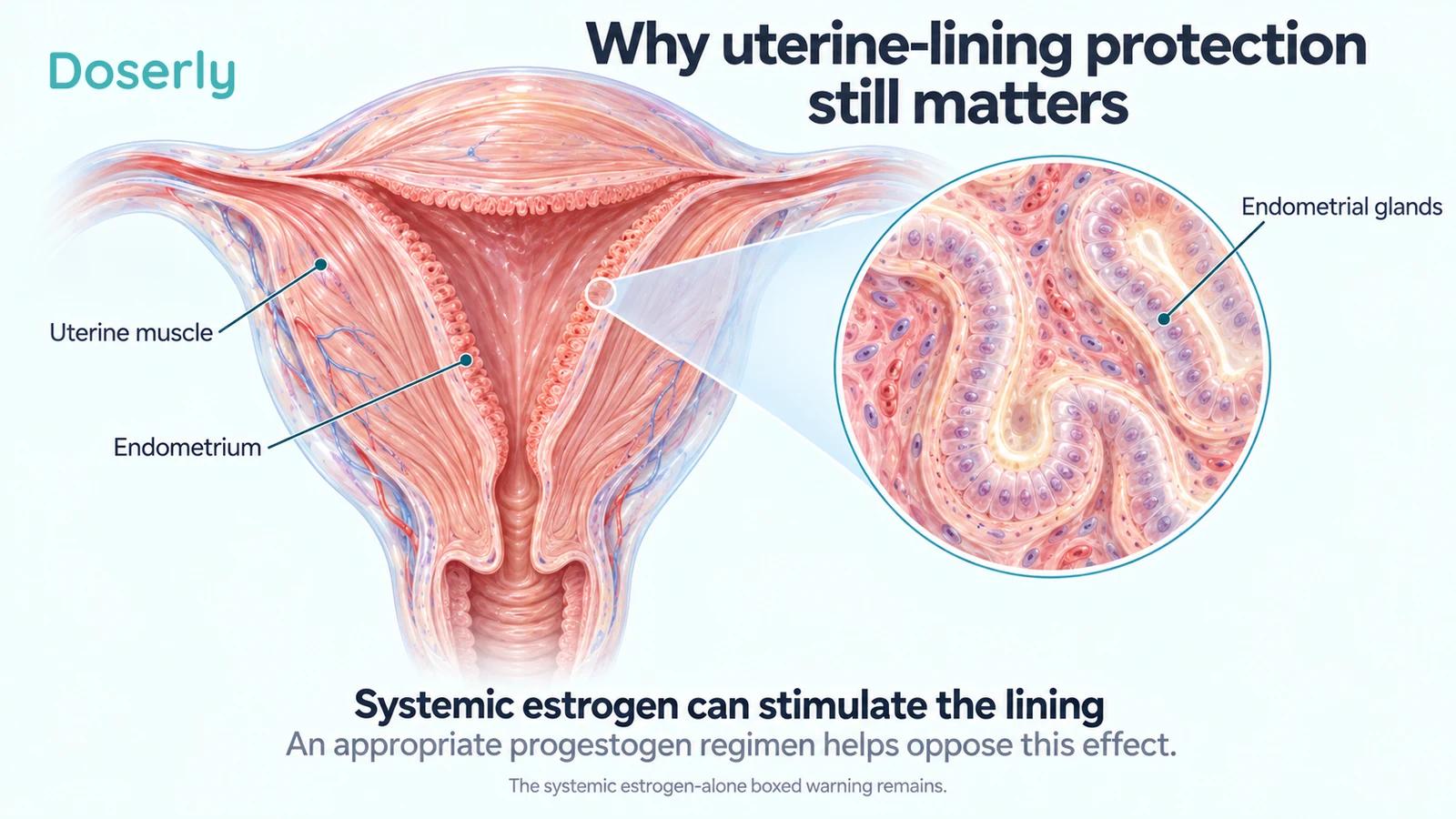
The endometrium is the lining inside the uterus. Systemic estrogen can stimulate it. Estrogen without adequate opposing treatment can increase endometrial hyperplasia, meaning excessive growth of the lining, and endometrial cancer risk. For this reason, people with a uterus using systemic estrogen generally need an appropriate endometrial-protection strategy.
The February Divigel label still carries a boxed warning about endometrial cancer with unopposed estrogen in women with a uterus. Its full warning explains that adding a progestogen reduces hyperplasia risk. “Progestogen” is the umbrella term covering progesterone and related medicines with progesterone-like activity. The retained warning is especially helpful evidence that FDA did not remove every boxed warning from every menopausal hormone product. Divigel prescribing information.
A progesterone product is therefore not necessarily prescribed simply to improve another symptom. Prometrium's labeling includes prevention of endometrial hyperplasia in postmenopausal women with a uterus receiving conjugated estrogen. It also describes a particular oral formulation and contains product-specific safety information, including its peanut-oil ingredient. Those details reinforce why replacing one product with another requires more than matching the word “progesterone” on the package. Prometrium prescribing information.
Why local vaginal estrogen needs its own discussion
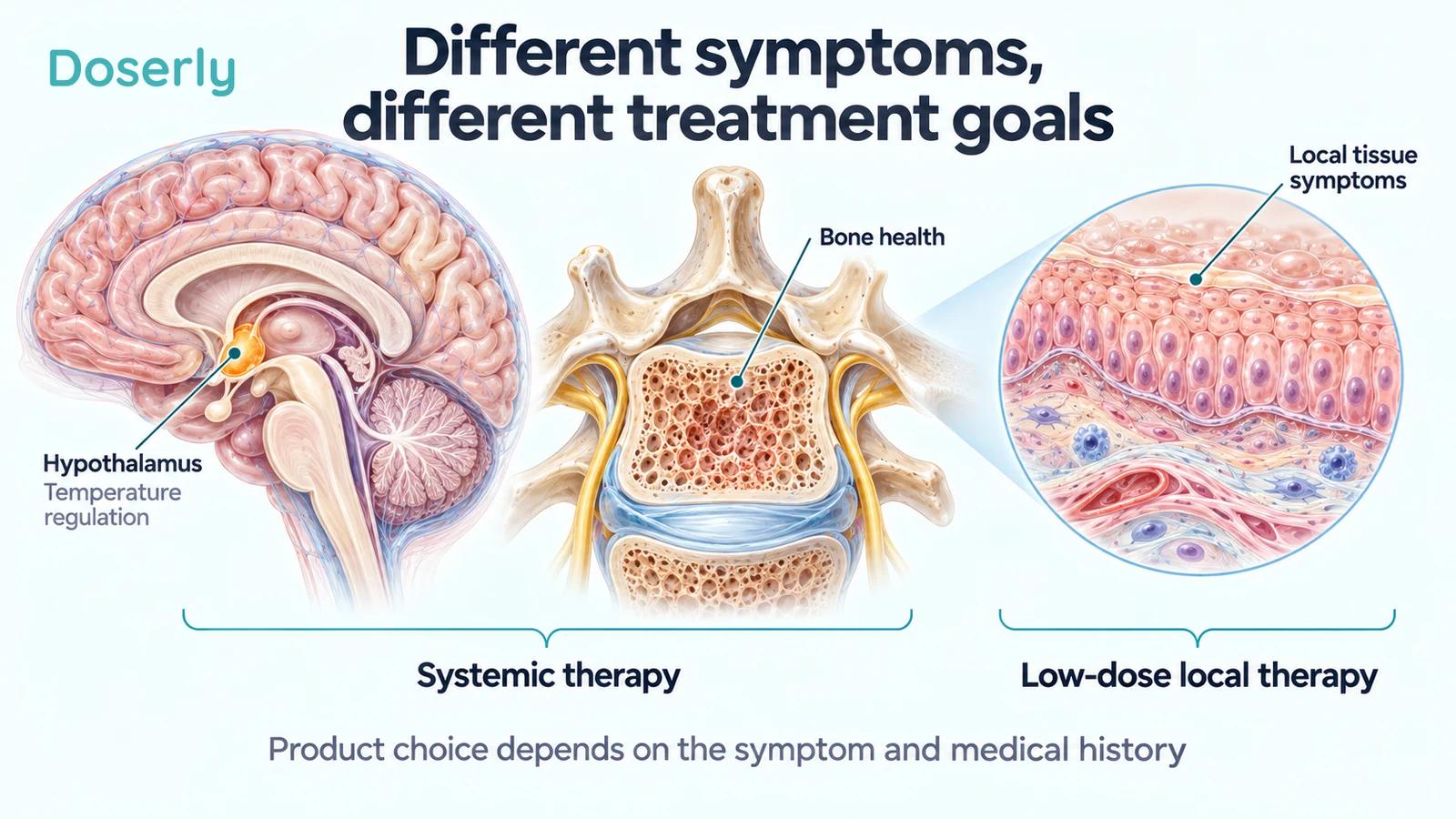
A local treatment can be aimed at dryness, irritation or discomfort in estrogen-responsive tissues without supplying the same systemic exposure as treatment for hot flashes. That difference was part of FDA's reassessment: the agency requested safety information more relevant to local vaginal formulations.
Estring illustrates why “local” and “no absorption” should not be treated as synonyms. Its prescribing information describes an initial rise in blood estradiol after insertion, followed by lower steady-state exposure in the range observed in untreated postmenopausal women. The product's purpose and exposure differ from systemic therapy, but some absorption occurs. Estring prescribing information.
This is a practical distinction if your main problem is vaginal discomfort rather than hot flashes. It changes which options deserve consideration and which risks need discussion. It also means that the route alone is insufficient: the specific product and intended level of exposure matter. A prescriber can explain whether a product is designed for local symptoms, systemic symptoms or both.
Did the earlier research become irrelevant?
No. The Women's Health Initiative, or WHI, still provides important randomized evidence. Its hormone trials studied specific oral regimens in defined populations, rather than every treatment now available. FDA's reassessment considered how findings from those trials should be communicated to people who may start therapy at different ages for different reasons.
The distinction between regimens is particularly clear in the long-term breast-cancer analysis. Among women with a prior hysterectomy, conjugated equine estrogen alone was associated with lower breast-cancer incidence than placebo: hazard ratio 0.78, with a 95% confidence interval of 0.65–0.93. In the separate trial among women with a uterus, that estrogen combined with medroxyprogesterone acetate was associated with higher incidence: hazard ratio 1.28, interval 1.13–1.45. WHI breast-cancer follow-up.
A hazard ratio compares the rate at which events occur over follow-up; it is not the percentage of participants who developed cancer. These findings do not prove that all estrogen-only products prevent breast cancer, or that every combination has exactly the same risk. They explain why the phrase “HRT and cancer” is too broad to answer a personal question. The Doserly WHI guide separates the trial populations and outcomes in more detail.
Does the change mean HRT helps everyone live longer?
That claim goes beyond a labeling revision. In an 18-year cumulative follow-up of the WHI hormone trials, all-cause mortality was 27.1% among participants originally assigned hormone therapy and 27.6% among those assigned placebo. The pooled hazard ratio was 0.99, with a confidence interval of 0.94–1.03, which did not establish an overall mortality difference. WHI mortality follow-up.
The distinction between treatment time and follow-up time matters. Participants did not all take their assigned therapy for 18 years: median intervention durations were 5.6 years for combined treatment and 7.2 years for estrogen alone. The later observation period adds information about longer-term outcomes after those interventions. It does not test lifelong hormone use or every contemporary regimen.
Age and time since menopause are relevant to treatment decisions, but a potentially favorable balance for symptom relief is not the same as a promise of longer life. The Menopause Society's 2022 statement describes a generally favorable benefit-risk balance for bothersome symptoms in suitable people younger than 60 or within 10 years of menopause, provided contraindications are absent. It also emphasizes individualized assessment and periodic review. Position statement.
Why prevention advice can sound different from symptom advice
A person waking repeatedly with night sweats has an immediate treatment goal. A person without symptoms who wants to prevent future disease is asking a different question. The expected benefit, relevant studies and alternatives differ.
The US Preventive Services Task Force recommends against systemic menopausal hormone therapy solely for primary prevention of chronic conditions. Its recommendation explicitly excludes treatment of menopausal symptoms and does not apply to premature or surgical menopause. It should therefore not be used as a blanket instruction to deny symptom treatment. Equally, an effective symptom treatment should not automatically be promoted as a general preventive medicine. USPSTF recommendation and scope.
How to use the news at your next appointment
Bring the name and formulation of each hormone medicine, your main symptoms, and the reason for any previous recommendation against treatment. If you have a uterus, include the medicine prescribed to protect its lining. A dated record of symptoms and medication changes can help distinguish what you hoped to improve from what actually changed.
Useful questions are specific: Which current label applies to my prescription? What benefit are we aiming for? Which parts of my history change the risk assessment? How will we review benefit, side effects and continued need? If a different preparation is proposed, ask what changes in exposure or evidence make it preferable for your situation.
The 2026 revisions create an opportunity to have that conversation with more accurate information. They leave room to take disruptive symptoms seriously while preserving the product-level distinctions that make treatment decisions safer and more useful.
Sources
- FDA February 2026 labeling announcement.
- FDA list of updated products.
- FDA November 2025 requested changes.
- Bijuva revised prescribing information.
- Divigel February 2026 label.
- Prometrium February 2026 label.
- Estring February 2026 label.
- WHI breast-cancer follow-up, 2020.
- WHI mortality follow-up, 2017.
- The Menopause Society hormone-therapy position statement, 2022.
- USPSTF chronic-disease prevention recommendation, 2022.