
Peptides
October 16, 2026
The 2025 TESTS trial: why immune theories must face patient outcomes
On this page
Thymosin alpha-1 has an appealing rationale in sepsis: if an infection has disrupted immune function, perhaps an immune-modulating treatment can help patients recover. But a plausible explanation is only the beginning of a treatment claim. The harder question is whether adding the treatment to clinical care helps people survive.
The large TESTS trial addressed that question directly. Published in 2025, it found no demonstrated reduction in 28-day mortality from thymosin alpha-1 compared with placebo in the adults with sepsis it studied. A subsequent correction changed some numerical estimates but did not reverse that conclusion. Those findings deserve more weight than a diagram of how the peptide might influence immune cells.
This article examines what the trial establishes, where uncertainty remains and why neither enthusiastic mechanism claims nor an absolute “it can never work” verdict accurately describes the evidence. Our thymosin alpha-1 guide provides the broader compound background.
Why sepsis makes an immune theory both plausible and difficult
Sepsis is a dangerous response to infection involving organ dysfunction. The Sepsis-3 consensus moved away from treating it simply as excessive inflammation, emphasizing a disrupted host response instead. That distinction matters: a person can have infection, immune abnormalities and organ injury simultaneously. “More immune activity” does not describe a complete therapeutic goal. Sepsis-3 consensus.
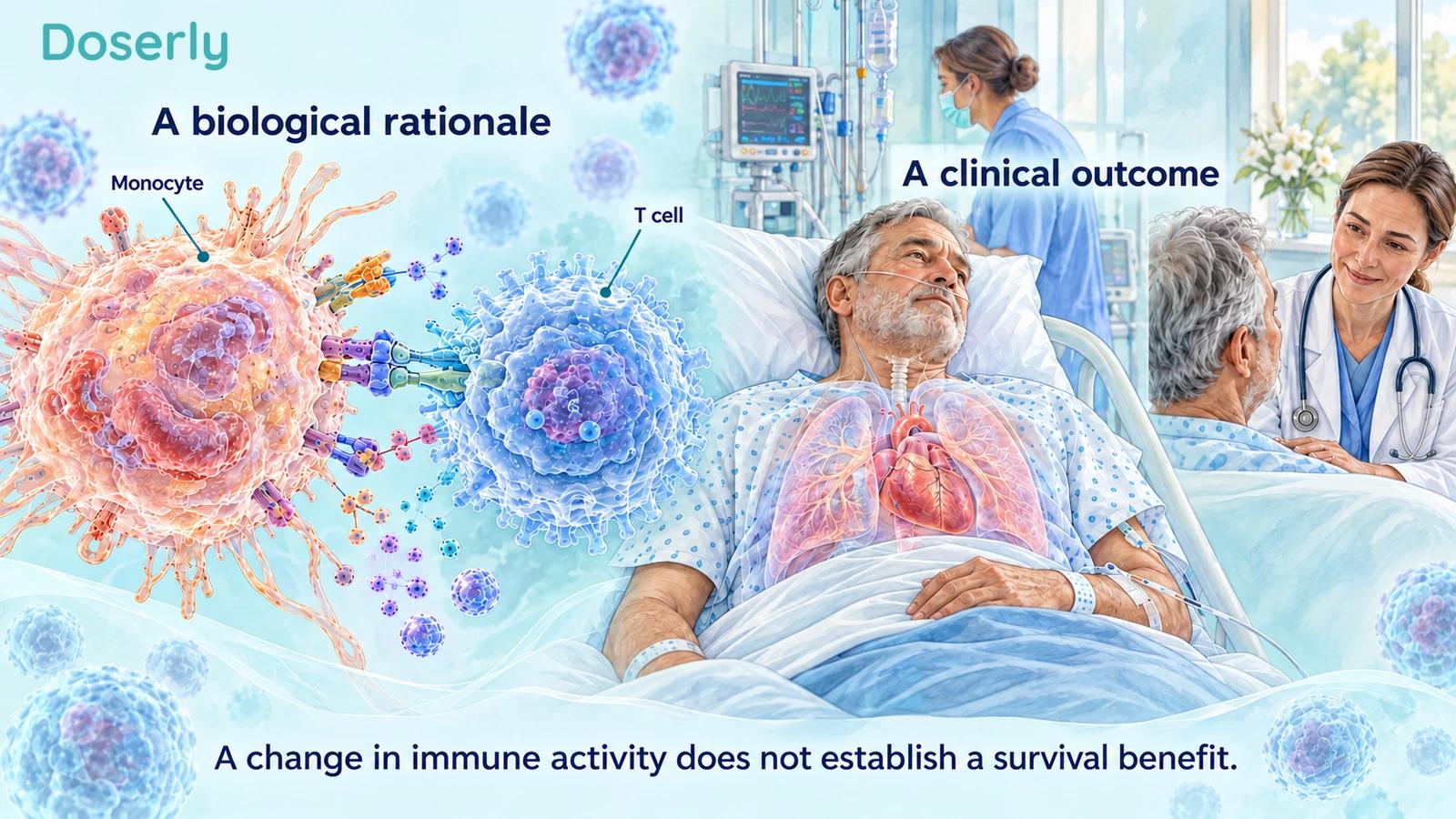
A proposed treatment must therefore do more than move a laboratory measurement in an attractive direction. The change has to occur in the relevant patients, at the relevant time, without creating harms that outweigh any benefit. It also has to improve something that matters clinically. A treatment that changes a cell marker while leaving survival and recovery unchanged has answered a biological question, not established the hoped-for patient benefit.
That is why an immune mechanism can justify a trial without prejudging its result. Researchers need a credible reason to test a therapy; patients need evidence about what happens when it is actually used. These are connected stages of investigation, but they are not interchangeable standards of proof.
What TESTS actually compared
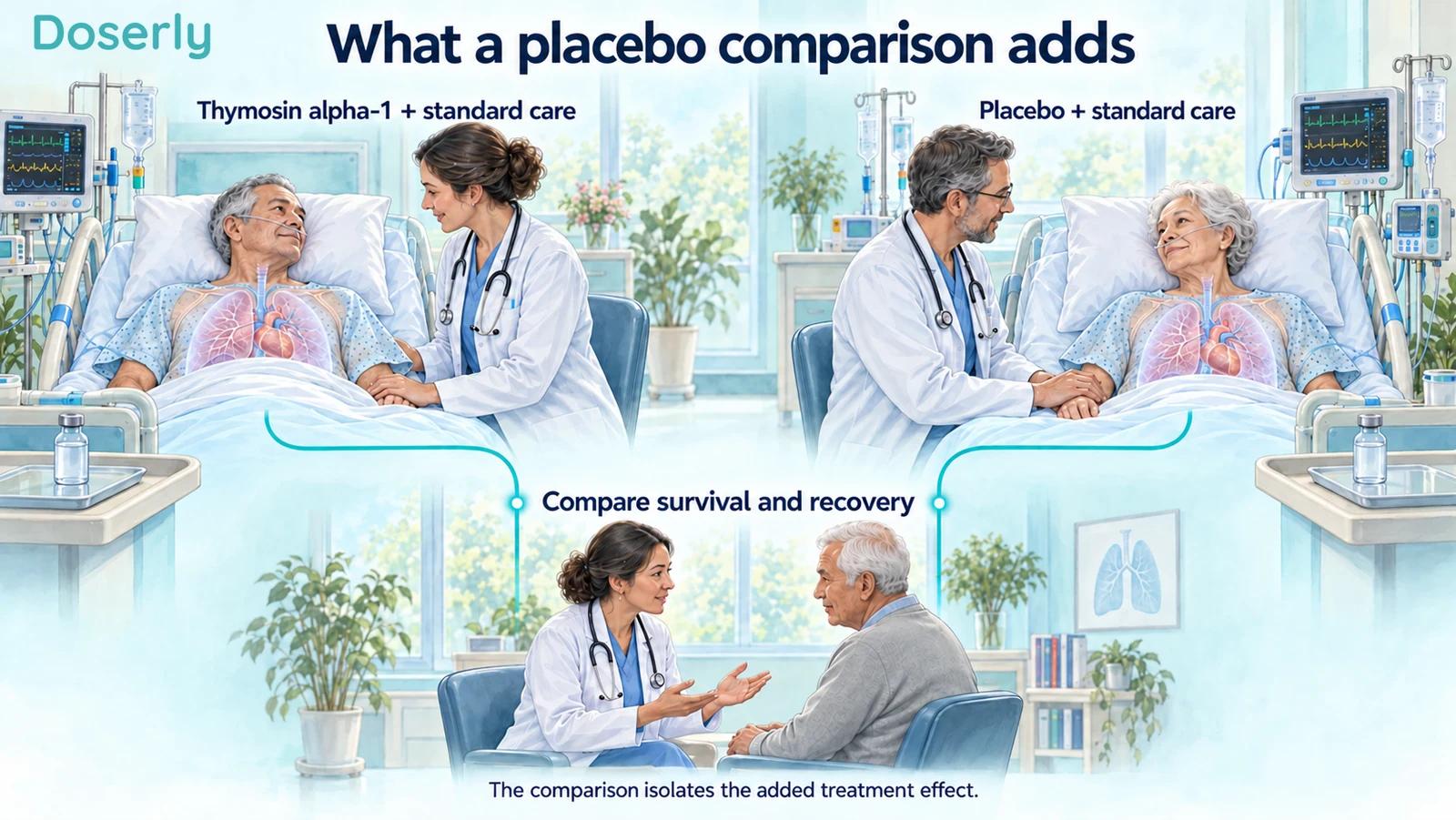
TESTS was a double-blind, placebo-controlled phase 3 trial at 22 centres in China. It randomized 1,106 adults; the modified intention-to-treat analysis included 1,089 who received study treatment. Both groups received standard care. The intervention was a seven-day course of subcutaneous thymosin alpha-1, compared with matching placebo. Corrected TESTS report.
The placebo group is central to understanding the result. People with serious illness can improve because of antibiotics, organ support, other care or the course of the illness. Looking only at treated patients would blend those influences with any effect of the experimental drug. A concurrent randomized comparison asks whether the added treatment changes outcomes beyond the care both groups receive.
Blinding also matters. When patients and treating teams do not know the assigned group, expectations have less opportunity to influence management and reporting. Randomization does not guarantee perfectly identical groups, but it gives a stronger basis for causal interpretation than selecting people who chose a treatment and comparing their stories with people who did not.
The difference between the randomized total and the analyzed total also deserves a clear explanation. Seventeen participants were excluded from the modified intention-to-treat analysis because consent was withdrawn before they received study treatment. The denominators in the mortality calculation therefore refer to the analyzed groups, not everyone initially randomized. Keeping those populations distinct avoids presenting a misleading fraction. Corrected TESTS report.
That distinction is useful whenever trial reports contain several totals. A reader should be able to follow participants from assignment through treatment and outcome assessment. A larger enrollment number can describe a study accurately while still being the wrong denominator for a particular result.
The trial population still defines the scope. This was hospital research in adults with sepsis, not a wellness experiment in healthy people or a study of preventing ordinary respiratory infections. Carrying its findings into those settings would require additional evidence, whether the result had been favorable or unfavorable.
The survival result, with the corrected estimate
By day 28, 127 of 542 participants receiving thymosin alpha-1 had died, compared with 132 of 547 receiving placebo: 23.4% versus 24.1%. The corrected hazard ratio was 0.97, with a 95% confidence interval of 0.76 to 1.24 and P=0.82. The primary comparison did not establish a survival benefit. Corrected TESTS report.
The percentages describe the observed proportions who died. The hazard ratio summarizes the comparison of death rates over follow-up within the trial's analysis. It is not the percentage of patients saved, and it should not be translated into a promise of a particular individual benefit.
The confidence interval is equally important. It includes values compatible with benefit and values compatible with harm, as well as no difference. That means the study did not prove the two treatments equivalent. But uncertainty is not positive evidence: a benefit that remains statistically possible is not a benefit the trial demonstrated.
The observed difference was less than one percentage point. Presenting the slightly lower percentage in the treatment group without the uncertainty would turn a numerical difference into a much stronger claim than the analysis supports. Conversely, replacing the result with “there is exactly zero effect” would pretend to a precision the trial does not have.
Why the correction belongs in the interpretation
The May 2025 correction explained that follow-up information for nine participants had become available but had not been incorporated into the original analyses. It also addressed errors in lymphocyte data and updated associated materials. The primary hazard ratio changed from 0.99 to 0.97; the conclusion remained unchanged. Published correction.
This creates a practical problem for readers: an abstract or an older summary may still show the original estimate. The appropriate response is to identify the corrected record, not silently combine numbers from different versions. A result can remain substantively stable while its exact reporting still needs repair.
The correction also illustrates why scientific interpretation should not rest on one unusually precise-looking number. Here, both versions were close to no difference and both failed to demonstrate the proposed survival advantage. Updating the estimate improves accuracy without creating a new positive trial or erasing the need to discuss uncertainty.
Immune markers cannot substitute for the primary outcome
TESTS also examined immune measurements and secondary clinical outcomes. It did not find significant between-group differences in its main secondary clinical comparisons, including 90-day mortality. Immune measurements were more nuanced than a simple claim that every marker either improved or stayed unchanged. Corrected TESTS report.
For a reader, the useful distinction is between a marker's biological meaning and its ability to establish treatment benefit. A blood-cell result can help explain a mechanism or identify a future research question. It cannot independently show that a person lived longer, avoided another infection or regained function.
Consider a hypothetical study in which a marker improves in both groups. The improvement might be related to recovery or shared care rather than the experimental treatment. Even a larger change in one group would still leave another question: did that change translate into better outcomes? This is why “the immune system responded” needs a defined measurement and a clinically meaningful comparison.
Nor should a disappointing primary result lead readers to search through many secondary measurements until they find an attractive one and treat it as the real answer. Secondary findings can be informative, but their place in the study should stay visible. The main question was chosen before the results were known for a reason.
Why earlier studies looked more encouraging
The earlier ETASS trial enrolled 361 patients and reported 28-day mortality of 26.0% with thymosin alpha-1 versus 35.0% with control. Its statistical interpretation depended on the analysis: the nonstratified comparison had P=0.062, while the time-to-event log-rank analysis had P=0.049. It also reported larger changes in a monocyte immune marker in the treatment group. ETASS original report.
Those findings supplied a reason for further study. They did not make a subsequent negative trial a scientific impossibility. A smaller study can produce an encouraging estimate that a larger, differently designed study does not reproduce. The right task is to compare the methods and uncertainty, not decide which result is preferable and discard the other.
Even a pooled result needs this discipline. A 2025 meta-analysis reported a mortality benefit across its combined trials, but its high-quality and multicentre subgroup analyses did not demonstrate one. That pattern makes study quality consequential to the conclusion. 2025 systematic review and meta-analysis.
A meta-analysis is not a device that automatically cancels out weaknesses in its inputs. Its usefulness depends on which studies are included, how comparable they are and whether the result changes when the analysis emphasizes more reliable designs. Reading only the overall headline can hide the qualification most relevant to a treatment decision.
What the result does not settle
It remains possible that a more specifically selected population, a different treatment window or another regimen would produce a different result. These are research possibilities, not established reasons to prescribe. A convincing follow-up would define its target population and outcome in advance and then test them prospectively.
Subgroup claims require particular care. Splitting a trial into many categories creates more opportunities for apparently favorable or unfavorable findings. A result within one subgroup is not enough by itself; researchers need evidence that the treatment effect actually differs between groups, consideration of multiple testing and ideally confirmation in another study.
This is especially important when a subgroup story fits an attractive biological explanation. Plausibility can make a chance finding feel inevitable after the fact. It becomes more useful when it generates a specific, testable prediction before the next trial begins.
Other diseases cannot resolve the question by analogy. A separate randomized trial in 508 patients with predicted severe acute necrotising pancreatitis did not show a significant reduction in infected pancreatic necrosis. That is a different illness and endpoint, but it reinforces the need to test each clinical claim directly. Pancreatitis trial.
Safety and meaningful care remain separate questions
TESTS reported similar overall adverse-event and serious-adverse-event frequencies between groups. This is useful safety information within its study conditions; it is not a guarantee for every patient, product or duration of use. Nor does tolerability establish efficacy. Corrected TESTS report.
An added treatment needs a reason to be added. Even when a study does not identify a clear safety difference, the absence of a demonstrated benefit remains relevant. A trial cannot justify a general “immune support” claim merely because its participants did not experience more recorded adverse events.
Sepsis care also has urgent priorities that an experimental immune rationale should not displace. The 2021 Surviving Sepsis Campaign guideline addresses rapid assessment, antimicrobials, source control and support for failing organs. These are clinical management decisions requiring an appropriate medical setting. Surviving Sepsis Campaign guideline.
For patients and families evaluating a claim about thymosin alpha-1, the useful questions are concrete: Which illness was studied? What was added to standard care? Was there a randomized comparison? Did the outcome improve, and how uncertain was the estimate? Is the claim using the corrected publication?
TESTS deserves attention because it asked a question that mechanism diagrams cannot answer. In the population and regimen tested, adding thymosin alpha-1 did not demonstrate improved survival. Future research can refine that answer, but present-day interpretation should begin with the patient outcome the trial actually measured.
Sources
- TESTS corrected full report, 2025
- TESTS correction, May 2025
- ETASS original trial, 2013
- Thymosin alpha-1 sepsis meta-analysis, 2025
- Acute necrotising pancreatitis randomized trial, 2022
- Sepsis-3 consensus definitions, 2016
- Surviving Sepsis Campaign international guideline, 2021