
Peptides
October 16, 2026
Tesamorelin with integrase inhibitors: what the 2024 analysis adds
On this page
HIV treatment has changed since the pivotal tesamorelin trials. Integrase strand transfer inhibitors, often shortened to INSTIs, now play a central role in antiretroviral therapy. Because weight and body-composition changes have been observed with modern HIV regimens, an understandable question is whether older tesamorelin results remain relevant to people taking these medicines.
A 2024 publication addressed that question using a subgroup from an existing randomized trial. It found favorable changes in visceral fat, liver fat, and regional fat distribution among participants taking an INSTI-based regimen. The result adds useful evidence, but it was a small post-hoc analysis, not a new large trial of tesamorelin against every current HIV regimen. 2024 primary report
The clinical question is worth taking seriously without enlarging the answer. The study helps evaluate tesamorelin in a more contemporary treatment setting. It does not establish that tesamorelin reverses all weight gain associated with integrase inhibitors, proves which antiretroviral caused a person’s weight change, or justifies interrupting effective HIV therapy.
Why the treatment era matters
The original phase 3 tesamorelin program showed a visceral-fat benefit in adults with HIV and excess abdominal fat. Those trials largely preceded the modern integrase-inhibitor era. Their results remain important, but changes in background treatment can create a reasonable need for additional evidence. Pooled phase 3 analysis, NIH guidance
Weight gain after starting antiretroviral therapy is multifactorial. A pooled analysis of eight randomized comparative ART trials, involving more than 5,000 participants, identified associations with demographic characteristics, HIV-related factors, and regimen components. INSTI use was associated with more weight gain than some other drug classes, but the investigators did not identify a single universal mechanism. Pooled ART weight analysis
That background explains the question asked by the 2024 paper. It does not mean an individual’s change can be assigned to an INSTI simply because the timing overlaps. Recovery from illness, changes in appetite or activity, other medications, aging, and prior treatment history can all complicate an individual account.
Current NIH guidance also distinguishes general weight gain from HIV-associated lipohypertrophy, while acknowledging that the boundary is not always clear. A study of visceral fat is therefore relevant to one part of the problem, but it is not automatically a study of overall weight-loss treatment. NIH weight-gain guidance
The parent trial was a liver-fat trial
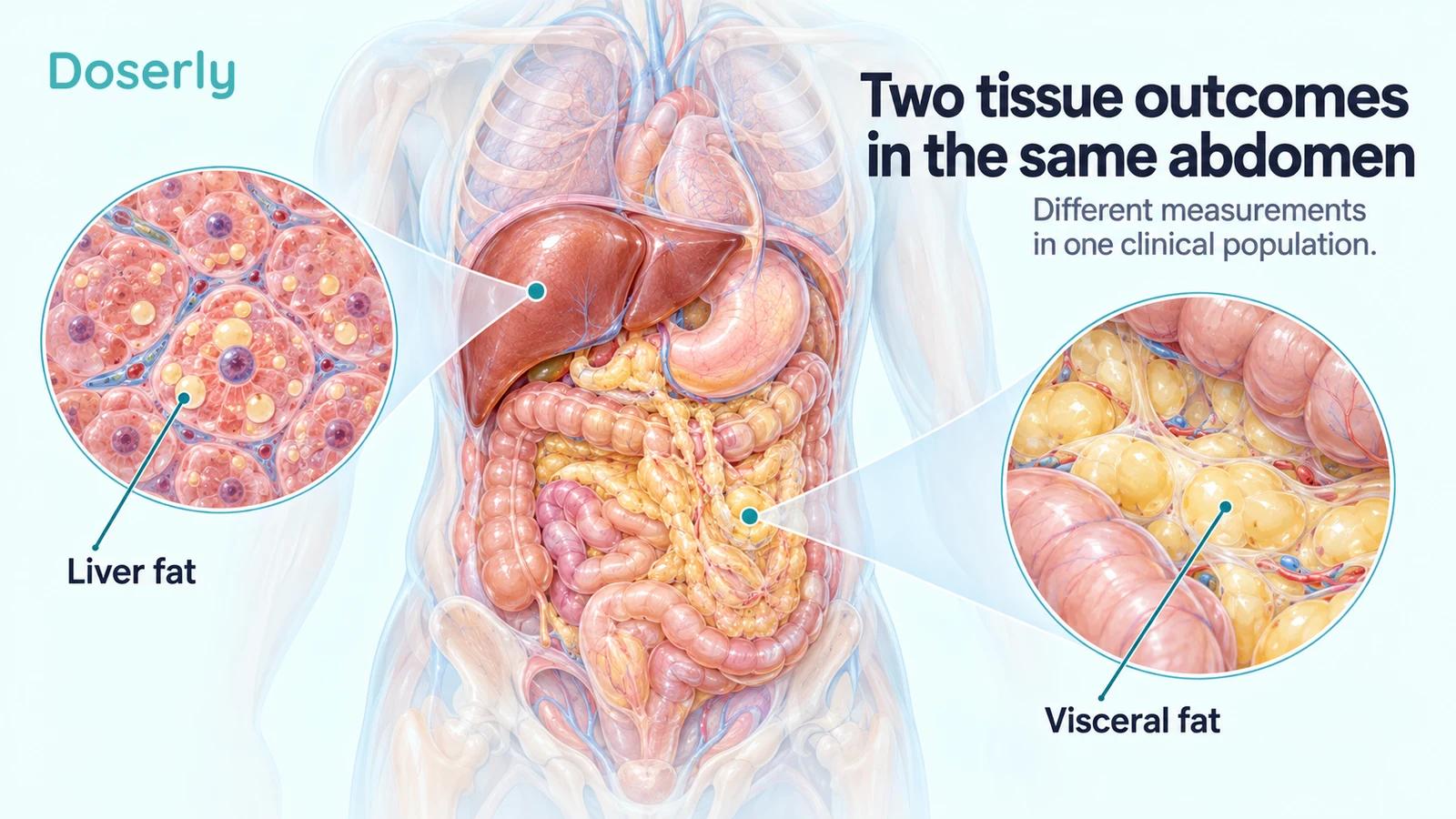
The data came from a 12-month randomized, double-blind, placebo-controlled study of 61 people with HIV and fatty liver disease. The parent trial’s main efficacy outcome was hepatic fat fraction. Participants also underwent detailed body-composition assessments, making it possible to examine visceral fat and regional fat distribution. 2019 parent trial
This selection matters. The subgroup was drawn from people with HIV and liver-fat accumulation, rather than from all people starting an INSTI or all people concerned about weight gain. The participants generally had longstanding, well-controlled HIV. Their clinical history is part of the result’s applicability.
A patient whose circumstances differ can still discuss the findings with their clinician. The point is to identify the difference rather than assume it does not matter. Someone newly starting HIV treatment, someone with no liver-fat disease, and someone with many years on a specific contemporary regimen are not necessarily represented equally by this cohort.
Doserly’s tesamorelin evidence guide provides the wider trial background. The 2024 analysis should be read as an addition to that evidence base, with its parent study and subgroup selection visible.
What “post hoc” means here
The authors explicitly describe the INSTI analysis as post hoc. They examined the subset using an INSTI-based regimen at baseline after the parent trial had already been conducted. The tesamorelin-versus-placebo assignment came from the randomized parent study; the subgroup question was an additional analysis of those data. Methods in the 2024 report
These two facts can coexist. Calling the analysis post hoc does not turn the parent treatment assignment into an observational prescription choice. Calling the parent trial randomized does not make the subgroup a separate, prospectively powered trial designed to settle every question about INSTIs.
Subgroup analyses are useful when they address a clinically important population that was not the main focus of an earlier report. They also reduce the number of participants available for comparison. With fewer people, random variation matters more, and the ability to detect uncommon harms or differences between specific regimens is limited.
The analysis used available data. That phrase should not be mistaken for complete follow-up of every person originally included. Knowing the baseline subgroup and the number who completed the study helps readers understand how much information supports the final comparisons.
Thirty-eight participants at baseline, thirty-one completers
Of the 61 participants in the parent trial, 38 were taking an INSTI-based regimen at baseline: 20 had been assigned to tesamorelin and 18 to placebo. Fifteen tesamorelin-treated participants and 16 placebo-treated participants completed the 12-month study. The paper’s abstract reports those 31 completers prominently. 2024 participant accounting
The distinction is not a bookkeeping detail. Thirty-eight describes the baseline subgroup; 31 describes completion. Saying “a trial of 61 INSTI users” would be wrong, as would implying that all 38 contributed complete 12-month observations to every endpoint.
Missing observations do not automatically invalidate a study. They do affect how confidently a result can be generalized, especially when the sample is already small. A careful summary preserves the denominator and avoids presenting a percentage or median as though it came from a much larger independent trial.
For the same reason, the paper is most informative about whether a signal was present in this subgroup. It is less capable of defining precisely who will respond, how large their personal response will be, or whether a rare adverse event differs between groups.
What changed after 12 months?
The reported median visceral-fat change was −25 square centimetres with tesamorelin versus +14 square centimetres with placebo. The interquartile ranges were broad, indicating substantial variation among participants. Liver fat and the trunk-to-appendicular fat ratio also decreased more with tesamorelin. Subgroup results
The visceral-fat value is an imaging area, not kilograms of body-weight loss. The liver-fat result is a tissue fat-fraction measurement, and the trunk-to-appendicular ratio compares fat in the trunk with fat in the limbs. They describe different aspects of body composition.
A median is the middle of the observed distribution. It does not mean every treated participant lost 25 square centimetres of visceral fat. The interquartile range describes the middle half of the observations; it is not a confidence interval around the treatment effect. These distinctions become particularly useful when a small study’s headline number is repeated as a personal expectation.
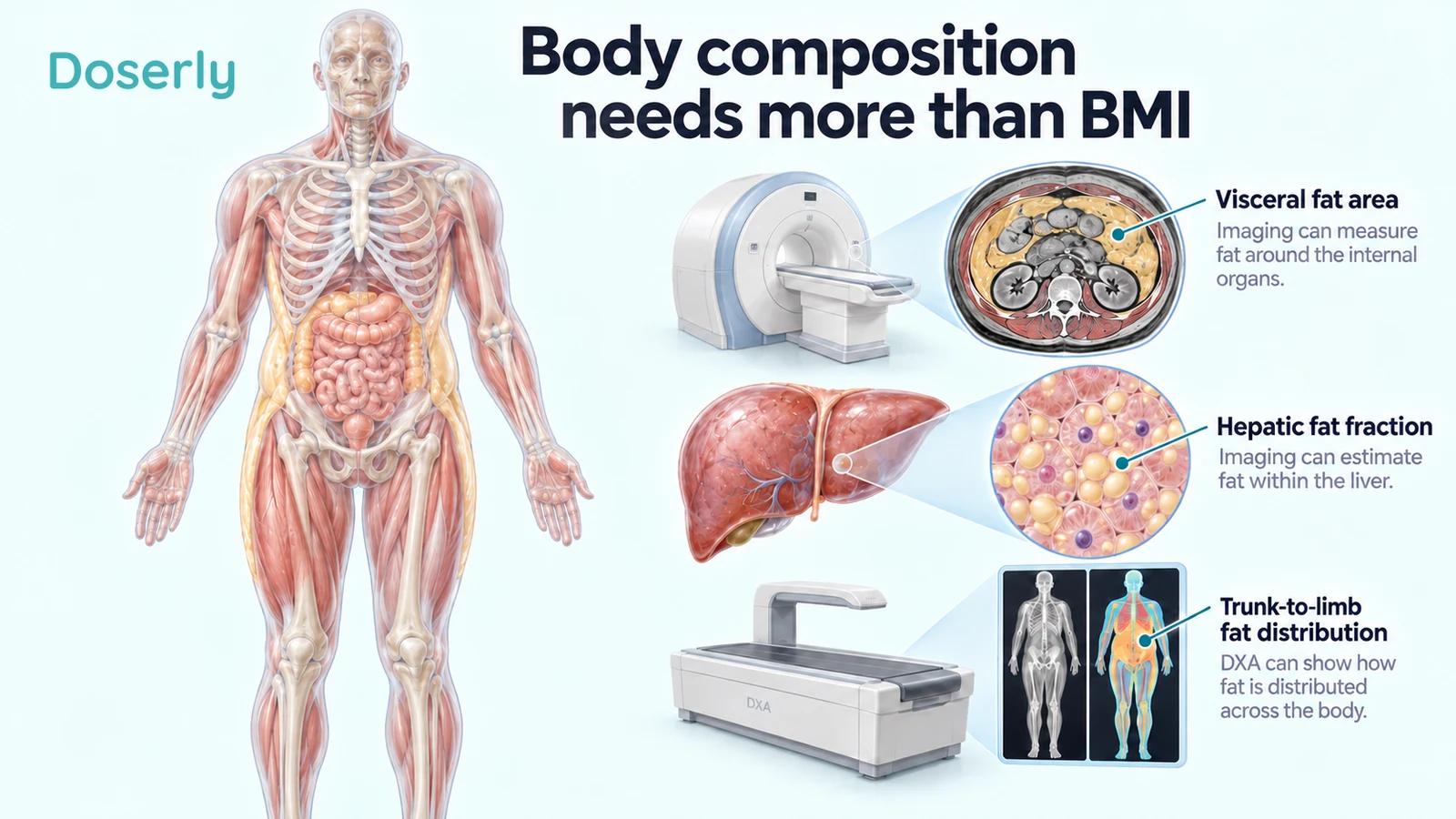
The authors also noted visceral-fat gain in the placebo group despite stable BMI. That observation reinforces the value of distinguishing body composition from total size. It does not prove that the INSTI itself caused the gain: there was no randomized INSTI-versus-no-INSTI comparison within this analysis. Discussion in the primary report
The study did not represent every integrase inhibitor
The baseline INSTIs were dolutegravir, elvitegravir, and raltegravir. No participant was taking bictegravir. The authors specifically identify this absence and the relatively small sample as limitations, and they could not reliably analyze tesamorelin effects within individual INSTI regimens. Population and limitations
That matters because a class-level label can conceal differences in individual drugs, accompanying regimen components, and treatment histories. A result in people taking some members of a class is useful but does not establish identical effects with every member.
The participants had also generally switched relatively recently to their current INSTI regimen compared with their longstanding HIV history. The findings do not settle what happens after much longer exposure to every contemporary combination or in people with little prior treatment experience.
A clinician can use the study as one piece of relevant evidence without treating the absence of a particular regimen as proof the treatment cannot work. The accurate position is narrower: direct data for that regimen were not supplied by this analysis.
A result within a subgroup is not a comparison between subgroups
A further question is whether tesamorelin works differently in people taking an INSTI than in people taking another ART class. Showing a benefit within the INSTI subgroup does not by itself answer that question. It would require an appropriately designed comparison of treatment effects across the groups, with enough participants to distinguish a real difference from chance.
Likewise, the presence of a statistically significant result in one group and a nonsignificant result in another would not automatically establish that the groups respond differently. The difference between the treatment effects needs to be evaluated directly. The 2024 paper’s small sample and stated inability to examine individual INSTI regimens make broad rankings especially inappropriate. Primary report and limitations
For a person taking bictegravir, the useful conclusion is that this study did not directly include their drug. It is neither a demonstrated bictegravir-specific benefit nor evidence of a bictegravir-specific failure. That boundary preserves the value of the observed results without manufacturing a comparison the investigators could not make.
Reassuring safety findings still have a small denominator
Adverse-event frequency, including hyperglycemia, was similar between groups, and the study did not show worsening of glycemic control with tesamorelin over the observation period. IGF-1 was monitored, with an independent endocrinologist helping preserve blinding; no participant met the study’s predefined IGF-1 threshold for dose reduction. 2024 safety methods and results
Those findings are reassuring within this monitored cohort. They do not establish that glucose or IGF-1 monitoring can be omitted in practice. A small analysis is poorly suited to excluding uncommon harms, and its participants were selected for a clinical trial.
The current prescribing information continues to warn about elevated IGF-1, glucose intolerance or diabetes, fluid retention, and other adverse effects. It calls for monitoring and reassessment of benefit. The approved indication remains reduction of excess abdominal fat in adults with HIV and lipodystrophy, not general weight-loss management. Current label
The study also did not establish that a fat change prevented cardiovascular events or liver failure. Imaging and metabolic outcomes can justify further research without substituting for longer-term clinical outcomes.
What the analysis changes in a clinical conversation
Before this analysis, an obvious question was whether evidence from an older HIV-treatment era would translate to people using INSTI-based regimens. The study provides a direct, though limited, answer: tesamorelin showed favorable body-composition effects in the INSTI subgroup that was actually examined.
It does not provide a reason to stop effective HIV treatment because of weight concerns. Current NIH guidance says ART should not be interrupted or discontinued for weight gain and emphasizes selection of therapy to optimize viral suppression. Body-composition concerns deserve attention within that ongoing care. NIH recommendations
A useful appointment can distinguish the concern—overall weight, visceral fat, liver disease, or a combination—and ask how closely the person resembles the study participants. It can then consider the exact regimen, the outcome that would count as benefit, monitoring, and alternatives appropriate to the clinical problem.
The 2024 paper strengthens the relevance of tesamorelin research to part of the modern HIV population. Its value is clearest when described accurately: a small post-hoc subgroup from a randomized liver-fat trial, with favorable tissue outcomes, incomplete representation of current regimens, and continued need for individualized monitoring.
Sources
- Russo and colleagues, 2024: tesamorelin in people using integrase inhibitors.
- Stanley and colleagues, 2019: parent randomized liver-fat trial.
- Pooled phase 3 tesamorelin trials.
- Sax and colleagues: pooled ART initiation and weight-gain analysis.
- NIH guidance on weight gain in people with treated HIV.
- EGRIFTA WR prescribing information.