
TRT
October 16, 2026
Testosterone pellets: convenience has a reversibility trade-off
On this page
The appeal of testosterone pellets is easy to understand. Instead of remembering a daily application or arranging repeated injections, a person has a procedure and receives hormone over a much longer interval. Treatment occupies less space in the ordinary week.
That convenience is real. So is the commitment made at implantation. Once pellets are under the skin, changing the next scheduled dose is no longer the same as deciding not to apply tomorrow's gel or revising a future injection. The treatment already placed in the body can continue releasing testosterone.
The decision is therefore about more than how often a medication needs attention. It includes how confidently the treatment requirement is established, how the person has responded to testosterone, and what happens if an adverse effect or new circumstance calls for a change. A good pellet plan explains both the months between procedures and the options when those months do not go as expected.
What is actually implanted?
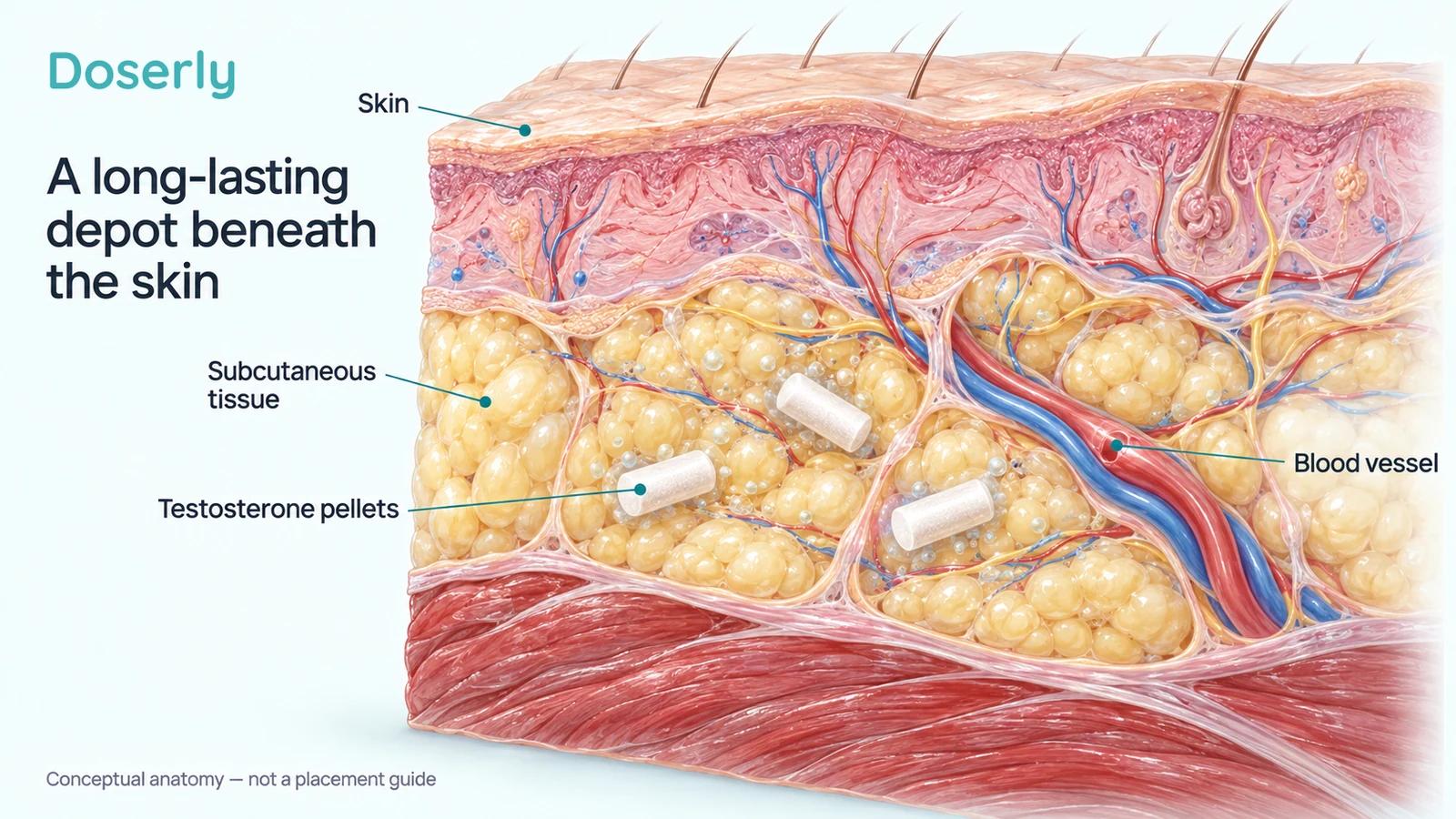
Testopel contains crystalline testosterone in small cylindrical pellets placed in subcutaneous tissue, beneath the skin. Each Testopel pellet contains 75 mg of testosterone. That product strength is useful for understanding the literature; it is not a recommendation for how many pellets someone should receive.
The prescribing information describes slow release from the implanted product. This is systemic testosterone treatment, not a local therapy acting only around the implantation site. Hormone absorbed from the depot enters circulation and can affect tissues throughout the body.
The word “pellet” describes a delivery form, not a single standardized research intervention. Older studies have used pellets with different amounts of testosterone. Compounded products should not be assumed equivalent to an FDA-approved product simply because they share the same shape or hormone name.
Doserly's Testopel guide provides broader product background. For an actual procedure, the patient should know the product, the planned total amount and the reason for that choice, rather than relying on “pellet therapy” as if it identified all three.
“Lasts for months” is not a guarantee of six good months
Duration can mean several things: detectable release, testosterone remaining above a study threshold, symptom benefit, or the time until another procedure is needed. Those endpoints are related but not identical.
A multi-institutional observational Testopel study reported sustained therapeutic concentrations for roughly four to six months, with higher pellet numbers associated with higher and longer-lasting levels. That is evidence that pellets can provide extended exposure. It is not a promise that every patient will feel well for the longest interval in the report.
A separate retrospective study of 273 men examined hormone measurements across 501 insertions. The investigators assessed pellet number, body mass index and repeated implantations, using fitted decay curves to explore exposure over time. Their analysis supported shorter reimplantation intervals than a blanket six-month expectation. Observational modeling can inform clinical judgment, but it does not produce a reliable countdown for an individual.
These studies also illustrate why simply adding more pellets is not a neutral way to buy more convenience. Greater implanted amounts can alter early concentrations as well as duration. A longer interval may therefore involve a different exposure trade-off, not just the same treatment stretched across more calendar pages.
If a clinic describes a typical interval, it helps to clarify what that interval represents. Is it an estimate from experience, a scheduled review, or a promise of symptom control? A planned follow-up should allow the actual response to inform the next step.
Long acting does not mean perfectly flat
A depot does not necessarily release hormone in a way that produces one unchanging blood concentration. Absorption and the body's handling of testosterone still matter.
In a 1996 pharmacokinetic study, 14 men received six pellets containing 200 mg each. Researchers observed an early burst, a plateau and a later decline. Those were different-strength implants from today's 75 mg Testopel pellets; the numerical profile should not be transferred directly to a Testopel prescription.
The relevant lesson is narrower: prolonged delivery can still have phases. A testosterone value soon after implantation and one near the end of an interval are measurements at different stages. Neither should be presented as the person's constant level throughout treatment.
The same distinction applies to feeling better or worse. A declining concentration might help explain a recurring late-interval pattern, but fatigue or reduced sexual interest is not specific enough to establish that explanation alone. The timing, laboratory context and other health changes still need review.
An attractive “steady release” description is therefore a starting point for discussing pharmacology. It does not replace evidence about the actual product, the patient's measurements or the outcomes that matter to them.
The reversibility warning is part of the product information
The Testopel label explicitly describes pellet implantation as less flexible for dose adjustment than oral treatment or intramuscular injections. It also states that complications requiring discontinuation of testosterone's effects would require pellet removal. That warning belongs in the conversation before implantation, not only after a problem appears.
Removal is a clinical procedure. It should not be described as an easy home remedy or an instant reset of every hormonal effect. The label's statement establishes a limitation of the delivery system; it does not guarantee how simple removal will be for a particular patient.
This does not mean pellets are always a poor choice. It means that the value of convenience depends partly on how much flexibility the person may need. Someone still establishing whether testosterone helps an appropriately diagnosed condition faces a different decision from someone with a consistent response and a well-understood replacement requirement.
A practical consent discussion can use a concrete scenario: if a safety measurement becomes unacceptable after implantation, who evaluates it, what options are available, and how will follow-up proceed? The answer should be more specific than “we will adjust the next round.” The current depot may still be relevant while the next round is months away.
Fewer administration days do not mean fewer systemic effects
Testosterone delivered by a pellet still acts as testosterone. A slow route does not exempt a person from changes in red blood cells, blood pressure or reproductive function.
A study of 158 men receiving long-term pellet therapy examined hematocrit and trough testosterone. Higher trough concentrations were associated with polycythemia, defined in that study as hematocrit above 50%, after accounting for age and smoking. The design included a cross-sectional analysis and a longitudinal subgroup; it was not a randomized comparison demonstrating that one route was safer than another.
That threshold is also a study definition, not a personal instruction to start or stop treatment. Its importance here is that sustained delivery did not eliminate the relationship between testosterone exposure and red blood cell effects. Long experience on a formulation was not a reason to stop checking.
The FDA's 2025 testosterone labeling action required information about blood-pressure increases across the class. Choosing an implant rather than a capsule or injection does not establish freedom from that concern.
Fertility is another separate consideration. The Endocrine Society guideline advises against testosterone treatment when fertility is planned in the near term. A long treatment interval is not a fertility-preserving interval. Reproductive goals should be discussed before implantation, especially when a change in those goals could make prolonged exposure inconvenient.
The procedure adds its own set of risks
An implant creates local considerations in addition to the systemic effects of testosterone. The Testopel label reports insertion-site infection, including cellulitis and abscess, and extrusion, in which a pellet comes out through the skin. These can occur together or separately. Most reported cases occurred within the first month, although later events are possible.
The label lists findings such as inflammation, pain, wound drainage, bleeding and bruising. A patient should receive clear instructions about expected recovery, wound care, activity and how to contact the treating service. New or worsening local problems deserve clinical assessment rather than an assumption that the depot is simply “settling.”
If a pellet appears to extrude, the patient should contact the clinician rather than attempting to reinsert it. The event can affect both the wound and interpretation of the treatment delivered. Its significance depends on the circumstances, not just whether the skin later looks closed.
A complication count from one clinic or study is not a universal probability. Technique, follow-up, product, patient selection and how events are collected can differ. The practical question is whether the service recognizes these complications, explains them in advance and provides a usable response plan.

Follow-up should measure benefit as well as exposure
A blood result within a reference interval does not establish that every treatment goal has been achieved. It indicates something about hormone concentration at a particular time. Symptoms, function, adverse effects and patient preferences require their own assessment.
The Endocrine Society guideline describes measuring testosterone near the end of a pellet dosing interval to help inform subsequent treatment. The treating clinician may also need earlier measurements or additional assessment for a particular concern. The key is to know what question each sample is intended to answer.
For example, a late-interval sample can help evaluate waning exposure before another procedure. It cannot retrospectively show how high the earlier peak was. An early sample cannot guarantee that the same concentration will persist until the next appointment. Recording the implantation date and the blood-draw date keeps those distinctions visible.
A symptom record can be similarly focused. Which problem was treatment intended to improve? Did it improve meaningfully? When did benefit begin or fade? Did a new problem arise after implantation? These observations are more useful than asking whether the person feels globally “optimized.”
If a symptom remains despite adequate replacement, the response should not automatically be more pellets. The possibility that the symptom has another cause remains. Increasing an implanted amount without clarifying the target can reduce flexibility while leaving the original problem unresolved.
Convenience has a whole-calendar cost
Pellets remove some recurring tasks but create others: arranging procedures, allowing for recovery instructions, obtaining blood tests and maintaining access to the treating team. A person who travels frequently may value fewer administration events, yet also need to consider what happens if a wound problem occurs away from the implanting clinic.
Costs and coverage should be clarified for the procedure and follow-up together. An attractive per-month comparison can become less informative if it excludes insertion fees, additional visits or management of complications. These details vary by service and insurance arrangement, so a written explanation is more useful than a generic price claim.
There is no requirement to prefer the delivery method with the fewest dosing events. Someone may value the ability to adjust a future administration more than the convenience of a long depot. Someone else may make the opposite choice after understanding the trade-off. Those are legitimate preferences when the medical indication and safety plan are sound.
Before agreeing to implantation, the patient should be able to explain the plan in ordinary language: what product is being used, what benefit is expected, when it will be assessed and what happens if treatment needs to change. The clinician should be able to explain why the expected convenience is worth the reduced flexibility in this particular case.
Testosterone pellets can make a treatment routine easier to live with. The strongest case for them includes an equally clear account of monitoring, local recovery and reversibility. Those details are part of the treatment's usefulness, not fine print outside it.
Sources
- Testopel prescribing information
- A multi-institutional observational study of testosterone levels after testosterone pellet (Testopel) insertion
- Pharmacokinetic evaluation and dosing of subcutaneous testosterone pellets
- Pharmacokinetics and pharmacodynamics of subcutaneous testosterone implants in hypogonadal men
- Trough serum testosterone predicts the development of polycythemia in hypogonadal men treated for up to 21 years with subcutaneous testosterone pellets
- Testosterone Therapy in Men With Hypogonadism: An Endocrine Society Clinical Practice Guideline
- FDA Issues Class-Wide Labeling Changes for Testosterone Products