
TRT
October 18, 2026
When a testosterone result is wrong: biotin, antibodies and lab methods
On this page
A testosterone result can look precise without accurately describing the hormone in your bloodstream. A person taking an unchanged TRT prescription might suddenly receive a surprisingly high value. Another person might undergo repeated investigations for hormone excess despite having few of the expected clinical findings. Sometimes the explanation is biological. Sometimes something in the specimen disrupts the laboratory method.
The important response is to investigate the mismatch, rather than assume either that the number is correct or that the laboratory must be wrong. Repeating a test and confirming a test are not always the same thing. If the same interfering substance meets the same vulnerable assay again, the error can repeat quite convincingly.
This article concerns analytical interference: biotin, antibodies and other substances that distort measurement. Testosterone gel entering a blood tube from the collection site is a separate problem, covered in our gel-contamination article. That distinction matters because a different laboratory method cannot remove testosterone that genuinely entered the specimen.
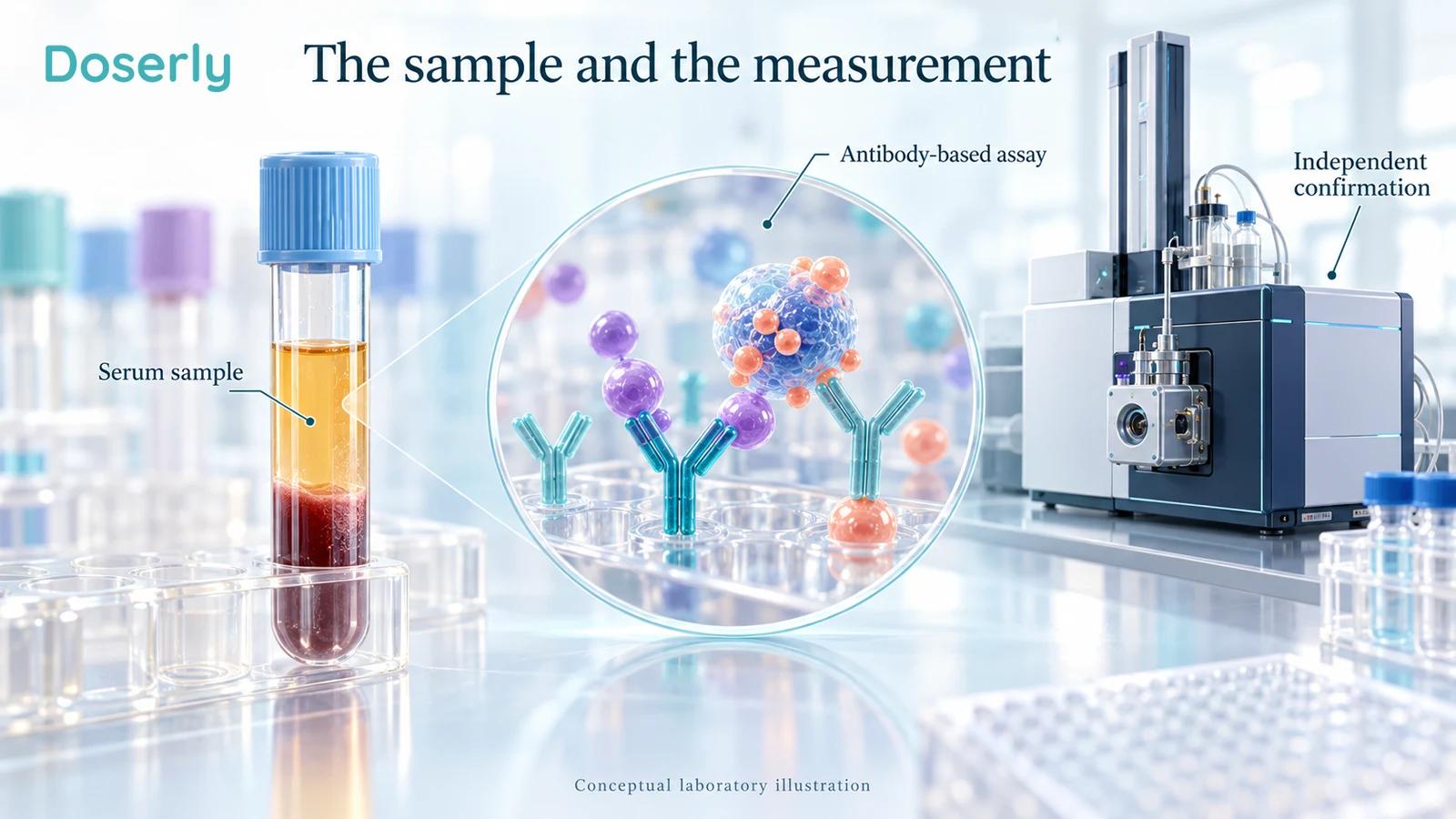
Conceptual laboratory illustration. The enlarged binding components are schematic; this is not a particular manufacturer's assay or a patient result.
For the broader treatment and monitoring context, explore our TRT guides.
Start with what the number actually represents
An assay is a measurement procedure. Many laboratories use immunoassays, which employ antibodies designed to recognize a particular substance. An instrument converts the resulting signal into a concentration. The result therefore depends on the specimen, the assay's chemistry, its calibration and the conditions under which it is run.
Total testosterone includes hormone carried by proteins as well as the small unbound fraction. Free testosterone is a different measurement or calculation. A report containing both does not necessarily provide two independent confirmations: calculated free testosterone uses total testosterone as an input. An error in that input can travel into the calculation.
The Endocrine Society recommends reliable assays and, when free testosterone assessment is appropriate, equilibrium dialysis or a suitable calculation using total testosterone, SHBG and albumin. Its diagnostic guidance also requires symptoms and consistently low concentrations, rather than treating a single isolated number as a diagnosis. These are principles for evaluating deficiency; monitoring someone already using TRT also requires formulation-specific timing. Endocrine Society clinical guideline
Before discussing exotic interference, put the original reports side by side. Check the analyte name, units, reference interval, laboratory and collection time. A screenshot containing only a large number discards precisely the details that help explain a discrepancy.
How biotin gets involved in the testing process
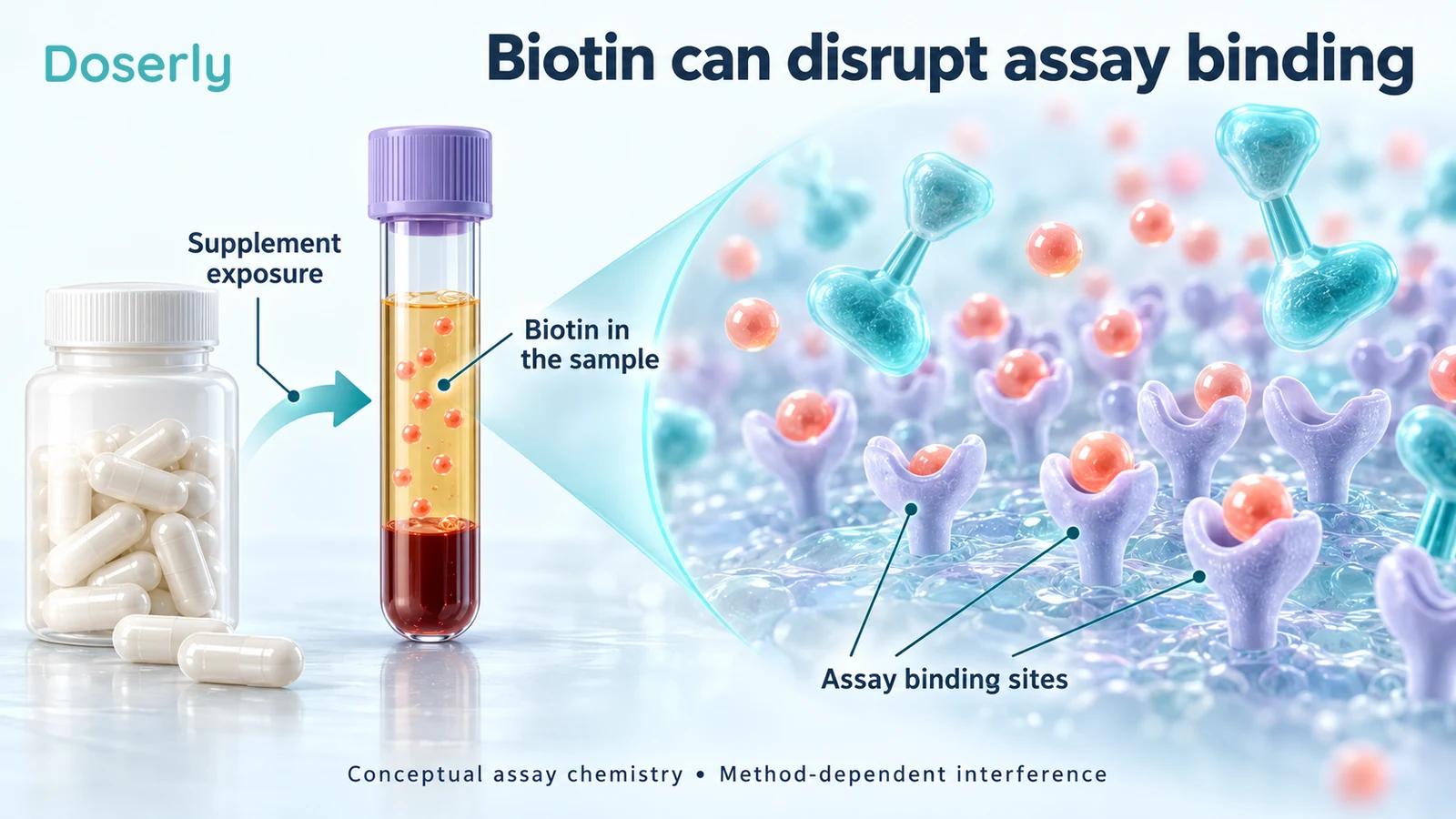
Biotin is vitamin B7. The potential problem here is not that taking a hair supplement necessarily raises testosterone production. Some assays use the strong binding between biotin and a protein called streptavidin as part of their laboratory machinery. Extra biotin arriving in a patient's specimen can compete with those test components.
The direction of error depends on the assay design. In susceptible competitive assays, including certain testosterone methods, interference can produce a falsely high result. In susceptible sandwich assays, the result can be falsely low. AACC's laboratory guidance emphasizes that susceptibility and the concentration needed to interfere vary among tests and manufacturers. AACC guidance on biotin interference
Consequently, “biotin affects hormone tests” is too broad to settle an individual case. The useful question is whether the specific method used for this specimen is susceptible at the likely exposure. Another test on the same panel may behave differently. Neither a normal thyroid result nor a previous uneventful blood draw automatically clears every testosterone assay.
Bring the product label rather than relying on its marketing name. Hair, nail and combination supplements may contain biotin even when it is not the reason someone bought them. Record the amount per serving, number of servings and last dose; milligrams and micrograms are different units.
What experiments in people actually showed
In a 2017 nonrandomized crossover study, six healthy adults took 10 mg of biotin daily for a week. Investigators examined 37 assays covering 11 analytes. Interference appeared in nine of the 23 assays incorporating biotin-related components, while none of the 14 nonbiotinylated assays showed it. Both falsely high and falsely low results occurred. Li and colleagues, JAMA
This is useful human experimental evidence that an ingested supplement can alter measurement without representing the corresponding disease. However, testosterone was not one of the 11 analytes. The study should not be advertised as proving that 39% of testosterone tests fail after biotin, or that 39% of supplement users receive erroneous results. Those are different denominators and different questions.
There were only six participants, and the assays reflected the systems examined at that time. Later reagent generations can have different tolerance. The study supports asking which test was used, not declaring every current assay unreliable.
For someone monitoring TRT, the practical lesson is about preparation and interpretation. A supplement history belongs beside the medication history when a clinician orders laboratory work. It should not emerge only after an unexpected result has already prompted a treatment change.
Testosterone-specific cases make the problem concrete
A 2018 report described a patient whose hormone results raised concern about a testosterone-producing tumor. Testosterone measured using liquid chromatography–tandem mass spectrometry, or LC-MS/MS, was within the reference interval, while susceptible immunoassay findings had been misleading. The investigation included measuring biotin and discussing continued supplement use. Results improved after the exposure was addressed. Original case report
A separate 2024 report described apparent hyperandrogenism after a 10 mg biotin tablet taken 33 hours before the first blood draw. Testing with other methods and subsequent assessment supported interference. That observation is a reason not to assume that a familiar short waiting interval always resolves the problem. It does not establish a universal 33-hour threshold, or prove that everyone needs the longer washout used in that case. 2024 clinical report
Both reports involved women being assessed for androgen excess, not a trial of men receiving TRT. They demonstrate a failure mode and its clinical consequences. They cannot estimate its frequency in a TRT clinic. Their relevance is the laboratory mechanism, which can also matter when monitoring replacement treatment.
Why there is no universal biotin waiting period
A planned retest should follow instructions agreed with the clinician and laboratory. The appropriate interval depends on the product exposure, the method and individual clearance. An instruction copied from a different test or laboratory may not answer the relevant question. AACC guidance discusses different intervals and alternative testing approaches rather than treating every assay as interchangeable. AACC guidance
More recent work also keeps patient context in view. A 2025 laboratory investigation examined biotin levels and assay susceptibility, highlighting elevated concentrations in hemodialysis and intensive-care populations and differences between assay systems. It was not a TRT dosing study and does not provide a single consumer rule for repeat testosterone testing. Chiu and colleagues, 2025
For medically prescribed high-dose biotin, do not independently interrupt treatment to make a blood test easier. The prescribing team can coordinate an alternative method or an appropriate collection plan. For an ordinary supplement, ask for a clear instruction and write down the actual last dose.
Urgent symptoms are a different situation. The FDA continues to describe falsely low troponin results in susceptible assays. If chest pain or another emergency develops, seek care and tell the team about biotin; do not wait at home for a supplement to clear. FDA troponin-interference notice
Antibodies can interfere even when no supplement is involved
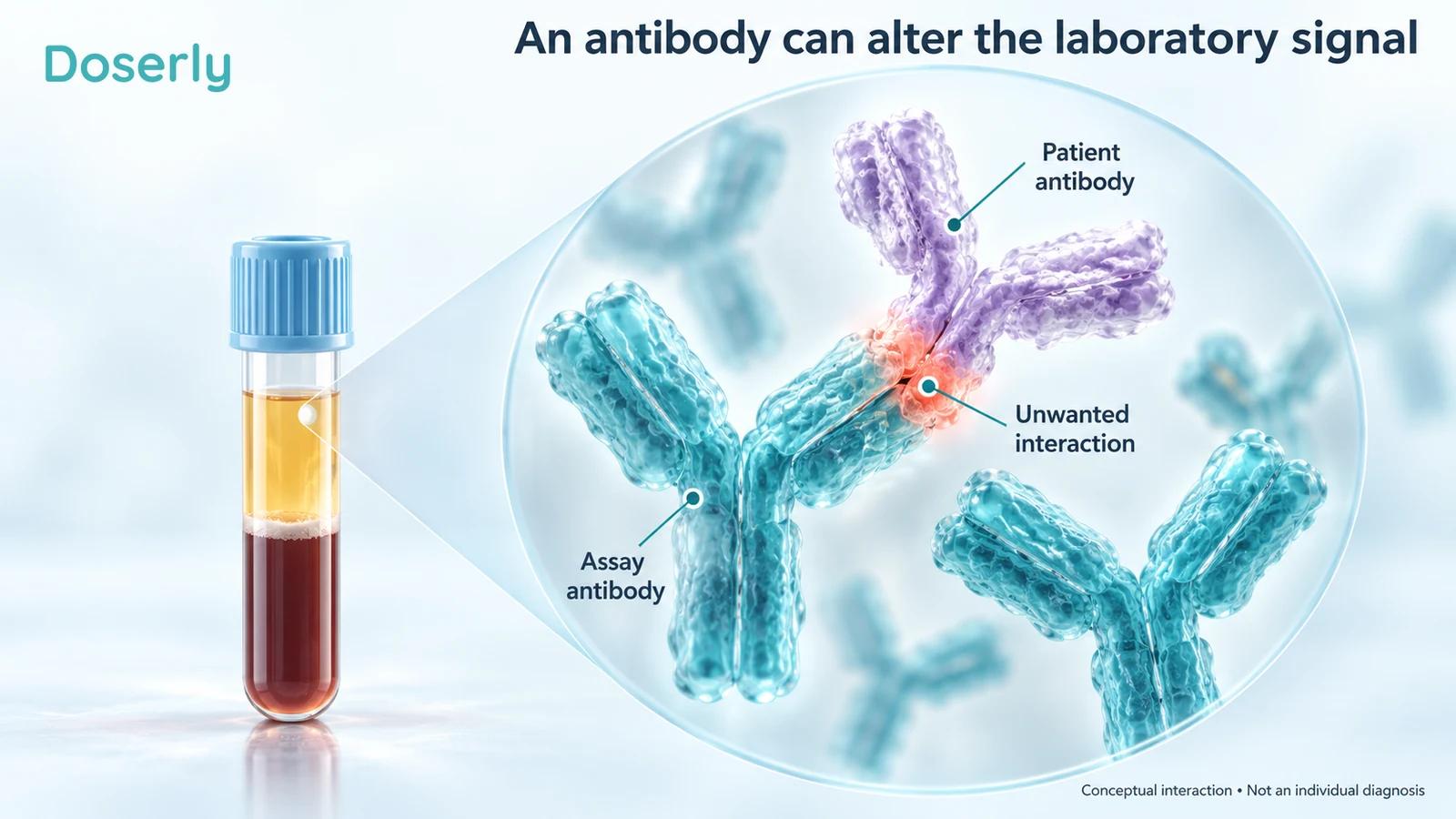
The patient's own antibodies may interact with the antibodies or other reagents used by the assay. Heterophile antibodies and human anti-animal antibodies are examples. Depending on the method, an unwanted interaction can increase or decrease the measured signal. These antibodies are an analytical explanation to investigate, not a diagnosis someone can make from symptoms.
A 2025 case report followed a woman with repeatedly elevated testosterone measurements over several months. Other platforms and LC-MS/MS produced normal results. Reanalysis after protein precipitation supported antibody-related interference. The authors reported no relevant financial interests and no public or commercial funding. Huang and colleagues, JCEM Case Reports
The striking feature is that persistence did not establish accuracy. Multiple abnormal reports can look like mounting biological evidence when they share a measurement vulnerability. Conversely, a disagreement between platforms is a clue, not permission to choose whichever value feels more comfortable.
The case also cannot tell us how common clinically important interference is. Detecting antibodies in a population and documenting erroneous testosterone results are different outcomes. A prevalence quoted for one should not be used as the probability of the other.
How the laboratory tests that possibility
A laboratory specialist may compare a different manufacturer's assay, use blocking reagents, examine dilution behavior or remove proteins before remeasurement. The choice depends on the suspected interference and the method's validation. None is a universal home test or a guarantee that every interfering substance has been excluded.
A 2025 report on falsely elevated testosterone describes the diagnostic complexity of these investigations, including the possibility that results behave unexpectedly after heterophile-blocking treatment. A blocking experiment is therefore interpreted as part of a pattern, alongside independent measurement and the clinical findings. Gardini and colleagues, 2025
It helps to ask the clinician to contact the laboratory directly. “Please repeat testosterone” may produce another run through the same workflow. “The result conflicts with the clinical picture; could analytical interference be assessed?” conveys a different problem. The laboratory can also clarify whether two apparently different collection centers send specimens to the same testing facility.
Keep the final explanation in the medical record. If a particular assay is unsuitable for this patient, future clinicians need that information. Otherwise, the same discrepancy can trigger a fresh round of imaging, anxiety or prescription changes years later.
Other steroids can resemble the target
Cross-reactivity is another route to an inaccurate result. The assay antibody recognizes something similar enough to testosterone to contribute to its signal. This differs from an antibody in the patient's blood interacting with test reagents, and from biotin disrupting the assay's binding system.
Krasowski and colleagues experimentally challenged several steroid immunoassays using compounds added to plasma. Their testosterone work identified cross-reactivity with some structurally related steroids, including methyltestosterone. These findings were method-specific laboratory experiments; the size of an error in a patient also depends on the concentration of the interfering compound. Original cross-reactivity study
A list of possible interferents is not a calculator for subtracting an amount from a reported value. Nor does structural similarity establish that every formulation or modern assay will behave identically. The laboratory needs the actual medication and supplement history to judge relevance.
That history should include prescribed hormones, bodybuilding products and products sold as hormone support. A clinician can only evaluate a possible interaction if the exposure is known. Reporting it accurately helps distinguish genuine hormone exposure from a measurement artifact; the two can coexist.
What mass spectrometry can and cannot resolve
LC-MS/MS first separates compounds chromatographically, then measures selected molecular signals using mass spectrometry. It offers a different analytical route from antibody recognition, making it valuable when immunoassay interference is suspected. It does not depend on the same biotin–streptavidin mechanism or immunological binding reactions.
Nevertheless, “mass spectrometry” is not a promise of perfection. Sample preparation, separation, calibration, sensitivity and quality assurance still matter. Published accuracy-based proficiency testing found variation among laboratories using both immunoassays and LC-MS/MS. The instrument category alone does not replace assessment of the actual method. Accuracy-based testosterone proficiency study
The CDC Hormone Standardization Program assesses laboratory performance against reference measurements. Its current description includes blinded samples, continuing performance assessment and time-limited certification. Certification supports confidence in analytical quality; it does not certify that every patient's specimen is free of every possible interference. CDC HoSt program
Also remember the specimen itself. Mass spectrometry can accurately measure testosterone in a sample contaminated during collection. It cannot reconstruct what the concentration would have been without that contamination. That is why collection problems and analytical problems need separate questions.

A repeat needs a specific question
Consider two hypothetical situations. In the first, the prescription is unchanged, but the blood draw occurred at a different point in the dosing interval. In the second, collection timing is comparable, but the laboratory changed its method. Both can produce an unexpected comparison; they call for different investigations. These examples are illustrations of the information needed, not evidence that either explanation applies to a particular reader.
Write the question on the follow-up plan: are we checking exposure at the intended collection time, excluding a supplement effect, or comparing an independent analytical method? If several things change simultaneously, a different result may be reassuring while leaving its cause uncertain. The clinician and laboratory can decide which variables need to be controlled and whether the original sample remains available for comparison.
A useful record keeps the original result visible alongside any corrected or confirmatory report. Deleting the inconvenient value loses the reason the investigation began. Instead, attach the explanation, method and date so the next person reading the chart can distinguish a documented analytical issue from a genuine change in treatment response.
A useful conversation after a surprising TRT result
Bring the full report and a short timeline. Include the exact testosterone product, when it was last used, when blood was collected, recent changes, symptoms and every supplement. If older results came from another laboratory, bring those reports too. The aim is to identify which conditions changed before deciding what the change means.
Useful questions include:
- Was this total testosterone, directly measured free testosterone or calculated free testosterone?
- Did the laboratory or assay method change between measurements?
- Could biotin or another recorded product affect this particular method?
- Would an alternative assay, LC-MS/MS or a laboratory interference investigation clarify the result?
- What collection instructions should apply to the repeat specimen?
- How will the confirmed result and any method limitation be documented?
These questions do not determine the prescription. A genuinely high concentration still needs clinical interpretation, and a suspected artifact does not make continued exposure automatically appropriate. The clinician may need to act before every analytical detail is resolved if there are concerning symptoms or other findings.
The most useful endpoint is an interpretable result with a clear explanation of how it was obtained. When the number and the person do not fit together, checking the method is part of good hormone care. It can protect against unnecessary investigations while preserving attention to real changes that need treatment.