
TRT
October 16, 2026
A spiking testosterone result on gel: could the blood sample be the problem?
On this page
A very high testosterone result during gel treatment can mean that exposure is excessive. It can also arise when testosterone residue near the blood-draw site contaminates the sample. Those explanations require different responses, which is why an unexpected result deserves a careful collection history.
This is not an argument for ignoring a high value. It is a reason to check whether the sample represents circulating testosterone before making a major treatment change. Published case reports and a larger retrospective review document how gel contamination can lead to misleading measurements. 2023 case series.
The useful information may be surprisingly practical: where the gel was applied, which arm was used, when the dose was taken and whether collection followed the instructions for that product. Our Testim guide and AndroGel guide explain the broader application and monitoring context.
How can skin residue affect a blood result?
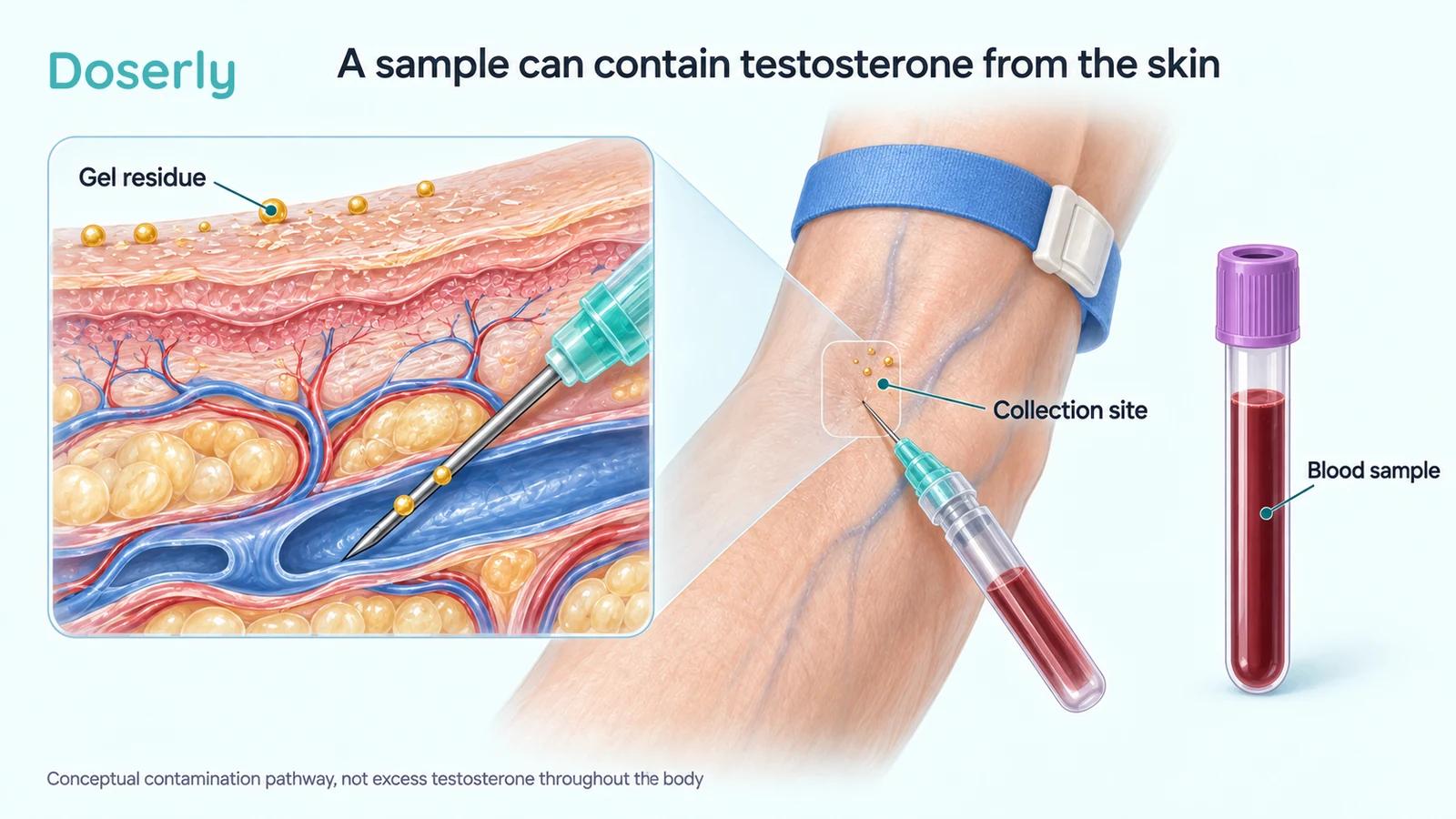
Testosterone gel contains the same hormone the laboratory is measuring. If residue is introduced into the specimen during venipuncture—the process of drawing blood through a needle—the sample can contain testosterone that did not represent the concentration circulating throughout the body.
This is a preanalytical problem: it happens before the laboratory measurement itself. A technically accurate instrument can correctly detect testosterone in a contaminated tube and still produce a clinically misleading result.
The distinction is important. An analytical interference means something disrupts the test’s measurement process. Contamination adds the actual substance being measured. Simply asking for a more sophisticated assay may not resolve a sample that already contains extra testosterone.
The published cases particularly concern gel applied at or near the phlebotomy site. They support asking about the relationship between the application area and the collection site rather than treating every unusual result as a dose problem. Kirk and Misita case reports.
What did the larger case series find?
A 2023 retrospective review identified 578 unique patients using topical testosterone gel. Forty-eight had at least one testosterone concentration above 1,000 ng/dL. The authors described seven cases in which documentation strongly suggested contamination from gel near the venipuncture site. Primary case series.
Those numbers need careful interpretation. The seven cases were not seven experimentally proven contamination events among a randomly sampled population. They were cases identified through clinical records and documentation. The study also does not show that all 48 high-result patients had contaminated samples.
The review illustrates a recognizable clinical problem and the risk of inappropriate treatment changes. It cannot give every gel user a precise probability that an unexpected high result is false.
The threshold used to search records is not a diagnostic rule. A value above 1,000 ng/dL does not prove contamination, and a lower value cannot automatically exclude it. The relevant question is whether the collection circumstances and repeat assessment support the explanation.
Why changing the dose immediately can create confusion
If a contaminated result is treated as genuine excessive exposure, a clinician may reduce a dose that was otherwise providing appropriate replacement. Subsequent symptoms or measurements can then become difficult to interpret.
The 2013 two-case report describes how application near the phlebotomy site produced spuriously elevated measurements and could lead to inappropriate dose changes. Its practical message is to recognize the collection problem before assuming the prescribed exposure explains the result. Original report.
The reverse mistake also matters. Assuming that every high result is contamination can delay recognition of genuinely excessive exposure. A person may have changed the amount applied, changed formulation or misunderstood instructions. The clinician needs to review those possibilities alongside the collection history.
The goal is therefore confirmation, not choosing the explanation that feels most reassuring. A result that conflicts with expectations is a reason to gather more information.
What does newer research add?
A 2025 study examined testosterone and estradiol measurements in transmasculine people using testosterone treatment and included an exploratory experiment in ten volunteers. The researchers asked whether an unusually high testosterone-to-estradiol ratio could be a clue to contamination, because testosterone introduced from skin into a sample would not first have undergone the body’s usual conversion to estradiol.
In the volunteer experiment, applying gel at the venipuncture site produced higher testosterone measurements and higher ratios in samples from the exposed arm than from the unexposed arm. The same difference was not reproduced when gel was applied distal to the collection site. Stangl and colleagues.
This adds a controlled demonstration to the case-report evidence. It does not validate a universal ratio that patients can use to diagnose contamination. The clinical cohort involved gender-affirming treatment, and the proposed marker needs interpretation in its population, assay and unit context.
For routine care, the practical contribution is straightforward: communicate the application site and avoid collecting from a gel-exposed area according to the clinical collection plan. A calculated ratio should not replace that history.
Why the ratio is a clue rather than a verdict
Testosterone and estradiol are related biologically, but they do not move in a fixed ratio in every person. Measurements also depend on the assays and units used. A high ratio could raise suspicion in the setting examined by the researchers without establishing the cause of an individual result.
Medicines that affect estrogen synthesis further complicate interpretation. A clinician reviewing the ratio needs the full medication history, including any aromatase inhibitor. It would be misleading to copy a numerical cutoff from one paper into a general self-testing rule.
The 2025 paper’s approach is best understood as an aid to recognizing a possible preanalytical problem. It does not establish that a normal ratio guarantees a clean sample, or that an elevated ratio proves the prescribed testosterone dose is appropriate.
If a clinician or laboratory specialist suggests additional measurements, ask what question they are intended to answer. The investigation should clarify the discrepancy rather than create a new target to chase.
Ordinary variability is another explanation
Not every surprising result comes from contamination. A study of older hypogonadal men treated with testosterone gel found substantial within-person variability and limitations in using a single timed measurement to predict average exposure on another day. Gel variability study.
That means a result can differ without either deliberate misuse or a contaminated draw. Application, absorption and sampling conditions all belong in the interpretation. The study does not make laboratory monitoring pointless; it shows why consistency and clinical context matter.
Avoid comparing two results as though collection conditions were identical when they were not. A test obtained before application and one obtained after application answer different timing questions. A change in laboratory method or product can add another difference.
A useful record preserves the circumstances, not just the number. This can reduce the temptation to explain every fluctuation by immediately changing treatment.
Product-specific timing still applies
The current Testim label directs morning, pre-dose serum testosterone assessment approximately 14 days after starting treatment. AndroGel 1.62% also uses pre-dose morning measurements for its labeled titration schedule. These details are different from some other topical products and from general discussions of post-application research sampling. Testim label, AndroGel 1.62% label.
Confirm the plan before the appointment. Do not assume that instructions heard for another gel apply to yours, and do not independently move an application to an unapproved body site to protect the draw site.
The prescriber and collection team can coordinate a suitable approach that respects the product instructions and avoids gel-exposed skin. Tell the person drawing blood that you use a topical testosterone product before they choose the site.
If a collection did not follow the intended timing, say so. That does not make the visit a failure; it gives the clinician information needed to decide whether the result is interpretable or should be repeated.
What should you tell the clinician after an unexpected result?
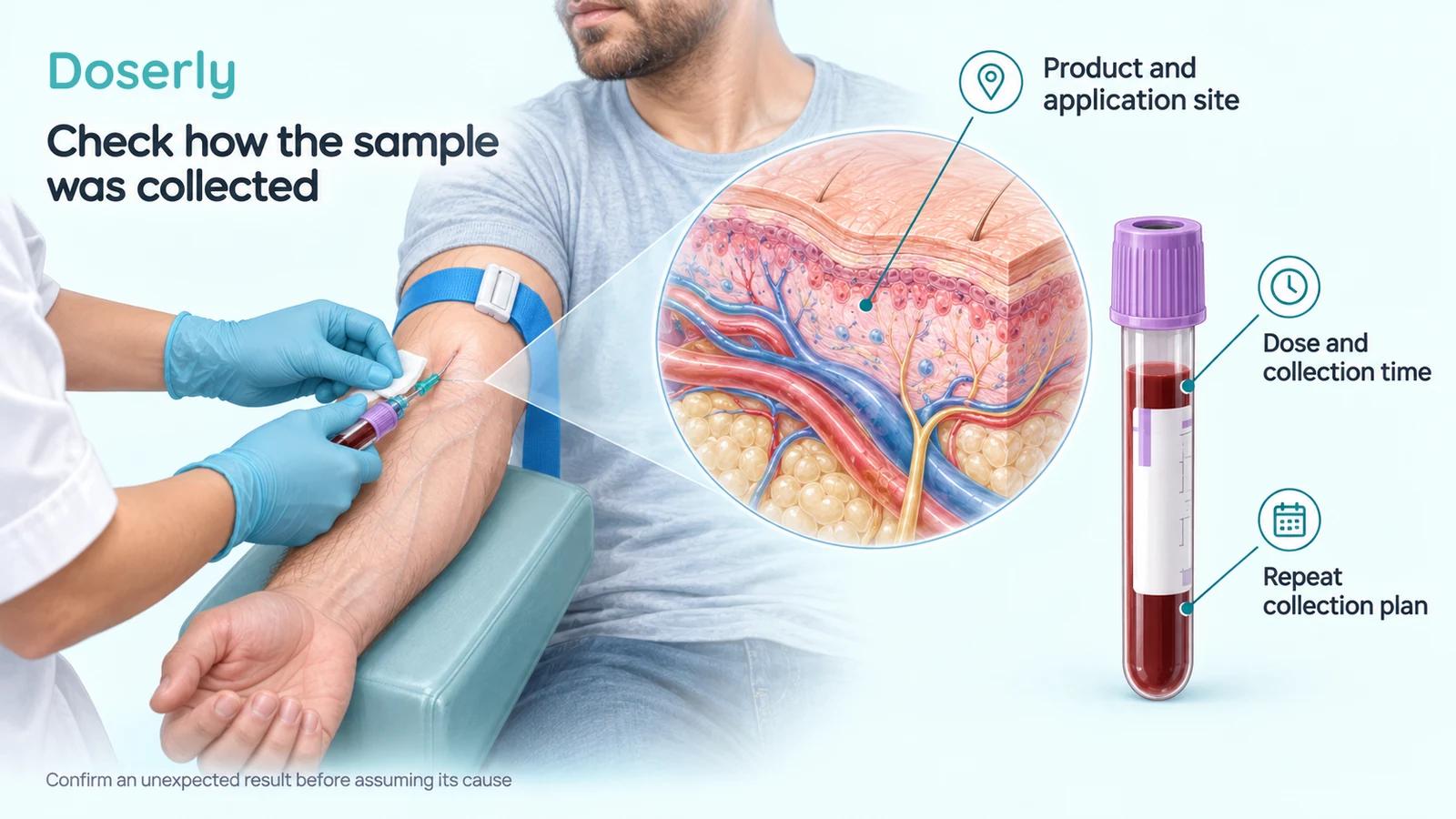
A concise account is more useful than a theory alone. Include the exact product and concentration, the prescribed amount, whether anything changed recently, where it was applied and which arm was used for collection.
Record the application and blood-draw times if known. Mention whether gel was applied near the elbow or another potential collection site, and whether there was any uncertainty about the instructions. It is also useful to identify supplements or other medicines that may affect interpretation.
Bring the original laboratory report, including units and reference interval. A screenshot cropped to one number can omit information that matters. If an earlier result is being used for comparison, provide its collection circumstances too.
The clinician may review the dose, arrange a properly planned repeat sample or consult the laboratory. The appropriate response depends on how high the result is, the wider clinical picture and whether there are safety concerns. Do not independently stop, increase or reduce the prescription on the assumption that contamination has been established.
What would a repeat result actually tell you?
A lower result after a carefully planned repeat can support the suspicion that collection circumstances mattered. It does not necessarily identify which part of the earlier process caused the difference. Timing, recent use and ordinary variability may also have changed.
That is why the repeat plan should be explicit. If both the dose and collection procedure change at the same time, it becomes harder to know which change explains the new result. A clinician may still need to make both changes for safety, but the interpretation should acknowledge that limitation.
Repeatedly high results under appropriate collection conditions require further assessment. The possibility of contamination should not become a permanent explanation that prevents review of genuine exposure.
The goal is a result that is sufficiently reliable to guide care. Once that is established, treatment decisions can return to the intended benefits and monitoring needs rather than a confusing series of unexplained numbers.
Keep sample contamination separate from household transfer
Both problems involve topical residue, but the consequences differ. Household transfer exposes another person through skin contact. Sample contamination introduces testosterone into a collected specimen and can misrepresent the treated person’s circulating concentration.
A clean blood-draw plan does not replace household precautions, and household precautions do not automatically guarantee a valid sample. Continue following product instructions for handwashing, drying, covering and contact while coordinating laboratory collection. AndroGel label.
An unexpected high testosterone result deserves attention. Asking how the sample was collected is a useful part of that attention—not an excuse to disregard it. The published evidence supports treating collection history as a clinical detail that can change the meaning of the number.
Sources
- Falsely Elevated Serum Testosterone Measurements Resulting from Testosterone Topical Gel Contamination of the Venipuncture Site: Case Series and Retrospective Review
- Spuriously Elevated Testosterone Measurements Caused by Application of Testosterone Gel at or Near the Phlebotomy Site
- Recognition, Prevalence and Prevention of Falsely High Serum Testosterone Concentrations in Testosterone Gel Users
- Serum Testosterone Level Variability in T Gel-Treated Older Hypogonadal Men: Treatment Monitoring Implications
- Testim US Prescribing Information
- AndroGel 1.62% US Prescribing Information