
TRT
October 16, 2026
Testosterone esters: what half-life can—and cannot—tell you
On this page
Testosterone cypionate and testosterone enanthate both deliver testosterone, but their names describe different chemical attachments called esters. These attachments help an injectable preparation release hormone over time. That makes ester pharmacology relevant when discussing treatment schedules, blood tests and how easily a prescription can be adjusted.
It doesn't make half-life a score for treatment quality. A longer half-life doesn't establish better energy, steadier mood, fewer side effects or a stronger response in the gym. Those are separate outcomes that require their own evidence.
If you're comparing prescriptions or wondering why a different product feels different, the useful question is broader: what changed about the preparation, exposure, measurement conditions and your health? Our cypionate versus enanthate guide explains the product differences in more detail. Here we'll focus on what the commonly quoted numbers actually mean.
What an ester changes
An esterified testosterone molecule has an additional chemical group attached to it. In an injectable oil preparation, that changes how the substance behaves at the injection site. The preparation forms a depot, a local reservoir from which drug is absorbed. After the ester is removed, the active hormone is testosterone.
The US cypionate label describes slow absorption from an intramuscular oil depot and gives an approximate intramuscular half-life of eight days. Those statements concern that formulation and route. They don't mean that every person has exactly half of their initial blood testosterone remaining eight days later. Cypionate prescribing information
The distinction matters because an injection isn't instantly mixed throughout the bloodstream. While some drug is still leaving the depot, some circulating hormone is being distributed and metabolized. A blood sample reflects the combined result of those processes. It also includes any testosterone the body is still making.
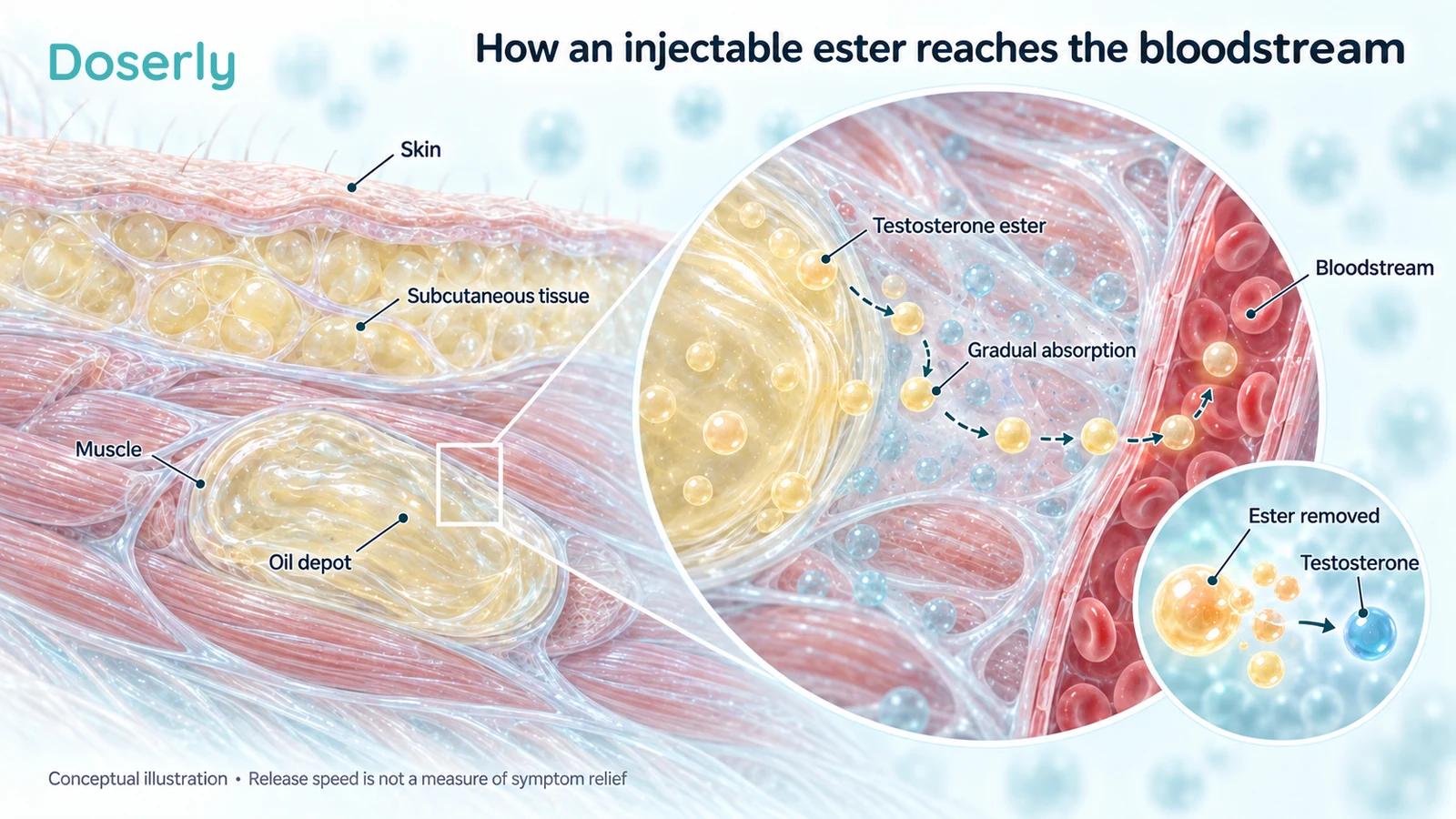
This conceptual illustration separates depot absorption from removal of the ester. The particle shapes are symbolic, not chemical structures or measured concentrations. Release speed alone doesn't establish symptom benefit.
Half-life is a description of decline, not a countdown to an empty body
In a simple elimination model, half-life is the time needed for a quantity or concentration to fall by half during the phase being described. One half-life leaves half; a second leaves a quarter. It doesn't reach zero at the first or second interval.
An injectable depot makes that simple picture more complicated. A reported value may describe the terminal decline seen in blood while absorption is still contributing to the profile. Another paper may estimate a parameter using a mathematical model. Another may report how long concentrations stay within a reference range. These are related descriptions, but they aren't the same measurement.
This is why a comparison needs the full sentence around the number. Which product was administered? Into muscle or under the skin? Was it one injection or repeated treatment? Was the calculation based on measured serum concentrations or an estimated release model? A table stripped of those details can make two different experiments look like a direct comparison.
A half-life can help clinicians anticipate persistence after changing treatment. It can't tell you the exact day that fatigue will return, the best interval for your prescription or whether an adverse effect will disappear. Those questions involve biological responses and individual circumstances beyond the concentration curve.
What actual blood-sampling studies show
A small 1987 study examined 11 men with hypogonadism after intramuscular testosterone cypionate. Testosterone peaked during days two to five, and hormone concentrations returned toward basal levels by days 13–14. The study demonstrates that substantial variation can occur within an interval. It doesn't compare symptom relief between esters or show that its schedule is the best one today. Nankin's primary study
Notice the difference between that observation and the label's half-life. A peak several days after injection, an approximate half-life and a return toward baseline describe different features of the same general process. There is no need to force them into one interchangeable number.
A 2015 phase II study investigated a subcutaneous enanthate autoinjector in 39 men with hypogonadism. It compared two weekly subcutaneous dose groups with an intramuscular reference group. Its primary purpose was to characterize exposure, with safety and tolerability also assessed. The investigators reported relatively steady profiles with the subcutaneous system. Kaminetsky and colleagues
That finding is relevant to the device and regimens tested. It cannot be turned into “enanthate is always smoother than cypionate.” Route, dose, frequency and delivery system differ across studies. Even when two papers report concentrations in the same units, their participants and treatment conditions may not be comparable.
These studies also answer a narrower question than many readers bring to them. Frequent blood sampling is well suited to describing exposure. A short study of a few dozen people cannot reliably determine which preparation produces the fewest uncommon cardiovascular events over many years.
Why the same ester can behave differently in practice
The ester name is only one part of a prescription. A preparation also has a concentration, a carrier, a container or device, and an approved route. The amount administered and the interval between administrations determine repeated exposure.
This helps explain why comparing the label on two vials is insufficient. If someone changes ester and simultaneously changes the interval, any difference they notice could reflect either change. If they also move from intramuscular delivery to an autoinjector under the skin, another important variable has changed.
A published comparison of intramuscular cypionate with a subcutaneous enanthate autoinjector is useful precisely because it compares real treatment systems. But it does not isolate ester chemistry: the route and delivery method change too. Its laboratory findings cannot identify the ester attachment as the sole cause of a difference. Comparative outcomes study
The practical lesson is to name the whole treatment when discussing it. “I changed testosterone” leaves too much unclear. “The pharmacy supplied a different preparation, the concentration changed, and my clinician changed the interval” gives a reviewer enough information to begin interpreting what happened.
A blood result needs a time attached to it
Imagine two people with the same laboratory result. One sample was taken shortly after treatment, the other near the end of an interval. The numbers match, but the exposure patterns may not.
Now imagine one person whose result rises after switching preparations. If the earlier sample was taken later in its interval, the apparent improvement might partly reflect sampling time. That doesn't mean the change is meaningless. It means the comparison needs context before anyone concludes that the new ester is working better.
The Endocrine Society guideline uses formulation-specific sampling recommendations rather than a single timing rule for all products. It also recommends assessing response and adverse effects alongside hormone measurements. Clinical practice guideline
For a useful record, keep the product name, treatment date and time, sample date and time, and whether the prescription had recently changed. A laboratory value without that information can still be clinically useful, but it may be much harder to compare with earlier results.

Total testosterone includes protein-bound and free hormone; it is not a separate type of molecule. This conceptual image illustrates the information surrounding a sample, not an actual concentration or a recommended treatment interval.
A smoother profile is not automatically a better life
There are reasonable reasons to care about fluctuations. A clinician may investigate a repeated pattern of symptoms across an interval, or choose a preparation that fits someone's ability to take treatment consistently. But a smoother laboratory profile and an improvement that matters to a patient are different endpoints.
To establish a benefit, a study could measure a defined symptom before and after treatment and compare otherwise similar groups. If the question is fatigue, the outcome should capture fatigue or daily function. If the question is injection burden, treatment satisfaction and missed administrations may be more relevant than a single hormone result.
The same principle applies to safety. A preparation can have a reassuring average concentration while still producing an adverse effect in some people. In 2025, FDA required class-wide labeling about increased blood pressure after reviewing ambulatory monitoring studies, while separately revising cardiovascular warning language using TRAVERSE findings. FDA labeling communication
That action did not rank esters by safety. It illustrates why the observation “my testosterone level looks stable” doesn't replace blood-pressure assessment or the rest of an agreed monitoring plan.
How to make sense of a switch that feels better—or worse
A personal response deserves attention. The difficulty is identifying its cause when several things change at once.
Start with what is observable. Did a specific symptom improve? Was the improvement present repeatedly, or only during a particularly good week? Did sleep, illness, training, work stress or another medicine change at the same time? These questions help describe the experience without dismissing it or assigning certainty it doesn't yet support.
Next, confirm the prescription details with the prescriber or pharmacist. Concentration and volume are especially easy to confuse: the same volume from two differently concentrated products does not contain the same amount. This is a reason to verify instructions, not to calculate and substitute a regimen independently.
Finally, compare like with like wherever possible. Use consistent wording for the symptom you're tracking. Record sampling conditions. Note missed treatments rather than trying to reconstruct them from memory. A brief reliable record is more useful than a complicated chart filled with guesses.
Changing multiple aspects again before review can make the story harder to interpret. A clinician may still decide that a change is necessary, but knowing which variable is being addressed helps make the next assessment meaningful.
What would establish that one ester is better?
A convincing comparison would match the participants' diagnoses, use clearly defined preparations and schedules, and specify what “better” means before results are examined. It would follow people long enough to measure the outcome in question and report withdrawals and adverse effects as well as benefits.
An experiment that compares a weekly system with a less frequent system might answer which complete regimen works better under those conditions. It wouldn't automatically establish a universal chemical advantage. Likewise, a result in people starting treatment may not answer what happens in people already stable on another preparation.
Absence of a decisive superiority trial is not proof that everyone will respond identically. People may prefer or tolerate one product. The narrower conclusion is that a half-life chart cannot tell us how large those differences are, who will experience them or whether the ester itself explains them.
Useful questions for the next appointment
Ask what problem a proposed change is intended to solve: symptoms, exposure outside the intended range, tolerability, access or the burden of treatment. Then ask how you and the clinician will judge whether that problem improved.
It also helps to ask when the next sample should be taken for that specific preparation, which safety measurements need review, and what information to record between visits. These questions turn an abstract ester debate into a treatment discussion with a clear purpose.
For broader background, our testosterone replacement therapy guide explains diagnosis, expected benefits and monitoring. The most useful preparation is the one that fits an established indication and a workable care plan, with its effects assessed directly.
Sources
- US testosterone cypionate prescribing information.
- Nankin, hormone kinetics after intramuscular cypionate, 1987.
- Kaminetsky and colleagues, subcutaneous enanthate phase II study, 2015.
- Intramuscular cypionate versus subcutaneous enanthate outcomes.
- Endocrine Society clinical practice guideline, 2018.
- FDA class-wide labeling changes, 2025.