
Peptides
October 16, 2026
Tesamorelin and visceral fat: what the evidence actually covers
On this page
A larger waist can reflect several different things: fat beneath the skin, fat deeper inside the abdomen, abdominal muscle, and the contents of the digestive tract. Those differences matter when a treatment is described as reducing “belly fat.” The phrase sounds specific, but it does not identify the tissue being measured or the people in whom a benefit was demonstrated.
Tesamorelin has meaningful clinical evidence for reducing visceral adipose tissue, the fat inside the abdominal cavity, in adults with HIV-associated abdominal fat accumulation. Its US indication is the reduction of excess abdominal fat in adults with HIV and lipodystrophy. The prescribing information explicitly says it is not indicated for weight-loss management and describes its effect as weight neutral. That is a narrower and more useful statement than a promise to flatten any abdomen. Current EGRIFTA WR prescribing information
For someone considering treatment, the first question is therefore not how many pounds they might lose. It is whether their diagnosis, fat distribution, and treatment goals resemble the situation that was studied. Doserly’s tesamorelin guide provides the broader medication background; this article focuses on how to interpret the abdominal-fat evidence.
The tissue behind the headline
Subcutaneous fat lies beneath the skin and outside the abdominal muscle wall. Visceral fat lies deeper, around internal organs. Both can contribute to abdominal size, but a change in one does not guarantee a comparable change in the other. A pinch of skin and underlying fat mainly samples the outer compartment; it cannot quantify the fat around the bowel.
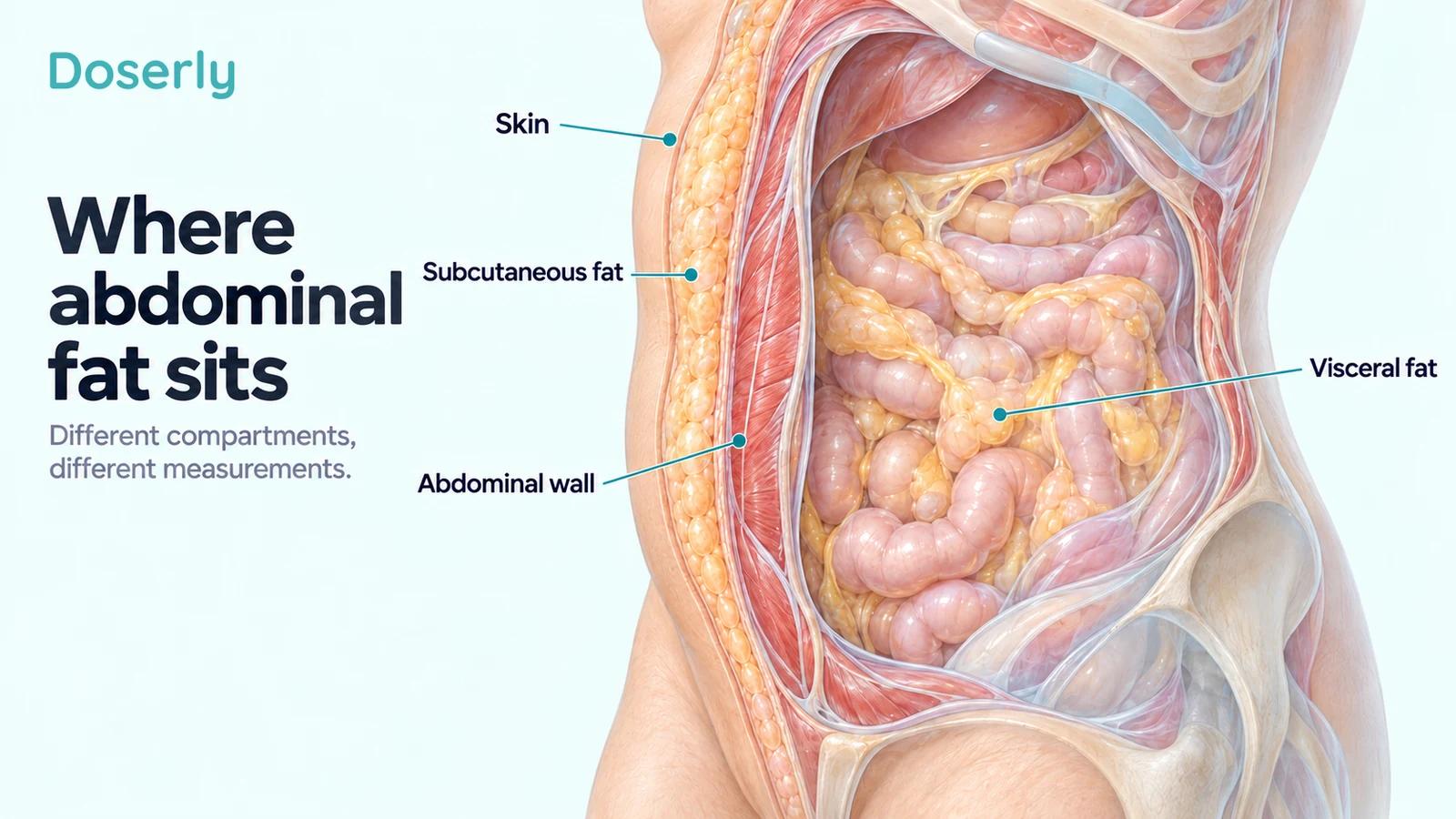
The distinction is visible in the tesamorelin results themselves. In the pooled phase 3 analysis, visceral fat changed significantly relative to placebo, whereas the difference in abdominal subcutaneous fat did not reach statistical significance. Calling both results “belly-fat loss” hides a central feature of the evidence. Pooled phase 3 trials
This also explains why photographs are an incomplete substitute for the trial measurements. Clothing, posture, lighting, and the outer fat layer affect the visible abdomen. A person could have a meaningful internal change without a dramatic photograph, or a striking photograph without evidence that visceral fat changed. Neither observation should be forced to stand in for the other.
Who entered the pivotal studies?
The main trials enrolled adults with HIV receiving antiretroviral therapy who had excess abdominal fat. They were not trials in an unselected group of people wanting weight loss. Eligibility included abdominal size criteria and other clinical requirements, and participants were followed within a structured research program. The label describes two controlled studies with an initial 26-week treatment period followed by a 26-week extension. Prescribing information, clinical studies
HIV-associated lipodystrophy is a clinical context, not a synonym for any large waist. Changes in regional fat distribution can coexist with overall obesity, and a clinician may need to address both. Having HIV does not automatically make every change in weight or appearance evidence of the particular fat-distribution problem targeted by tesamorelin.
The converse matters too: a person without HIV may have substantial visceral fat. Anatomical similarity is a reason to investigate a treatment, but it does not establish that the same balance of benefit and harm applies. The trial population, accompanying conditions, and treatment history help define what the result means.
A useful consultation should therefore describe the problem in ordinary language before naming a drug: which tissue appears excessive, how that assessment was made, what symptoms or concerns it creates, and what other health issues need attention. A sales conversation that begins and ends with the size of a waistband skips those distinctions.
What “about 15%” means
The 2010 pooled publication included 806 participants: 543 assigned to tesamorelin and 263 to placebo. At 26 weeks, mean visceral-fat area changed by approximately −24 square centimetres with tesamorelin and +2 square centimetres with placebo. The reported relative treatment effect was −15.4%. These were group results from CT measurements, not the percentage of total body weight lost. Pooled analysis
An area in square centimetres describes a cross-section. It is not a direct statement about kilograms of fat throughout the body. A relative treatment effect also compares groups; it should not be rewritten as a guarantee that every treated person loses exactly that proportion of their own visceral fat.
Consider a purely mathematical example, unrelated to any participant. If a measured area falls from 200 to 170 square centimetres, that is a 15% reduction in that area. It does not mean body weight falls by 15%, that waist circumference falls by 15%, or that a person’s cardiovascular risk falls by 15%. Each of those claims requires its own measurement and supporting evidence.
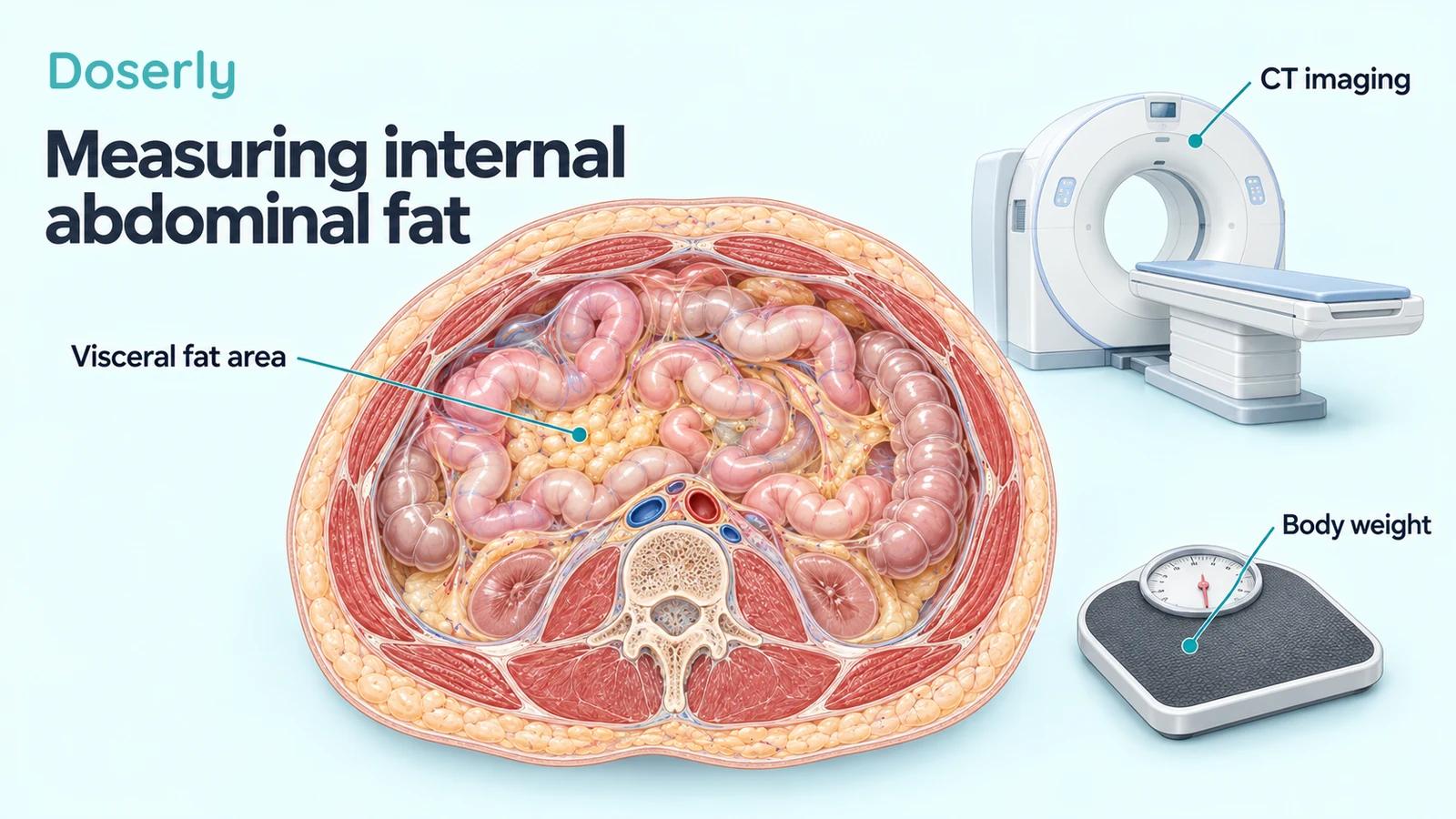
For an individual, the important follow-up is whether the agreed clinical goal improved enough to justify continuing treatment. The average trial response helps set expectations, but it cannot replace an assessment of that person’s benefit, adverse effects, and treatment burden.
Weight neutrality does not make the result meaningless
A medicine can alter body composition without causing substantial net weight loss. The scale adds together fat, muscle, fluid, bone, and other tissues. It cannot identify which compartment changed. Tesamorelin’s weight-neutral labeling is compatible with a reduction in visceral fat; it limits the claim rather than cancelling it. Prescribing information
The distinction protects people from two opposite mistakes. Someone whose main goal is substantial overall weight reduction should not be offered visceral-fat evidence as though it were evidence for that goal. Someone being treated for an appropriate fat-distribution problem should not be told the treatment necessarily failed simply because the scale stayed similar.
Waist measurements can add useful context, especially when taken consistently, but they do not isolate visceral fat. They are affected by both fat compartments and other abdominal contents. A clinician can decide which measurements are appropriate in routine care; reproducing every research scan is not automatically necessary or justified.
The same care applies to “body recomposition.” A secondary study reported changes in CT muscle area and density among selected tesamorelin responders. It restricted the treated group to people whose visceral fat had already fallen by at least 8%, and it did not establish improved strength or everyday physical function. That is interesting additional evidence, but it cannot turn the pivotal abdominal-fat studies into a universal muscle-building claim. Exploratory muscle analysis
There is non-HIV research, but it answers a selected question
It would be inaccurate to say tesamorelin has never been studied outside HIV. A randomized trial enrolled 60 adults with abdominal obesity and reduced growth-hormone secretion and followed treatment for 12 months. It found a visceral-fat benefit relative to placebo without a significant effect on abdominal subcutaneous fat. This was a deliberately selected endocrine and metabolic population. Non-HIV randomized trial
That study makes the scientific picture broader than a simple “HIV only” evidence claim. It does not establish a general obesity indication or tell us that everyone with a larger abdomen has the same hormone physiology. A low or variable growth-hormone measurement should not be casually converted into a diagnosis or a reason to reproduce the study treatment.
The trial also assessed cardiovascular risk markers, including carotid artery wall thickness. A favorable marker is not equivalent to fewer heart attacks or longer life. The current US label continues to state that long-term cardiovascular safety has not been established. Those are separate questions: whether some markers move favorably, whether clinical events are prevented, and whether harms emerge over longer exposure. Non-HIV trial, current label
A smaller fat compartment is not a complete health outcome
Visceral-fat reduction is a real measured outcome, but its clinical importance needs context. A person may value an improvement in abdominal discomfort or appearance, while also needing separate management of blood pressure, glucose, lipids, smoking, or overall weight. One change should not erase those other priorities.
Regulatory discussions illustrate this distinction. In 2012, the European marketing application was withdrawn while the assessment was ongoing. The European Medicines Agency’s explanation included uncertainty about whether the observed fat reduction translated into health benefits, alongside other concerns. This was a historical application withdrawal, not evidence that the drug was withdrawn from the US market or that a particular harm had been proved. EMA withdrawal assessment
For readers, the practical lesson is to ask which benefit is being promised. Reducing an imaging measurement, improving how someone feels about their abdomen, preventing diabetes, and preventing cardiovascular events are different endpoints. A responsible explanation names the endpoint supported by the study rather than letting the word “healthier” carry all four meanings.
The product in a study also matters
The original studies used an earlier tesamorelin formulation. Current branded formulations have their own preparation instructions and dose strengths, supported by product-specific pharmacokinetic information. The milligram number printed in an older paper should not be treated as a self-directed dosing instruction for a different vial. The current label explicitly distinguishes EGRIFTA WR from EGRIFTA SV and explains their differing administration instructions. Current product information
This matters when a clinic or vendor quotes a published trial next to an unnamed preparation. The publication establishes what happened with the product and protocol that investigators used. It does not independently establish the identity, purity, stability, or equivalent exposure of every product sold under the same ingredient name. Asking for the exact prescription product is therefore part of understanding whether the cited evidence matches the proposed treatment.
It also helps separate a medication decision from a package of simultaneous changes. If someone starts several hormones, supplements, and a new training plan together, a change in their waist cannot be assigned specifically to tesamorelin from a before-and-after comparison. The controlled trials are informative precisely because they included a comparator rather than relying on that kind of attribution.
Benefit and monitoring belong in the same discussion
Tesamorelin stimulates the growth-hormone pathway and raises IGF-1. The prescribing information calls for IGF-1 monitoring and assessment of glucose before treatment and periodically afterward. It also addresses fluid retention, joint symptoms, hypersensitivity, and other precautions. Producing a more endogenous pattern of hormone release does not remove those requirements. Prescribing information, warnings and precautions
The treatment horizon matters as well. Participants switched from tesamorelin to placebo in the extension program tended to regain visceral fat. A short course cannot be presented as a demonstrated permanent reset. The FDA review described reaccumulation toward baseline after discontinuation, making maintenance and stopping plans relevant before treatment begins. FDA medical review
A useful appointment can bring these points together: the diagnosis being treated, the outcome that would count as success, how it will be assessed, when benefit will be reconsidered, and which safety findings could change the plan. Those questions make the evidence personal without pretending that a group average predicts an individual result.
Tesamorelin’s strongest abdominal-fat evidence deserves an accurate description. It supports a specific treatment effect in a specific setting. Keeping that description intact helps people with HIV-associated lipodystrophy understand a relevant option, while helping everyone else recognize when a familiar “belly fat” headline has travelled beyond the evidence.
Sources
- Falutz and colleagues: pooled phase 3 tesamorelin trials.
- Current EGRIFTA WR prescribing information.
- Makimura and colleagues: randomized trial in selected adults without HIV.
- Adrian and colleagues: exploratory CT muscle analysis.
- FDA original medical review.
- EMA explanation of the 2012 application withdrawal.