
Peptides
October 16, 2026
Tesamorelin and liver fat: what the HIV trials measured
On this page
Fat stored inside liver cells is different from fat surrounding the abdominal organs. The two can occur together, but they are measured differently and do not always change together. That distinction is essential when reading about tesamorelin: its established US indication concerns excess abdominal fat in adults with HIV and lipodystrophy, while the liver-fat studies ask an additional question.
The liver findings are encouraging, particularly in people with HIV and fatty liver disease. They are also more specific than claims that tesamorelin “heals the liver.” A reduction in the liver’s fat fraction does not automatically mean inflammation has resolved, scar tissue has reversed, or future liver failure has been prevented. The main trials measured some of these outcomes separately, and their results should remain separate. 2019 randomized liver trial
This article explains what changed, what did not clearly change, and why the population matters. For the wider medication context, including the approved indication and safety precautions, see Doserly’s tesamorelin guide.
Three liver questions that should not become one
Steatosis means excess fat in liver cells. Inflammation and cellular injury describe different aspects of liver disease. Fibrosis means scar tissue, which can become more extensive over time. A study that detects less fat has answered a meaningful question, but it has not necessarily answered the other two.
The older studies use the terms nonalcoholic fatty liver disease, or NAFLD, and nonalcoholic steatohepatitis, or NASH. More recent publications use metabolic dysfunction-associated steatotic liver disease, or MASLD, and related terminology. It is useful to preserve the original study terminology when discussing its eligibility criteria rather than assume every historical cohort maps perfectly onto a newer definition. The 2024 tesamorelin subgroup paper describes its parent population using MASLD terminology. Original liver trial, 2024 subgroup analysis
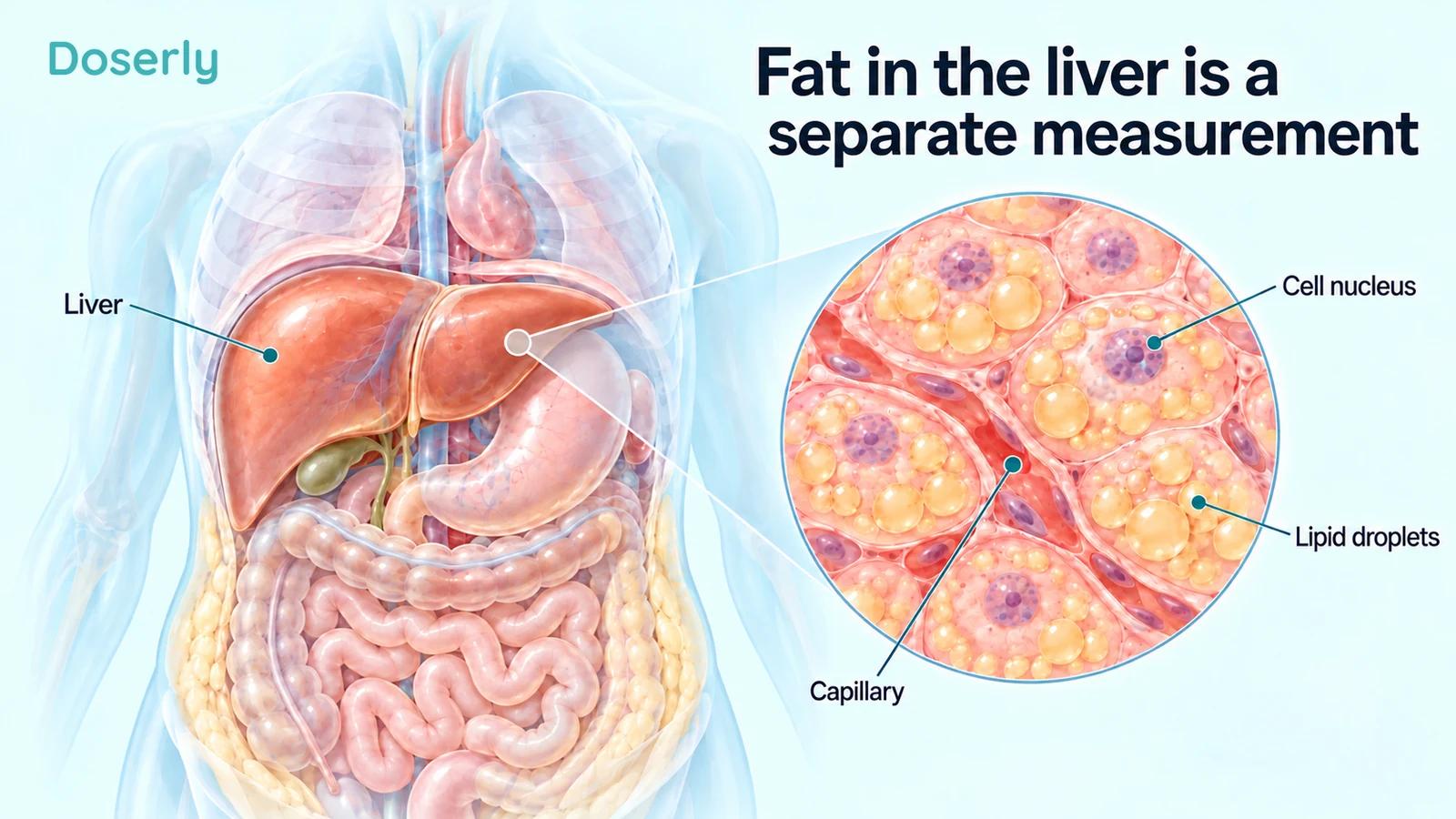
Hepatic fat fraction is an imaging estimate of how much of the measured liver signal is attributable to fat. In these studies, proton magnetic resonance spectroscopy helped quantify it. A liver biopsy, by contrast, allows tissue assessment of fat, inflammation, injury, and fibrosis. Neither should be replaced by a photograph of someone’s abdomen or by a single body-weight reading.
Blood liver enzymes add another kind of information. They may change with liver injury, but a change in an enzyme is not a direct measurement of fat fraction or scar stage. This is why a careful report names the test instead of saying simply that “the liver improved.”
The six-month study established a liver-fat signal
A 2014 randomized trial assigned 50 adults with HIV and abdominal fat accumulation to tesamorelin or placebo; 48 received treatment. Investigators measured visceral fat and liver fat over six months. Liver fat fell more with tesamorelin, with a net treatment effect of approximately −2.9 percentage points in the study’s liver lipid-to-water measure. Visceral fat also declined relative to placebo. 2014 JAMA trial
This was direct human treatment evidence, not an inference from animal experiments or from a hormone increase alone. At the same time, its small size and six-month duration limit what it can tell us about uncommon harms or long-term liver disease. The study did not establish prevention of cirrhosis, transplantation, or liver-related death.
Glucose findings also depended on timing. Fasting glucose increased more in the tesamorelin group at two weeks, while the between-group difference was not statistically significant at six months. Reporting only the final visit would miss that early observation; describing persistent deterioration throughout the trial would also be inaccurate. 2014 trial
For a reader, the result supports a focused statement: tesamorelin produced a liver-fat reduction in a small, monitored HIV trial. It does not support treating the absence of a final average glucose difference as proof that glucose monitoring is unnecessary.
The 12-month trial asked a more targeted question
The 2019 multicenter study enrolled 61 people with HIV and hepatic fat fraction of at least 5%. Participants were randomized to tesamorelin or matching placebo for 12 months. Change in hepatic fat fraction was the primary efficacy endpoint; glucose was the primary safety endpoint. The analysis used available observations, with additional sensitivity analyses for missing data. Full trial report
The reported treatment effect on hepatic fat fraction was −4.1 percentage points, with a 95% confidence interval from −7.6 to −0.7. The authors also expressed the effect as a 37% relative reduction. Those are two descriptions of the result, not two benefits to add together. At 12 months, 35% of participants in the tesamorelin group versus 4% in the placebo group had a hepatic fat fraction below 5%. 2019 trial
Percentage points and relative percentages often cause confusion here. In an illustrative example, a fat fraction falling from 10% to 6% has fallen by four percentage points and by 40% relative to its starting value. That example explains the arithmetic; it is not the trial’s average participant or a prediction of an individual response.
Crossing below a study threshold is also different from proving complete recovery. A liver-fat fraction under 5% describes that measurement at that visit. It does not establish the absence of every form of liver injury, guarantee that the result will persist after treatment, or show that no further liver care is needed.
The fibrosis result was about progression, not demonstrated reversal
The biopsy findings deserve attention because they address something imaging fat alone cannot. Among participants with relevant paired assessments, fibrosis progressed in 2 people receiving tesamorelin and 9 receiving placebo, corresponding to 10.5% and 37.5%. The difference was statistically significant in this small study. Biopsy results in the primary report
However, the study did not demonstrate improvement in existing fibrosis. Among participants with fibrosis at baseline, improvement occurred in 2 tesamorelin-treated participants and 3 placebo-treated participants, without a significant difference. The overall NAFLD activity score, lobular inflammation, and hepatocellular ballooning also did not show significant between-group improvements. These findings prevent a responsible summary from becoming a claim of scar reversal. 2019 histology results
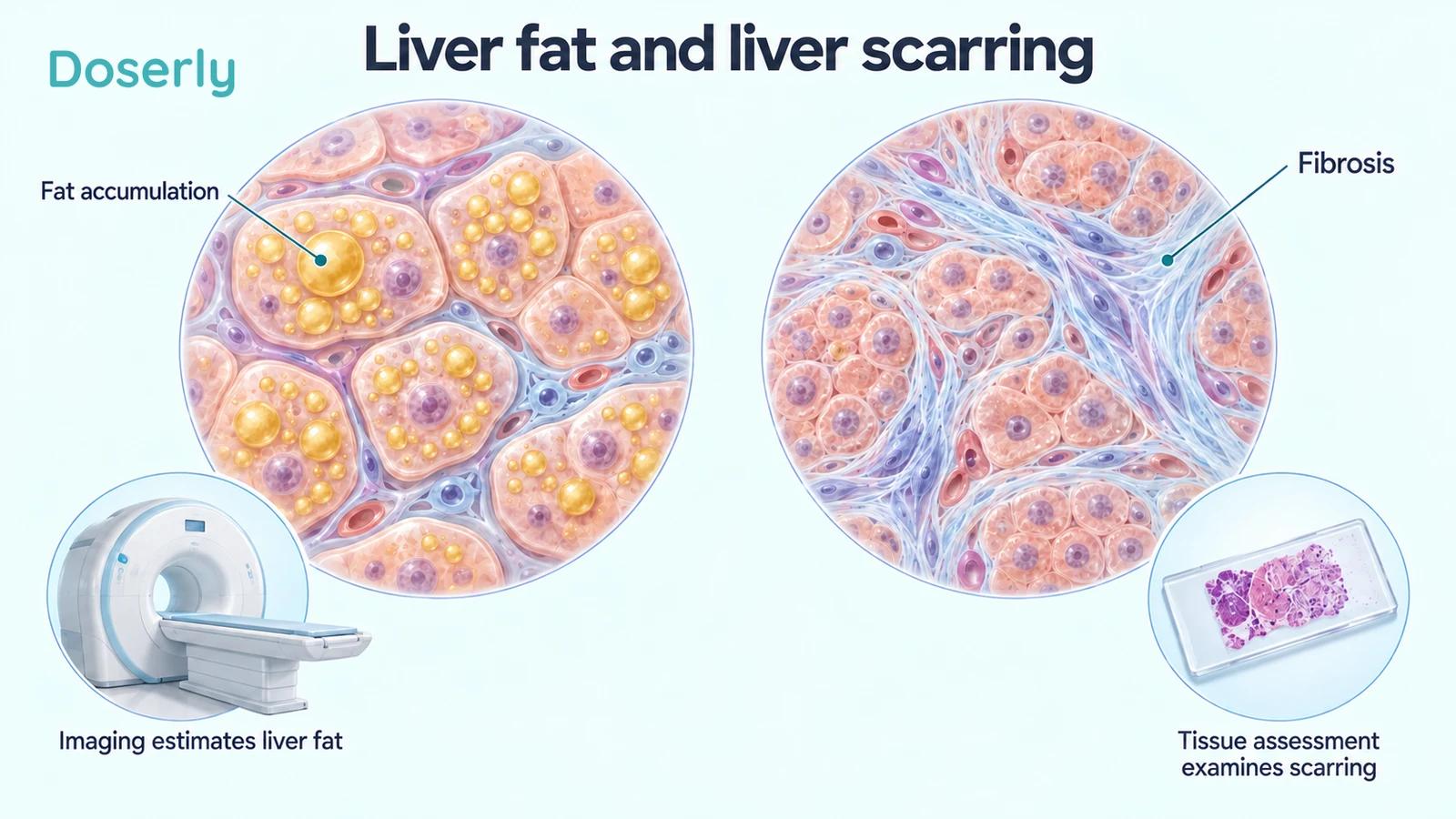
The distinction between slowing progression and reversing existing disease is practical. If a person already has fibrosis, they need an explanation of evidence relevant to that condition. A favorable result on the number of people whose fibrosis worsened cannot be rewritten as evidence that their existing scar tissue will disappear.
The small biopsy sample also matters. Only a subset of the original cohort contributed to those comparisons, and a few events can meaningfully change the percentages. The finding supports further investigation; it is not the same level of certainty as a large trial designed primarily to test a fibrosis endpoint and clinical outcomes over several years.
What the broader trial registry adds
A separate registered study, NCT03375788, investigated a growth-hormone-releasing-hormone analog for fatty liver disease and associated cardiovascular risk. Its eligibility criteria centered on obesity or overweight with steatohepatitis and evidence of liver fat, rather than requiring HIV. The study enrolled 51 participants, and results were first posted in November 2025. This is therefore more than an uncompleted registration, but the posted results should still be identified as registry evidence. ClinicalTrials.gov results
The participant flow records 38 people completing the 12-month blinded phase with at least one assessment, while the primary liver-fat outcome includes 34 participants. Those denominators are not interchangeable. They tell a reader that enrolling 51 people did not yield 51 complete primary-outcome measurements.
The posted median change in fibrosis stage was zero in both groups. That does not establish that every participant was unchanged, that fibrosis could never respond, or that the trial proved equivalence. A median is the middle of a distribution; individual changes can occur on either side. The registry also reports liver-fat results, but its outcome units require care and should not be casually mixed with the percentage-point estimates from the HIV publications. Registry outcome tables
This newer record broadens the questions being studied. It does not make the original HIV findings universally applicable or create a US liver-disease indication. The current EGRIFTA WR label remains framed around excess abdominal fat in adults with HIV and lipodystrophy. Current prescribing information
Liver enzymes need their own interpretation
The 2019 trial did not show a significant overall reduction in ALT or GGT, two liver-related blood measurements. In a subgroup with elevated ALT at baseline, ALT fell more with tesamorelin. That is a narrower finding than improvement across the whole cohort, and it should be described with the baseline restriction intact. Primary trial results
This helps explain a situation that can otherwise feel contradictory: an imaging result may improve while a routine blood test changes little. The tests are not interchangeable, and participants with normal or near-normal starting values may have less room for a numerical decrease. The reverse is also important. A lower enzyme result does not, by itself, document a lower fibrosis stage.
For someone following several results, the useful record preserves the name of each test rather than reducing them to a single “liver score.” That makes it possible to discuss an imaging trend, an enzyme trend, and a fibrosis assessment on their own terms before drawing an overall clinical conclusion.
Why body weight and liver fat may tell different stories
The liver trial did not show a significant effect on body weight or total body fat, despite the liver-fat result. That is not a contradiction: an organ-specific measurement and total body mass answer different questions. Similarly, an unchanged waist does not show that liver fat was unchanged, and a smaller waist does not prove that it fell. 2019 trial
This matters when people track treatment with the measurements available at home. A scale, tape measure, symptom diary, or photograph can document useful observations, but none directly quantifies hepatic fat fraction or fibrosis. They are best used as context for clinical follow-up rather than as substitutes for the relevant assessment.
It also prevents overinterpretation of a good-looking laboratory panel. A person can have several favorable results without all aspects of liver disease moving together. The clinician’s job is to integrate the diagnosis, imaging or fibrosis assessment where appropriate, metabolic health, medication history, and changes over time.
Safety results need their own reading
The 2019 study found no significant between-group difference in fasting glucose or HbA1c over the treatment period. Local injection-site complaints were more frequent with tesamorelin. These observations are useful, but the study was small and participants were screened and monitored. Trial safety findings
The current prescribing information separately warns about glucose intolerance or diabetes, elevated IGF-1, fluid retention, and other risks. It calls for glucose assessment before treatment and periodically afterward, along with IGF-1 monitoring. A promising liver-fat response does not make those precautions irrelevant, and an increase in IGF-1 is not a reason to assume liver benefit. Prescribing information
A useful treatment discussion identifies the actual liver problem first. Is the concern excess fat, suspected inflammation, established fibrosis, or a combination? Which result would change management? What evidence applies to the person’s HIV status and metabolic profile? How would benefit and safety be reassessed?
Those questions allow the liver studies to be taken seriously without asking them to prove more than they measured. Tesamorelin reduced liver fat in controlled HIV trials, and the histology findings generated an important signal about progression. The evidence does not yet justify replacing those precise statements with a broad promise of liver repair.
Sources
- Stanley and colleagues, 2014: six-month liver and visceral-fat trial.
- Stanley and colleagues, 2019: randomized HIV fatty-liver trial.
- 2024 integrase-inhibitor subgroup analysis.
- NCT03375788: protocol, participant flow, and posted results.
- Current EGRIFTA WR prescribing information.