
Peptides
October 16, 2026
Tesamorelin and IGF-1: why a higher result is not the goal
On this page
IGF-1 often appears in tesamorelin discussions as proof that the medication is “working.” There is a physiological reason for the connection: tesamorelin stimulates growth-hormone secretion, which increases insulin-like growth factor 1, or IGF-1. But the same laboratory result is also part of safety monitoring. A rise can show that a hormonal pathway responded without establishing that the person gained a worthwhile clinical benefit.
The current prescribing information is explicit about both sides. It describes tesamorelin’s effect on IGF-1, calls for monitoring during therapy, and advises considering discontinuation when elevations persist, especially when the efficacy response is not robust. It also states that the effects of prolonged IGF-1 elevation are unknown. EGRIFTA WR prescribing information
For someone reviewing a blood test, the useful question is therefore not how high the number can go. It is what the result means in relation to the laboratory reference, the person’s age, the treatment goal, other safety findings, and the trend over time. Doserly’s tesamorelin monitoring guide provides the broader context.
What IGF-1 tells us about the hormone pathway
Growth hormone is released by the pituitary gland and acts on several tissues. Some of its effects are mediated by IGF-1 produced in the liver and in peripheral tissues. Tesamorelin stimulates the upstream growth-hormone-releasing-hormone receptor pathway; it does not directly administer IGF-1. Label, mechanism and pharmacodynamics
Growth-hormone concentrations fluctuate substantially during the day. IGF-1 is relatively more stable, which makes it useful for assessing the growth-hormone axis. Its usual levels also change across the lifespan, rising through childhood and puberty before declining in adulthood. That age dependence is one reason an isolated number needs a reference context. MedlinePlus IGF-1 test explanation
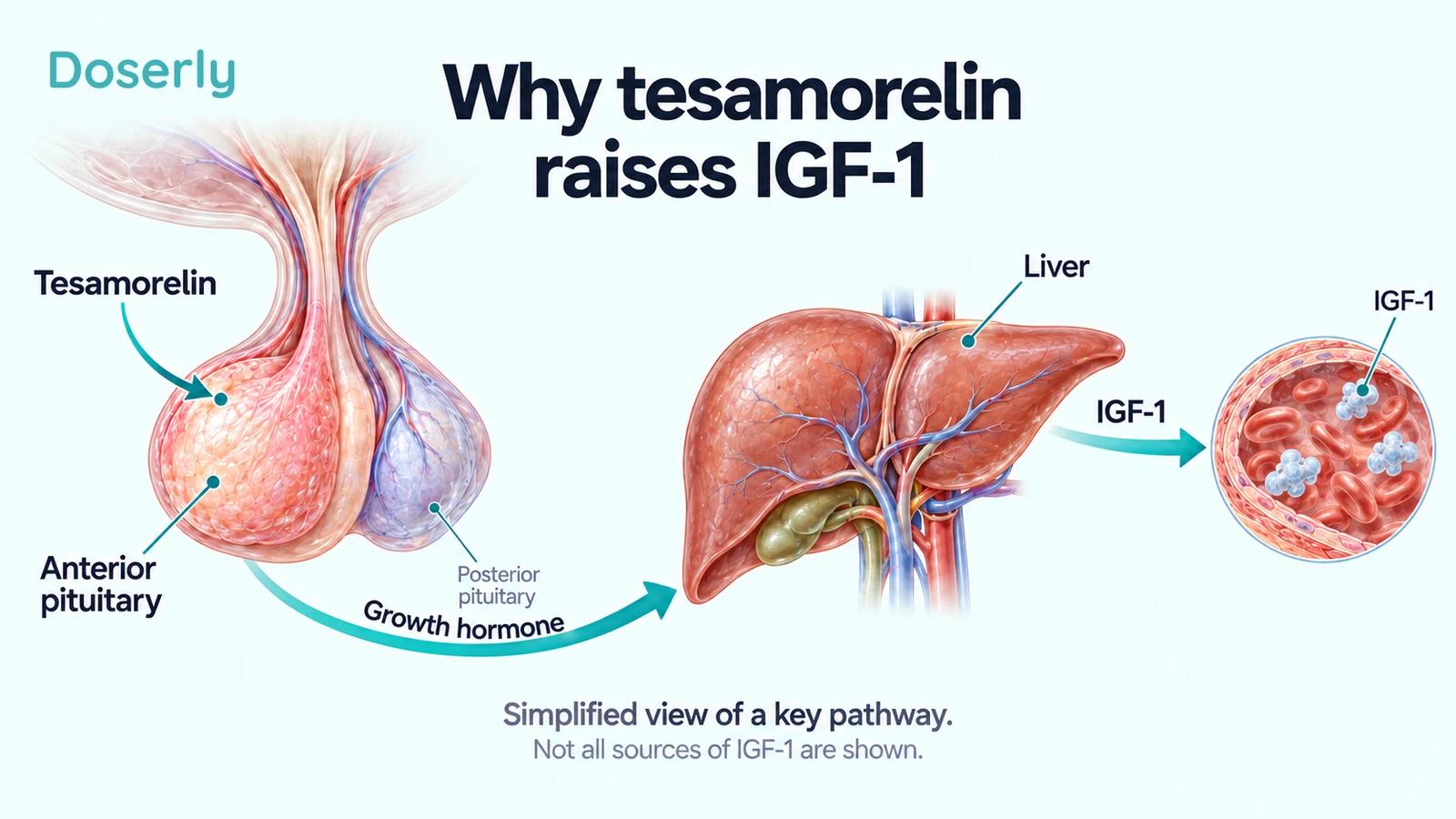
A blood concentration is still only one part of the picture. It does not directly measure visceral fat, strength, symptoms, or long-term health. Those outcomes require their own assessments. Treating the laboratory change as the final goal reverses the purpose of monitoring: the test should help evaluate treatment, not become a number that treatment is pushed to maximize.
Read the value, units, and reference together
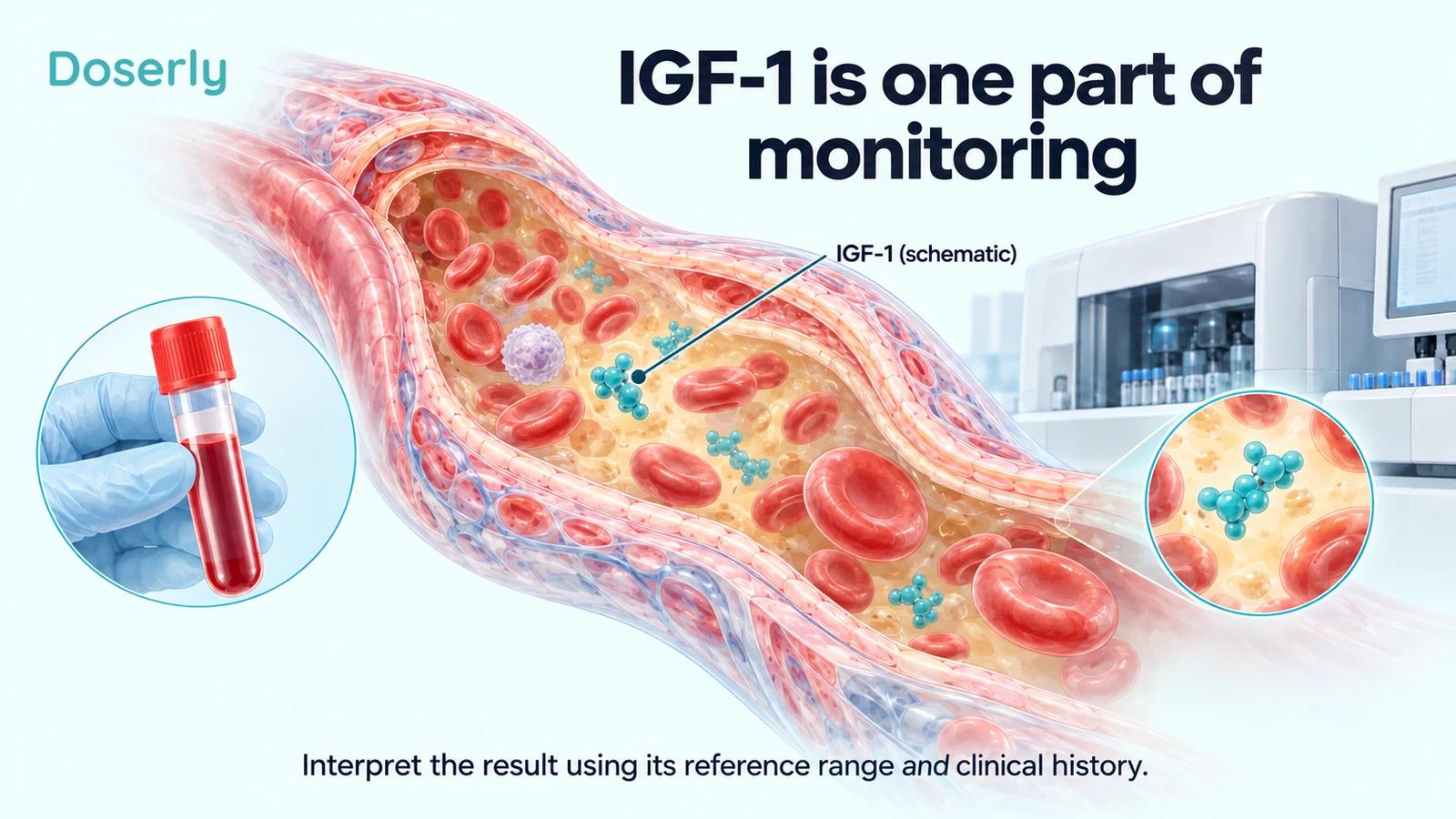
Laboratories report results with units and a reference interval. Different methods and laboratories can use different reference ranges, so a result should be interpreted against the range printed on that report. A comparison with a screenshot from another person or another laboratory can be misleading. MedlinePlus: understanding laboratory results
For IGF-1, age-related interpretation is particularly relevant. A concentration that looks familiar from a younger person’s report is not automatically an appropriate target for an older adult. “Youthful” is not a validated safety category, and a reference range is not an instruction to aim for its highest value.
Some reports use a standard deviation score, abbreviated SDS, or a z-score. This expresses how far a result lies from the reference distribution rather than giving the concentration alone. A positive score indicates a value above the reference mean. The tesamorelin label uses SDS when describing elevated results and its monitoring precaution. Prescribing information, elevated IGF-1
An SDS of 3 is not “three times the normal IGF-1 concentration.” It is a standardized position relative to the reference distribution. The laboratory’s calculation and reference population matter, so a reader should not invent a personal conversion from a concentration to an SDS using an online rule of thumb.
How common were elevated values in the trials?
The label reports that after 26 weeks of EGRIFTA treatment, 47% of participants had IGF-1 values above 2 SDS and 36% had values above 3 SDS. Among those who remained on treatment for 52 weeks, the corresponding proportions were 34% and 23%. These are two thresholds applied to the trial population, not percentages by which IGF-1 increased. Label, section 5.2
The groups overlap: a person above 3 SDS is also above 2 SDS. The percentages should not be added together. Likewise, the 52-week figures concern people remaining on treatment and should not be interpreted as proof that every individual’s result naturally returned toward normal with time.
These findings explain why monitoring is part of ordinary treatment evaluation. They do not mean that everyone with an elevated result developed a particular complication. The label distinguishes an observed laboratory effect from uncertainty about the consequences of prolonged exposure.
That distinction matters emotionally as well as scientifically. A flagged result deserves interpretation and follow-up, but a flag alone is not a diagnosis of cancer, acromegaly, or another specific disease. Conversely, feeling well does not make a persistent elevation irrelevant.
The label describes a decision, not a performance target
The prescribing information advises considering discontinuation for persistent elevations, giving greater than 3 SDS as an example, particularly when the efficacy response is not robust. This is a clinical benefit-risk decision. It is not a recommendation to aim just below that value or to adjust a dose independently until a preferred number appears. Current label
“Persistent” also matters. The clinician needs to understand the timing, repeat measurements where appropriate, the laboratory context, and the medication history. One result and a sustained pattern are not identical pieces of information. The label does not provide a universal self-managed retesting calendar or a titration algorithm for readers to follow.
A practical discussion can start with the actual report: the concentration and units, the age-adjusted range or score, prior results, and the date relative to treatment changes. That is more useful than reporting only that IGF-1 was “high” or “optimal.” It also makes it easier to identify when a change of laboratory or method complicates comparison.
An association with response is not permission to chase the marker
A secondary analysis of the pivotal program compared people whose visceral fat fell by at least 8% with those who did not meet that threshold. The responder definition had been specified in advance, but the comparisons of metabolic and endocrine responses were post hoc. Responders generally had more favorable changes in several metabolic measures. Responder analysis
This kind of analysis can help researchers understand patterns accompanying response. It does not randomly assign people to different IGF-1 targets or prove that deliberately pushing IGF-1 higher will improve their outcome. The groups are defined by what happened after treatment, which makes them different from randomized treatment arms.
A separate liver-fat trial illustrates another limit. Tesamorelin increased IGF-1 and reduced liver fat overall, but the investigators did not find a significant relationship between the individual change in IGF-1 and change in hepatic fat fraction among treated participants. The hormone result and the clinical measurement should therefore remain distinct. 2019 liver trial
For a patient, the implication is straightforward: an increased IGF-1 result cannot substitute for evidence that the intended abdominal-fat problem improved. If the clinical response is weak, a larger hormone change does not automatically rescue the treatment rationale.
Glucose monitoring answers a different safety question
IGF-1 is not a stand-in for blood glucose. The tesamorelin label calls for assessing glucose before treatment and periodically during therapy because glucose intolerance or diabetes can develop. In the clinical program, diabetes defined by HbA1c of at least 6.5% occurred more often with tesamorelin than placebo, reported as 5% versus 1%. Label, glucose precautions
A normal IGF-1 result does not establish normal glucose regulation, and an acceptable glucose result does not settle the IGF-1 question. Each test contributes different information. The treatment goal, both laboratory trends, and any symptoms need to be considered together.
Timing can also matter. In the small 2014 liver-fat trial, fasting glucose rose more with tesamorelin at two weeks, but the between-group difference was not significant at six months. A final average can therefore conceal an earlier change. It is one reason a statement that “glucose was fine in a study” needs the study’s duration and assessment schedule. 2014 randomized trial
Small newer studies with reassuring average glucose findings do not cancel the larger clinical program’s safety precautions. They add evidence for their own monitored populations and durations, with limited ability to detect uncommon outcomes.
Similar hormone changes can lead to different decisions
Consider two hypothetical people whose IGF-1 rises during treatment. One has a clear improvement in the clinical problem being treated, stable glucose measurements, and no troublesome symptoms. The other has little clinical improvement and a worsening glucose trend. The same direction of IGF-1 change would not make their overall treatment assessments equivalent.
This example does not establish a rule for either person. It shows why the label connects persistent elevation with the strength of the efficacy response, and why it separately addresses glucose intolerance in people without clear benefit. A laboratory response needs to be interpreted within a benefit-risk assessment, not awarded a pass or fail in isolation. Prescribing information
The comparison also explains why another person’s successful treatment story is an incomplete guide to your result. Their starting level, reference range, clinical response, and other findings may differ even if the number printed on the report looks similar.
Other clinical findings still matter
Tesamorelin’s safety assessment is broader than two blood tests. The label addresses fluid retention, joint symptoms, carpal tunnel symptoms, hypersensitivity, and malignancy-related precautions. Active malignancy is a contraindication, while a history of treated malignancy requires a careful benefit-risk assessment. Prescribing information
These precautions should not be distorted into a claim that an elevated IGF-1 value proves tesamorelin caused a cancer. They reflect the drug’s growth-factor biology, clinical observations, and uncertainty that requires attention. The useful response is accurate monitoring and interpretation, not either reassurance based only on the word “natural” or alarm based only on one number.
The exact product and other medications also belong in the record. Current EGRIFTA formulations have different preparation and administration instructions, and the label states that WR and SV are not substitutable. A dose number from an older publication is not a safe basis for changing a current prescription. Product information
Use the result to evaluate treatment
A useful review connects three questions: did the intended clinical outcome improve, are safety findings acceptable, and is the ongoing burden worthwhile? IGF-1 contributes to the second question and can confirm a pathway response, but it does not answer the first or third by itself.
Bringing the complete laboratory report, prior results, medication changes, and relevant symptoms to follow-up helps keep those questions connected. The aim is not to turn a personal log into a diagnostic tool. It is to give the clinician enough context to interpret a pattern rather than an isolated screenshot.
Tesamorelin can raise IGF-1 as expected and still require reconsideration. That is not a contradiction. A biomarker can be part of the mechanism and part of safety monitoring at the same time. Its most useful role is to inform a treatment decision grounded in clinical benefit, rather than become a number pursued for its own sake.
Sources
- Current EGRIFTA WR prescribing information.
- MedlinePlus: IGF-1 testing.
- MedlinePlus: understanding laboratory results.
- Stanley and colleagues: visceral-fat responder analysis.
- 2019 randomized liver-fat trial.
- 2014 randomized visceral and liver-fat trial.