
Longevity
October 17, 2026
Are longer telomeres always better? Aging, repair and cancer risk
On this page
Telomeres are often presented as the body's countdown clock. These protective structures at chromosome ends tend to shorten as cells divide, so the proposed solution sounds obvious: preserve them, lengthen them, keep the clock from running out.
The biology is more interesting than that story. Telomeres help cells maintain the capacity to divide, but unlimited cellular persistence is not the same thing as a longer, healthier human life. A useful tissue needs renewal. A potentially dangerous cell can also benefit from the opportunity to keep multiplying. Human genetics now makes this tradeoff difficult to ignore.
That does not mean long telomeres are a diagnosis of cancer, or that short telomeres are desirable. Rare disorders of telomere maintenance can cause serious disease. It means telomere length is one part of a regulated system, not a number everyone should try to maximize.
This distinction matters for commercial telomere tests, supplements and peptides marketed around telomerase activation. To evaluate those claims, we need to separate what happens to cells in a dish, what inherited biology tells us about disease and what an intervention has actually improved in people.
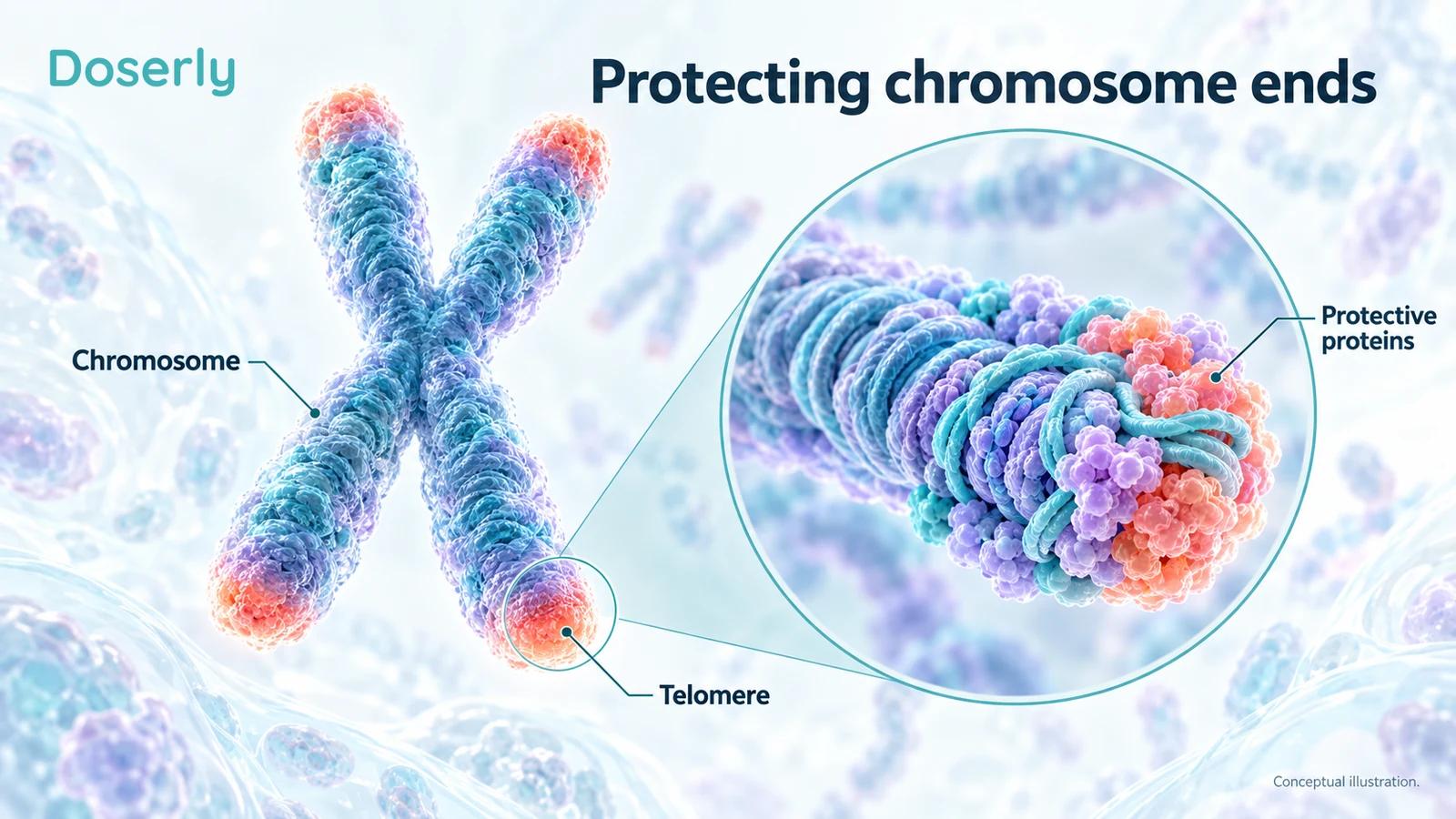
Conceptual chromosome illustration; colors identify structures rather than measured telomere lengths.
What a telomere protects
A chromosome contains a long DNA molecule. Its ends need special handling because a natural chromosome end should not be mistaken for a broken piece of DNA. Telomeres consist of repeated DNA sequences together with associated proteins that help protect and regulate those ends. The protein machinery matters alongside the amount of repeat DNA.
Telomerase is an enzyme complex capable of adding telomeric repeats. Its activity varies between cell types and biological circumstances. In classic experiments, introducing the catalytic component of telomerase into normal human cell cultures extended their replicative lifespan. These studies helped establish that telomere maintenance can influence how many times particular cells divide. They did not show that giving a telomerase activator to a person extends that person's life. Bodnar and colleagues, 1998 cell experiments
Replicative lifespan is a precise cellular term. It describes a cell population's capacity to continue dividing under the conditions studied. Human lifespan includes organ function, infection, cancer, vascular disease, injury and many other processes. Moving between those two meanings of “lifespan” without explanation creates a powerful but misleading impression.
The popular shoelace-cap analogy is useful for understanding protection at an end. It becomes less useful if it suggests that adding more cap material is always beneficial. Biological chromosome ends are actively regulated, and their consequences depend on the cell carrying them, its other mutations and the tissue surrounding it.
Very short telomeres can cause real disease
Short-telomere syndromes are an important corrective to any suggestion that telomere shortening is simply protective. Defects in maintenance genes can limit tissue renewal and contribute to bone-marrow failure, immune problems, pulmonary fibrosis and other disease. The presentation can differ with age and the severity of the inherited defect.
A hospital-based study of telomere testing used flow cytometry with fluorescent in situ hybridization, usually called flow-FISH, to evaluate patients with relevant clinical presentations. Results helped identify or exclude particular telomere-related diagnoses and informed decisions in a subset of people with otherwise unexplained bone-marrow failure. This was targeted diagnostic testing, supported by clinical and genetic assessment. Alder and colleagues, diagnostic utility study
That is a different use from sending a healthy person a “telomere age.” In the hospital setting, there is a specific suspected disorder, a method with an appropriate reference range and a decision that can change because of the result. The purpose is to understand illness, not to rank a person on a universal aging scale.
Someone with unexplained blood-count abnormalities, pulmonary fibrosis or a striking family history may have a reason for specialist evaluation. Those findings have many possible causes; they do not diagnose a telomere disorder by themselves. Early gray hair alone is especially unsuited to becoming a home diagnostic shortcut. The pattern of illness and family history matters much more than a single familiar feature.
Longer telomeres can support unwanted cell persistence
The other side of the tradeoff became especially visible in a 2023 study of families with loss-of-function variants in POT1, a gene involved in telomere protection and regulation. Researchers initially studied 17 carriers and 21 noncarrier relatives, then added six carriers in a validation group. Many assessed carriers had unusually long telomeres, and the families showed a range of benign and malignant growths and expanded blood-cell clones. DeBoy and colleagues, long-telomere syndrome study
The explanation is not that telomere DNA itself behaves like a carcinogen. Extended replicative capacity can allow a cell lineage carrying other mutations to persist and expand. In the study, inherited telomere-maintenance biology helped explain why particular blood-cell lineages could remain active over long periods.
These were selected families with a rare genetic condition. The study does not provide the cancer probability of an otherwise healthy person whose commercial test reports above-average telomere length. It also does not prove that a short course of a particular supplement recreates the lifelong biology of a POT1 variant. Those are different exposures with different unanswered questions.
The finding does undermine a universal “longer is better” claim. If a biological change can support both tissue renewal and the survival of abnormal clones, a treatment designed to produce that change needs to demonstrate its overall effect. The attractive mechanism alone cannot settle the balance.
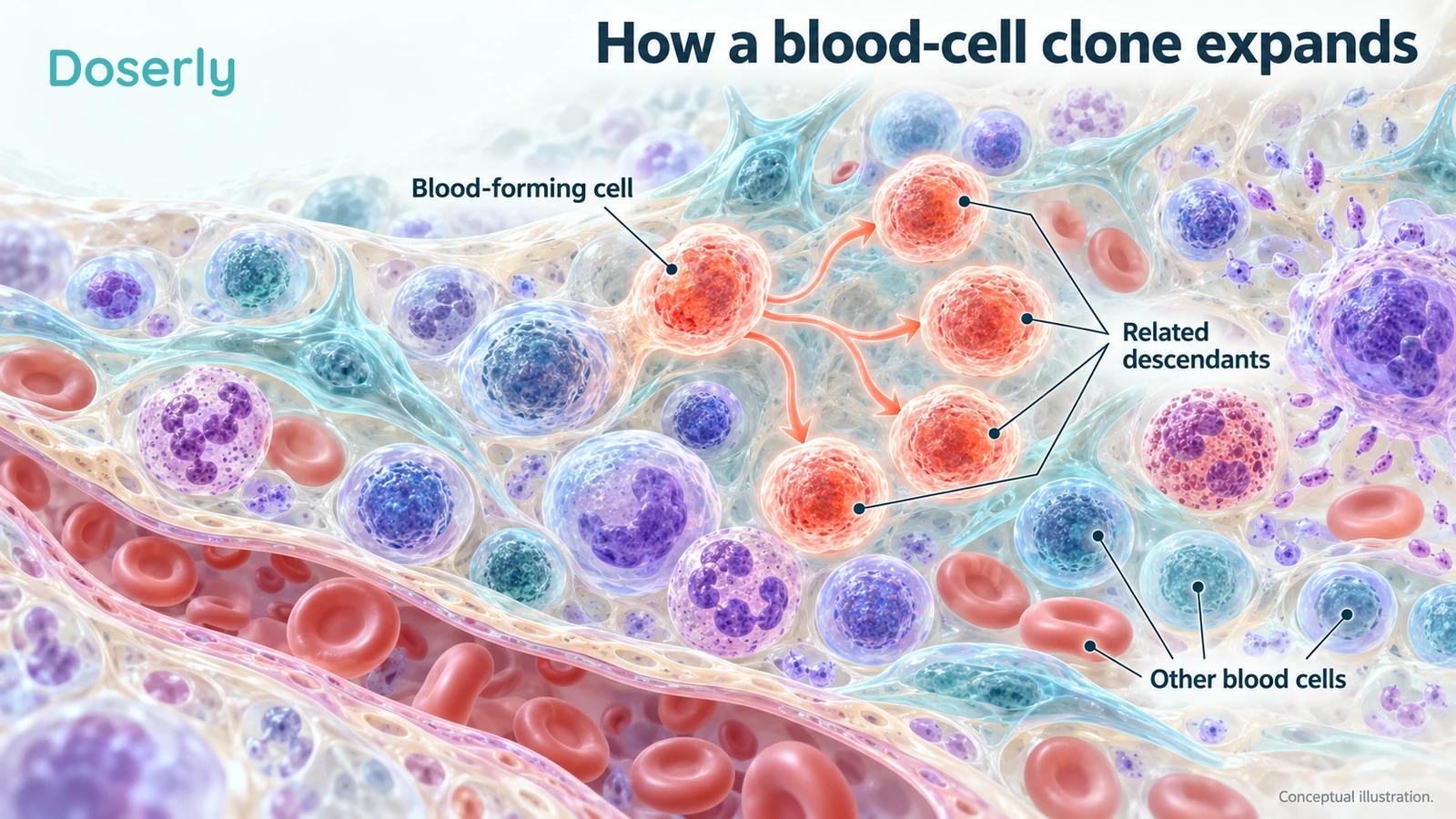
Conceptual lineage illustration; a blood-cell clone is not automatically leukemia.
A blood-cell clone is not the same as blood cancer
Blood is continually replenished by stem and progenitor cells. When one cell acquires a mutation and its descendants make up a growing share of blood production, researchers call that clonal hematopoiesis. “Clonal” refers to shared ancestry. It does not automatically mean the cells have become malignant.
Large human sequencing studies linked clonal hematopoiesis with age and with higher subsequent blood-cancer risk. They also showed that detectable clones can exist in people without a diagnosed blood cancer. The presence of a clone and the development of leukemia are therefore distinct events, often separated by substantial time and additional biological changes. Genovese and colleagues, blood-DNA sequencing study
This distinction prevents two unhelpful reactions to telomere research. One is to dismiss a clonal finding because no cancer has appeared. The other is to treat any mention of a clone as a cancer diagnosis. The relevant questions include the mutation, clone size, blood counts, symptoms, age and clinical context. A telomere measurement cannot supply all of that information.
It also explains why ordinary consumer testing is not a substitute for a clinical evaluation. A test measuring average telomere length is not the same as sequencing blood-cell mutations. Neither should be assumed to answer the other's question. Packaging both under “cellular aging” does not make their meanings interchangeable.
Newer research complicates both extremes
A 2025 study analyzed 454,098 UK Biobank participants alongside mechanistic work. It found that the relationship between inherited telomere length and clonal hematopoiesis differed by mutation type. Unlike many common clone types, certain splicing-factor-associated clones were linked with shorter genetically predicted telomeres. The investigators proposed and tested mechanisms through which telomere attrition can create selection pressure favoring some mutant cells. McLoughlin and colleagues, Nature Genetics
The implication is more subtle than replacing a long-telomere warning with a short-telomere warning. A tissue's environment influences which cells gain an advantage. Some clones may benefit from a larger initial capacity to divide; others may gain an advantage when surrounding cells struggle with critically short telomeres. Length and regulation interact with the identity of the mutation.
A September 2026 Nature Communications report examined how telomeres inherited from both parents contribute to POT1-associated biology, including preferential extension of shorter inherited chromosome ends. The families were highly selected. The study adds mechanistic detail rather than a validated screening rule for the general population. The findings describe telomere inheritance; they do not establish a longevity treatment. POT1 inheritance report
These findings make a single optimization target less plausible. They do not give readers a new ideal telomere length to chase. A biological system with several routes to disease is unlikely to be safely managed by moving one average measurement as far as possible in one direction.
What population genetics can tell us
Mendelian randomization uses genetic variants associated with an exposure to explore possible causal relationships with disease. A large 2017 analysis examined genetically influenced telomere length across 35 cancers and 48 non-neoplastic diseases. Longer genetically predicted telomeres were associated with greater risk of several cancers, while associations for some noncancer conditions, including coronary disease and interstitial lung disease, pointed in the opposite direction. Telomeres Mendelian Randomization Collaboration
This is valuable because inherited variants precede a later diagnosis, reducing some problems of reverse causation. For example, a disease or its treatment can change blood-cell biology, making it difficult to know whether a measured telomere difference came before or after the illness. Genetic approaches help investigate that problem.
They still depend on assumptions. A variant may affect more than the intended biological exposure, and the population studied may not represent everyone. Most importantly for intervention claims, the analysis concerns lifelong genetically influenced differences. It does not directly estimate the effect of starting a telomere-related product in midlife.
A risk association is also not an individual forecast. Relative estimates for rare cancers can sound alarming without telling a person their absolute likelihood of disease. The responsible conclusion is that telomere biology has competing consequences across diseases. It is not that a longer result means cancer is inevitable, or that shortening telomeres is a sensible prevention strategy.
What a commercial telomere result actually measures
A blood sample contains multiple cell populations. A result can summarize telomeric DNA across those cells, or a method can distinguish selected populations. Different assays answer somewhat different questions. A mean value also loses information about the distribution of chromosome ends, including very short ends that may be biologically important.
In an international comparison, ten laboratories measured the same human DNA samples using several methods. Relative rankings often agreed, but absolute measurements differed substantially between laboratories. The authors cautioned against freely sharing reference ranges across methods and laboratories. This older study does not establish the performance of every current product; it demonstrates why reproducibility and calibration need to be shown rather than assumed. Martin-Ruiz and colleagues, measurement comparison
There is another wrinkle when a report estimates telomere length from DNA methylation rather than measuring telomeric repeats directly. A 2021 comparison found only moderate correlations between a methylation-based estimator and measured telomere length, with wide limits of agreement. The estimator may capture related biology without being interchangeable with the physical measurement. Pearce and colleagues, assay comparison
Before interpreting a number, ask what sample and assay produced it, what reference population was used and how large a change exceeds expected variation. A label expressed in “years” does not make those technical questions disappear. It can actually obscure them by turning an uncertain biological comparison into a familiar-looking age.
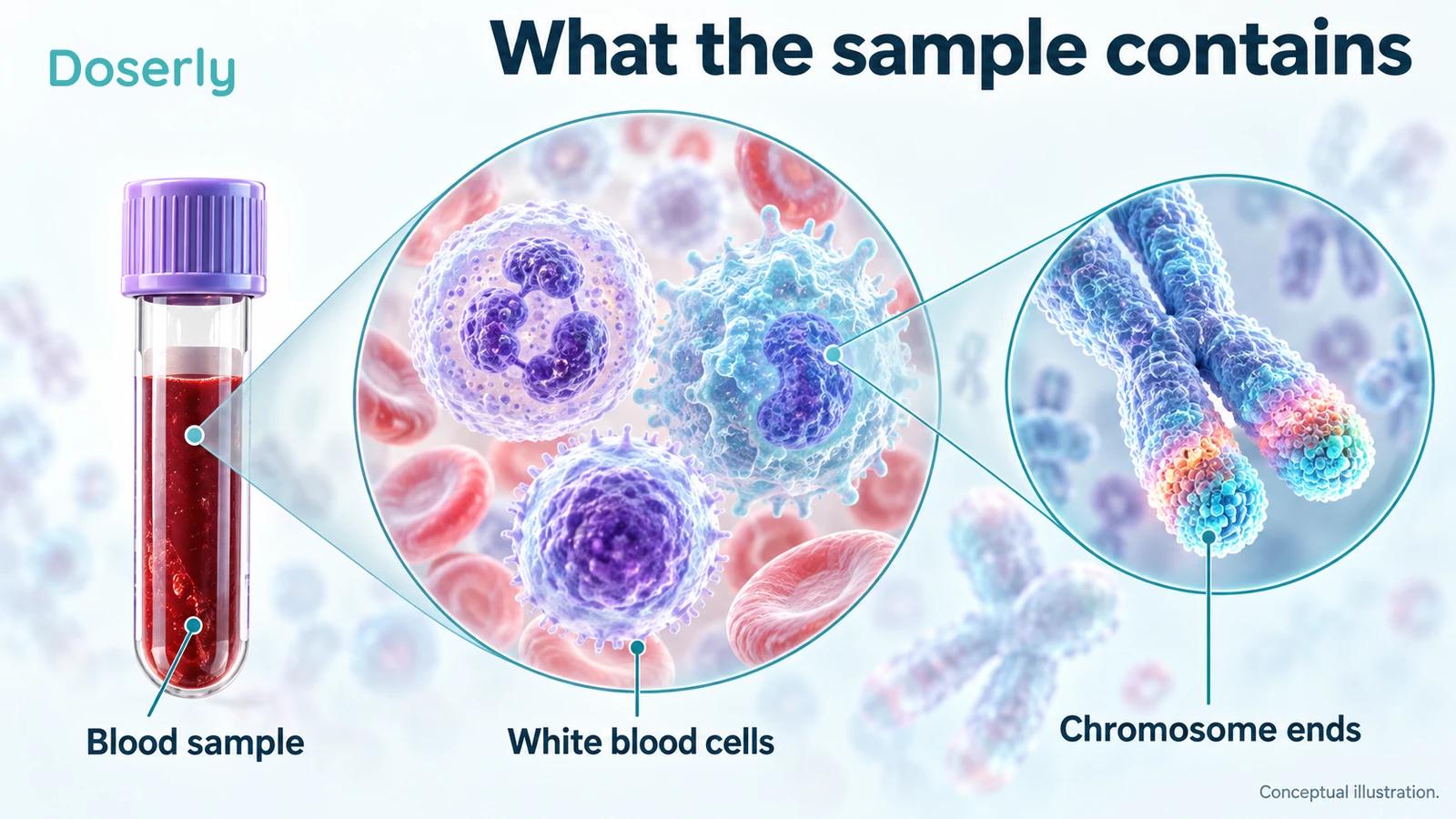
Conceptual measurement illustration; it contains no patient values, reference ranges or age estimate.
Why a longer follow-up result is not proof of rejuvenation
Suppose someone changes several habits, starts a supplement and repeats a telomere test. The second number is longer. That observation can be real and still fail to establish the story attached to it.
First, the difference needs to exceed measurement variation. Next, the samples and methods need to be comparable. A change in the mixture of cells being measured can affect a summary without meaning that every tissue has gained the same telomere length. Finally, even a convincing biological change needs a connection to outcomes that matter. It does not automatically show that an intervention prevented disease or restored function.
A before-and-after comparison also has no untreated counterfactual for that person. We do not know what would have happened without the intervention. When several changes occur together, attribution becomes harder still. This is a reason to interpret personal results carefully, not a reason to abandon habits that are worthwhile for other established benefits.
There is no need to make every healthy behavior pass through a telomere explanation. If a person becomes stronger, walks more comfortably or achieves better control of a diagnosed condition, those gains have value directly. Requiring a telomere result to certify them can make a less informative measurement seem more important than the improvement itself.
Epitalon: human cells are not treated humans
Epitalon, also spelled epithalon, is frequently discussed as a telomerase-related longevity peptide. A 2003 experiment reported telomerase activity and telomere elongation in cultured human fetal fibroblasts exposed to the peptide. The word “human” describes the origin of the cells. It does not make the experiment a human clinical trial. Original fibroblast study
A 2025 study examined normal epithelial and fibroblast cells alongside two breast-cancer cell lines. It reported telomere lengthening through different apparent mechanisms: telomerase-related effects in the normal cells and evidence of alternative lengthening of telomeres, or ALT, in the cancer lines. These were laboratory experiments, not observations of cancer incidence in people taking epitalon. Al-Dulaimi and colleagues, Biogerontology
The publisher issued a November 2025 correction replacing three figures; the original article has been corrected. The findings justify further investigation of mechanism and safety. They do not establish that epitalon causes cancer in people, and they do not establish that it safely prolongs life. Both claims would outrun the study. A culture dish cannot reproduce the full distribution, metabolism, immune surveillance and long-term consequences of an intervention in a person.
Older human longevity claims also require attention to product identity. A report involving 266 older people studied the pineal preparation epithalamin and the thymic preparation thymalin over several years. Those products and combinations should not be silently relabeled as the synthetic epitalon peptide. The accessed abstract reports mortality differences but does not provide enough methodological detail to establish a modern, independently confirmed longevity treatment. Original older-person report
For a reader evaluating a product, this is the central chain of questions: was the same substance studied, in people, against an appropriate comparator, for the claimed outcome? A familiar name and a plausible molecular pathway are not enough to connect unrelated studies into a clinical benefit.
For more on the peptide itself, the Doserly epitalon guide separates its proposed mechanisms from the limits of human safety and outcome evidence.
Treating a telomere disorder is a different question
There are legitimate clinical efforts to treat people with telomere biology disorders. In an early phase study, 27 patients received danazol. Telomere attrition and blood-related responses were assessed; only 12 were evaluable at the 24-month primary endpoint. The study was uncontrolled and ended early, and liver-enzyme elevations and muscle cramps were common. It offered a disease-specific research signal, not an anti-aging strategy for healthy adults. Townsley and colleagues, 2016 trial
Newer evidence shows why the affected organ and tolerability matter. In the 2026 ANDROTELO report, only ten of 24 evaluable participants with telomere-related pulmonary fibrosis completed a year of danazol treatment. The authors concluded that poor tolerance prevented a clear assessment of efficacy in that group. Five participants in the bone-marrow-failure group completed treatment and had at least a partial response. This was also a small, single-arm study. ANDROTELO primary report
The clinical objective in these studies is to address serious disease where the potential benefit may justify substantial treatment burden. That balance cannot be transported to a person who feels well and wants a younger laboratory age. Even within a rare disorder, a favorable blood response does not guarantee a favorable lung outcome.
Research in this area is worthwhile precisely because patients need better options. Keeping the indication narrow protects that work from being mistaken for evidence of general rejuvenation. It also keeps safety monitoring and clinical expertise connected to the treatment rather than treating them as optional extras.
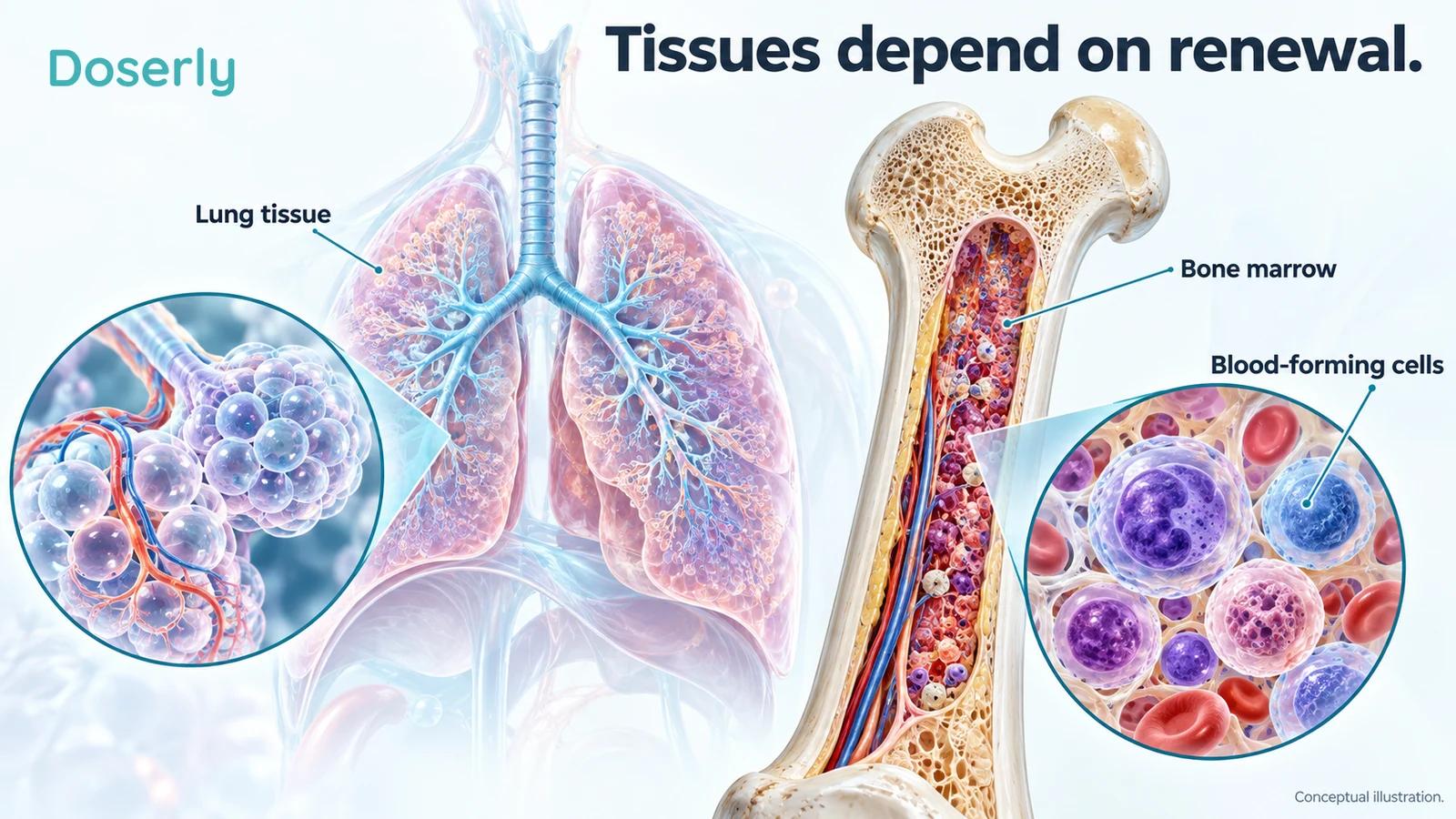
Conceptual tissue illustration; it does not depict treatment effects or diagnose a telomere disorder.
What is useful to take away
If you are considering a telomere test, ask what decision would change because of the result. A specialist investigating a suspected inherited disorder may have a clear answer. A commercial report that recommends the same supplement package regardless of the number offers a much weaker reason to test.
If you already have a result, keep the report with its method, laboratory and date. Avoid converting it into a prediction of remaining lifespan. A striking result can be discussed with a clinician alongside symptoms, blood counts and family history, but it should not replace that history. Nor should a reassuring result be used to dismiss a health problem that deserves evaluation on its own terms.
If the interest is an intervention, separate the promised biological change from the promised health benefit. Ask whether both have been demonstrated in the relevant population and whether follow-up was long enough to examine meaningful harms. For telomere-related approaches, preserving one cell population's ability to divide is only part of the safety question.
Longer telomeres are not always better, and shorter telomeres are not a goal. Human studies show a regulated balance between renewal, cellular limits and the persistence of abnormal clones. The useful ambition is healthier tissues and better human outcomes. Telomere science can help explain how those outcomes arise, but a single length measurement cannot stand in for them.