
Peptides
October 16, 2026
TB-500 or thymosin beta-4? Why the molecule changes the answer
On this page
Thymosin beta-4 is a peptide involved in how cells organize actin, a protein that helps them maintain shape and move. That biology has made it interesting to researchers studying wounds and tissue repair. TB-500 is discussed in the same conversations, often as though the two names describe the same treatment.
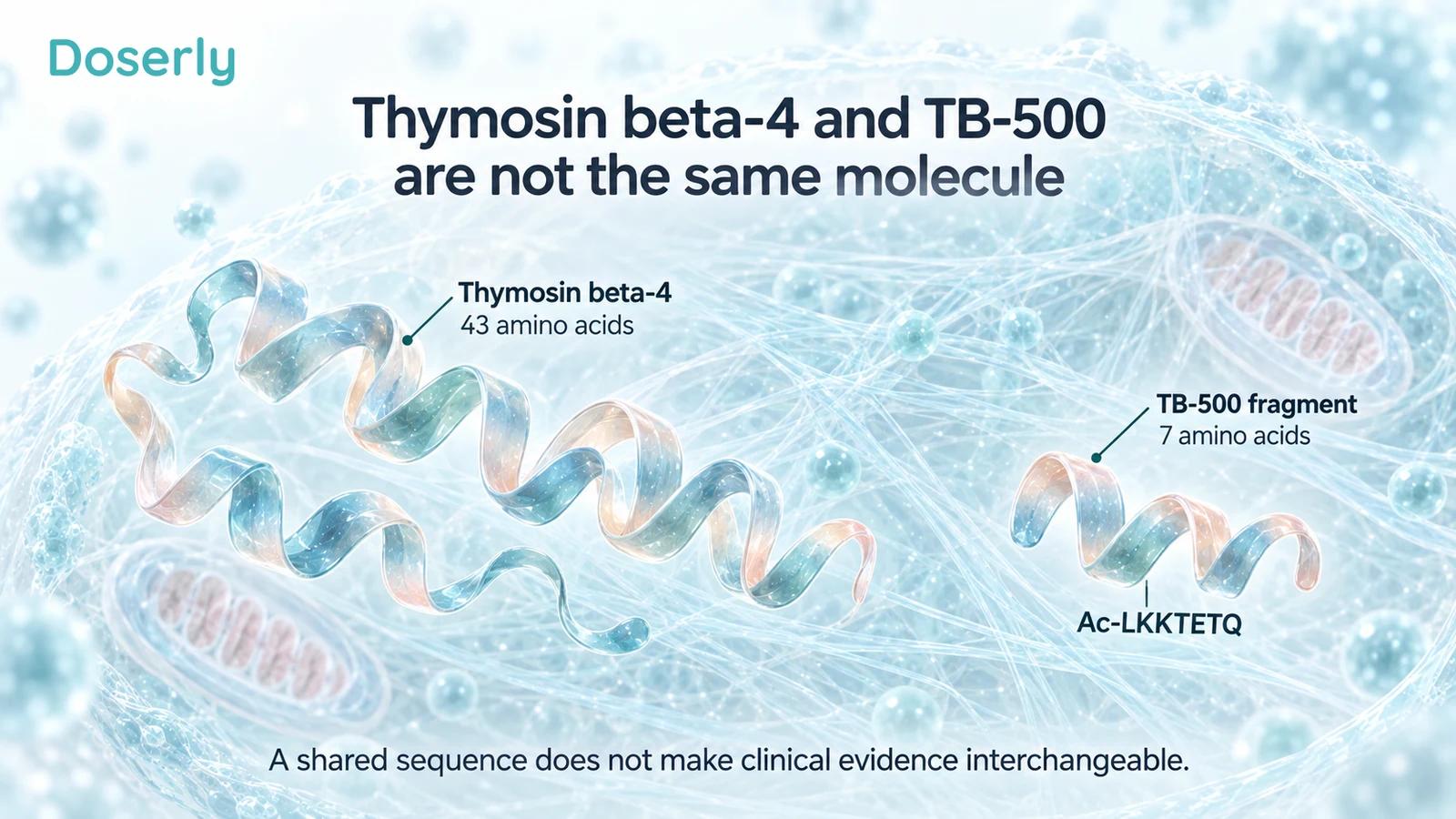
They do not reliably do so. Full-length thymosin beta-4 contains 43 amino acids. The TB-500 substance examined in FDA's 2026 briefing is a seven-amino-acid fragment with an acetyl group at one end. Products and publications have not always used the name consistently. FDA TB-500 briefing.
Before asking whether TB-500 works, establish which molecule was tested. Otherwise, a human study of a thymosin beta-4 eye drop can quietly become an argument for injecting a different peptide for tendon recovery. The study may be real, yet the treatment claim still doesn't follow.
The full peptide, the fragment and the chemical modification
Amino acids are the building blocks in a peptide chain. Their order and the chemical groups attached to the chain help determine how the molecule interacts with its surroundings. A seven-amino-acid segment from a larger peptide shares part of its sequence, but it is not the whole molecule.
The fragment discussed here corresponds to positions 17–23 of thymosin beta-4. Its sequence is written LKKTETQ, using one-letter abbreviations for the amino acids. Ac-LKKTETQ adds an acetyl group at the beginning. This is the identity commonly meant by TB-500 in analytical research and in the FDA review.
There is another distinction: the acetyl group attached to the peptide is not the same thing as an acetate salt. One concerns a chemical modification of the chain; the other concerns the form in which the substance is supplied. A name containing “acetate” does not settle whether the peptide is full-length or a fragment.
You don't need to become a peptide chemist to use this information. The practical point is that the product's exact identity should be stated clearly enough to compare it with the methods section of the supporting study. Our TB-500 identity guide provides additional background.
Why a shared active region does not establish equivalence
The fragment is interesting because it comes from a region associated with biological activity. That is a legitimate reason to investigate it. But calling something an “active region” does not establish that administering it reproduces every effect of the larger peptide.
A smaller molecule may differ in breakdown, distribution and interactions with other molecules. A chemical modification can also change its behavior. Whether the change preserves, reduces or alters a particular activity needs measurement under the relevant conditions.
Think about the actual research question. Investigators might ask whether a fragment helps cells migrate, whether it persists in blood, or whether it improves healing in an animal model. Those are distinct experiments. A positive answer to one is not a universal certificate of equivalence.
The same principle applies when comparing a recombinant product with a synthetic preparation. “Recombinant” describes production using biological expression systems. It doesn't eliminate the need to identify the resulting molecule, formulation and exposure. Evidence belongs to what was administered, not merely to the name used in a summary.
What the early mouse wound study found
A 2003 study examined full-length thymosin beta-4 in impaired wound-healing models, including diabetic and aged mice. The researchers reported changes in wound repair and collagen deposition. In aged mice, a synthetic seven-amino-acid LKKTETQ fragment produced repair effects comparable to the parent peptide under the conditions tested. Primary wound-repair study.
This is relevant fragment research, but the paper's fragment was LKKTETQ, not automatically the N-acetylated material represented by Ac-LKKTETQ. The experiment also concerned dermal wounds in animals, not a clinical recovery stack in people.
That leaves a useful, specific conclusion: a short region of thymosin beta-4 showed activity in that animal experiment. It does not tell us that every marketed TB-500 preparation has the same activity, or that a particular human injection schedule improves tendon healing.
The distinction should not erase the result. It should keep the result attached to the molecule and setting that produced it. Otherwise both supporters and critics can end up arguing about an experiment that was never performed.
The human infusion study used recombinant thymosin beta-4
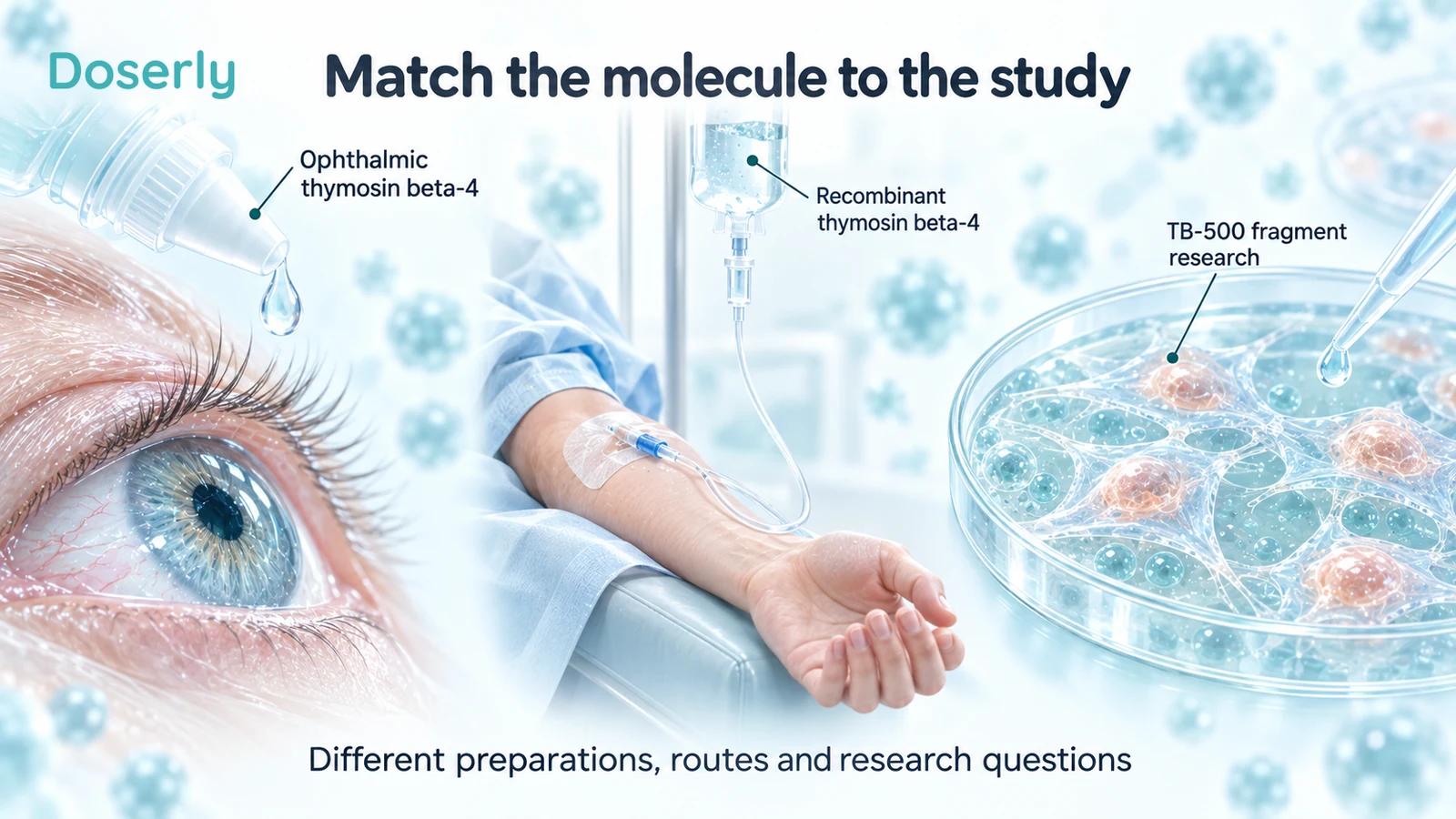
A 2021 phase 1 study evaluated the recombinant product NL005 in healthy volunteers. It included 54 participants in a single-dose component and 30 in a multiple-dose component, with intravenous administration and placebo comparisons. The multiple-dose component involved ten days of administration, with observation extending to 28 days. Primary phase 1 report.
The investigators evaluated tolerability, pharmacokinetics and anti-drug antibodies. Reported adverse events were mild to moderate, with no serious adverse events or dose-limiting toxicities. These are useful early findings for the product studied.
They do not demonstrate that the seven-amino-acid fragment improves an injury. The participants were healthy, the route was intravenous and efficacy for tendon recovery was not the study's purpose. The findings also cannot establish the long-term safety of unrelated products sold under the TB-500 name.
This is why saying “thymosin beta-4 has been studied in humans” can be accurate while saying “this TB-500 recovery protocol is clinically validated” is unsupported. The first statement identifies a research program; the second claims an equivalence and a benefit that the trial did not test.
Eye research involves another specific preparation
RGN-259 is an ophthalmic formulation of thymosin beta-4. A small randomized trial studied it in people with neurotrophic keratopathy, a condition involving impaired corneal healing associated with reduced corneal nerve function. It was applied to the eye rather than injected for general recovery. Primary RGN-259 report.
At four weeks, complete healing was reported in six of ten treated participants and one of eight placebo participants. The reported p-value was 0.0656, so the comparison did not cross the conventional 0.05 threshold. Later and secondary findings were encouraging, but this was a small study with an uncertain primary comparison.
Even a much larger positive eye trial would need to remain attached to its formulation and indication. It would not automatically establish that a fragment injected elsewhere reaches an injured tendon at an effective concentration. The molecule, route, tissue and outcome all change.
Analytical studies show why the name alone is insufficient
A 2012 horse study developed a method to detect N-acetylated LKKTETQ and its metabolites in urine and plasma after administration. The analytical identity was explicit. The study's purpose was doping control, not demonstration of human therapeutic benefit. Primary equine analysis.
A later analytical report examined online products sold as TB500, TB1000 and SGF1000. The authors found that the contents of the TB500/TB1000 products were not consistently aligned with their previous descriptions. Primary product-analysis report.
That study should not be stretched into a numerical estimate of how often all products are mislabeled. It does show why a commercial name is weaker evidence of identity than validated analysis of the relevant material. A study using one characterized preparation does not certify a different supplier's vial.
For someone reviewing a proposed treatment, the useful documents identify the peptide, relevant modifications, salt form and batch. A general “purity” percentage without an adequately established identity cannot tell you whether the tested material corresponds to the molecule in a clinical paper.
What FDA's human-evidence conclusion means
The 2026 FDA review did not identify clinical evidence in which the evaluated TB-500 substances were administered to patients for wound healing or another condition. It distinguished those substances from thymosin beta-4 and noted naming inconsistencies. This is not a statement that no thymosin beta-4 clinical research exists. FDA briefing.
That distinction resolves an apparent contradiction often encountered in summaries. A document can correctly say that human data are missing for a fragment while a database contains human trials of the longer peptide. The search terms overlap, but the treatment identities do not.
The briefing was prepared for an advisory committee and should not be described as a drug approval. It is useful here because it explains exactly which substances the agency evaluated and which evidence could not be transferred to them.
How to read a study attached to a TB-500 claim
Start with the intervention, not the headline. Look for the complete name, sequence or product identifier. Then identify how it was given: an eye drop, topical gel, infusion and subcutaneous injection create different exposures. Finally, identify the population and outcome.
For example, a paper might provide real evidence that an eye preparation changed corneal healing in a small patient group. That does not answer whether a different preparation improves muscle recovery after training. The gap is not a technicality; it is the clinical question you are trying to answer.
If the publication does not characterize the molecule sufficiently, say so. It is better to preserve uncertainty than to assign the product to a convenient category. A manufacturer calling a full-length product TB-500 does not turn fragment studies into evidence for it, and calling a fragment thymosin beta-4 does not import the full peptide's trial record.
A useful evidence summary therefore reads something like: “This preparation, delivered by this route, was studied in this group for this outcome.” That sentence can be followed by the result and its limitations. It is more informative than describing the entire family as clinically proven or entirely unstudied.
What this changes for a recovery decision
If someone recommends TB-500 for an injury, ask them to identify the actual substance and the completed human study supporting the proposed use. If the answer points to full-length thymosin beta-4, ask what evidence supports transferring the finding to the offered product.
The absence of that link doesn't prove that the fragment cannot have useful effects. It means its benefit and safety remain unanswered for that application. A clinician can then discuss your diagnosed problem and established care without presenting an untested equivalence as a known treatment effect.
For a broader overview, our TB-500 human-research guide separates the different preparations and clinical settings. Keeping those distinctions intact allows promising biology to remain promising biology while giving human trials credit for precisely what they found.
Explore the research
- FDA TB-500 briefing, 2026: identity, salt distinctions and human-evidence gaps.
- Philp and colleagues, 2003: full peptide and unacetylated fragment in animal wound models.
- Wang and colleagues, 2021: intravenous recombinant thymosin beta-4 phase 1 study.
- RGN-259 neurotrophic keratopathy trial: small randomized ophthalmic study.
- Equine TB-500 analysis, 2012: detection of acetylated fragment and metabolites after horse administration.
- TB500/TB1000 product analysis, 2023: analytical identity problems in sampled online products.