
Supplements
October 16, 2026
Taurine and longevity: the leap from animal lifespan to a human routine
On this page
Taurine is found throughout the body, including muscle and nervous tissue, and participates in several normal cellular functions. It became a prominent longevity topic after experiments showed that supplementation extended lifespan in some laboratory animals. For a person deciding whether to add it to a daily routine, the relevant question is whether comparable benefits have been demonstrated in humans.
They have not. Human research includes encouraging findings for particular blood-pressure or metabolic measurements, but those are different from demonstrating longer life. Newer research also challenges an important part of the original narrative: that falling blood taurine is a consistent feature of human aging.
This article follows the actual experiments, including what changed between the 2023 animal report and later human analyses. The taurine guide provides additional background on the compound and its studied uses.
Why taurine attracted aging researchers
Taurine is often described as an amino acid, although it is not incorporated into proteins in the same way as the amino acids used to build muscle proteins. Its normal roles and distribution make it biologically interesting; a higher circulating amount, however, does not automatically mean better cellular function.
The 2023 research proposed that declining taurine might contribute to age-related changes rather than merely accompany them. That distinction matters. If a molecule becomes low as a consequence of illness, restoring its blood concentration may not address the cause. If its decline contributes causally to dysfunction, supplementation could be worth testing.
Researchers therefore used animal interventions, not just measurements, to investigate the idea. The results justified interest in further research. They did not establish a taurine-deficiency syndrome that every older adult should treat. Original 2023 report.
What the animal experiments showed
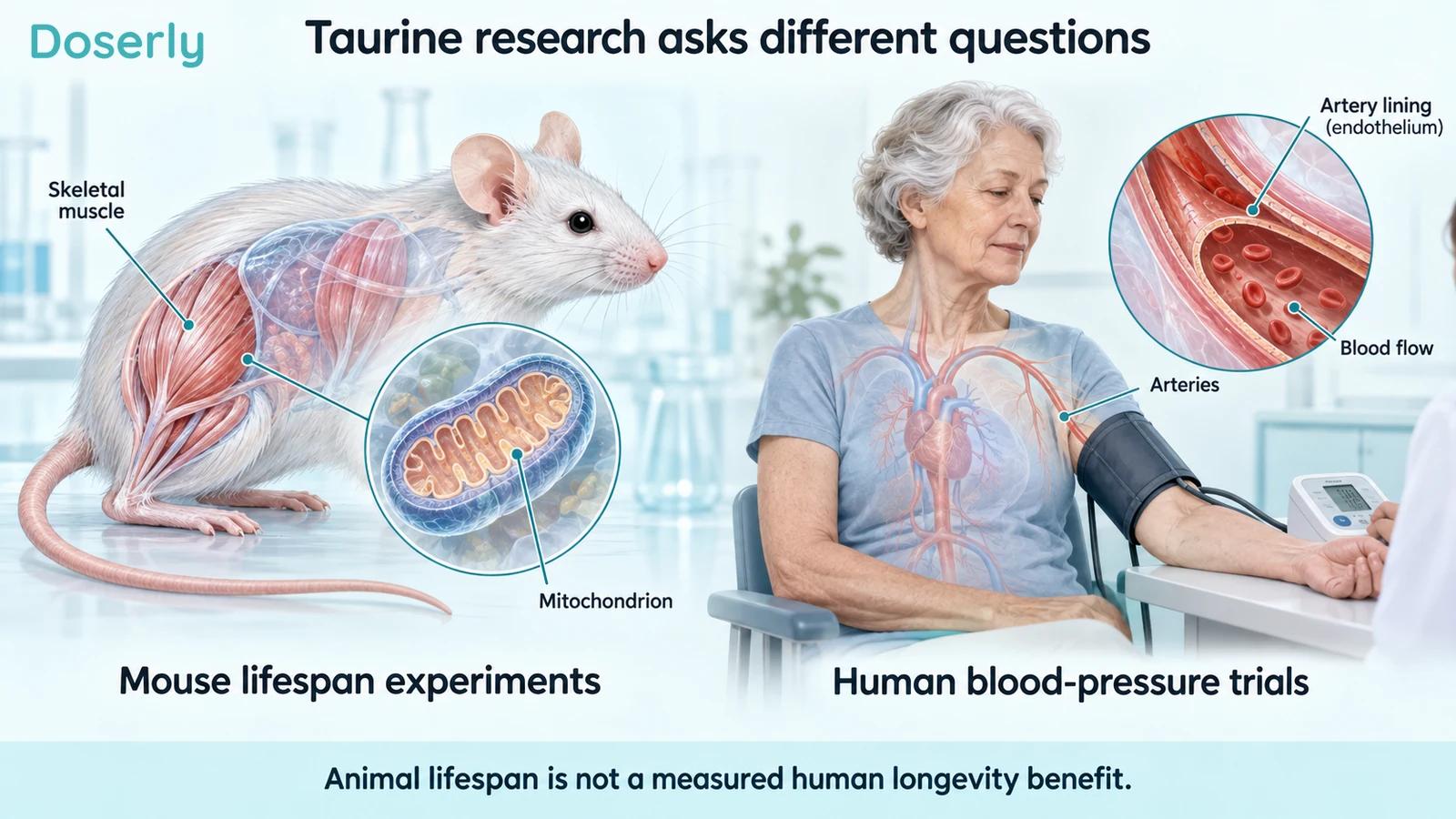
The 2023 paper reported extended lifespan in mice and worms, alongside improvements in several measures described as healthspan. In monkeys, the study examined health-related measurements rather than demonstrating longer lifespan. The paper also investigated cellular processes involving mitochondrial function, DNA damage and senescence, a state in which cells stop dividing and can alter surrounding tissue behavior.
Its human work was different: it examined associations between taurine concentrations and health, and changes around exercise. Humans were not randomized to years of taurine or placebo to determine survival. Taurine deficiency as a driver of aging.
Species distinctions cannot be skipped. An experiment in mice can establish an effect under that model’s conditions, including its strain, diet and laboratory environment. It cannot establish the size—or even the existence—of a human lifespan effect.
Nor is an animal amount a human dosing instruction. Translating exposure requires pharmacology and safety research, not copying a body-weight calculation from an internet summary.
Do taurine levels actually fall as humans age?
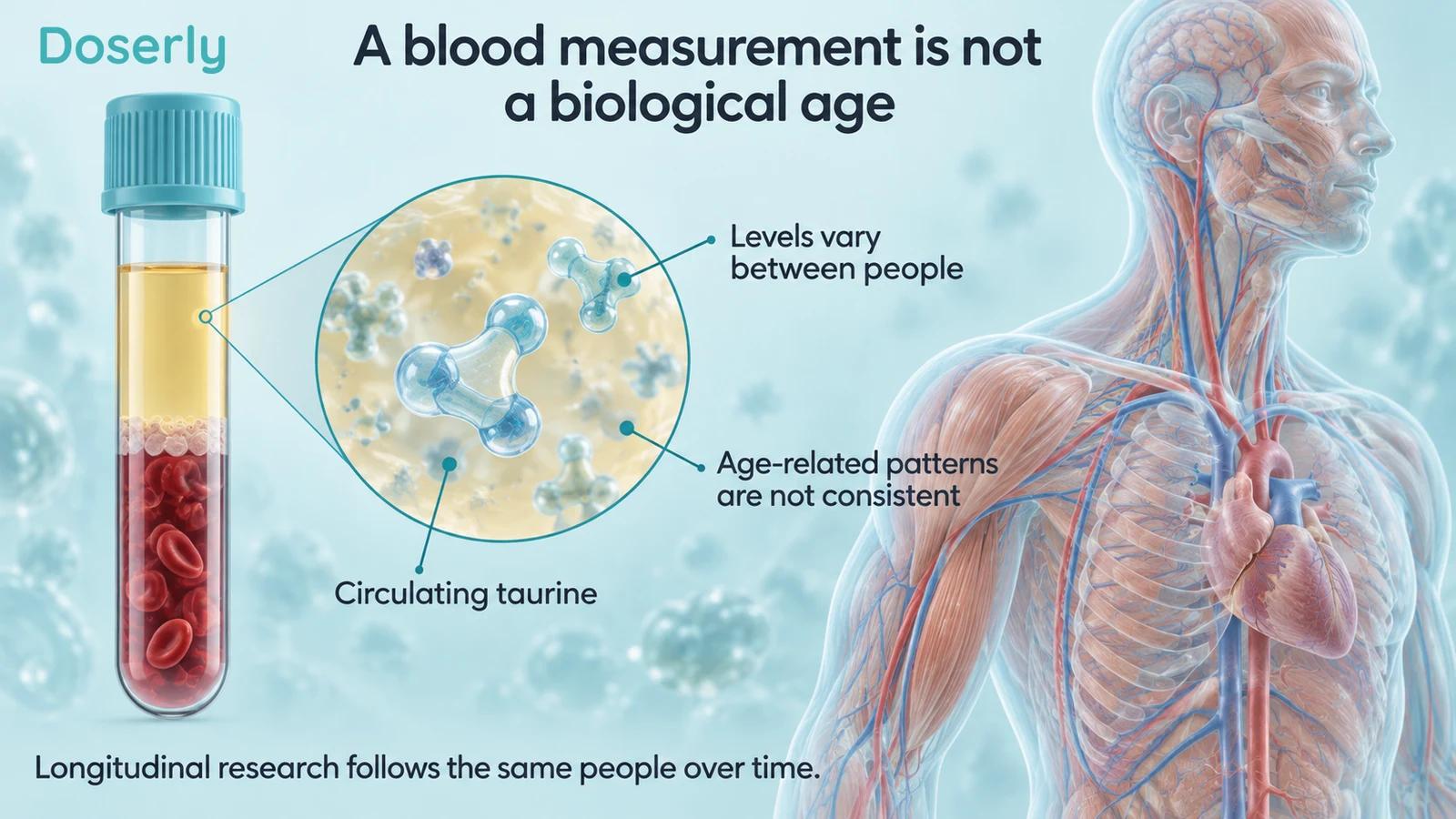
A 2025 paper asked this directly using repeated measurements and several populations. Circulating taurine increased or remained stable with age in three geographically distinct human cohorts, as well as in the nonhuman species examined. Associations with measures of function and energy balance varied by context. Is taurine an aging biomarker?.
That finding challenges a universal “aging causes taurine depletion” story. It does not prove that supplementation can never help a person with a particular condition. Measuring what happens naturally and testing what happens after treatment are different experiments.
The design matters here. A cross-sectional study compares people of different ages at one period. A longitudinal study follows the same people over time. Differences between young and old groups can reflect diet, health or other characteristics that differ between generations; repeated sampling helps examine change within individuals.
NIH’s account of the 2025 research notes substantial within-person variation, sometimes greater than age-related changes. A single blood value therefore should not be interpreted as a reliable measure of how quickly someone is aging. NIH study explanation.
A separate human study adds another caution
Another 2025 study examined 137 physically active and inactive men aged 20–93. It did not find an association between circulating taurine and age, muscle mass, strength, physical performance or mitochondrial function. Human taurine and function study.
This was not a randomized supplement trial, and it involved men. It cannot determine whether women or patients with a specific disease respond to treatment. Its value is more focused: it did not reproduce the proposed pattern linking lower taurine with aging-related functional decline in that cohort.
Taken together, these studies mean that “restoring youthful taurine” is not a clinically established treatment target. Before using a test to guide supplementation, researchers would need to show that a threshold identifies a meaningful problem and that treating people below it improves outcomes.
What did the human blood-pressure trial find?
A 2016 randomized, blinded trial assigned 120 people with prehypertension to taurine, 1.6 g daily, or placebo for twelve weeks. “Prehypertension” was the terminology used in that study for blood pressure above the optimal range but below its hypertension threshold.
Clinic systolic pressure fell by 7.2 mmHg with taurine and 2.6 with placebo, a difference in average reductions of about 4.6 mmHg. Ambulatory systolic pressure, measured over 24 hours, fell by 3.8 versus 0.3 mmHg. Vascular-function measurements also improved. Primary blood-pressure trial.
Those findings are relevant to cardiovascular research. They are not evidence that every healthy adult should lower an already normal pressure, or that taurine prevents strokes or extends life. The study was short and measured pressure and vascular responses rather than clinical events.
The amount above identifies the intervention studied. It does not account for an individual’s existing treatment, baseline pressure or medical conditions and should not be read as a personal recommendation.
Why blood pressure is meaningful but still not lifespan
Blood pressure is a clinically useful measurement, not an arbitrary laboratory curiosity. A sustained favorable effect could be worth studying further. But the overall benefit of a treatment depends on more than whether one marker moves in the desired direction.
For example, a long-term study would need to assess whether the effect persists, whether people continue treatment and whether any adverse effects offset benefits. It would also need to examine the people who would actually use the supplement, including those already taking medication.
The placebo group in the taurine trial improved too. Reporting only the 7.2 mmHg decline would make the supplement appear responsible for the entire change. The between-group comparison is the relevant estimate of the added effect under the study conditions.
For someone monitoring pressure at home, changing measurement conditions, medicines and several supplements together makes interpretation difficult. A clinician can help define a monitoring plan; a supplement record cannot turn uncontrolled readings into a prevention trial.
What about the trial described as “antiaging” in older women?
A 2022 trial enrolled 24 women aged 55–70 and compared taurine, 1.5 g daily, with placebo for sixteen weeks. Its primary outcomes were taurine and oxidative-stress measurements in plasma.
The investigators reported changes involving superoxide dismutase, or SOD, an antioxidant enzyme, and other markers. The paper’s title described a possible antiaging therapy, but the experiment did not measure lifespan or demonstrate prevention of age-related disability. Older-women trial.
This distinction is especially useful because readers often encounter the title before the methods. An enzyme result can motivate further work on biological mechanisms. It cannot tell you how many years someone will remain independent or whether the same intervention improves memory, walking or daily symptoms.
The sample was small, and sixteen weeks cannot settle the safety or effectiveness of decades of use. Calling the result preliminary does not dismiss it; it describes the question the experiment was able to answer.
Metabolic findings are not uniform
A separate eight-week trial randomized 120 people with type 2 diabetes to 3 g taurine daily or placebo. Both groups followed a low-calorie diet. Taurine improved insulin and a calculated insulin-resistance measure, HOMA-IR, as well as several inflammatory or vascular markers.
However, fasting glucose, glycated hemoglobin and lipid profiles did not improve significantly compared with placebo. Diabetes trial.
Glycated hemoglobin, commonly called HbA1c, reflects glucose exposure over a longer period than a single fasting glucose measurement. HOMA-IR is calculated from fasting measurements and estimates insulin resistance. These tests are related, but an improvement in one does not establish improvement in all.
This mixed pattern is more informative than describing taurine as simply “good for metabolism.” It identifies possible signals and the outcomes that remained unchanged. Neither result establishes fewer diabetes complications or permits replacing prescribed treatment.
What does the evidence mean for safety?
The human studies discussed here used defined formulations over weeks or months. Their findings cannot guarantee the safety of lifelong use, especially in groups that were not well represented. A small study can also miss uncommon adverse effects.
An energy drink is not interchangeable with the isolated taurine intervention in a trial. Other ingredients and amounts alter the exposure. Likewise, a combination capsule may make it impossible to identify which ingredient produced a symptom or change in a measurement.
If you are considering taurine because of blood pressure or diabetes, involve the clinician managing that condition. The research is not a reason to stop proven treatment or to adjust it based on a supplement’s reputation. Pregnancy, significant illness and complex medication regimens also require individualized assessment because these trials do not answer every safety question.
A reasonable discussion should identify the intended benefit, the evidence relevant to that benefit and what would lead to reassessment. It should not begin with the assumption that an aging-related blood measurement needs to be pushed upward.
What a useful human longevity trial would need
A trial aimed at healthy aging should define a meaningful outcome before starting. That might be maintaining mobility, reducing disability or preventing a specified clinical event. A lifespan claim would require survival follow-up, not merely a favorable panel of blood tests.
Participants would need an appropriate comparator and enough follow-up to distinguish a durable effect from short-term fluctuation. Researchers would also need to report adverse events, discontinuation and whether changes differed by baseline health or taurine status.
It would also help to define how large a difference would matter to participants. A statistically detectable laboratory change can be too small to improve daily life, while a meaningful mobility effect may require a larger study to estimate reliably. Reporting all planned outcomes is important, including neutral ones. If only favorable results from a large panel are highlighted, readers cannot tell whether the proposed aging benefit is reproducible or simply the most attractive finding from many comparisons.
These requirements are not a proposed personal protocol. They explain what remains missing between an exciting mouse experiment and a recommendation for a healthy person’s daily routine.
For now, taurine is a subject of active biological and clinical research with several specific human findings. It is not an established human longevity treatment. A dated record in Doserly can support a discussion about what you take and why, while the taurine guide provides broader context beyond the lifespan headline.
Sources
- Singh et al., 2023: animal interventions and human observations.
- Is taurine an aging biomarker?, 2025.
- Human taurine and physical-function study, 2025.
- Blood-pressure trial, 2016.
- Older-women biomarker trial, 2022.
- Type 2 diabetes trial, 2022.
- NIH explanation of the 2025 longitudinal findings.