
HRT
October 16, 2026
Tapering HRT: why a gentle exit does not guarantee symptoms stay away
On this page
After years of sleeping comfortably on hormone replacement therapy, a person may reasonably hope that reducing it slowly will make stopping uneventful. A gradual change can feel more manageable. It offers time to notice symptoms, discuss alternatives, and decide whether continuing still makes sense.
What it cannot promise is that hot flushes will stay away once treatment ends. Small randomized trials have not established a lasting advantage of tapering over stopping immediately. That is a narrower conclusion than “tapering is pointless,” and a more useful one than “slow withdrawal prevents symptoms.” The immediate experience, the eventual symptom burden, and the decision to restart are different outcomes.
The first conversation should therefore be about why treatment is being reconsidered. The second is how to change it. A birthday, a new diagnosis, an unwanted effect, a prescription problem, and a personal preference do not all call for the same response.
What the randomized studies actually tested
In a Swedish trial, women taking combined estrogen and progestogen for hot flushes were assigned to tapering or abrupt cessation. The published abstract describes 81 participants; the author manuscript records 87 randomized and 81 entering the baseline study population. Through follow-up of up to a year, the groups did not differ in hot-flush frequency or severity, health-related quality of life, or restarting treatment. Approximately half resumed HRT within that year. People who restarted tended to report worse symptoms and a greater deterioration in quality of life. Lindh-Åstrand and colleagues
This was a small trial of combined treatment in a selected population already using HRT for vasomotor symptoms. It does not tell us that every modern formulation, every taper duration, or every person will have an identical experience. It does show why a claim that tapering reliably prevents recurrence goes beyond the evidence.
A second trial in Brazil randomized 60 women to immediate cessation or lower-dose combined treatment for two or four months before cessation; 54 completed the study. Symptoms remained controlled while participants were receiving the lower-dose treatment. After it ended, their hot-flush and overall symptom scores resembled those of the abrupt-stop group. Cunha and colleagues
The timing matters. Feeling well during a taper can mean that a lower dose is still treating symptoms. It does not establish that the body has been permanently prepared to remain symptom-free without treatment. Equally, a person who feels well after stopping has learned something useful about their own current needs, even though a trial cannot predict that outcome in advance.
Why observational studies can tell a different story
A survey of 836 female veterans who had stopped combined hormone therapy found that one quarter had tapered and three quarters stopped abruptly. Tapering was associated with lower symptom scores after discontinuation, but also with higher odds of subsequently resuming hormones: an adjusted odds ratio of 2.06, with a 95% confidence interval of 1.20–3.52. Haskell and colleagues
That result is not evidence that tapering causes people to become dependent on HRT. Participants chose their approach. Those who tapered differed in age, duration of treatment, reasons for using hormones, income, and other practices. A person particularly concerned about symptom recurrence may be more likely both to taper and to restart. Statistical adjustment cannot reconstruct random assignment.
The study also illustrates why “successful stopping” needs a definition. Fewer hot flushes, better sleep, acceptable daily function, and remaining off medication are related but not interchangeable goals. A study can find improvement in one without improvement in another.
For an individual, staying off treatment at any cost is not necessarily the most useful endpoint. If the original symptoms return and substantially impair life, the appropriate next step is a renewed benefit–risk discussion. Conversely, manageable symptoms may support a preference to remain off systemic treatment. Neither choice can be judged solely from the speed of the taper.
What a returning hot flush does—and does not—mean
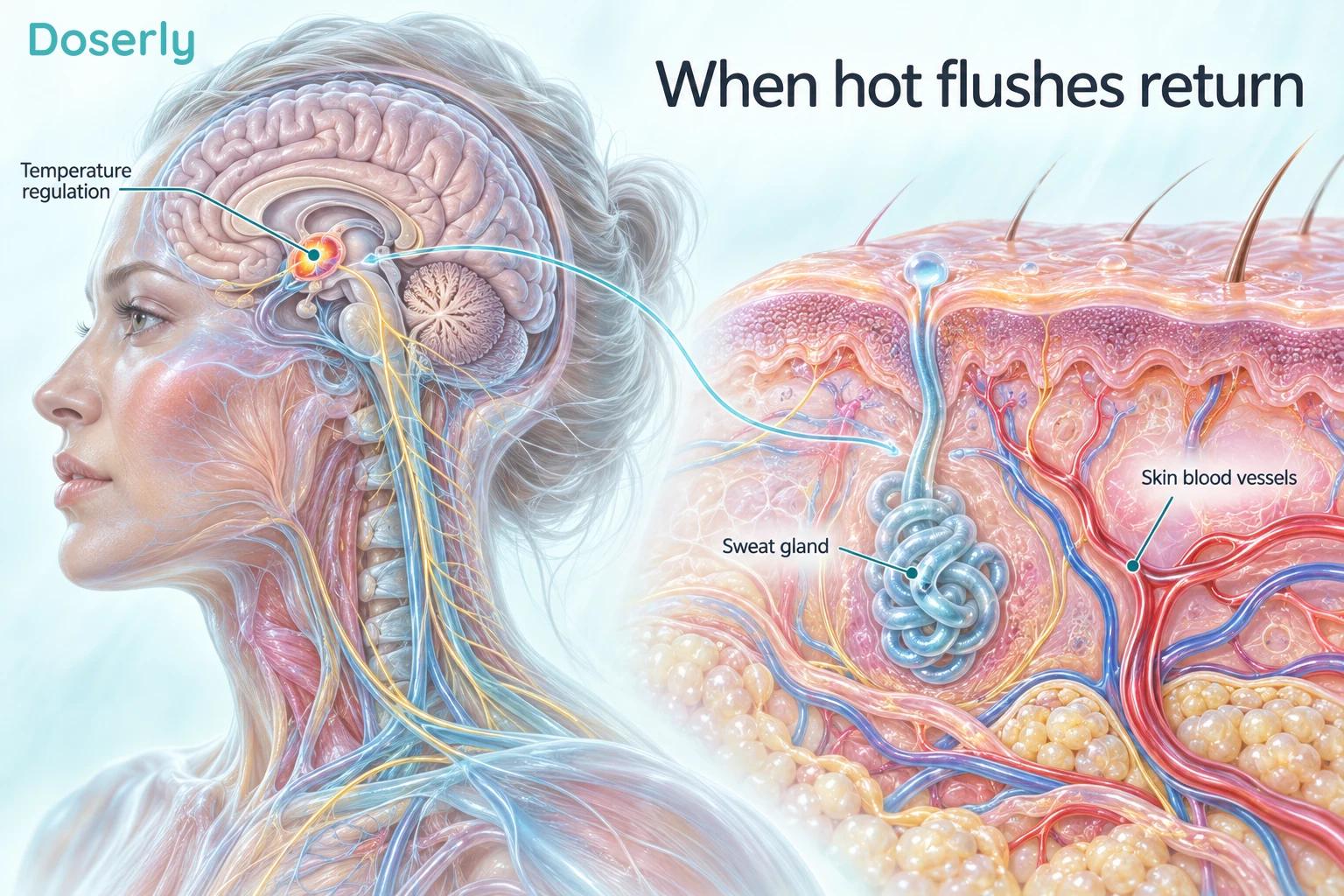
Hot flushes involve temperature-regulation pathways and bodily responses such as sweating and changes in skin blood flow. The illustration explains those relationships; it is not a map of damage caused by stopping HRT. A return of symptoms is not, by itself, evidence that treatment has harmed the brain or that a person stopped “incorrectly.”
The Swedish and Brazilian trials measured symptoms after treatment changes; they did not establish a blood-hormone threshold that predicts who will be comfortable without HRT. Nor did they establish a taper schedule that guarantees comfort. An individualized plan should be honest about that uncertainty. Lindh-Åstrand trial, Cunha trial.
Symptom timing also needs interpretation. If several things change together—medication, sleep schedule, work demands, alcohol intake, or another illness—it may be difficult to know what caused the change. Recording the actual treatment change and a few meaningful symptoms helps the subsequent discussion. It does not turn an uncontrolled personal experience into proof of a mechanism.
New symptoms should not automatically be assigned to menopause. For example, persistent unexplained illness, a major change in mood, or unexpected bleeding calls for clinical assessment rather than simply extending a taper. The useful question is whether the current pattern fits the original symptoms, whether another explanation needs consideration, and what evaluation would change the plan.
A manageable transition is still a worthwhile goal
NICE offers a choice between gradual reduction and immediate stopping. Its guidance distinguishes a possible reduction in short-term recurrence with tapering from the absence of a longer-term symptom advantage. That leaves room for preference without presenting tapering as a proven prevention strategy. NICE menopause recommendations
Someone who values gradual change may reasonably discuss that approach. Someone who wants a clear assessment off treatment may prefer a different plan. The practical details depend on the actual preparation, the reason for stopping, and the clinician's assessment.
The tapering trials should not be converted into a do-it-yourself schedule. Products differ, and changing one component of a combined regimen can create a different clinical situation. A person with a uterus who continues systemic estrogen still needs an appropriate endometrial-protection plan. A prescription for estrogen, a separate progestogen, and a hormonal IUD may have distinct purposes and review dates.
Before changing treatment, it is useful to have the names and strengths of all products together, including local vaginal treatment. Ask the prescriber or pharmacist how the agreed change works with those specific products. This avoids ambiguous instructions such as “take less HRT,” which may leave the person unsure which medicine is changing.
The Doserly stopping and tapering HRT guide provides broader background for that discussion. The important output is a clear, individualized plan with a review point, rather than a universal calendar copied from someone else's prescription.
Sleep and daily function deserve explicit attention
In a separate survey, 802 women reported attempting to discontinue hormone therapy. Three quarters reported hot flushes after stopping. Those who had not successfully stopped reported more sleep difficulty and mood disturbance than those who had. Because these were survey associations, they do not prove that a particular sleep intervention would ensure successful cessation. They do identify burdens that a flush count alone can miss. Newton and colleagues
A simple record can distinguish “three flushes” from “three awakenings followed by difficulty returning to sleep and an unsafe drive the next morning.” Both descriptions are accurate, but the second gives a clinician a more meaningful treatment target. Similarly, a mild warm sensation during the day may matter less than persistent nighttime disruption, even if the event counts are similar.
Choose a small number of outcomes that reflect the reason for changing treatment: sleep continuity, the interference caused by hot flushes, ability to complete ordinary activities, or an unwanted treatment effect. Note whether the pattern is improving, stable, or worsening. Elaborate daily scoring is unnecessary if it becomes another burden.
Support can include discussion of menopause-specific cognitive behavioural therapy and suitable medical alternatives when systemic HRT is unsuitable or unwanted. Options depend on symptoms, medical history, other medicines, and local availability. A stopping plan should include access to that discussion, rather than leaving someone to interpret recurrence alone or to buy an unproven “hormone reset” product.
Bone protection is a separate question from symptom recurrence
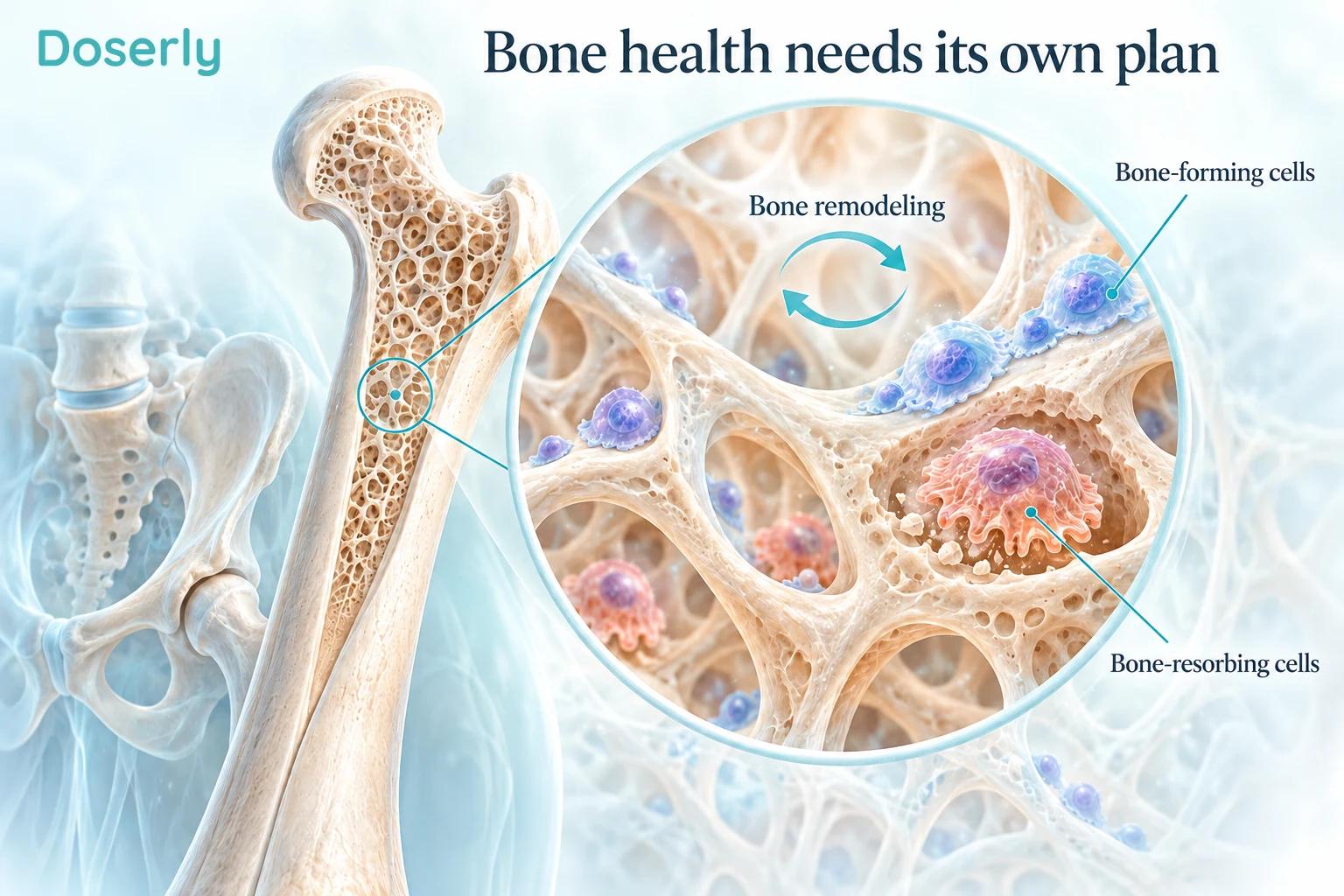
A person can stop HRT without hot flushes and still need a bone-health review. Conversely, severe returning flushes do not show that bone density has suddenly fallen. Symptoms and fracture risk are different outcomes.
A 2025 study using UK primary-care records compared 648,747 people with fractures with 2,357,125 controls. Current HRT use was associated with lower fracture odds. Findings after discontinuation varied by formulation and previous duration. During years one through ten after stopping, estrogen-only use was not associated with a statistically clear excess compared with never-use, while previous combined use had a small higher association. Vinogradova and colleagues
This was an observational analysis, not a randomized test of tapering. It cannot show that a slow taper prevents fractures, and it should not be simplified into “stopping causes rebound fractures in everyone.” Prescription records, reasons for stopping, and differences between users and nonusers complicate interpretation.
The practical implication is to revisit why HRT was being used and whether bone protection still needs attention. Relevant information includes a previous fragility fracture, earlier bone-density results, age, and other clinical risk factors. The clinician can decide whether assessment or a different osteoporosis treatment is appropriate. Extending a taper is not a substitute for that decision.
People who started replacement because of premature ovarian insufficiency or early surgical menopause have a different context from someone considering cessation well beyond the usual menopause age. Their original indication should remain visible in the discussion. The symptom experience alone does not capture every reason treatment was prescribed.
Define the decision before judging the result
Imagine two people who both experience night sweats after stopping. One had only occasional mild symptoms, prefers fewer medicines, and can function comfortably. The other is awake repeatedly and cannot manage normal daily demands. Calling both attempts a “failed taper” loses the information needed to help either person.
A better review asks what changed, how much it matters, and whether the original reason for stopping still applies. A new contraindication may make resuming systemic treatment inappropriate even when symptoms are difficult. A preference-based trial off treatment may leave more options open. A decision made because of an arbitrary age cutoff deserves a different discussion from a decision made after a new serious diagnosis.
Restarting, when clinically appropriate, is not proof of addiction or a personal failure. Remaining off treatment is not proof that everyone else should do the same. The aim is a treatment decision that fits current benefits, risks, and preferences.
It can also help to agree in advance who will review the outcome. A pharmacist can clarify product instructions; the prescribing clinician can reassess the treatment decision; another specialist may be needed when a new diagnosis changes the risk assessment. Clear responsibility prevents a temporary change from becoming an indefinite unsupported experiment.
Stopping systemic HRT does not automatically settle vaginal or urinary symptom care. Local treatment has its own purpose and assessment. NICE menopause guidance. Keep that separate, just as contraception and bone protection may require separate plans.
A gentle exit can be valuable because it is understandable, supported, and responsive to symptoms. The evidence does not justify promising that it will permanently prevent those symptoms from returning.
Sources
- Lindh-Åstrand et al. Randomized taper-down versus abrupt discontinuation trial (2010).
- Cunha et al. Abrupt discontinuation versus gradual dose reduction (2010).
- Haskell et al. Tapering versus quitting cold turkey among female veterans (2009).
- Vinogradova et al. HRT discontinuation and fracture risk (2025).
- NICE NG23 menopause recommendations (2026).
- Newton et al. Factors associated with successful discontinuation of hormone therapy (2014).