
Supplements
October 16, 2026
Synbiotics: does combining a probiotic with its food improve symptoms?
On this page
Synbiotic products combine living microorganisms with a substrate that microbes can use. The appeal is understandable: if a probiotic might help, perhaps supplying something useful to microbes will make the result more reliable. For someone struggling with bloating, constipation or irritable bowel syndrome, a combined formula can sound like a more complete approach.
Sometimes the combination does improve symptoms in a clinical trial. But a useful combination and a proven synergistic interaction are different findings. A trial comparing a finished product with placebo can show whether that product helps. It cannot, on its own, show that adding the substrate made the microorganism more effective than it would have been alone.
The distinction matters when a formula's marketing relies on studies of its separate ingredients. Our synbiotics guide introduces the category; this article looks at how the combination is tested and what digestive-health trials can tell you.
What does “synbiotic” mean?
The 2020 ISAPP consensus describes a synbiotic as a mixture of living microorganisms and selectively used substrates that provides a health benefit. A substrate is material that an organism can use; “selectively used” means the effect involves particular microorganisms rather than simply assuming all fiber feeds all microbes in the same way. ISAPP consensus
The definition includes two designs. A complementary synbiotic combines a probiotic and a prebiotic, each meeting its own evidence requirements. The components do not have to be specially designed to work together. The finished combination still needs evidence of benefit in the intended host.
A synergistic synbiotic is designed so that the supplied substrate is selectively used by the supplied microorganism. Demonstrating that relationship requires more than showing that the mixture changed someone's stool bacteria. Researchers need evidence of selective use and health benefit in the relevant experiment, with comparisons that can identify the contribution of the pairing. Consensus evidence requirements
The word “synergistic” should therefore not be treated as a more impressive synonym for “contains two ingredients.” It describes a testable relationship. A complementary product may be useful without that relationship, and a beautifully reasoned pairing may still fail to improve symptoms.

Why adding a fiber does not settle the question
A fiber ingredient has its own identity and quantity. Inulin, fructooligosaccharides and other substrates should not be treated as interchangeable merely because they appear beside probiotic organisms on a label. Likewise, bacterial species names alone may not identify the strain used in a supporting trial. NIH guidance emphasizes the importance of specific strains when interpreting probiotic evidence. NIH probiotic fact sheet
There are several plausible outcomes when ingredients are combined. Both might contribute independently. One might account for most of the effect. The substrate might primarily support microbes already present in the gut. Or the combination might be poorly tolerated by some people. Which explanation fits is an empirical question.
Consider a hypothetical product that combines a studied probiotic with a small amount of a studied fiber. If the fiber trial used a substantially different amount, the package has not recreated that intervention. If the probiotic trial used another strain, the organism's species name does not repair the mismatch. These are examples of why matching the complete preparation matters, not instructions to increase either ingredient.
The practical question is not whether the ingredients have interesting research somewhere. It is whether the available research supports the formula, quantity and goal under consideration.
What did the small IBS dose trial actually show?
A study published in 2019 randomized 30 adults with irritable bowel syndrome to three groups for eight weeks: a higher amount of a synbiotic, a lower amount, or placebo. Everyone took two capsules daily, with active and placebo capsules combined as needed to preserve the comparison. Two participants in the higher-amount group withdrew, leaving 28 completers. Lee and colleagues
The product was more complicated than a single microbe paired with one fiber. Each active capsule contained a mixture of Lactobacillus and Bifidobacterium organisms, fructooligosaccharides, inulin and botanical ingredients. That matters because any observed response belonged to the whole mixture; the experiment could not identify one organism-substrate partnership.
Some end-of-study comparisons favored the higher-amount group for abdominal discomfort, bloating, formed stools and a fatigue visual scale. However, the full report did not establish a statistically clear dose-dependent clinical effect, and its change analyses were less conclusive than the headline could suggest. The sample was small, baseline age differed between groups, and both withdrawals occurred in the higher-amount arm. Full trial report
For a person hoping to reduce fatigue along with digestive symptoms, this is a preliminary signal, not evidence that increasing a synbiotic reliably improves energy. The trial did not include probiotic-only or substrate-only groups. Even a convincing whole-product response would not have demonstrated which ingredients were responsible or that they worked synergistically.
A larger IBS-D trial provides a more specific positive example
A 2020 randomized, double-blind trial enrolled 80 adults with moderate or severe diarrhea-predominant IBS. It tested a five-strain mixture with short-chain fructooligosaccharides against placebo for eight weeks. Sixty-eight participants completed the study. The strains were individually identified, including Lactobacillus rhamnosus FloraActive 19070-2 and four other named Lactobacillus or Bifidobacterium strains. Skrzydło-Radomańska and colleagues
Compared with placebo, the combination improved the total IBS Symptom Severity Scale and the Global Improvement Scale. The reported p-values were 0.042 and 0.043, respectively. Improvements were also reported for selected symptoms, including flatulence and bowel-habit measures. Adverse-event frequency did not differ between groups. Primary trial
These findings give a more useful answer than simply saying that the ingredients “support the microbiome.” Participants had a defined disorder, took a specified product and reported changes in clinically relevant symptoms. However, the modest sample, dropouts, multiple outcomes and short duration still matter when interpreting the size and reliability of the benefit.
The design also leaves the synergy question open. The study did not compare the complete mixture against the same bacteria without fructooligosaccharides or against fructooligosaccharides alone. It supports further consideration of that preparation in IBS-D. It does not establish that adding the fiber was necessary for the observed effect, or that another blend will reproduce it.
Why constipation research should be kept separate
A randomized 2018 trial in Malaysia enrolled 85 adults with functional constipation. Participants received a synbiotic sachet or placebo daily for 12 weeks. The preparation contained Lactobacillus plantarum LP01, Bifidobacterium lactis BB12 and inulin-oligofructose. Researchers assessed bowel frequency, stool form, constipation symptoms and quality of life. Lim and colleagues
Both groups improved, but the synbiotic did not significantly outperform placebo on the main between-group symptom comparisons. The paper describes favorable changes within the active group; those changes do not establish a treatment effect when similar improvement can occur in the comparison group.
This is a common source of confusion. Suppose bowel frequency improves after someone starts a supplement. That is a real observation, but it might also reflect changes in diet, attention to bowel habits, natural variation or other influences. A randomized comparison helps estimate how much improvement can reasonably be attributed to the product.
The constipation result does not negate the IBS-D trial. Different populations received different preparations. It does show why a positive result for one bowel condition should not be expanded into a promise of “regularity” for everyone. The pattern of symptoms and the precise question being treated belong at the center of the decision.
What experiment would show that the pairing adds benefit?
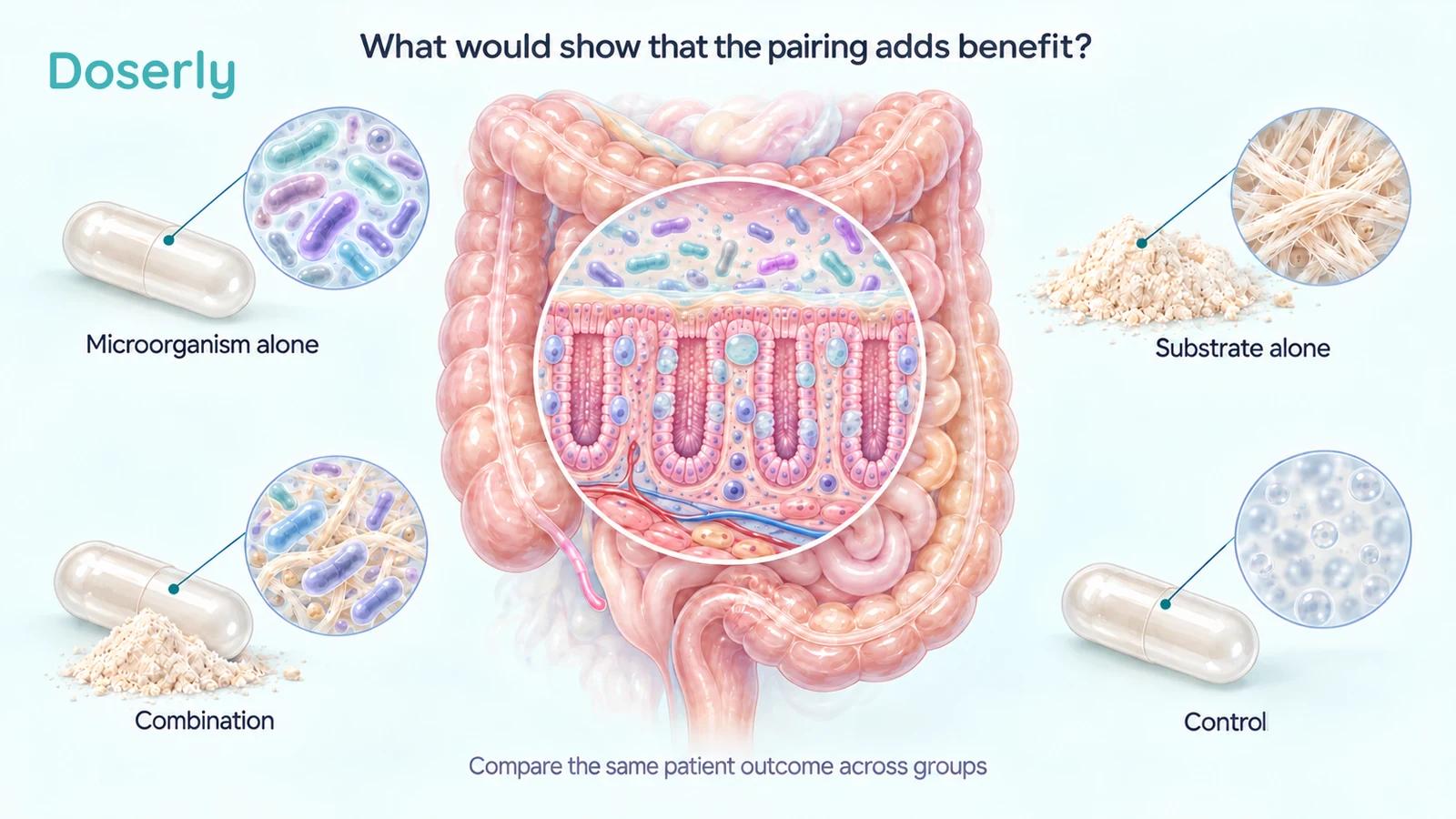
To assess the contribution of a combination, researchers can compare four groups: microorganism alone, substrate alone, the two together and an appropriate control. They should use comparable treatment durations and the same main health outcome. If the hypothesis involves selective use of the substrate by the administered organism, that relationship also needs to be measured. ISAPP study-design framework
An important detail is that “better than placebo” and “better than either component alone” are not the same comparison. Even being better than each ingredient separately may not by itself establish a particular statistical interaction. The analysis must match the claim researchers intend to make.
For a complementary synbiotic, it is not necessary to prove a special cooperative interaction. But it is still necessary to show that the combination provides benefit, rather than assuming the separate ingredient studies automatically establish that fact. This leaves room for useful products while giving the stronger synergy claim an appropriate evidentiary standard.
Which outcomes matter to someone taking a synbiotic?
Microbial measurements can help explain a product's activity, but the most relevant outcome depends on why you are considering it. For constipation, easier and more complete bowel movements may matter. For IBS, abdominal pain, urgency and interference with daily activities may be more important than a change in the number of one bacterial group.
It is possible for a microbiome measurement to change without meaningful symptom relief. It is also possible for symptoms to improve without researchers measuring every biological step that produced the benefit. A useful study reports both types of information without treating them as interchangeable.
Ask whether the trial's main outcome matches your goal. Then look for the difference between groups, the number of participants and the duration. A result assessed after eight weeks cannot automatically predict the effect of a few days of use or continuous use over years.
A practical personal record can include the product name, strain list, substrate amount, start date and one or two symptoms. Record major dietary or medication changes as well. This will not recreate a controlled trial, but it can prevent a vague impression of “better gut health” from obscuring persistent pain or poor tolerance.
Safety and tolerance still depend on the whole formula
Because synbiotics contain living organisms, the safety issues associated with probiotics remain relevant. NCCIH identifies increased concern in people with serious illness or compromised immune systems and notes gaps in long-term safety knowledge. Such individuals should not assume that adding a fiber makes a live-microbe product safer. NCCIH safety guidance
Also read the nonmicrobial ingredients. The small IBS trial illustrates how a formula described as a synbiotic may contain botanicals as well as microbes and fibers. Allergens, excipients and additional active ingredients can matter to a person's suitability and tolerance.
If symptoms worsen, do not assume that discomfort proves the product is feeding beneficial bacteria. A worsening symptom is something to discuss and assess, not a laboratory demonstration of successful fermentation. Persistent symptoms also deserve evaluation rather than an indefinite cycle of switching complex formulas.
Choose the clinical question before the combination
A reasonable discussion starts with the problem: diagnosed IBS-D, functional constipation, or another clearly identified concern. Next comes the exact preparation and the closest relevant trial. Only then is it useful to discuss how the combination might work.
Ask the manufacturer or clinician whether evidence exists for the finished formula, whether its strains and substrate amounts match that research, and whether a synergy claim was actually tested. If the supporting study compared only the blend with placebo, describe it that way.
Synbiotics can be an interesting treatment approach without being a universal upgrade over probiotics or dietary fiber. The Doserly synbiotics guide can help you identify the components. The better decision comes from connecting those components to a credible whole-product trial and an outcome that matters to you.
Sources
- ISAPP synbiotic consensus, 2020: definitions and combination-study requirements.
- Lee et al., 2019: small three-arm IBS trial and its full analyses.
- Skrzydło-Radomańska et al., 2020: five-strain synbiotic in IBS-D.
- Lim et al., 2018: functional-constipation trial.
- NIH Office of Dietary Supplements: strain-specific interpretation.
- NCCIH: safety considerations.