
TRT
October 16, 2026
Subcutaneous autoinjectors: a different device does not mean risk-free TRT
On this page
An autoinjector can remove some of the friction from an injection routine. A prepared device may feel more manageable than drawing medicine from a vial, and a person who dislikes handling a visible needle may find the design reassuring. Usability is a real part of choosing treatment.
The device does not change the basic purpose of testosterone replacement therapy: delivering a hormone throughout the body to treat an appropriate deficiency. A comfortable injection can still produce changes in blood pressure, red-cell production, reproductive signaling, and other tissues. Ease of administration and medical safety need separate answers.
The best-studied US testosterone autoinjector discussed here is XYOSTED, a single-use device containing testosterone enanthate for subcutaneous use. Its evidence should not be treated as proof about every syringe, every testosterone ester, or every product someone injects under the skin.
Subcutaneous describes a location, not a safety category
Subcutaneous tissue is the layer beneath the skin and above deeper muscle. An injection into that layer differs from an intramuscular injection in where the medicine is deposited. Once absorbed, however, the testosterone reaches the circulation.
The XYOSTED label specifies subcutaneous administration in the abdominal region and excludes intramuscular and intravascular administration. Those instructions belong to the particular product. They are not permission to change the route of another injectable testosterone preparation. Current XYOSTED prescribing information
The formulation also matters. Testosterone enanthate is an ester delivered in an oil vehicle. The device, formulation, dose selection, and dosing interval together determine the exposure being studied. It is too simple to attribute every difference to the depth of the injection.
That is why a comparison between a commercial autoinjector and a conventional injection can involve several changes at once. Unless a study separates those variables, a result cannot tell you which feature caused the difference.

What early development research asked
A phase 2 study examined the pharmacokinetics of subcutaneous testosterone enanthate delivered by a prefilled autoinjector. Pharmacokinetics describes how exposure changes over time: how high concentrations rise, how they vary across an interval, and what remains before the next dose. Phase 2 study
This kind of research helps establish whether a delivery system can produce a suitable hormone profile. It does not automatically establish superior symptom relief or long-term safety. A relatively small development study is not designed to rule out uncommon events that may occur over years.
The distinction is useful when reading phrases such as “stable levels.” Stability refers to a measured pattern under a particular regimen. It does not mean that every individual's level is identical, that the dose never needs review, or that adverse effects cannot occur.
A person can reasonably value a practical delivery system while still asking for evidence about its effects. The two questions complement each other: can this product deliver testosterone as intended, and is the resulting treatment appropriate and tolerable for me?
The 52-week trial: a successful exposure endpoint
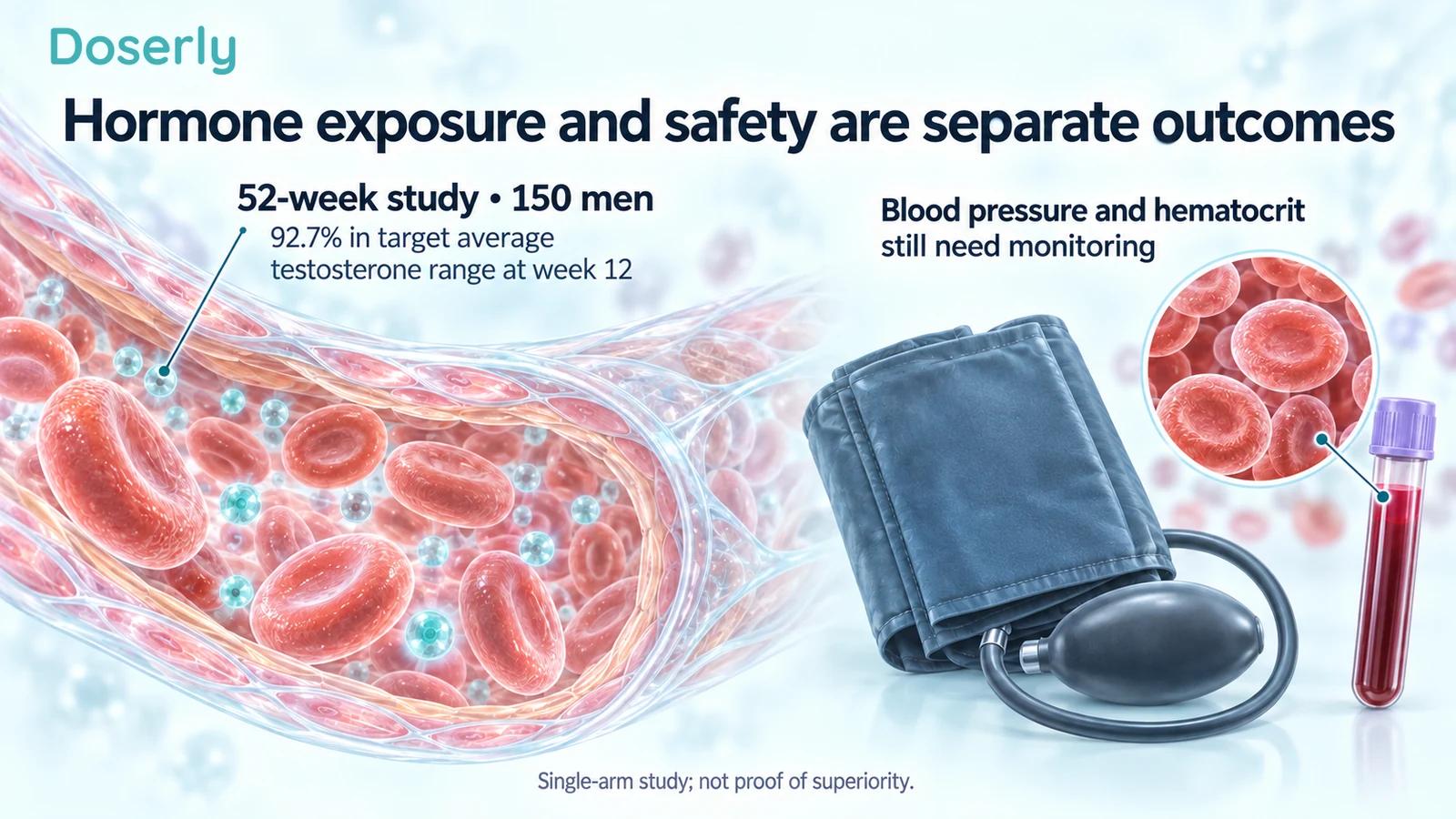
A 52-week, open-label, single-arm study enrolled 150 men with hypogonadism. The dose was adjusted using testosterone measurements. At week 12, 92.7% achieved an average total testosterone concentration within the study's target range of 300–1,100 ng/dL. Kaminetsky and colleagues
That is a meaningful pharmacokinetic result. It shows that the treatment approach could produce average exposure in the specified range for most participants at that assessment. It is not the percentage whose symptoms disappeared, nor the percentage guaranteed to remain free of adverse effects.
The trial also reported that more than 95% of participants experienced no injection-related pain. At the same time, increased hematocrit, hypertension, and increased prostate-specific antigen were among the commonly reported treatment-emergent events, and adverse events led to discontinuation in 30 men.
Both observations belong in the account. Comfortable administration can coexist with clinically important monitoring findings. Because the study had no randomized comparator, it cannot by itself establish that the device is safer or more effective than all other testosterone options.
Nor should the target interval become a personal dose target copied from the paper. A trial's average concentration endpoint is not the same measurement as an individual's trough sample, and the clinician interprets results in the context of the actual product and treatment plan.
The 26-week safety study adds another perspective
A separate phase 3 study followed 133 men with symptomatic testosterone deficiency for 26 weeks. It included clinic blood-pressure measurements and ambulatory monitoring, which records blood pressure through ordinary daily activity. Gittelman and colleagues
In the published report, mean clinic blood pressure increased by 3.4 mm Hg systolic and 1.8 mm Hg diastolic by week 26. At week 12, the ambulatory measurements showed mean increases of 3.7 and 1.3 mm Hg. These are different measurement settings and time points, not interchangeable estimates.
The study also reported increased hematocrit and local reactions such as bruising or bleeding at the injection site. Of 965 assessed injections, mild pain was reported by one participant. The painless-injection observation therefore did not erase the blood-pressure or laboratory findings.
A small mean increase does not predict the change in every person. Some may have little change, while others need closer assessment. Without a concurrent randomized control group, the study also cannot isolate every cause of the observed changes. It nevertheless provides a direct reason to measure blood pressure rather than infer it from how comfortable the injection feels.
A removed boxed warning does not mean the concern disappeared
Older information about XYOSTED may describe a boxed blood-pressure warning. The current FDA label records its removal in 2025, while retaining a warning about blood-pressure increases and recommendations for monitoring. Quoting the old box as current is inaccurate; interpreting its removal as proof of no blood-pressure effect is also inaccurate. Current label
FDA's 2025 class-wide labeling action distinguished cardiovascular outcomes evidence from blood-pressure findings. These are different questions: whether a trial detected a difference in major cardiovascular events, and whether a medicine increases blood pressure. FDA labeling announcement
The major cardiovascular trial informing that action used a topical gel, not this autoinjector. Its findings should not be rewritten as a head-to-head trial proving that all devices, formulations, and dosing patterns have identical risks.
For the individual patient, the practical task is straightforward: establish the blood-pressure history, follow the current product's precautions, and have a plan for repeat measurements. A label revision changes how evidence is communicated; it does not remove the need to check what is happening in your body.
The diagnosis still comes before the device
An easy-to-use product does not make nonspecific symptoms diagnostic. The Endocrine Society recommends symptoms or signs of testosterone deficiency together with consistently low testosterone concentrations, with repeat morning testing and assessment of the cause. Endocrine Society guideline
That evaluation can change the treatment conversation. Low testosterone arising from testicular disease is not the same clinical situation as a temporary low measurement during illness or a pattern requiring pituitary investigation. A product preference should not prevent the clinician from asking why testosterone is low.
The current XYOSTED label identifies adult male conditions associated with deficient or absent endogenous testosterone and notes limitations concerning age-related hypogonadism. Availability of a prescription device should not be interpreted as approval for general energy enhancement or athletic performance.
Discuss the specific symptom or consequence the treatment is intended to improve. That gives follow-up a purpose beyond repeatedly reaching a numerical range. If the original problem persists, the next step may be reassessment rather than assuming the device needs to deliver more hormone.
Follow-up includes more than a testosterone measurement
Hematocrit, blood pressure, symptoms, and adverse effects each provide different information. A testosterone concentration can help assess exposure; it cannot substitute for those other observations.
The Endocrine Society recommends monitoring response and adverse effects, testosterone and hematocrit, and prostate risk as appropriate after discussion. Fertility planning also belongs before treatment: the guideline recommends against starting testosterone in men planning fertility in the near term. Subcutaneous administration does not remove suppression of reproductive signaling. Guideline
Ask who reviews results and what happens if a value changes. A laboratory report arriving in a portal is not the same as a clinician interpreting it with the medication history. Know how to reach the service between scheduled appointments.
Doserly's autoinjector guide explains the product context, and the TRT blood-work guide helps organize sampling questions. Record administration dates and blood-test dates together. A missed dose or a changed schedule is useful clinical information, not something to conceal because it makes the record less tidy.
Training is still part of a simpler device
Automation can reduce manual steps, but it does not remove the need to learn the product's instructions. A clinician or pharmacist should confirm that you can use the exact device supplied, understand storage and disposal, and recognize when something has not gone as expected.
If an administration seems incomplete, do not assume that repeating it is harmless. Contact the prescribing service or pharmacist for product-specific advice. Guessing how much entered the body can lead to unintended additional exposure.
Plan for travel, supply interruptions, and the practical handling of used devices. These concerns may seem mundane compared with hormone results, but a routine that repeatedly fails is difficult to evaluate. Ease of use should be demonstrated in your actual circumstances rather than inferred from advertising.
Also consider cost and access over time. A device that is manageable physically may still be difficult to obtain consistently. Ask about the ongoing prescription and monitoring arrangements before making the delivery method the deciding factor.
Compare options using the outcomes you actually care about
A useful comparison names the goal. Are you trying to avoid drawing up injections, reduce local discomfort, improve consistency with a prescribed routine, or change an exposure pattern that has been difficult to manage? Those are different reasons to discuss a formulation change.
Then separate what is known from what is assumed. The autoinjector trials support a workable delivery system and characterize exposure and observed adverse effects. They do not establish universal superiority, eliminate the need for monitoring, or make testosterone appropriate without a supported diagnosis.
The best choice may be the one you can use correctly, obtain reliably, and follow up consistently while achieving a worthwhile clinical benefit. A different device can improve the experience of care. It remains part of testosterone treatment, with the same obligation to understand what the hormone is doing beyond the injection site.
Sources
- XYOSTED: FDA prescribing information, 2025
- Phase 2 autoinjector pharmacokinetic study
- Kaminetsky and colleagues: 52-week dose-adjusted autoinjector study, 2019
- Gittelman and colleagues: 26-week safety study, 2019
- FDA: Class-wide testosterone labeling changes, 2025
- Endocrine Society: Testosterone therapy guideline