
Peptides
October 16, 2026
SS-31 and macular degeneration: what the eye trials actually found
On this page
SS-31, also called elamipretide, is being investigated because of its relationship with mitochondria, the structures that help cells produce usable energy. In the eye, the question is particularly interesting: cells responsible for vision need a dependable energy supply, and damage to those cells can make ordinary tasks such as reading increasingly difficult.
The human studies discussed here concern dry age-related macular degeneration, or AMD. They don't establish that SS-31 sharpens normal vision or reverses every form of eye disease. The largest published study, ReCLAIM-2, found no statistically significant benefit on its two main outcomes. Some additional retinal imaging findings favored elamipretide, giving researchers a reason to keep investigating. Understanding both parts of that result is more useful than calling the drug either a proven eye treatment or a failed idea. ReCLAIM-2 report
If you're considering this research because you or a family member has AMD, the first question is what type and stage of disease is present. The second is what improvement would matter: reading more easily, preserving retinal tissue, or slowing the enlargement of an area already affected by atrophy. Those goals overlap, but a study needs to measure each one explicitly.
What part of the eye is involved?
The retina is the light-sensitive tissue lining the back of the eye. The macula is a small central region important for seeing fine detail. Damage there can affect faces, print and other things you look at directly, even while much of your side vision remains usable. AMD therefore isn't well described by a simple distinction between seeing and blindness. Changes in central vision can be substantial without removing all vision. National Eye Institute: AMD
Within the retina, photoreceptors respond to light. The retinal pigment epithelium, a supporting layer next to them, helps maintain their environment. The early elamipretide program examined people with different AMD features, including high-risk drusen, deposits associated with the disease, and geographic atrophy, areas where retinal tissue has been lost. These are different study populations, so their results should not be combined as if everyone had the same starting condition. ReCLAIM high-risk drusen study, ReCLAIM geographic atrophy study
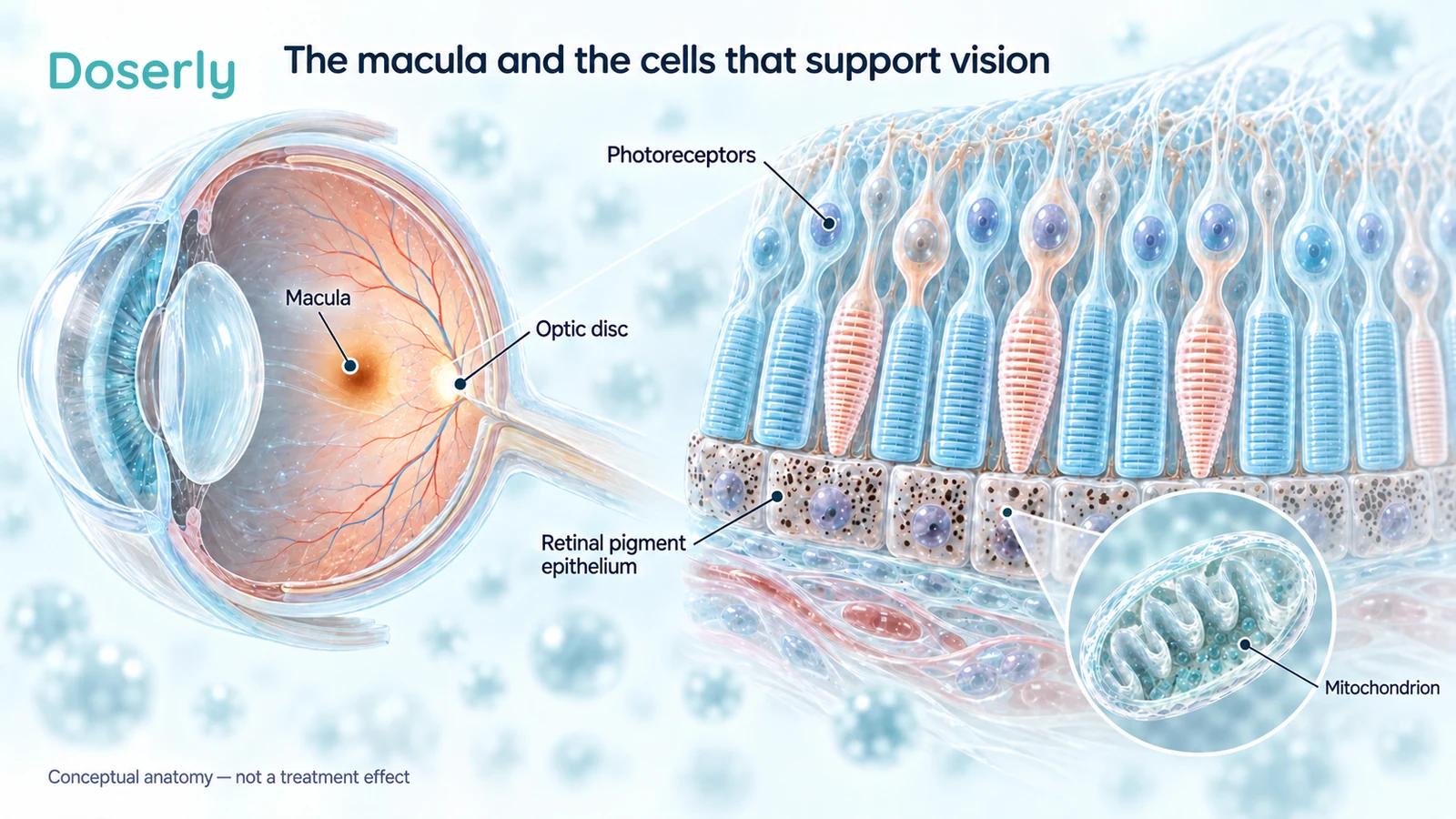
SS-31 is a synthetic peptide that binds cardiolipin, a lipid associated with the inner mitochondrial membrane. That provides a biological reason to investigate mitochondrial function in different diseases. It doesn't tell us in advance which patients will benefit. Our SS-31 guide explains the mitochondrial background and the broader clinical program. Forzinity prescribing information
Why an eye chart and a retinal scan can tell different stories
Imagine that someone reports difficulty reading a menu in a dim restaurant, but can still read an eye chart reasonably well in a bright examination room. Both observations can be true. Lighting, contrast, print size and the particular task all influence what vision is being tested. This is why an eye study may include several functional measurements rather than relying on one familiar chart.
Best-corrected visual acuity measures performance with appropriate optical correction. A low-luminance version tests acuity under reduced lighting. Reading tests examine another practical task. A questionnaire can ask how vision affects daily life. None of these is a direct picture of the retina; they describe performance or experience.
Optical coherence tomography, usually shortened to OCT, uses light to create cross-sectional images of retinal tissue. Researchers can use those images to assess structural features and changes over time. The scan supplies information that a letter chart cannot, but a favorable scan result doesn't automatically quantify how much easier reading has become. National Eye Institute: eye examinations and OCT
A useful treatment could conceivably preserve tissue before a short study detects a functional difference. Conversely, a functional test might improve without showing the expected structural change. These possibilities explain why researchers collect several measurements. They don't justify choosing whichever measure looks best after a trial ends and treating it as the whole answer.

What happened in the first ReCLAIM study?
The high-risk drusen cohort included 21 adults aged at least 55 with intermediate AMD. Everyone received daily subcutaneous elamipretide for 24 weeks. The primary purpose was to examine safety and tolerability; visual outcomes were exploratory. Eighteen participants completed the study. Among completers, mean improvement was 3.6 letters under normal lighting and 5.6 letters under low lighting. Several reading and questionnaire measures also improved, while other structural and functional tests did not. Primary report
The missing comparison group is central to interpretation. A change from someone's starting score includes any drug effect, but can also include variation in testing, familiarity with the test and other changes over time. With an open-label study, people also know that they are receiving the experimental treatment. A positive result is therefore a reason to arrange a more rigorous comparison, rather than a reliable estimate of what the drug adds.
The geographic atrophy cohort was reported separately. Among its 15 completers, investigators described improvements in normal- and low-light acuity over 24 weeks. It, too, was an open-label phase 1 study. It should not be counted as a separate placebo-controlled confirmation. ReCLAIM noncentral geographic atrophy report
These studies helped establish that the treatment and assessments could be carried out and identified outcomes worth examining further. They were not designed to provide the final answer about effectiveness.
What did the larger randomized trial find?
ReCLAIM-2 enrolled 176 people, assigning 117 to elamipretide and 59 to placebo. Participants were at least 55 and had dry AMD with geographic atrophy. Treatment lasted 48 weeks, followed by four weeks of follow-up. The study was randomized and double-masked: treatment assignment was concealed from participants and investigators.
The two primary efficacy outcomes were change in low-luminance best-corrected visual acuity and change in geographic atrophy area measured with OCT, using a square-root transformation of area. Neither primary endpoint met statistical significance. This is the main result to retain when judging whether the trial demonstrated its intended benefits. ReCLAIM-2
Randomization matters because the placebo group supplies an estimate of what would have happened over the same period without the active drug. That makes the comparison more informative than an improvement within a treated group alone. Masking also helps reduce differences in expectations and assessment. These safeguards don't make a trial infallible, but they address important weaknesses of the earlier studies.
A nonsignificant result does not prove that the treatment has exactly zero effect in every patient. It means the study did not establish the specified benefit with the required statistical confidence. It also doesn't allow us to replace the original question with a different, favorable one and declare the original trial successful.
Why researchers remain interested in the ellipsoid zone
An additional outcome examined the ellipsoid zone, or EZ, an OCT feature associated with photoreceptor integrity. ReCLAIM-2 reported less progression of total and partial EZ attenuation or loss with elamipretide. The relative reductions in those specific measures were 43% and 47%, respectively, with nominal p-values of 0.0034 and 0.0040. Published report
Those percentages describe an imaging analysis. They do not mean 43% of sight was restored, 47% of damaged cells regenerated, or that a person's likelihood of blindness fell by either percentage. They also concern a different measurement from the primary geographic atrophy-area endpoint.
“Nominal” is an important qualification. When researchers examine multiple outcomes, an apparently positive result is easier to encounter by chance. A nominal p-value is not, by itself, evidence that all the statistical requirements for a confirmatory claim were met. The sensible next question is whether a later trial, built to test the imaging outcome in advance, can reproduce a useful and credible effect.
Even successful replication would leave a patient-centered question: how strongly does preserving this feature predict preserved function over time? Imaging can reveal subtle changes earlier than a person notices them. That makes it valuable, while still requiring care when translating it into promises about daily vision.
Does the eye research imply better energy or less fatigue?
An organ-specific result cannot establish a whole-body benefit. Someone might read about mitochondrial effects in retinal cells and wonder whether the same medicine would help persistent tiredness. That is a reasonable question, but it needs research that actually measures fatigue and function in the relevant population.
MMPOWER-3 studied 218 people with primary mitochondrial myopathy, a specific muscle disease, over 24 weeks. It found no significant benefit on its primary walking-distance or fatigue outcomes. The estimated walking-distance difference was −3.2 metres, with a 95% confidence interval from −18.7 to +12.3 metres. Those participants differed from the AMD population, and the study does not answer every cause of fatigue. It does show why a proposed mitochondrial mechanism is insufficient to promise more energy. MMPOWER-3
Similarly, FDA's accelerated approval of Forzinity in September 2025 concerns improving muscle strength in adults and children with Barth syndrome weighing at least 30 kg. It is not an AMD approval. The approval relied on strength findings during a longer open-label period, and confirmatory work is required under the accelerated pathway. FDA trial snapshot
What risks and practical questions remain?
Elamipretide was given under the skin in these trials, not into the eye. That distinction matters when comparing it with other AMD treatments. The prescription label identifies injection-site reactions as common and warns about serious allergic reactions. A medication aimed at an eye condition can still cause effects elsewhere in the body. Forzinity label
The balance also depends on treatment burden. A person considering a trial may reasonably care about repeated injections, travel for testing, additional appointments and how long the research lasts. Those burdens deserve discussion even when the study drug's mechanism sounds promising. Ask what happens if treatment is poorly tolerated and how changes in vision will be assessed.
It is also important not to infer that there are no existing options for geographic atrophy. FDA has approved medicines specifically for that condition, including avacincaptad pegol. Whether an approved treatment is suitable requires an eye specialist's assessment of the disease, likely benefit and risks. Elamipretide research should be discussed within that wider clinical conversation. FDA: Izervay
What to bring to an eye appointment
A description of the actual difficulty is often more helpful than a general statement that vision feels worse. Explain whether you struggle with dim lighting, small print, faces, distortion or a new central blank area, and whether one or both eyes seem affected. New wavy lines or other new central visual changes warrant prompt assessment. National Eye Institute guidance
For an elamipretide discussion, ask which study population resembles you, which outcome treatment is intended to change and how that outcome relates to your daily goals. Ask whether the evidence comes from a completed randomized trial or an ongoing research program. A study registration describes planned research; it doesn't supply the eventual answer.
The published eye research supports continued investigation of particular retinal measurements. It does not yet establish that SS-31 improves the main visual and atrophy outcomes tested in ReCLAIM-2. Keeping that distinction clear lets you discuss the scientific promise without losing sight of the practical question: whether a treatment helps preserve the vision and activities that matter to you.
Sources
- ReCLAIM high-risk drusen cohort, 2022 collection: phase 1, open-label study.
- ReCLAIM noncentral geographic atrophy cohort, 2022: separate phase 1 population.
- ReCLAIM-2, online 2024; 2025 collection: randomized study and additional imaging findings.
- National Eye Institute: AMD: anatomy, symptoms and examinations; its older treatment wording should not be used to describe current approvals.
- Forzinity prescribing information: indication, mechanism and risks.
- FDA: Forzinity trial snapshot: approval evidence and its limits.
- MMPOWER-3, 2023: fatigue and walking outcomes in mitochondrial myopathy.
- FDA: Izervay: a separate approved geographic atrophy treatment.