
Supplements
October 16, 2026
Spore-based probiotics: what survival can—and cannot—tell you
On this page
Spore-based probiotics contain bacteria capable of entering a dormant, protected state. That helps explain their appeal: a microorganism that tolerates storage and the journey through the stomach may be easier to deliver to the intestine. If you have been comparing products for diarrhea, bloating or recovery during antibiotics, survival sounds like a sensible starting point.
It is a starting point. The next question is whether the particular preparation improves the problem you want to address. Surviving digestion and improving health are different findings. Human research supports both gastrointestinal survival and some specific clinical uses of certain Bacillus preparations, but it does not establish that every spore product is better than every other probiotic.
Here is how those findings fit together, using Bacillus clausii as a concrete example. Our spore-based probiotics guide provides broader background on the category; this article focuses on what a survival claim actually tells you when choosing a product.
What is a bacterial spore?
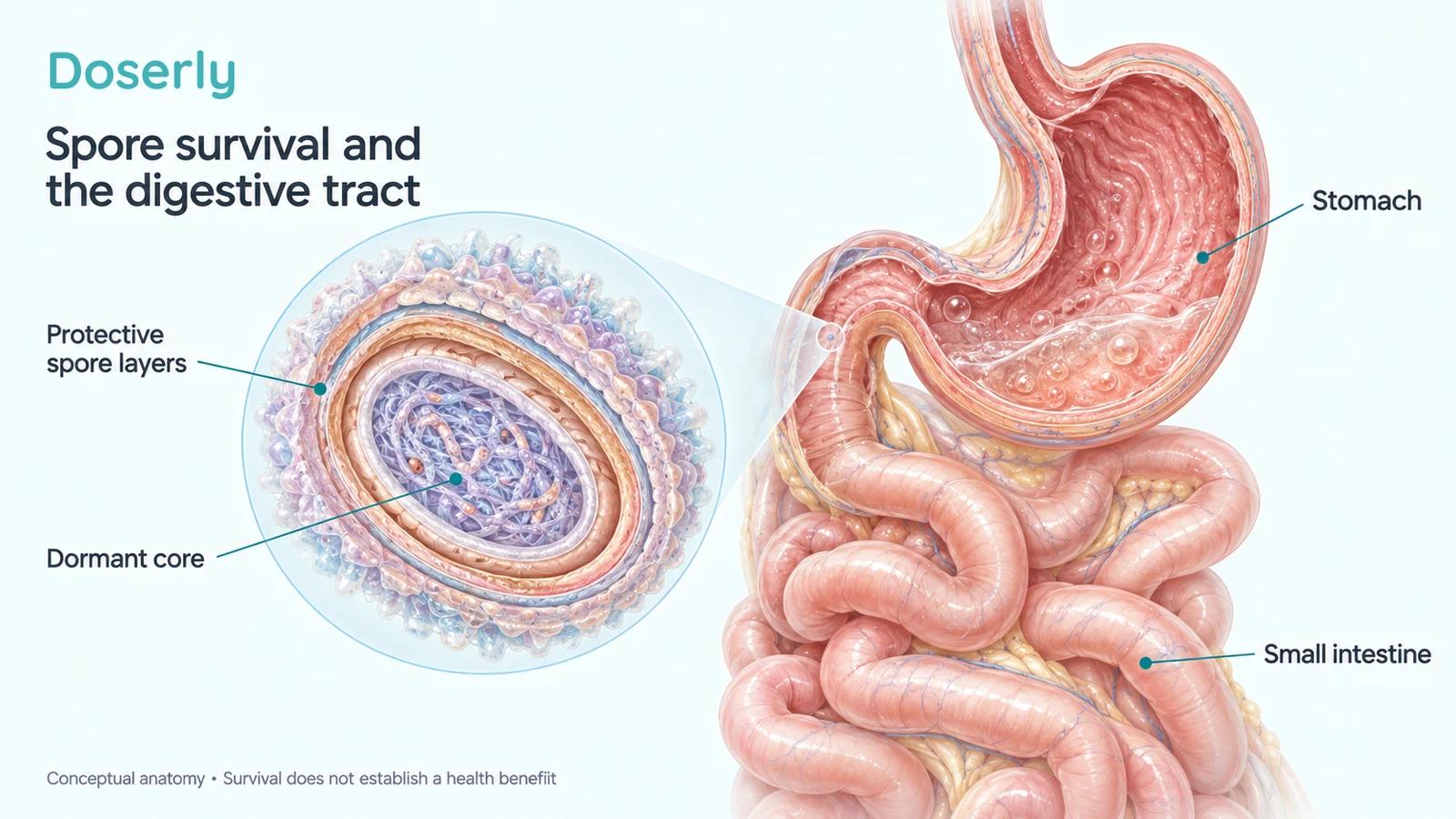
A spore is a dormant form that certain bacteria can produce. Protective structures around its core allow it to endure conditions that can be difficult for actively growing cells. Under suitable conditions, it can germinate and return to a growing, metabolically active form. The point is persistence through a challenging environment, rather than continuous activity while dormant.
Researchers tested this in people in a 2015 randomized, open-label crossover study of two B. clausii preparations. Healthy volunteers received a single administration of each formulation in separate periods. Researchers cultured organisms from stool and used a genetic identification method to check that recovered bacteria matched the administered strains. Living B. clausii could be recovered for up to 12 days. In some volunteers, the number recovered exceeded the number initially administered, supporting germination and multiplication. Ghelardi and colleagues
This is useful delivery evidence. It tells us more than exposing a capsule to acid in a laboratory. But the study measured passage and persistence, not relief of a particular digestive condition. Recovery over several days also does not mean the organism has become a permanent resident of the gut.
Why the strain name matters more than the category name
“Spore-based” describes a biological property shared by different organisms. It is not a single treatment. Within a bacterial species, individual strains can differ, and a commercial preparation may contain several strains together. The name B. clausii alone therefore gives less information than a label specifying the strains and formulation used in a clinical study.
The NIH Office of Dietary Supplements explains that probiotic effects can be strain-specific. It also distinguishes a live microorganism from a probiotic with demonstrated health benefit: a product's use of the word “probiotic” does not itself establish efficacy. A high colony-forming-unit count, usually abbreviated CFU, measures viable organisms under laboratory conditions, not units of clinical benefit. NIH probiotic fact sheet
Imagine two bottles containing B. clausii. One reproduces the preparation tested during a particular antibiotic treatment; the other contains a different strain with a larger number on the front label. The second might eventually prove helpful, but the first trial cannot establish its benefit. The extra organisms do not resolve the mismatch in identity.
The same reasoning applies to a blend. Adding more species changes the intervention. It may change tolerance or activity, and it makes a study of one ingredient a less direct guide to the finished product. A more elaborate formula is not automatically a more thoroughly studied formula.
What has B. clausii actually helped in a controlled trial?
A trial published in 2020 enrolled 130 adults receiving treatment for Helicobacter pylori, a bacterium that infects the stomach. Participants received either B. clausii capsules or matching placebo for two weeks. During the first week, both groups also received the same antibiotics and acid-suppressing medicine. The main question was whether diarrhea occurred during that first week.
Diarrhea affected approximately 29% of participants receiving B. clausii and 48% receiving placebo. The reported relative risk was 0.61, with a 95% confidence interval of 0.39–0.97. That is evidence of benefit for this preparation in this setting, not merely evidence that its spores survived. Plomer and colleagues
The rounded percentages differ by about 19 percentage points. This is not a 19% improvement in every person's digestion, and it is not a promise that someone taking an unrelated antibiotic will experience the same benefit. The result concerns the proportion of people who had a particular event during a specified interval.
There are important boundaries. The trial took place at one Italian center, excluded people with several relevant illnesses, and used a specific H. pylori regimen. Although published in 2020, it was conducted in 2003–2004. Sanofi funded the study. Its short duration does not establish long-term safety or benefits for chronic bloating. The week-two relative-risk confidence interval crossed 1 despite a reported p-value below 0.05; that secondary result warrants more caution than the primary week-one finding. Full trial report
For someone starting antibiotic treatment, the practical value is a focused conversation: does this evidence fit the prescribed regimen, the person's risks and the exact product available? It does not justify substituting a probiotic for infection treatment.
Did an earlier trial find the same thing?
An earlier randomized, double-blind trial included 120 people with H. pylori. It compared B. clausii with placebo alongside seven days of antibiotic-based treatment; the probiotic or placebo continued for 14 days. Nausea, diarrhea and upper abdominal pain occurred less often in the B. clausii group. However, there was no difference in treatment adherence or H. pylori eradication rates. Nista and colleagues, 2004
That distinction is clinically helpful. A person can have fewer treatment-related symptoms without a higher chance of eliminating the infection. These are separate goals, and the study should not be retold as showing that the probiotic treated H. pylori.
The two trials give the category a more concrete basis than a general “survives stomach acid” statement. They also show why specificity matters: the positive examples involve a defined adjunct used during a defined course of medicines. They cannot answer all the questions someone with longstanding, unexplained digestive symptoms might have.
What does the newer evidence review add?
A 2025 review focused on B. clausii strains O/C, N/R, SIN and T during antibiotic treatment. Its search ran through May 2024. The four included publications were two randomized trials, a meta-analysis and an expert consensus. That is not four new, independent randomized experiments. Counting publications without identifying their designs would overstate the direct evidence. Abreu and colleagues
The review concluded that the preparation appeared helpful for antibiotic-associated diarrhea and related symptoms, while recommending further studies in other populations. It is useful for locating the clinical literature, but a synthesis cannot erase the limitations of the trials it summarizes.
For the reader, the main unanswered comparison remains straightforward: would a particular spore preparation work better than a particular alternative for the same condition? A comparison with placebo can establish benefit over that control. It cannot establish superiority over an untested competing probiotic. “Effective in one study” and “best available choice” require different comparisons.

Does a stool test show that your microbiome has been repaired?
Finding the administered strain in stool can confirm that organisms passed through the digestive tract. It does not, by itself, establish a healthier microbial community, explain persistent symptoms or demonstrate restoration of a damaged intestinal barrier. The survival study above did not validate those conclusions.
This matters because a technical result can sound more comprehensive than it is. A person might receive a report showing a new organism after taking a supplement and reasonably wonder whether the product is working. The report has answered a detection question. To answer the health question, you still need an outcome that matters: fewer diarrhea episodes, less pain, or another clearly defined improvement.
Conversely, permanent colonization is not a necessary condition for every possible benefit. A temporary exposure could plausibly have a temporary effect. The useful evidence would measure the effect and its duration rather than treating permanence as the objective. There is no need to promise lifelong residence to explain a short-term clinical result.
If a company advertises “microbiome restoration,” ask what that meant in its study. Was it a laboratory profile, a symptom score, an infection outcome or simply detection of the product's organisms? Those measurements can contribute different information, but one cannot silently substitute for another.
How can you compare products without getting lost in the label?
Start with the full organism designation and the product tested. Then check whether the study concerns the symptom and population relevant to you. A product intended for a healthy adult during antibiotics raises different questions from one proposed for a child with acute diarrhea or someone who is immunocompromised.
Next, look at the quantity and storage information. A viable count can be useful for matching the studied preparation, but a larger count does not establish a stronger effect. The NIH advises attention to viable counts through the end of shelf life and to the strains and doses supported for the intended use. NIH selection guidance
Quality is a separate question from effectiveness. Health Canada's probiotic monograph describes species identification, strain characterization, CFU measurement and assessment of properties such as toxin production and antibiotic resistance. These requirements illustrate why a generic “soil organism” label is inadequate information about an organism's identity or safety. Health Canada probiotic monograph
A sensible comparison might fit on a few lines: the exact strain or blend, why you are considering it, the closest clinical study, the formulation used, and what improved. If the product cannot be matched to research, record that uncertainty rather than filling it with assumptions about the category.
Who should be especially careful?
Probiotics often cause few problems in otherwise healthy people, but they are not risk-free. NCCIH identifies greater concern in people with serious illness or compromised immunity and notes that long-term safety information is limited. Infections caused by organisms in probiotic products have occurred in vulnerable patients. Manufacturing contamination is another potential problem. NCCIH safety overview
A short trial that reports no serious events is reassuring about what happened in that trial. It cannot exclude rare complications or establish safety in people excluded from enrollment. Someone receiving intensive treatment or living with major immune impairment should involve the treating team before taking a live-microorganism supplement.
New or worsening digestive symptoms also deserve attention in their own right. A probiotic should not become a reason to postpone assessment or to assume every symptom represents a desirable adjustment. The safety question is whether continuing makes sense for this person, not whether discomfort can be made to fit a marketing explanation.
Make the treatment goal specific
Before adding a product, write down what you hope will change. “Improve gut health” is difficult to assess. “Reduce diarrhea during this prescribed antibiotic course” gives you a recognizable outcome and a relevant body of research to discuss.
If a clinician recommends a trial, keep the product name, strain designation, start date, medicine changes and symptom history together. Note stool frequency, urgency or discomfort consistently rather than relying on the best or worst day. That record can make follow-up clearer, although it cannot prove causation on its own.
The Doserly spore-based probiotics guide can help you prepare those questions. The most useful advantage is a product that has been tested for the outcome you need, with acceptable safety and quality. Spore survival may help deliver that product; the clinical evidence tells you whether delivery achieved something worthwhile.
Sources
- Ghelardi et al., 2015: human gastrointestinal survival and persistence.
- Plomer et al., 2020: randomized capsule trial during H. pylori treatment.
- Nista et al., 2004: randomized adjunct trial during H. pylori treatment.
- Abreu et al., 2025: review of four-strain B. clausii evidence.
- NIH Office of Dietary Supplements: probiotics.
- Health Canada: probiotic monograph.
- NCCIH: probiotic usefulness and safety.