
Supplements
October 16, 2026
Spermidine and autophagy: what the human studies can tell us
On this page
Spermidine is a small molecule found in our cells and in food. It belongs to a family called polyamines, which participate in cell growth and other basic processes. Researchers are interested in it partly because of its connection to autophagy, a process through which cells break down and reuse some of their contents. That connection has made spermidine a familiar ingredient in supplements marketed for healthy aging.
The appealing idea is that supporting cellular maintenance might help preserve health as we age. But a capsule's spermidine content, a blood measurement and a useful change in memory or immune function are different things. Human research now includes studies of all three, with results that deserve more explanation than “activates autophagy.” Our spermidine guide provides broader background on the compound and its preparations.
What happens during autophagy?
In the form usually discussed here, a cell encloses material in a membrane-bound compartment called an autophagosome. That compartment joins a lysosome, which contains enzymes that break down the enclosed material. The resulting components can be used again. Researchers study both the structures involved and the rate at which material moves through the process.
That rate is called autophagic flux. A snapshot showing more autophagosomes doesn't necessarily mean more material is being successfully broken down: compartments can accumulate when their formation increases or when their clearance slows. This is why laboratory guidance recommends complementary measurements rather than treating one marker as a complete answer. Autophagy assay guidelines
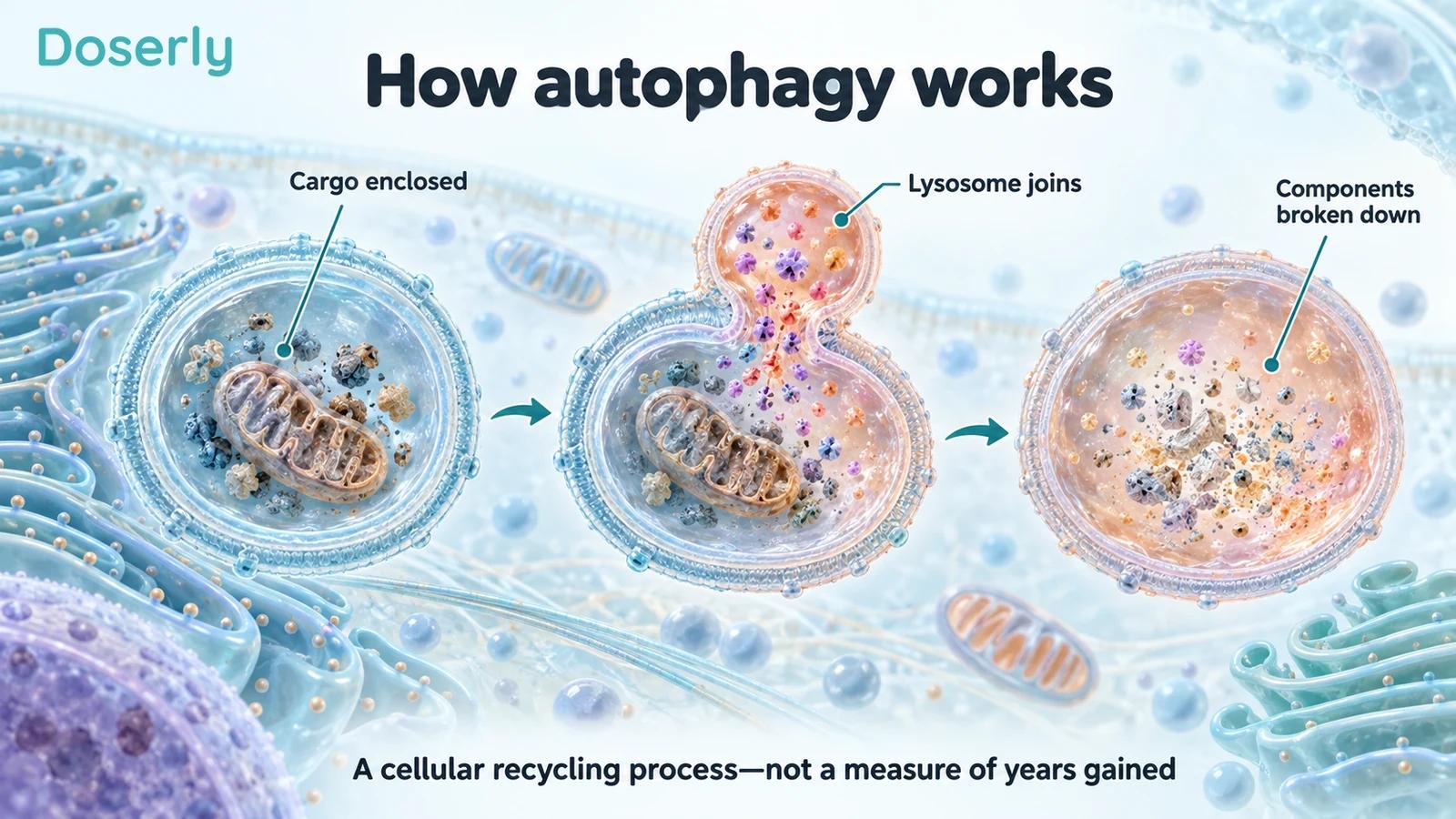
Conceptual illustration of cellular recycling. The arrows describe stages of autophagy, not a demonstrated effect of taking spermidine or a change in lifespan.
For someone considering a supplement, the distinction is practical. A manufacturer might report that a protein associated with autophagy increased. That could be a useful research clue, but it doesn't by itself tell you how much cargo was cleared, which tissues changed or whether you would feel better. Those questions need measurements suited to the proposed benefit.
Why spermidine became a longevity research topic
A foundational 2009 paper investigated spermidine in experimental systems including yeast, worms and flies, alongside cellular experiments. It connected survival effects with autophagy-related mechanisms. These experiments helped establish a biological reason to investigate spermidine; they were not a trial showing that supplements extend human life. Eisenberg and colleagues
A 2024 study extended the mechanistic work by examining spermidine during fasting and calorie restriction across several species. Human volunteers had changes in circulating spermidine during fasting, while experiments manipulating the pathway in model organisms helped test its role in autophagy and longevity. The human participants weren't randomized to spermidine capsules to establish a survival benefit. Hofer and colleagues
This research also explains why “spermidine mimics fasting” is too broad a conclusion. Showing that a molecule participates in a response doesn't establish that taking it reproduces the entire response. Fasting changes many signals at once. Nor does a change in one blood molecule tell us that someone should fast longer or increase a supplement dose.
Does taking spermidine raise its level in blood?
The answer has been less straightforward than the ingredient label might suggest. In a randomized crossover study of 12 healthy adults, researchers compared 15 mg daily with placebo during two five-day treatment periods, separated by a washout. Plasma spermine, a related polyamine, increased; plasma spermidine and putrescine did not. Salivary measurements also did not show the hoped-for increase. Pharmacokinetic study
Pharmacokinetics describes how a substance enters, moves through and leaves the body. These results suggest that metabolism and regulation matter: the compound swallowed isn't necessarily the compound that rises in a sampled fluid. The study was small and short, so it doesn't map every tissue response or establish what happens during long-term use.
An unchanged blood concentration therefore shouldn't be interpreted as proof that nothing happened anywhere in the body. Equally, an increased concentration wouldn't prove that a beneficial amount reached the brain or that autophagy improved there. Blood testing and tissue function answer different questions.
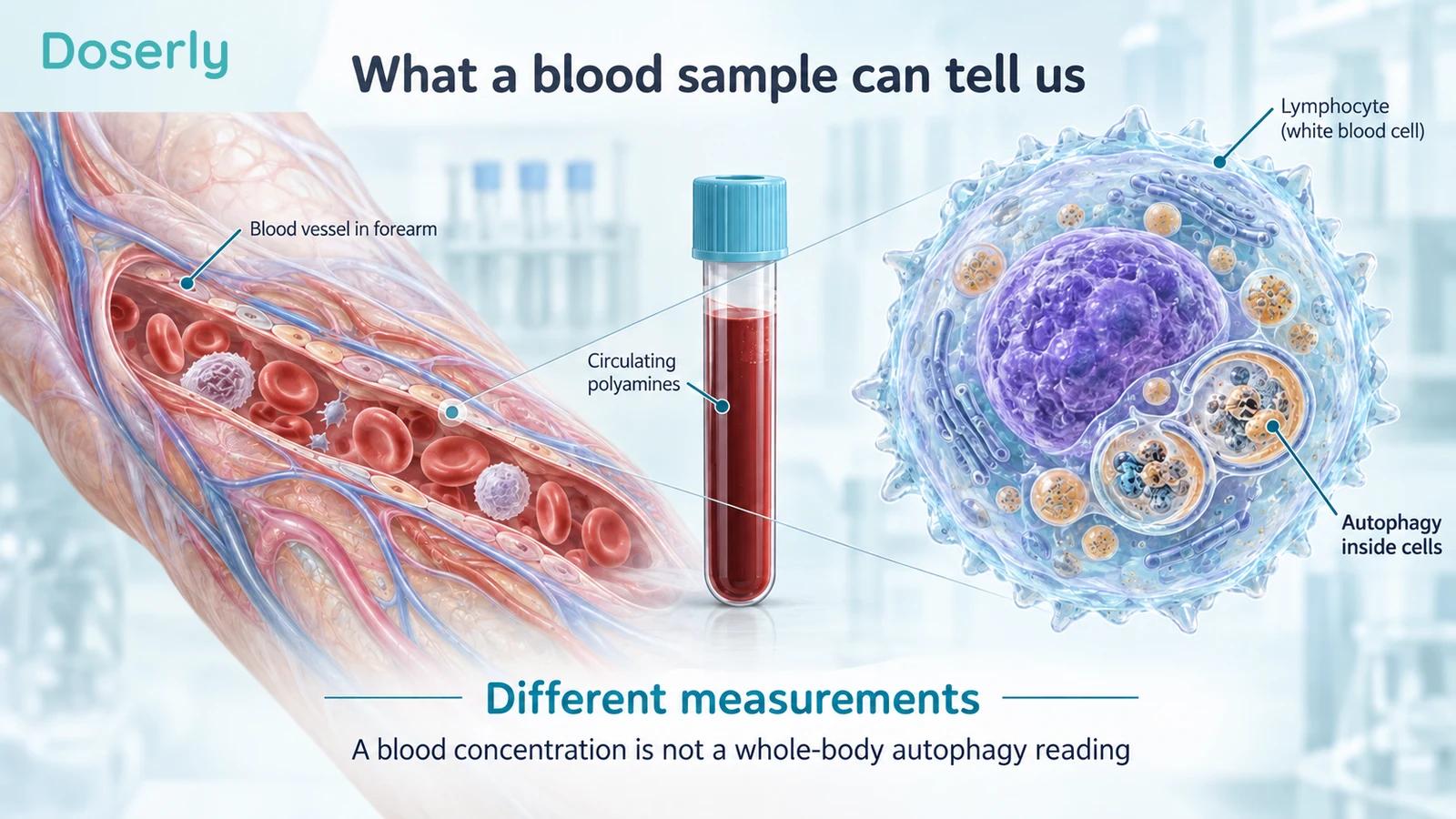
Circulating polyamines and autophagy within cells require different measurements. The vessel and lymphocyte are enlarged conceptual views; the sample tube does not administer a treatment.
What did the higher-dose safety trial establish?
A 2024 exploratory trial studied 37 healthy men aged 50–70, using a high-purity spermidine trihydrochloride preparation at 40 mg daily, with assessments after seven and 28 days. The randomized, blinded, placebo-controlled study found no significant adverse changes in the reported clinical chemistry, blood-cell or lipid measurements. No study-product-related adverse events were reported, and serum and urine polyamines changed little. High-purity spermidine trial
That is useful short-term tolerability evidence for the preparation and population tested. It doesn't establish lifelong safety, safety during pregnancy, safety with every medication or a benefit from taking this amount. Thirty-seven people followed for weeks cannot reliably reveal rare or delayed problems.
The dose is included here to identify the experiment, not as a suggested regimen. It also shouldn't be compared casually with a milligram number on a plant-extract label: an extract's total weight and its actual spermidine content are different quantities. The formulation matters as much as the headline number when comparing products with research.
Have newer studies measured autophagy-related changes in people?
Yes, but their designs make a difference to the interpretation. A 2025 pilot involving 12 adults assigned participants to two amounts of a spermidine-rich rice-germ extract for 56 days. The study compared 1.5 mg with 3.3 mg of spermidine daily, rather than including an inactive placebo group. Rice-germ pilot
In the higher-dose group, the authors reported increases from baseline in Beclin-1 and ULK1, proteins involved in autophagy-related processes. They also reported changes in other biomarkers. These were comparisons with the group's own starting measurements; they don't establish how much of a change would have occurred without supplementation. The sample was very small, and an author held a scientific role at the ingredient supplier.
The finding is more specific than “no human research exists,” but considerably narrower than “human autophagy has been optimized.” Protein measurements are not a direct measurement of successful cargo clearance throughout the body. A larger, independently replicated trial with an appropriate control and relevant functional outcomes would make the result more useful for a consumer decision.
What does the 2026 immune-cell study add?
A 2026 randomized pilot enrolled 40 adults over 65 after a third SARS-CoV-2 vaccination and studied 6 mg daily for 13 weeks. The report describes 38 participants in its baseline comparison, 20 receiving spermidine and 18 placebo. Researchers measured antibodies, immune-cell characteristics and autophagic flux in sampled cells. Immune-cell pilot
The most interesting signals involved participants who initially had weak vaccine responses. However, these nonresponders were unevenly distributed: eight in the spermidine group and two in the placebo group. The authors explicitly describe the immune findings as exploratory; the trial was not powered for definitive efficacy comparisons. The overall anti-spike IgG increases were not statistically significant, despite encouraging findings in particular analyses.
This study advances the human mechanistic evidence beyond a simple blood polyamine measurement. It does not demonstrate that spermidine prevents infections, replaces vaccination or slows whole-body aging. Improved laboratory responses in a small subgroup need confirmation, especially when the starting groups differ in the feature central to the analysis.
For an older adult, the useful question is whether a future trial finds fewer meaningful illnesses or a durable, clinically relevant improvement, not simply whether a marker moves. The present study helps identify that next research question.
Has spermidine improved memory in a larger trial?
Memory is a more direct outcome for people worried about cognitive aging. An early three-month pilot in 30 adults with subjective cognitive decline reported a promising memory signal. “Subjective” means participants noticed worsening cognition even though they were not selected for diagnosed dementia. Early memory trial
The later SmartAge trial tested a spermidine-rich wheat-germ extract providing 0.9 mg daily against placebo for 12 months in 100 adults aged 60–90. Its main outcome was performance on a task requiring participants to distinguish similar remembered images. The between-group difference was −0.03, with a 95% confidence interval from −0.11 to 0.05 and P=.47. The study did not show a significant benefit on its primary memory outcome. SmartAge results
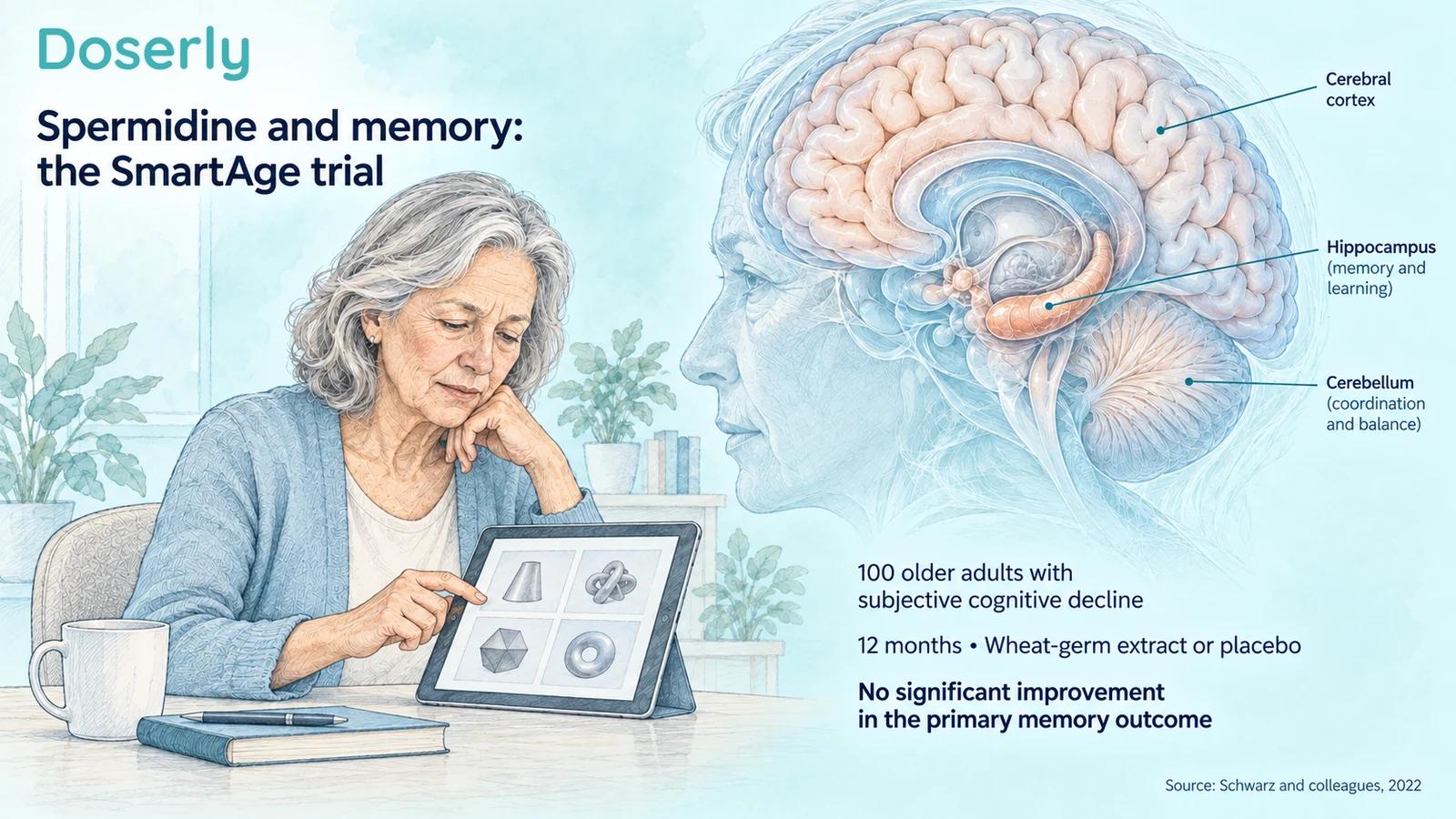
SmartAge did not find significant improvement on its primary memory outcome. The person, tablet task and brain are explanatory illustrations, not an actual participant or evidence of brain repair.
The confidence interval includes differences on either side of zero; it doesn't support a reliable improvement with the tested preparation. Exploratory signals in other analyses can inform future studies, but they don't reverse the main result. Nor does this trial settle every other dose or formulation. It answers a specific and clinically useful question about a year of the intervention tested.
What about people who eat more spermidine-rich food?
An observational study followed 829 adults and used repeated dietary questionnaires over many years. Higher estimated spermidine intake was associated with lower mortality. Researchers adjusted for other measured factors, but they did not randomly assign participants to different spermidine intakes. Prospective dietary study
People consuming different foods may also differ in overall diet, activity, health and circumstances that cannot be fully captured by statistical adjustment. The association is a reason to investigate further, not an estimate of how many years a capsule adds. It also doesn't isolate spermidine from everything else present in those foods.
This leaves room for a sensible food-based approach without a longevity promise. Someone can choose a varied diet for its overall nutritional value while recognizing that the spermidine-specific contribution remains uncertain. There is no need to turn an observational association into a personal target blood level or a supplement escalation plan.
How to make the research useful in a real decision
Start with the benefit you actually want. If you're worried about memory, discuss the pattern and timing of that change with a clinician; an autophagy claim doesn't explain its cause. If your interest is healthy aging without a specific symptom, be clear that the available studies haven't established longer life from supplementation.
Bring the actual product label, including the source material and amount of spermidine per serving. A rice-germ extract, wheat-germ extract and purified preparation are not interchangeable merely because all mention the same molecule. Your medication list and medical history also matter when deciding whether the uncertainty and expense are worthwhile.
If you and your clinician choose to monitor a change, record a relevant outcome consistently rather than relying on a vague impression of “cellular health.” Dated symptom notes can help describe what happened, but they cannot measure autophagy or prove that a supplement caused the change. A blood marker should only be ordered or interpreted when there is a clear clinical reason and a plan for what the result would change.
Spermidine research is becoming more informative as it moves from model organisms into human measurements and trials. The strongest practical reading remains specific: some studies support short-term tolerability and mechanistic investigation, while a larger memory trial did not meet its main objective. None of these results supplies a personal longevity meter.
Sources
- Autophagy assay guidelines, fourth edition (2021)
- Induction of autophagy by spermidine promotes longevity (2009)
- Spermidine is essential for fasting-mediated autophagy and longevity (2024)
- High-dose spermidine pharmacokinetic study (2023)
- High-purity spermidine short-term trial (2024)
- Rice-germ extract biomarker pilot (2025)
- Immune-cell and vaccine-response pilot (2026)
- Early memory trial (2018)
- SmartAge randomized memory trial (2022)
- Dietary spermidine and mortality cohort (2018)