
Supplements
October 16, 2026
Shilajit: check the preparation before the vitality claim
On this page
Shilajit is a complex material associated with rock deposits and used in Ayurvedic medicine. Products are sold as resins, powders and capsules, often with claims about energy, testosterone or recovery. Some human studies are real and worth discussing. They tested particular purified or standardized preparations, however—not every dark resin sold under the same name.
That makes product identity an essential part of the health question. Before asking whether shilajit could help, you need to know what the product is, how it was processed and what testing applies to the finished batch. Then the claimed benefit needs its own evidence.
Our shilajit guide introduces the category. This article looks at three human research settings and explains why a laboratory hormone change, a strength test and a quality certificate answer different questions.
What exactly is being sold?
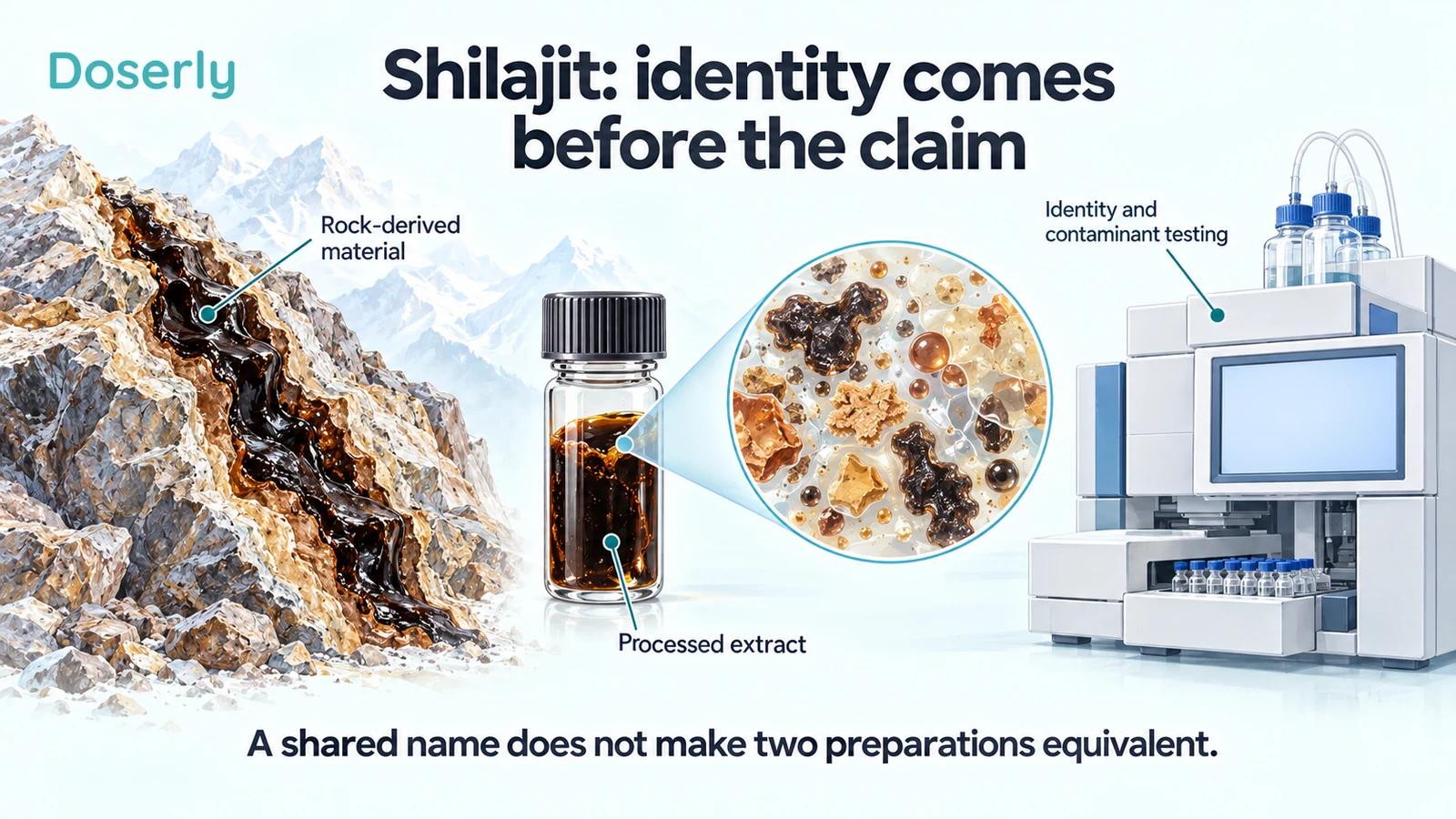
Shilajit isn't one purified molecule with a single chemical formula. Research descriptions identify a mixture of organic material, including fulvic-acid fractions, alongside mineral components. A published exercise study used a specifically purified, standardized extract called PrimaVie, with a stated compositional specification. Keller and colleagues
That preparation detail is not a brand recommendation. It tells us what the investigators administered. It also explains why a trial cannot automatically validate a differently processed resin, gummy or multi-ingredient capsule.
A percentage of fulvic acid may help describe an extract, but a single marker doesn't establish the identity, safety and clinical equivalence of the entire mixture. Two products could share a headline marker while differing in other constituents, serving amount or processing.
The source story is similarly incomplete. A mountain region, traditional name or photograph of raw material may explain origin, but it doesn't show what reached the finished bottle. The useful connection is traceable: the ingredient, the finished preparation, the tested batch and the study exposure.
What the testosterone trial actually found
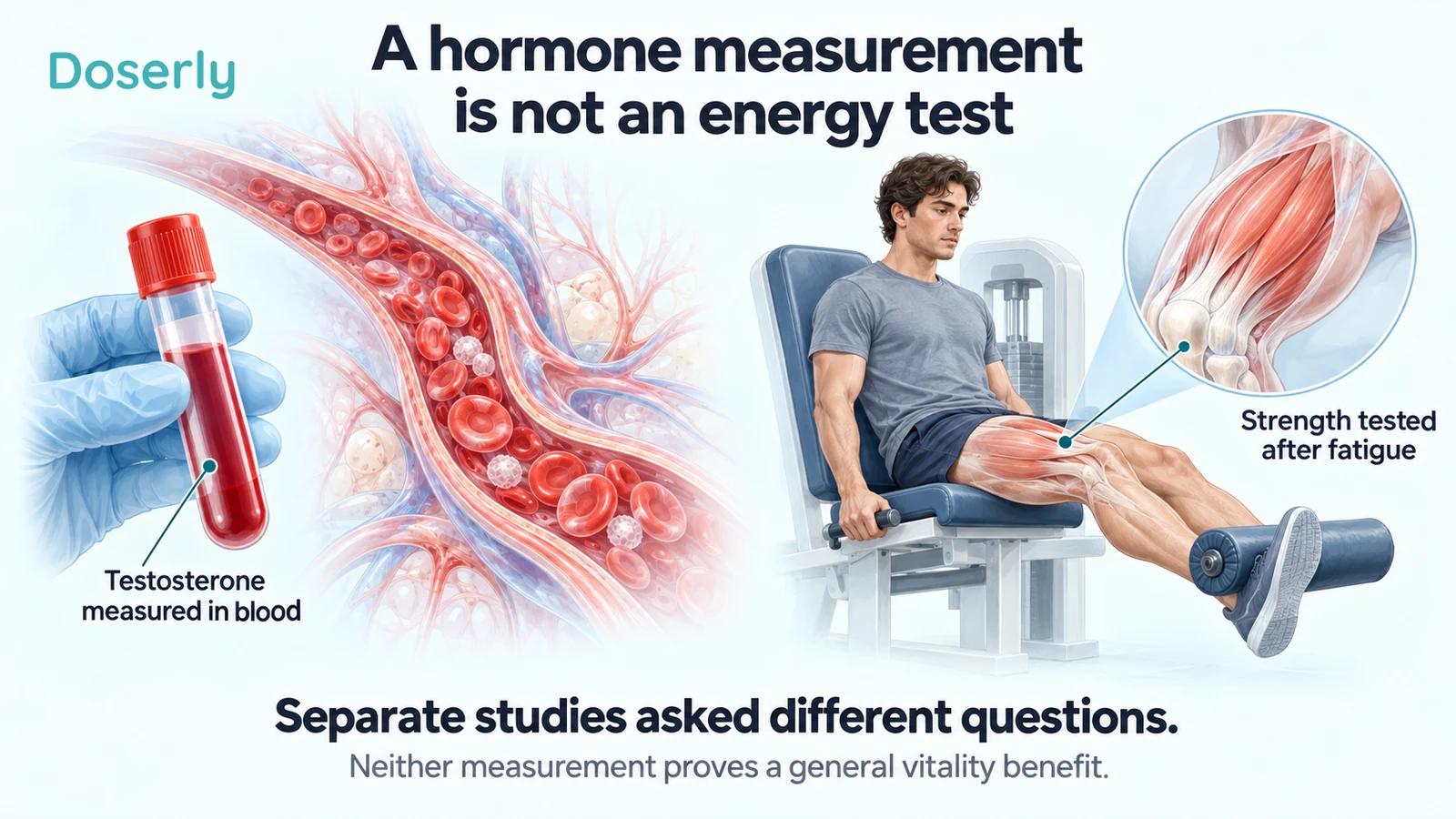
A randomized, double-blind, placebo-controlled study published in 2016 tested purified shilajit in healthy men aged 45–55. The studied amount was 250 mg twice daily for 90 days. The abstract reports increases in total testosterone, free testosterone and DHEAS compared with placebo. DHEAS is an adrenal androgen-related hormone measured in blood. Pandit and colleagues
This is a hormone finding in a defined group. The accessible abstract does not provide enough detail to independently evaluate the absolute between-group changes, their confidence intervals or a complete participant-flow analysis. It also does not establish a clinically meaningful improvement in fatigue, sexual function or fertility.
Those omissions matter more than a headline percentage. A change in concentration can be statistically detectable without telling a reader whether they would feel better. It also doesn't establish treatment for diagnosed testosterone deficiency, because the study described healthy volunteers.
The research amount is included to identify the experiment. It is not a recommendation to copy that exposure with a different product. The preparation and clinical purpose are part of the study, not optional details that can be removed from the result.
A low-testosterone concern needs its own assessment
Testosterone varies with timing and clinical circumstances. The Endocrine Society recommends diagnosing hypogonadism only when compatible symptoms or signs occur with consistently and unequivocally low testosterone, and confirming a low result with repeat morning fasting measurement. It also recommends evaluating the cause. Endocrine Society guideline
That is different from trying to raise a number that falls somewhere within a laboratory range. If the concern is fatigue, low libido or reduced function, describe it directly. A clinician can decide whether hormone testing is appropriate and how to interpret it.
The shilajit trial doesn't identify a blood level at which someone should start a resin, and it doesn't establish a target increase. It should not be used to replace assessment of persistent symptoms.
A useful question is: “What outcome are we trying to improve, and was that outcome measured in people like me?” For a hormonal claim, also ask whether the trial began with low testosterone or simply reported a rise in otherwise healthy participants.
What about physical fatigue and strength?
A 2019 trial randomized 63 recreationally active young men, 21 per group, to a standardized shilajit preparation at 250 mg daily, 500 mg daily or placebo for eight weeks. Researchers tested knee-extension strength before and after a fatiguing exercise protocol.
In the subgroup with higher starting strength, the higher-dose group's adjusted strength decline was 8.9%, compared with 16.0% for placebo. The whole-sample findings were less straightforward, and the favorable placebo comparison should not be presented as a uniform result for every participant. The study was funded by the ingredient supplier, Natreon. Keller trial
The experiment concerns retention of measured force after a particular laboratory task. It is not a trial of chronic fatigue, and it doesn't show that someone will feel more energetic through the workday. Nor does a smaller post-exercise decline establish long-term muscle growth.
Subgroup findings can be useful for deciding what to test next, but they need replication. Here, baseline strength and the chosen measurement affect interpretation. A general claim that shilajit “improves strength” leaves out the conditions under which the favorable comparison appeared.
The bone study answers another question
A 2022 randomized trial enrolled 60 postmenopausal women aged 45–65 with osteopenia, meaning lower-than-normal bone density that does not necessarily meet the threshold for osteoporosis. Participants received placebo or a standardized aqueous shilajit extract at 250 or 500 mg daily for 48 weeks.
The investigators reported less loss of bone mineral density at the lumbar spine and femoral neck in the supplemented groups, along with changes in biochemical markers. The abstract does not report a fracture-prevention benefit. Bone-density trial
Bone density is relevant to bone health, but it is not the same endpoint as fewer broken bones. This small trial also cannot establish broad safety for years of use or show that shilajit can replace established osteoporosis care.
The participants, duration and measurements differ substantially from the testosterone and exercise studies. Combining them into one “clinically proven vitality” claim obscures the actual questions. A person worried about bone loss needs an assessment of bone health and fracture risk, not an inference drawn from a male hormone study.
Why contaminant testing deserves attention
FDA has warned about heavy-metal poisoning associated with certain unapproved Ayurvedic products. Its warning describes products containing harmful metals and symptoms that can include gastrointestinal problems, fatigue and neurological effects. This is a genuine category-level safety concern. It does not establish that every shilajit product is contaminated. FDA heavy-metal warning
That distinction avoids two errors: dismissing all risk because a substance is traditional, and claiming a contamination rate for shilajit that the cited warning did not measure.
NCCIH likewise notes that some Ayurvedic preparations can contain metals and advises discussing their use with health professionals. Traditional use and modern safety assessment answer different questions. NCCIH Ayurveda overview
Testing is especially relevant for a complex source material whose composition cannot be judged from appearance. Color, texture, taste or how a resin dissolves cannot substitute for an analytical result.
The word “purified” also needs a referent. It may describe a manufacturing step, but the consumer still needs to know what was removed, what remains and what limits were applied. Purification is a process claim; a batch test is evidence about a sample.
What a useful test report would show
A certificate of analysis is most informative when it can be matched to the finished product's lot number. Look for the laboratory identity, sample identification, testing date, substances measured, units, methods and results. These are practical questions to ask the manufacturer, not a guarantee that a report is authentic.
For metals, a bare “pass” is hard to interpret without knowing the threshold and intended serving exposure. A result in micrograms per gram is a concentration; the amount consumed also depends on how many grams are used. A smaller scoop and a larger scoop do not produce the same exposure from an identical concentration.
“Not detected” also has a technical meaning. It normally refers to a test's detection capability, rather than proving that a substance is literally absent. Ask whether the report states that limit and whether the testing is appropriate for the material. FDA’s analytical guidance distinguishes results below reliable detection from those that can be quantified. FDA analytical reporting guidance
A report covering lead alone doesn't answer questions about every other contaminant. A report covering several metals doesn't prove microbial quality, and neither establishes clinical benefit. The point is to identify which questions have actually been answered rather than treating one seal or document as universal reassurance.
Quality control doesn't establish effectiveness
A correctly identified, well-characterized product may still lack convincing evidence for the benefit you want. Conversely, a positive study of a characterized extract does not verify a different commercial batch.
These are two separate requirements. The first concerns what you're exposed to. The second concerns what that exposure does in a particular population. It is reasonable to want both, particularly when the intended use is prolonged.
FDA's 2017 advisory letter to a seller of shilajit products addressed disease-treatment claims, including claims involving diabetes and cancer. The letter was about the regulatory status of those claims; it was not a randomized trial showing benefit or a laboratory finding that all shilajit is toxic. FDA advisory letter
That example shows why even impressive-looking health language should be tied to the actual research. Evidence for a hormone measurement cannot support an unrelated disease claim.
What remains unknown about longer-term use?
The studies discussed here followed selected participants for weeks or months. They cannot rule out uncommon adverse effects or establish safety across pregnancy, childhood, complex medical conditions and combinations with medicines.
The comparison also becomes harder with blended products. If a resin is combined with several botanicals or stimulants, the trials of a single standardized shilajit preparation no longer describe the complete exposure. A manufacturer cannot transfer every ingredient's most favorable finding to the mixture without testing the mixture.
This is a reason to avoid treating trial doses as personal instructions. A clinician or pharmacist needs the actual preparation, full ingredient list and health history to discuss relevance. If use is associated with new symptoms, keep the packaging and lot information and seek appropriate medical advice. A symptom such as fatigue should not automatically be interpreted as a reason to increase the amount.
A more useful way to frame the decision
Start by naming the concern: persistent fatigue, a hormone result, reduced exercise performance or low bone density. Then locate research that measured that concern in a comparable population. Keep the product identity attached to the result.
For shilajit, the human evidence offers specific signals worth further investigation. It does not establish a general promise of vitality across ages, sexes, medical conditions and commercial preparations.
Before adding it to a routine, the practical questions are concrete: what exactly is in the product, which batch was tested, what outcome is expected, and how would a meaningful benefit or problem be recognized? If those answers remain vague, the traditional story and the laboratory signal have not yet become a clear personal rationale.
Sources
- Pandit et al.: purified shilajit and testosterone, 2016.
- Keller et al.: strength after fatigue, 2019.
- Shilajit extract and bone density trial, 2022.
- Endocrine Society: hypogonadism guideline.
- FDA: heavy-metal poisoning and certain Ayurvedic products.
- NCCIH: Ayurvedic medicine.
- FDA: Healthy Nutrition Group advisory letter, 2017.
- FDA Elemental Analysis Manual: elemental analysis and reporting.