
Peptides
October 16, 2026
Was sermorelin FDA-approved? Understanding Geref and today's products
On this page
Sermorelin stimulates the pituitary gland to release growth hormone. That biological action led to two historical US uses: testing whether the pituitary could respond and treating growth failure in children with a particular hormone deficiency. The approved products were called Geref.
If you're considering sermorelin today, those facts can sound reassuring. They are worth knowing, but the next question matters just as much: is the product being offered to you the product that FDA approved, for the use that FDA evaluated? A compounded preparation does not acquire FDA approval because its active ingredient appeared in an older approved medicine.
The history is also more nuanced than saying sermorelin was “banned.” FDA later determined that the Geref products had not been withdrawn for safety or effectiveness reasons. That finding did not restore the old approvals or establish an adult wellness indication. Here's how to understand the dates, the biology behind the original uses and the questions to ask about a current prescription. FDA's 2013 determination.
Why was a hormone-releasing drug used as a test?
The pituitary is a small gland beneath the brain. Among its hormone-producing cells are somatotrophs, which make growth hormone. A substance that stimulates those cells can help investigators observe the gland's response.
That is different from diagnosing a condition from symptoms alone. A clinician can give a stimulus and collect timed blood samples to examine hormone release. The historical Irish Geref 50 label describes this diagnostic approach and the need for specialist interpretation. It also lists factors that can influence the response, including thyroid status and metabolic conditions. This archived Irish document explains the test; it is not current US prescribing information. Geref 50 product information.
A diagnostic approval therefore answers a particular question about a test's intended use. It does not establish that repeatedly taking the testing substance improves energy, body composition or healthy aging. A medicine can be useful for provoking a measurable response without being approved as ongoing treatment for everyone who undergoes testing.
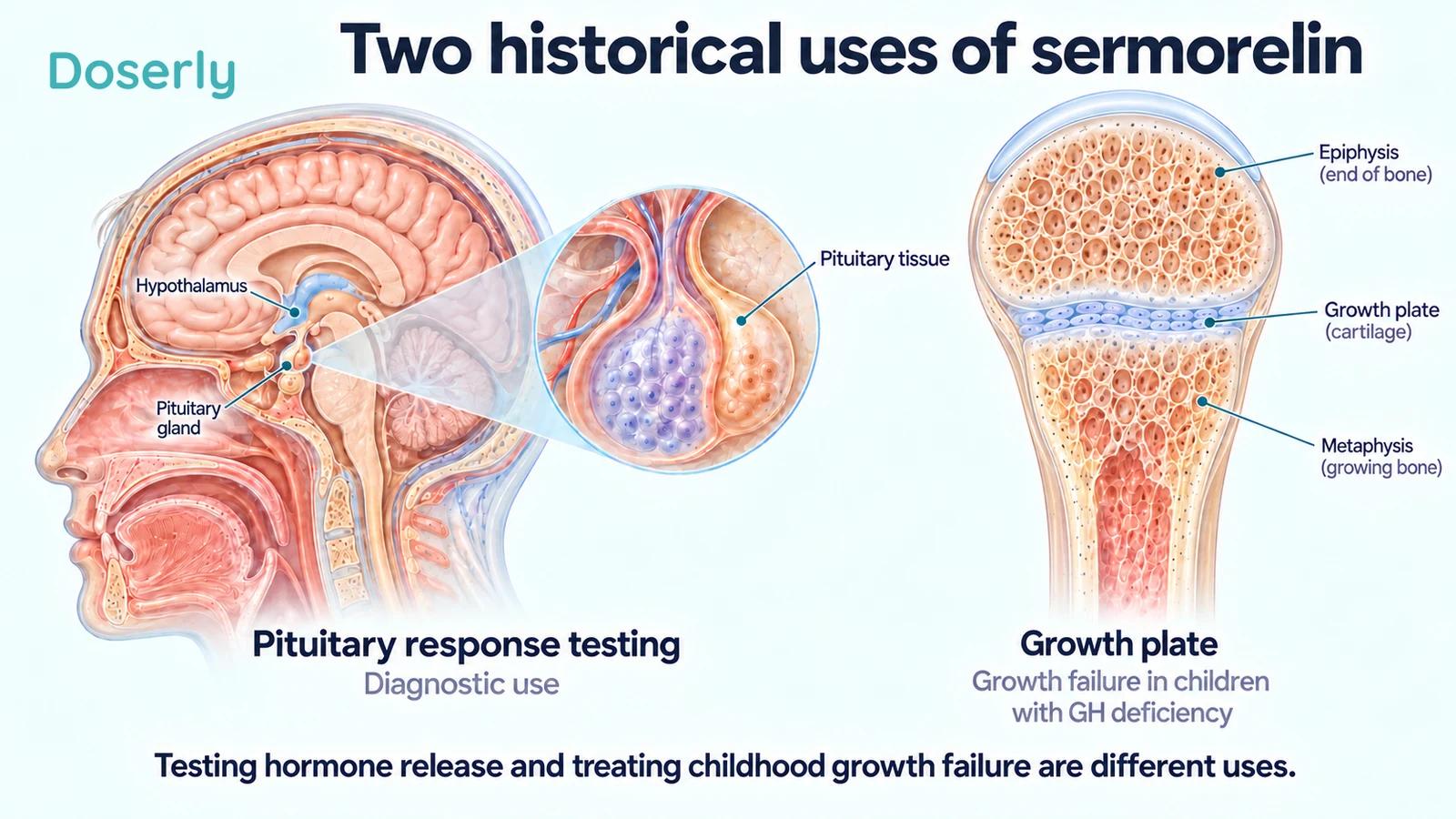
Image sources: AAOS OrthoInfo
What were the actual US approvals?
FDA's historical notice identifies two applications. Geref's diagnostic formulation, associated with NDA 19-863, was initially approved on December 28, 1990. The treatment formulations under NDA 20-443 were initially approved on September 26, 1997, for idiopathic growth-hormone deficiency in children with growth failure.
The manufacturer notified FDA of discontinuation in 2008 and requested withdrawal of the applications. Withdrawal of approval became effective on June 18, 2009. These are separate events: stopping sales, asking for withdrawal and the effective date of withdrawal are not interchangeable dates. FDA historical record.
The indication is as important as the date. Children's growth failure related to hormone deficiency is a defined medical problem. It is not another name for an adult wanting to reduce abdominal fat or recover faster after exercise. Likewise, demonstrating that a pituitary gland releases hormone is not the same endpoint as demonstrating better health after months of treatment.
Our sermorelin guide explains the molecule and the studies in more detail. When reading those studies, keep the population and purpose alongside the result. The shared ingredient does not make every study a test of the same clinical use.
What did FDA decide in 2013?
The 2013 notice addressed whether the Geref products had been withdrawn from sale for reasons of safety or effectiveness. FDA determined that they had not. That distinction matters because it affects whether a future abbreviated new drug application could refer to those products, if all other requirements were met.
It was not a new approval of a marketed sermorelin product. Nor was it a finding that every possible use is safe or effective. The notice discussed the historical products and the regulatory question before the agency. FDA determination.
Two common explanations therefore go too far. “It was removed because it was dangerous” contradicts the determination. “FDA reconfirmed approval for today's adult injections” assigns the notice a meaning it does not have. A careful description can acknowledge the historical approval and the nonsafety withdrawal finding without converting either into a contemporary product endorsement.
The public notice also doesn't establish a complete commercial explanation for discontinuation. Unless another reliable record supports a specific business reason, it is better to describe the documented events than to guess why a manufacturer made them.
An ingredient and a finished medicine are different things
An active ingredient is the substance intended to produce the pharmacological action. A finished medicine also has a formulation, strength, dosage form, manufacturing process, packaging and labeling. Those features influence what the patient actually receives.
For example, knowing that a label names sermorelin does not establish the amount in a vial, how the preparation was made or what storage conditions it requires. A historical label for a different product cannot answer those questions. The dispensing pharmacist and prescriber need to identify the actual preparation and its instructions.
FDA explains that compounded medicines are not approved before marketing and that quality problems can include contamination or too much active ingredient. Compounding can meet medical needs, but the absence of the standard product approval review is a real distinction. FDA on compounded-drug risks.
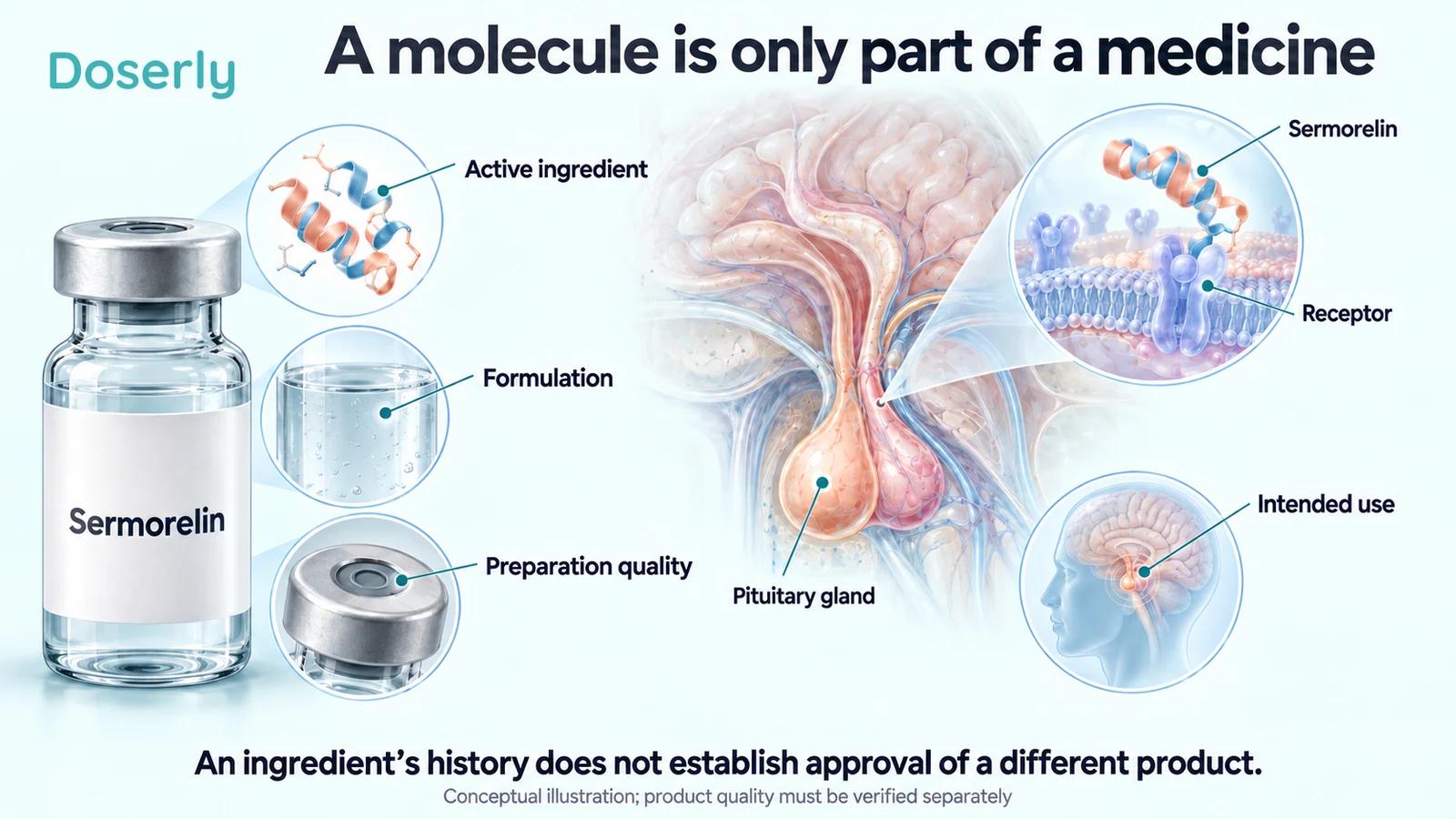
Is a compounded version the same as a generic?
No. FDA distinguishes approved generic medicines from compounded preparations. An approved generic follows an application pathway with requirements that include therapeutic equivalence to its reference product; a compounded drug is not FDA-approved. A familiar ingredient name on both labels does not erase that difference. FDA compounding questions and answers.
This is particularly relevant to sermorelin because the 2013 notice discusses the possibility of future abbreviated applications. Permission for an application pathway to remain available is not proof that a particular pharmacy preparation completed it. If someone describes a product as an approved generic, the claim should be tied to the exact product's approval record.
Nor does a prescription itself answer the approval question. A prescription tells you a clinician has ordered a treatment. It does not turn an unapproved compounded preparation into an FDA-approved medicine. These distinctions help patients understand what has been independently reviewed and what remains part of the prescriber's clinical judgment.
How is this different from off-label prescribing?
Off-label use concerns using an approved drug in a way its approved labeling does not describe. FDA explains that this can involve a different condition, dose or route of administration. Clinicians may prescribe approved drugs off label when they judge that use medically appropriate. FDA explanation of off-label use.
With a compounded sermorelin preparation, there is an additional product question: the preparation itself is not FDA-approved. Calling the prescription “off label” does not resolve that issue. The approval status of the product and the evidence for the intended use need separate explanations.
Off-label prescribing also does not mean the proposed use has been established by a clinical trial. Sometimes substantial evidence supports it; sometimes the basis is more preliminary. The useful question is what supports this particular treatment in people like you, rather than treating the phrase as either a guarantee or a warning by itself.
Does FDA registration mean FDA approval?
FDA says that registering an establishment or listing a drug does not denote approval. The agency also does not approve individual health care providers. A statement that a facility is registered, inspected or licensed therefore answers a different question from whether a medicine has an approved application. FDA: Is It Really FDA Approved?.
This can be confusing because the words often appear close together in advertising. Consider a hypothetical description: “prescribed by a licensed clinician and prepared at an FDA-registered facility.” Even if both statements are accurate, neither establishes that the dispensed product is FDA-approved or that its proposed use has demonstrated benefit.
The same care applies to laboratory testing claims. A test report may address identity, purity or another measured attribute. It cannot establish clinical effectiveness on its own. Ask what was tested, which batch the result concerns and what the test cannot tell you.
What should a patient ask before deciding?
First, ask for the exact product name and whether it is an approved medicine or a compounded preparation. If approval is claimed, ask for the application or official record that matches that product. An old Geref document is useful history, but it is not enough to identify a current vial.
Second, clarify the clinical goal. Treating a diagnosed hormone disorder, investigating pituitary function and trying to improve nonspecific symptoms are different tasks. The adult growth-hormone-deficiency guideline emphasizes appropriate diagnostic evaluation, usually including stimulation testing. It does not establish an adult anti-aging indication for sermorelin. Endocrine Society guideline.
Third, ask what evidence supports the proposed benefit and how improvement will be assessed. If the goal is better physical function, a change in a hormone measurement alone does not settle whether that goal has been met. Discuss potential harms, product instructions and reasons to reconsider treatment alongside the hoped-for benefit.
Finally, keep the actual dispensing information available. The preparation, pharmacy, concentration, instructions and dates are more useful in a follow-up conversation than a general memory that the ingredient was “FDA approved.” Do not substitute a historical product's storage or administration instructions for the directions supplied for your own prescription.
The accurate description is specific: sermorelin has a history of FDA-approved Geref products for diagnostic testing and selected childhood growth failure; those approvals were withdrawn, and a current compounded product is not itself FDA-approved. That wording preserves the meaningful history while leaving today's clinical and product questions open for proper assessment. The sermorelin guide can help you prepare that discussion.
Sources
- FDA Federal Register determination, March 4, 2013.
- Archived Irish Geref 50 diagnostic product information.
- FDA: Understanding the Risks of Compounded Drugs.
- FDA: Compounding Questions and Answers.
- FDA: Understanding Off-Label Use.
- FDA: Is It Really FDA Approved?.
- Endocrine Society: Adult Growth Hormone Deficiency.