
Peptides
October 16, 2026
Sermorelin and healthy aging: which evidence applies to whom?
On this page
Sermorelin stimulates the pituitary through the growth hormone–releasing hormone pathway. Because growth hormone and insulin-like growth factor 1 tend to change with age, researchers have asked whether stimulating this system could improve aspects of later-life health.
That question has produced some human research, including small hormone studies and a placebo-controlled cognitive study. It has not established sermorelin as a general treatment that reverses aging, prevents frailty or extends life. Evidence from children with growth hormone deficiency answers a different question again. Older-men study; cognition study.
The useful approach is to match each result to the people, molecule and outcome actually studied. Doing that preserves the interesting findings while avoiding the assumption that any increase in a youthful-looking laboratory value means improved health.
What does sermorelin do?
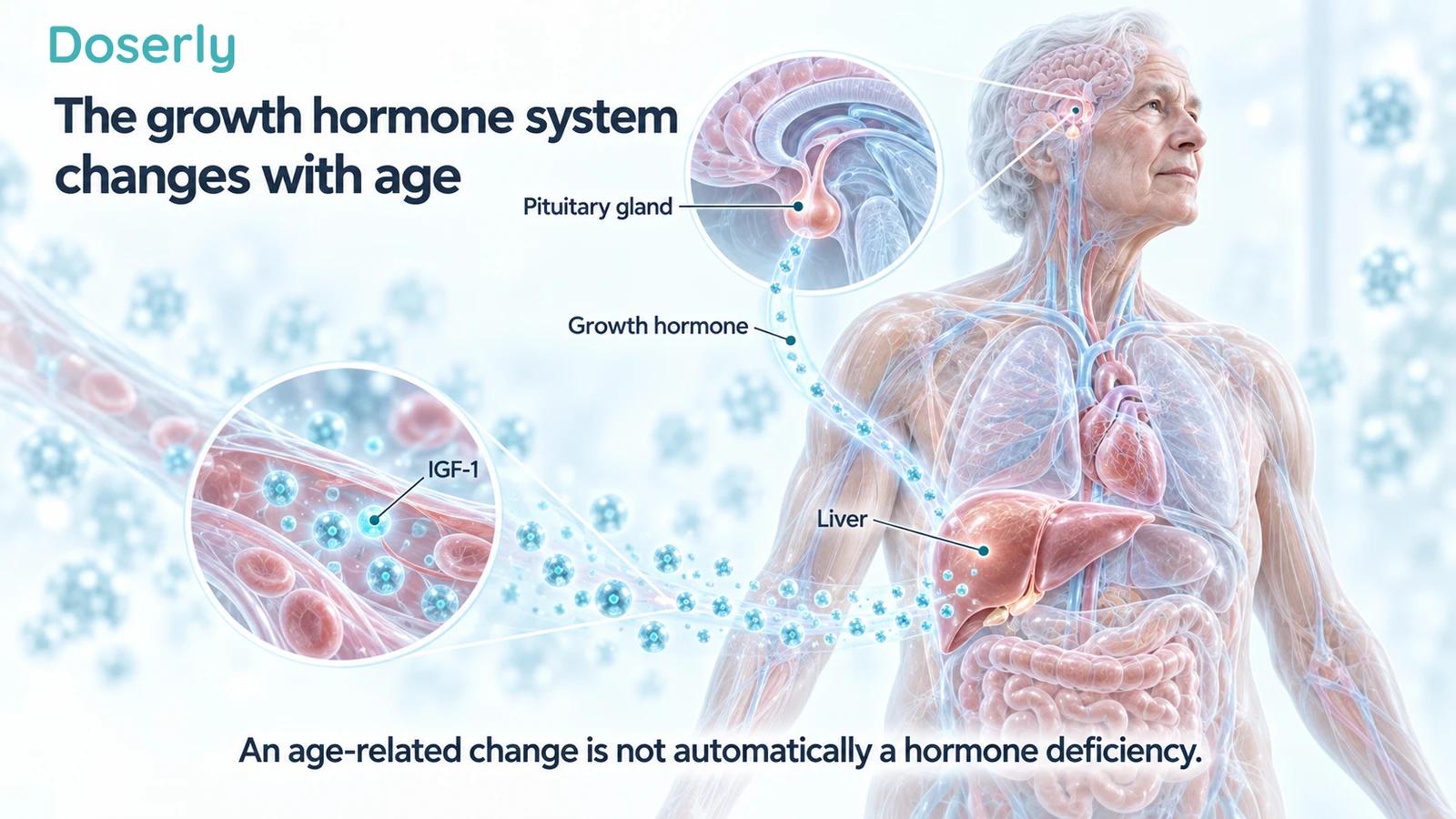
Sermorelin is the biologically active 1–29 fragment of growth hormone–releasing hormone, commonly written GHRH(1–29)-NH2. It stimulates pituitary cells that release growth hormone, or GH. GH in turn influences several tissues and stimulates production of insulin-like growth factor 1, usually called IGF-1.
This is different from directly administering GH. A releasing hormone depends on a functioning pituitary response, which helps explain its historical use in diagnostic testing as well as treatment research. An archived Geref diagnostic label describes testing the functional capacity of the pituitary's GH-producing cells under specialist supervision. Archived product information.
Stimulating an existing biological system does not automatically restore every feature of younger physiology. The timing and pattern of GH release, the resulting IGF-1 response and the effects in different tissues may not all change together.
The Doserly sermorelin guide provides a fuller introduction to the peptide, its history and the distinction between releasing hormone and GH replacement.
Aging and diagnosed GH deficiency are not the same population
Adult GH deficiency is a clinical diagnosis, often considered in the context of pituitary or hypothalamic disease. The Endocrine Society notes that confirmation usually requires stimulation testing, with exceptions in particular established conditions. A single low-looking laboratory value does not automatically establish the diagnosis. Adult GH-deficiency guideline.
Age-associated changes raise a different question. If a hormone level is lower in older adults than in younger adults, that observation does not by itself show that raising it improves health. The change might contribute to some problems without being the sole cause or an appropriate treatment target in every person.
For someone experiencing fatigue or declining physical capacity, the distinction matters. These symptoms are not specific enough to identify a GH-system problem on their own. A clinical assessment should begin with the symptom and context, not with an assumption that aging represents an endocrine deficiency.
Benefits established for GH replacement in severe diagnosed deficiency should therefore not be presented as benefits established for sermorelin in otherwise healthy older adults.
What did the childhood studies measure?
Historical studies examined GHRH(1–29)-NH2 in children with GH deficiency of hypothalamic origin. The main outcome was growth in height, an appropriate goal for that condition.
In one randomized six-month study, 60 children received one of two GHRH regimens or GH. The reported annualized height velocities were 9.2 and 9.3 cm/year in the GHRH groups and 14.6 cm/year with GH. The administration pattern involved continuous GHRH infusion, which matters when comparing it with other studies. Sixty-child trial.
Another six-month study randomized 43 prepubertal children to different GHRH regimens or GH. It found comparable height velocities in the higher-dose GHRH and GH groups, while other growth measures differed. The results should not be merged casually with the first study because the administration schedules and details were not identical. Forty-three-child trial.
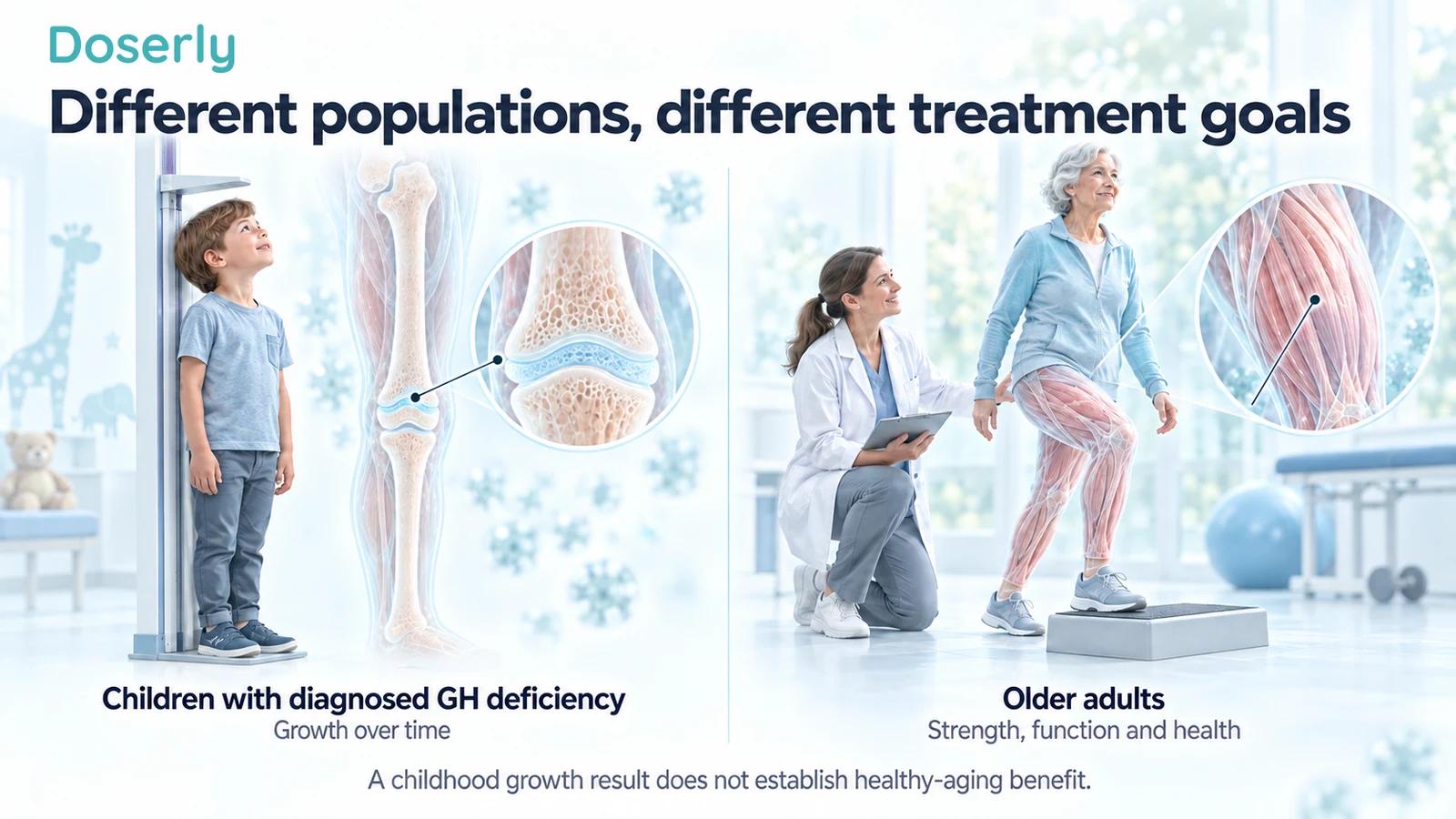
These studies show why the compound attracted clinical interest. They do not demonstrate improved sleep, strength or longevity in older adults. Growing children with a defined endocrine disorder have a different physiology and treatment goal.
What does Geref's regulatory history mean?
Geref was historically approved in the United States for particular diagnostic and pediatric uses. FDA later determined that the discontinued products had not been withdrawn from sale for reasons of safety or effectiveness. Federal Register determination.
That finding is sometimes reduced to an overly broad statement that sermorelin is “FDA-approved for anti-aging.” The notice does not establish that. It addresses the withdrawal history of specified products and the regulatory consequences for potential applications.
Likewise, a modern compounded formulation is not automatically the same approved finished product merely because it contains sermorelin. The historical notice should be used to explain history, not as a substitute for evidence supporting a new indication.
For an older adult, the relevant question remains whether the proposed use has demonstrated a worthwhile benefit in comparable people.
The short older-men study showed a hormone response
A 1992 study compared baseline physiology in ten older men and nine younger men. The older participants then received two 14-day GHRH(1–29) treatment periods at different exposures, in randomized order.
At the higher studied exposure, GH and IGF-1 measures increased toward the younger comparison group's levels. The investigators did not observe changes in several routine safety measurements over those short periods. Original study.
This is evidence that the aging pituitary could respond to stimulation in those participants. It is not a demonstration that the men became biologically younger, avoided falls or lived longer. Those outcomes were not established by a two-week hormone study.
The phrase “restored youthful levels” can therefore be misleading if detached from what was measured. It describes selected endocrine measurements, not a reversal of the whole aging process.
Six weeks of nightly treatment gave a mixed picture
A 1997 study enrolled eleven healthy men aged 64–76 with low baseline IGF-1. After six weeks of nightly GHRH(1–29), nocturnal GH release increased, but IGF-1 did not significantly change. Body-composition measures also did not change.
Two of six strength tests and one endurance test improved. However, the study lacked a concurrent placebo group, making it difficult to separate a treatment effect from test familiarity, normal variation or other influences. Six-week study.
The findings are worth reporting because they are more nuanced than a simple success or failure. The endocrine response did not guarantee an IGF-1 response, and some performance measures changed without a clear controlled demonstration of overall functional benefit.
They also do not establish a superior regimen for present-day use. Comparing this small study with the earlier study cannot identify an optimal schedule because the participants, duration and assessments differed.
There is a genuine cognitive finding to discuss
A placebo-controlled study reported cognitive outcomes in 89 healthy older adults after six months of daily GHRH treatment. Participants receiving active treatment performed better on several tests, including measures involving problem solving, attention and processing. Cognitive study.
The investigators' account of the research program identifies the treatment as sermorelin acetate, Geref. This helps distinguish the study from later work using different GHRH analogues. Investigators' report.
The positive test findings should not be ignored. They are also not equivalent to preventing dementia, maintaining independent living or extending healthy lifespan. The study involved healthy older adults and particular cognitive tests over six months.
For a reader worried about memory, the result is a reason for further research rather than evidence that sermorelin is an established dementia-prevention treatment. The outcome that matters clinically must remain connected to what was actually observed.
Preliminary reports are not the same as complete trial publications
The University of Washington investigators also described preliminary findings from their broader treatment program. Their report discussed changes in GH, IGF-1, body composition and functional measurements, while emphasizing that some analyses were incomplete.
The sleep findings did not support a straightforward improvement. Subjective sleep quality worsened slightly in the active-treatment group, and the authors described the meaning of that change as uncertain pending fuller analysis. Investigator-written preliminary report.
This is not a reason to dismiss every observation. It is a reason to identify the reporting stage accurately. Preliminary findings described within a review should not be promoted as though they were the final primary report of a large confirmatory trial.
It also illustrates that potential effects may differ across domains. A cognitive test result cannot be used to infer improved sleep, and a body-composition change cannot be used to infer longer survival.
Modified GHRH analogues need their own labels
Some aging studies used a modified molecule, such as [Nle27]GHRH(1–29)-NH2, rather than unmodified sermorelin. In one small study of nineteen older men and women, a placebo lead-in was followed by sixteen weeks of the analogue.
Hormone and some metabolic or body-composition findings differed by sex and time, while self-reported sleep quality was unchanged. The IGF-1 response rose earlier and moved back toward baseline by the end of treatment. Modified-analogue study.
That work is relevant to the broader pathway. It should not be relabeled as a direct trial of every sermorelin product. Even a small molecular modification can affect how a compound behaves.
The same caution applies to tesamorelin and CJC-1295. Related mechanisms do not make trial populations, formulations or clinical outcomes interchangeable.
What would a convincing healthy-aging claim require?
“Healthy aging” is broad enough to conceal very different goals. Preventing falls, preserving strength, improving memory, sleeping better and avoiding disease are separate outcomes. A useful trial would choose the relevant goal and measure it directly.
It would also need enough participants and follow-up to distinguish a durable benefit from a short-lived laboratory or test change. Safety should be assessed alongside efficacy, especially when the proposed use involves prolonged exposure in people without an established endocrine deficiency.
The studies discussed here do not establish a lifespan effect. They provide a mixture of biological responses, limited functional observations and a positive cognitive signal. That is a more accurate description than either “proven rejuvenation” or “no human research.”
Further studies could clarify whether a particular subgroup benefits. They would need to define that subgroup prospectively rather than assuming that all older adults share the same treatment need.
How to make the discussion personal and specific
If you are considering sermorelin because you feel weaker, more tired or less sharp, identify the change you want to address. Describe when it began, what activities it affects and what else changed around the same time.
Ask whether the supporting evidence involved people like you. A child's height response, a short study in ten men and a six-month cognitive comparison each answer a different question. None should be presented as a universal result.
Then ask how improvement would be assessed and what would prompt reconsideration. A higher IGF-1 value may document a biological response, but it should not replace the symptom or functional outcome that motivated treatment.
Sermorelin has an interesting research history and some human findings worth understanding. The strongest practical conclusion is that evidence belongs to its population and outcome. The sermorelin guide can help you explore those studies without treating a shared hormone pathway as proof of a general anti-aging benefit.
Explore the research
- Geref 50 Summary of Product Characteristics (2004): Archived Irish diagnostic product document, printed 2006; not current adult wellness approval.
- Evaluation and Treatment of Adult Growth Hormone Deficiency (2011): Guideline concerns diagnosed GHD and GH therapy, not blanket sermorelin use.
- A comparative study of growth hormone (GH) and GH-releasing hormone(1-29)-NH2 for stimulation of growth in children with GH deficiency (1993): Continuous-infusion pediatric study; does not establish adult healthy-aging benefit.
- Growth response to growth hormone-releasing hormone(1-29)-NH2 compared with growth hormone (1993): PubMed abstract truncated at 250 words; claims restricted to visible abstract; different administration schedule from 60-child trial.
- Determination That GEREF (Sermorelin Acetate) Injection Was Not Withdrawn From Sale for Reasons of Safety or Effectiveness (2013): Historical determination does not approve modern compounded products or anti-aging use.
- Growth hormone (GH)-releasing hormone-(1-29) twice daily reverses the decreased GH and insulin-like growth factor-I levels in old men (1992): Small short study centered on hormones; not proof of healthspan improvement.
- Effects of single nightly injections of growth hormone-releasing hormone (GHRH 1-29) in healthy elderly men (1997): No concurrent placebo group; multiple outcomes; no durable function conclusion.
- Growth hormone releasing hormone improves the cognition of healthy older adults (2006): Test performance does not establish dementia prevention or lifespan effects; molecule identity corroborated by investigators' account.
- Treating age-related changes in somatotrophic hormones, sleep, and cognition (2001): Review containing investigators' preliminary original trial findings; not a completed definitive sleep-trial report.
- Endocrine and metabolic effects of long-term administration of [Nle27]growth hormone-releasing hormone-(1-29)-NH2 in age-advanced men and women (1997): Modified Nle27 analogue, not unmodified sermorelin; sequential phase design.