
Peptides
October 16, 2026
Semaglutide microdosing: what the emerging evidence actually means
On this page
“Microdosing” sounds precise. In semaglutide discussions, it can describe several quite different things: starting treatment slowly, remaining at a lower dose, using a compounded product, changing the interval between doses or investigating a new indication. Those approaches should not inherit one another's evidence simply because they share a name.
There is real research on lower-dose semaglutide, and new observational reports appeared in September 2026. There are also registered trials explicitly using the word microdosing. The accurate conclusion is therefore more useful than either “there is no research” or “microdosing is proven.” The evidence belongs to particular products, regimens, populations and outcomes.
For someone considering treatment, the first question is what the proposed plan actually is. The second is whether research has tested that plan for the benefit being promised.
Lower than what?
A dose can be low relative to one regimen and ordinary relative to another. Semaglutide products have different approved indications, formulations and dosing schedules. Ozempic's injectable prescribing information includes 0.5 mg weekly as a maintenance dose for glycemic control, while Wegovy uses a different treatment framework for weight management. Calling every dose below a weight-management target a microdose obscures those distinctions. Ozempic prescribing information
The same issue arises with starting doses. A gradual escalation schedule is part of approved treatment, intended to support tolerability. An initiation dose is not automatically a separately validated long-term regimen for every outcome studied at maintenance doses. Wegovy prescribing information
This is a matter of definition, not a rule that every person must reach the same dose. Clinical decisions can account for response and tolerability. But a tailored decision for an individual and a claim that a named strategy has proven benefits are different statements.
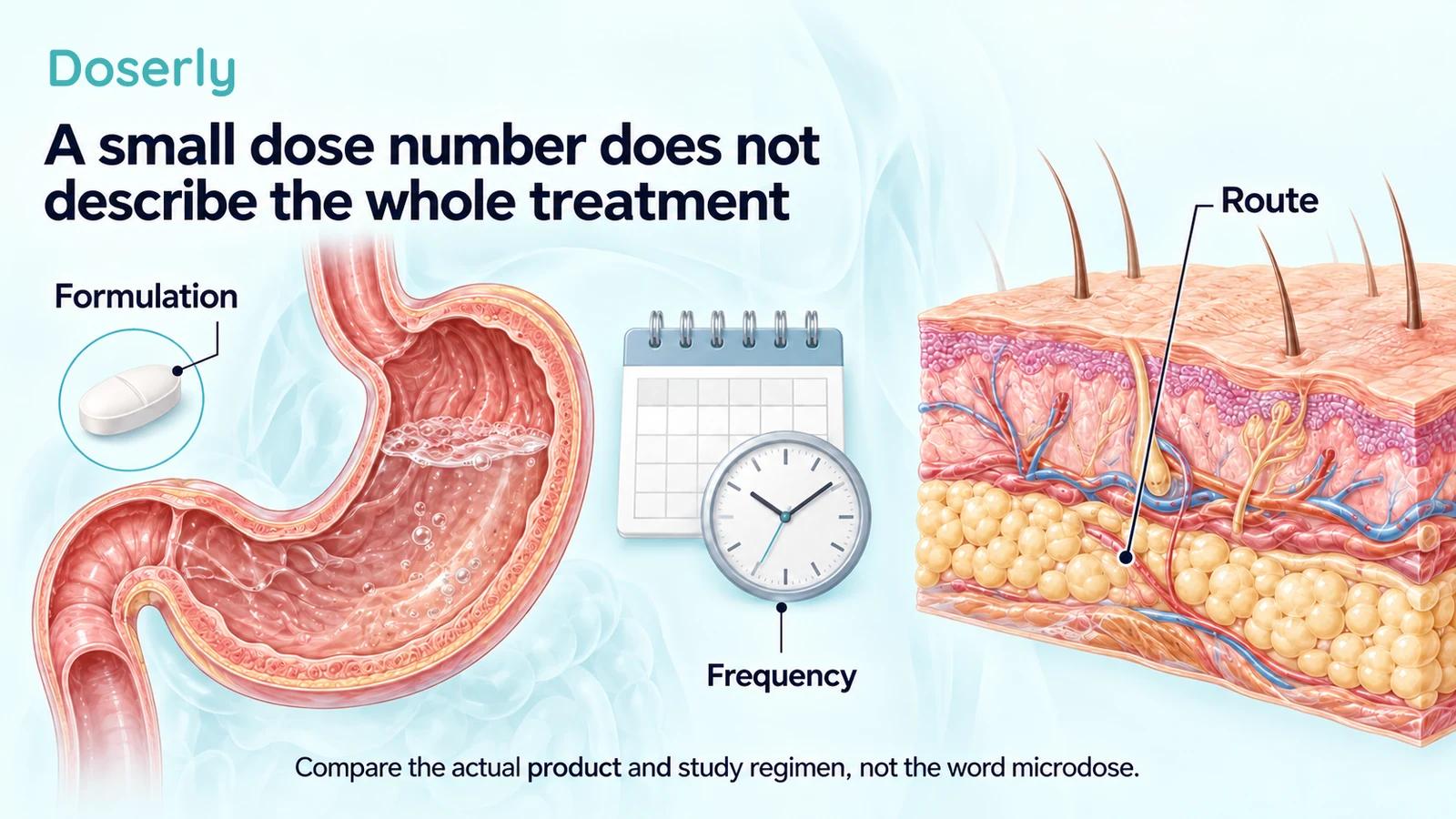
Before evaluating a claim, identify the product, route, frequency, treatment goal and comparison. “Lower dose” becomes interpretable only when those details are supplied.
What established dose-ranging research can tell us
A 2018 phase 2 trial randomized 957 adults with obesity to several semaglutide doses, liraglutide or placebo. The semaglutide doses ranged from 0.05 to 0.4 mg, and the injections were given daily. The trial found weight loss across the studied semaglutide groups, with generally greater effects at higher doses. Original dose-ranging trial
That is meaningful evidence that dose and response can be studied systematically. It is not evidence that the same small number given once a week produces the same outcome. Leaving the word daily out of a summary changes the regimen being described.
Nor should a reader multiply or divide those doses to design a modern schedule. A treatment regimen is more than an arithmetic weekly total. Drug exposure over time, escalation, formulation and the population being treated all matter.
This older trial can support a discussion of dose response. It cannot settle claims about current compounded programs, intermittent dosing, preserving muscle or extending life. Those questions require their own comparisons and outcomes.
What changed with the September 2026 Noom preprint?
A preprint examined a 16-week retrospective cohort in a behavioral weight-management program. It compared a program using compounded semaglutide up to 0.6 mg weekly, another using up to 1.2 mg weekly, and a behavioral program without those medication regimens. The matched analysis included 3,657 participants, with 1,219 in each group. Reported average weight loss was 8.3%, 9.1% and 2.6%, respectively. Noom weight-loss preprint
The report gives emerging real-world evidence about those programs. As of this article's research date, it was a preprint rather than a peer-reviewed trial. Participants were not randomly assigned, and matching on recorded characteristics cannot remove every reason people entered, stayed in or responded to different programs.
The higher-dose comparator was also a specific compounded regimen. It was not a randomized comparison with every approved semaglutide product or maintenance dose. A claim that the lower-dose program achieved roughly nine-tenths of the comparator's average weight loss should remain attached to that comparison and its short follow-up.
For interpretation, separate three layers: what was observed, what might explain it and what it predicts. The observed difference is a starting point. It does not prove identical long-term effectiveness, fewer serious complications, preserved muscle strength or successful maintenance after stopping.
An early report can be worth reading without becoming a prescription template. Its main contribution is to make the next research questions more concrete.
Matching is worth understanding because it can sound like randomization. Researchers select or weight groups to resemble one another on recorded variables, such as age or starting body size. That can improve a comparison, but it cannot balance a factor that was not measured well. Motivation, treatment preferences and differences in follow-up may still matter. Random assignment addresses a different problem by allocating treatment prospectively rather than reconstructing comparable groups afterward. This is why a large observational sample does not automatically answer the same question as a smaller randomized trial.
What are the registered microdosing trials studying?
The AgelessRx study registered as NCT07092605 describes a randomized, single-masked early-phase comparison involving sublingual semaglutide, subcutaneous semaglutide and placebo, with health and quality-of-life measurements. The registry record had no posted results when checked on October 15, 2026. Its recorded recruitment status was last updated in 2025, so it should not be treated as a reliable live recruitment announcement. AgelessRx registry record
A separate trial, REINFORCE, asks about weight regain in people living with HIV after an initial semaglutide treatment period. It compares continued lower-dose treatment with no further semaglutide and uses 0.5 mg weekly in the maintenance arm. The registry listed an estimated enrollment of 30 and no posted results. REINFORCE registry record
These are distinct research questions. One explores a set of health measurements using different routes. The other studies maintenance after initial treatment in a specific population. Neither registration establishes that its intervention works.
A protocol tells us what investigators intend to test. Results tell us what happened, and a critical reading asks how reliably the design supports the conclusion. Moving directly from a trial registration to “clinically proven” skips the central step.
Why the route cannot be left out
Swallowed tablets, sublingual preparations and injections are not interchangeable delivery systems. The approved oral product has formulation-specific administration instructions and absorption characteristics. A sublingual compound cannot borrow that evidence merely because both products enter through the mouth. Wegovy label
The number printed in milligrams describes the amount of drug in a dose, not automatically the amount reaching circulation. A small number on an injectable product and a larger number on an oral product do not create a reliable potency comparison.
This matters particularly when a marketing description groups several routes under the same microdosing label. A study of one formulation cannot establish the absorption, consistency or effectiveness of another without supporting evidence.
Doserly's semaglutide guide explains the route distinctions in more detail. For the microdosing question, the essential habit is to keep the exact formulation attached to every claim.
Does a lower dose mean fewer risks?
Lower exposure may change tolerability, but “lower” does not mean risk-free. Approved semaglutide labeling includes important contraindications, interactions and warnings. Those considerations do not disappear when a regimen is described with a reassuring name. Current Wegovy safety information
There is also a separate product-quality question. FDA notes that compounded GLP-1 products do not undergo the same premarket review for safety, effectiveness and quality as approved medicines. That does not mean every compounded preparation is identical or that every clinical circumstance is the same. It means the evidence for an approved product should not be silently transferred to an unapproved preparation. FDA's current concerns
Dose measurement adds another distinction. Milligrams describe drug mass; milliliters describe liquid volume; syringe “units” describe markings associated with volume. The concentration connects mass and volume. FDA has reported serious errors when these quantities were confused, including errors involving compounded semaglutide. FDA dosing-error alert
An online unit count is therefore not a transferable prescription. If the dispensed product or instructions are unclear, the useful step is clarification from the prescriber or pharmacist using that exact product, rather than adapting another person's numbers.
What about muscle, inflammation and longevity?
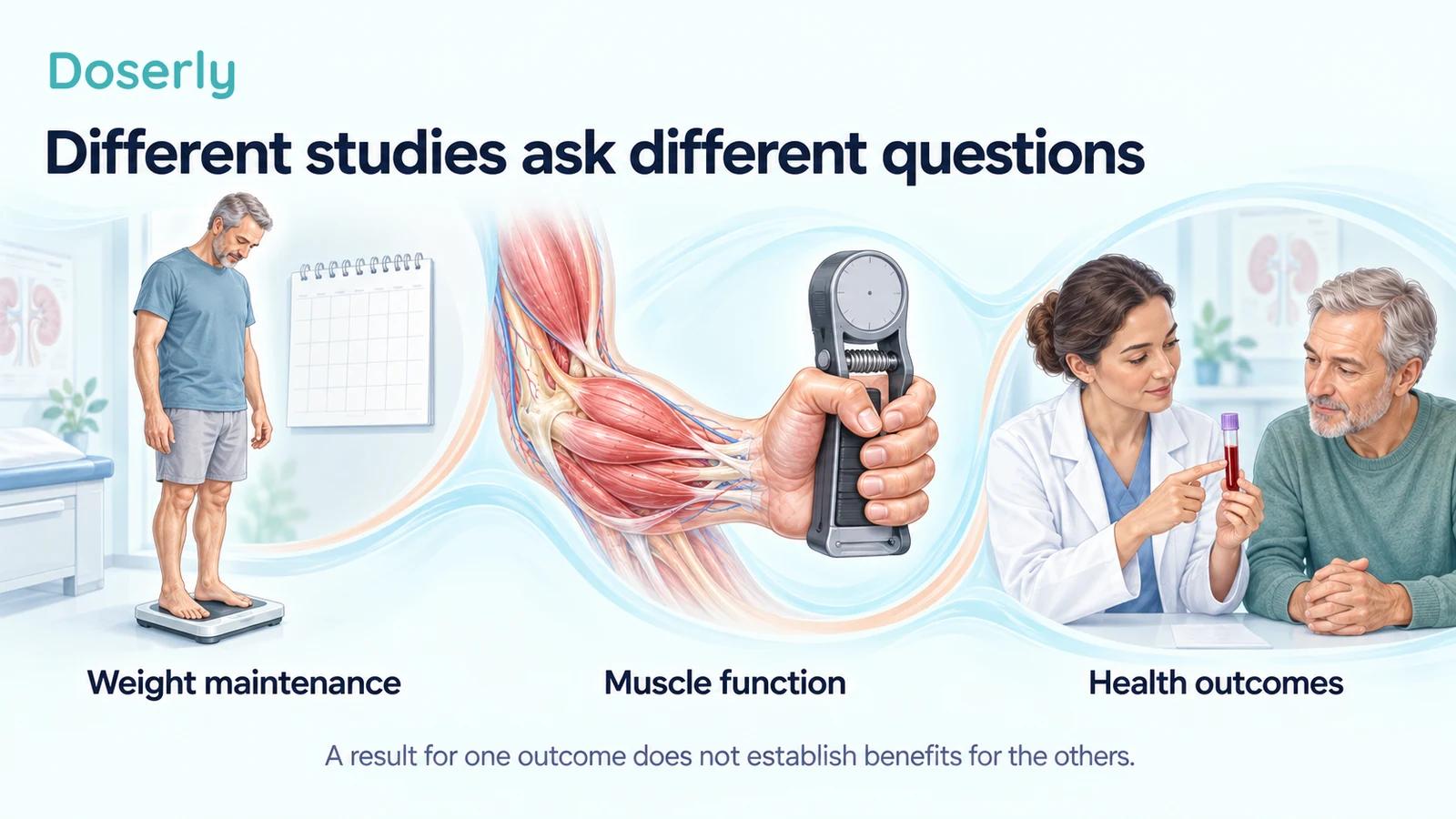
These claims need separate evidence. A weight-loss result cannot establish preserved muscle strength unless strength was assessed appropriately. A blood biomarker change cannot by itself establish fewer clinical events or a longer life. Even a plausible biological mechanism remains a hypothesis about benefit until the relevant outcome is tested.
That distinction is especially important for people who are not seeking weight treatment but are offered a low-dose regimen for broad wellness. The population and treatment goal differ from the groups in major obesity trials. Benefits observed in a high-risk disease population cannot automatically be assigned to a healthier population using a different regimen.
A useful way to read a promise is to turn it into a question with an observable answer. “Supports longevity” is broad. “Reduced a specified clinical event over a defined period in this population” is testable. The more the promise expands beyond the measured outcome, the more uncertainty it introduces.
This does not rule out future benefits. It keeps a promising possibility from being presented as an established result today.
Can microdosing prevent weight regain?
That is one reason maintenance studies are interesting, including REINFORCE. But a planned maintenance comparison is not a completed answer, and the term microdosing does not identify a single maintenance strategy. Continuing a lower weekly dose, spacing injections farther apart and stopping medication are different interventions.
Someone who has responded well may reasonably want to discuss the least burdensome plan that maintains health benefits. The research question is whether a particular plan preserves the outcomes that matter, with acceptable tolerability and follow-up. A short weight-loss cohort does not answer that long-term question.
The same caution applies to tapering. An anecdote about appetite returning slowly does not establish a tested method for preventing regain. Doserly's semaglutide maintenance discussion provides context for the withdrawal evidence without treating it as a personal stopping schedule.
What makes a treatment conversation more useful?
Bring the actual claim and product details. It helps to distinguish a concern about side effects from a concern about cost, excessive weight loss or maintaining a previous response. Those are different problems and may lead to different discussions.
Then ask which evidence supports the proposed goal, how benefit will be assessed and when the plan will be reviewed. If the answer relies on a study, check whether its participants, formulation and outcome resemble the situation being discussed. If the evidence is preliminary, that uncertainty should be part of the decision rather than hidden behind a familiar drug name.
Semaglutide microdosing is an evolving research and marketing term. The most dependable way to understand it is to replace the label with the details: what product, what regimen, for whom, compared with what, and with which measured result. That approach leaves room for new evidence while making it harder for an attractive word to promise more than a study has shown.