
Peptides
October 16, 2026
Semaglutide and knee pain: what improved in STEP 9
On this page
Knee osteoarthritis can make a short walk, a flight of stairs or getting out of a chair painful. For someone who also lives with obesity, weight management may be part of treatment, but pain itself can make activity harder. Researchers therefore asked whether semaglutide could improve both body weight and knee symptoms in the same clinical trial.
The STEP 9 trial found greater weight loss, greater reduction in knee pain and better physical-function scores with weekly semaglutide than with placebo. Both groups also received counseling about diet and physical activity. Those are useful findings for patients with a similar combination of conditions. They do not establish that semaglutide rebuilt cartilage or reversed the structural changes of osteoarthritis. STEP 9 primary report
Understanding that distinction helps keep two worthwhile goals in view: feeling and moving better now, and learning whether a treatment changes the joint's longer-term disease course. STEP 9 provides evidence for the first set of goals. The second requires different measurements and longer follow-up.
What happens in an osteoarthritic knee?
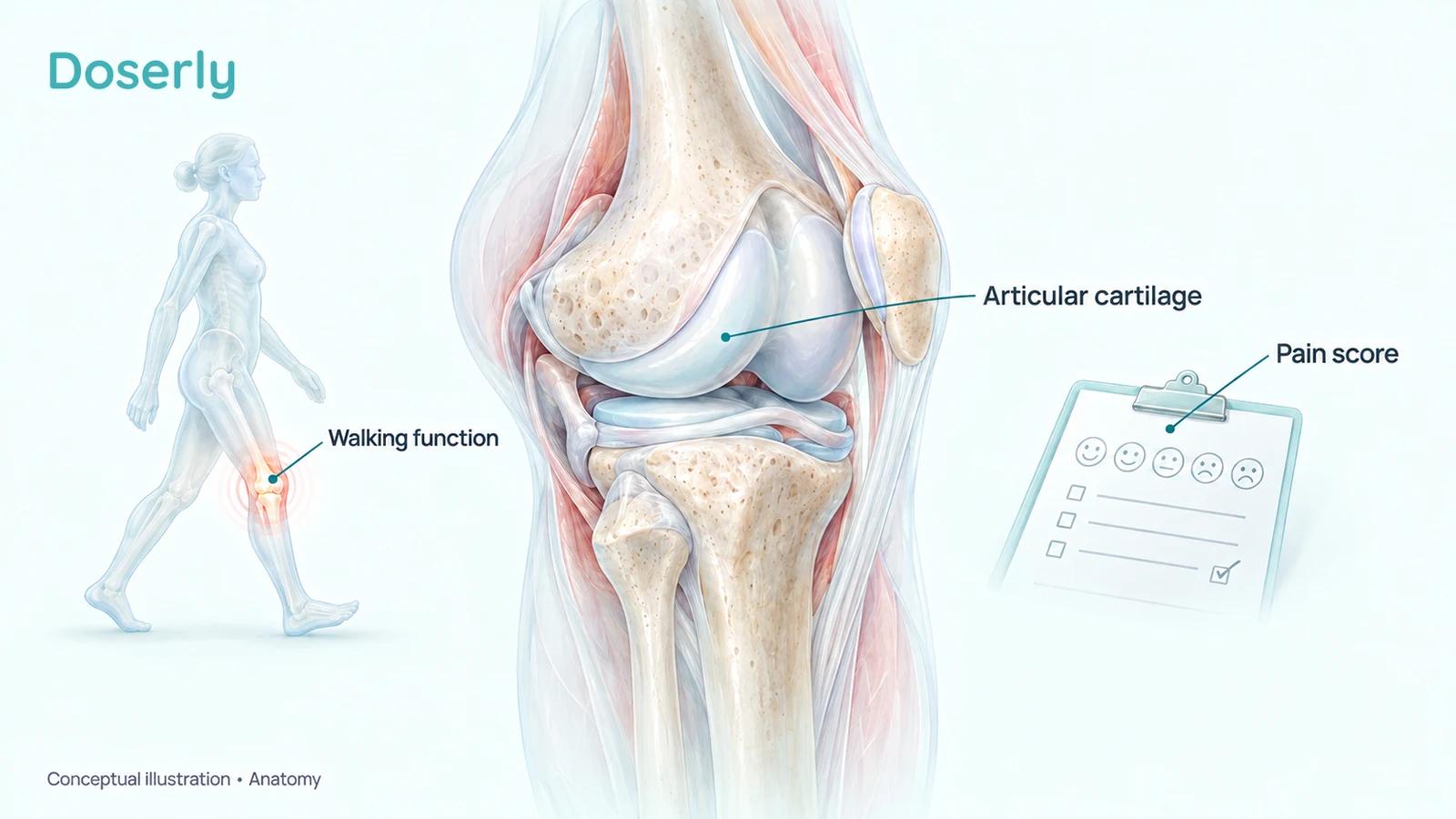
The ends of the bones in a joint are covered by articular cartilage, a smooth tissue that helps surfaces move against each other. Osteoarthritis involves changes in cartilage and other joint tissues, including bone and tissues surrounding the joint. It is more complex than a simple description of cartilage “wearing out.” Pain, stiffness and reduced function can develop as the joint changes. NIAMS overview
That complexity matters when interpreting improvement. A person can have less pain or greater capacity for activity without a scan showing newly restored cartilage. Symptoms are influenced by the whole joint and how it is used; a questionnaire cannot identify exactly which tissue changed.
The reverse is also important: a structural measurement alone may not fully describe how someone feels or functions. Researchers studying disease modification need to connect tissue findings with meaningful clinical outcomes. Patients do not have to dismiss pain relief just because a trial has not demonstrated regeneration.
Our semaglutide guide explains the medicine's broader effects and uses. The question here is narrower: what the knee-specific human trial actually measured, and how its results can inform care.
Who took part in STEP 9?
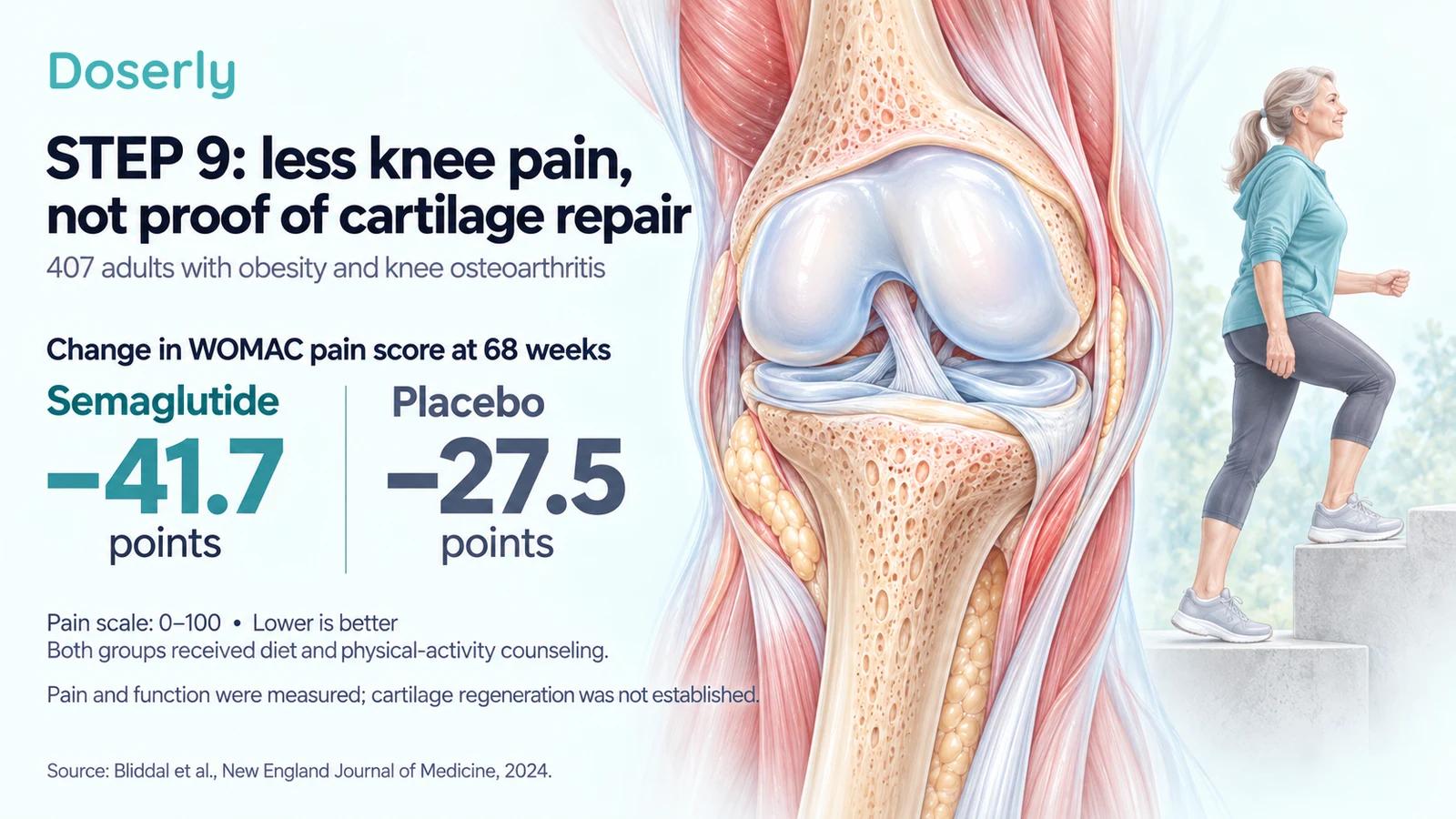
STEP 9 enrolled 407 adults with obesity, a clinical and radiological diagnosis of moderate knee osteoarthritis, and at least moderate pain. It ran for 68 weeks at 61 sites in 11 countries. Participants were assigned in a two-to-one ratio to semaglutide, targeting 2.4 mg weekly, or a matching placebo. Both groups received counseling about physical activity and a reduced-calorie diet. Trial design
The average age was 56, average BMI was 40.3, and approximately 82% of participants were women. Their average baseline WOMAC pain score was 70.9 on a 0–100 scale, indicating substantial symptoms in the group studied.
This was not a trial of every cause of knee pain. It does not directly answer questions about a young athlete's torn meniscus, inflammatory arthritis, a recent injury or knee pain in someone without obesity. Even within osteoarthritis, disease severity, symptoms and other health conditions can differ from the trial population.
If semaglutide is being discussed because of knee symptoms, identifying the cause of the pain comes first. A medicine that helped participants with obesity and diagnosed knee osteoarthritis is not evidence that unexplained knee pain should be treated the same way.
How much did weight and pain improve?
At 68 weeks, mean body-weight change was −13.7% with semaglutide and −3.2% with placebo. Mean WOMAC pain-score change was −41.7 points and −27.5 points, respectively. Both comparisons favored semaglutide statistically. The simple difference between the reported pain-score changes is 14.2 points. STEP 9 results
The pain numbers are points on a questionnaire scale, not percentages of cartilage repaired. They also describe average change from baseline, not the score everyone had at the end. A 41.7-point reduction should not be presented as an extra 41.7-point benefit over placebo, because the placebo group improved substantially too.
A randomized placebo comparison helps distinguish the added effect of the assigned medicine from improvements associated with the broader trial experience. Counseling, other care, expectations and variation in symptoms can contribute to change in both groups. The entire improvement in the active-treatment arm cannot be credited to semaglutide alone.
For a patient, the result makes a combined weight-management and symptom discussion more concrete. It still cannot predict exactly how much less pain one person will experience. Averages are useful for estimating likely treatment value, while follow-up determines what happens for the individual.
What does a WOMAC score mean in everyday life?
WOMAC stands for the Western Ontario and McMaster Universities Osteoarthritis Index. STEP 9 used its pain component, expressed on a 0–100 scale, where a higher score means worse pain. The score collects the patient's experience rather than taking an image of the joint. STEP 9 endpoint description
It is helpful to connect that kind of measure with activities you want to regain. One person's priority may be walking to public transit; another's may be sleeping more comfortably or managing household stairs. A meaningful improvement is easier to discuss when the activity and circumstances are clear.
For example, “I can walk the same route with fewer stops” is more informative than “my knee is better.” If the route became shorter, pain medicines changed or activity was reduced, that context also matters. These are examples of useful symptom tracking, not substitutes for a validated questionnaire or clinical assessment.
A dated record can include pain during a consistent activity, swelling, the distance or time you can manage, and treatment changes. The goal is to describe progress accurately. It is not to diagnose cartilage growth from a series of lower pain scores.
Physical function improved too, but it was still a different endpoint
STEP 9 also assessed physical function with the SF-36 questionnaire. Unlike the pain scale, higher physical-function scores indicate better well-being. Mean improvement was 12.0 points with semaglutide and 6.5 points with placebo. Primary report
This supports a broader symptom benefit than a change in pain alone. But it remains a patient-reported measure. It should not be relabeled as an MRI finding, a measured gain in cartilage thickness or a proven reduction in the future need for joint replacement.
The two questionnaires also cannot be combined casually. A lower pain score and a higher function score move in opposite numerical directions because the scales are constructed differently. Neither uses “points” as a universal unit that can be compared with another unrelated scale.
For readers comparing treatment headlines, that is a practical detail. Always keep the name of the measure, direction of improvement and length of follow-up with the result. Otherwise, a precise-looking number can lose the meaning that makes it useful.
Was the improvement caused by weight loss?
Weight reduction is a plausible contributor. It is already part of established osteoarthritis care for people with overweight or obesity. But STEP 9 assigned semaglutide or placebo, not identical weight loss achieved by different methods. It cannot completely separate a weight-mediated effect from other possible effects of treatment.
Earlier human research helps put the question in context. The IDEA trial randomized 454 adults aged 55 or older with overweight or obesity and knee osteoarthritis to intensive diet plus exercise, diet alone or exercise alone for 18 months. The combined approach produced better pain and function outcomes than the individual approaches. It also investigated joint loading and inflammatory measurements. IDEA primary trial
IDEA shows that meaningful clinical improvement can occur through a structured weight-management and exercise program without semaglutide. It does not prove that every kilogram lost has the same effect regardless of how it is lost, or that its results can be used as a head-to-head comparison with STEP 9. The study populations and interventions differed.
Possible direct anti-inflammatory or tissue effects of GLP-1 treatment remain research questions. To establish a benefit beyond weight loss more clearly, investigators would need designs and measurements capable of separating those pathways. An attractive biological explanation cannot replace that comparison.
What evidence would support a cartilage-repair claim?
Researchers would need to measure the relevant tissue directly or through validated structural methods, use an appropriate comparison and show that the change is reliable. They would also need to consider whether the structural change leads to lasting benefits that matter to patients.
Pain relief alone cannot do that job. Nor can an illustration showing smooth cartilage after treatment. A before-and-after healing picture may look persuasive while claiming more than the underlying study established. The illustrations here explain anatomy and measured symptom outcomes; they do not depict regeneration.
This does not mean everyone needs repeated scans to monitor ordinary osteoarthritis care. NICE advises against routinely using imaging for follow-up or to guide nonsurgical management. Clinical research trying to prove a structural treatment effect and clinical care trying to help someone function better have different measurement needs. NICE osteoarthritis recommendations
The distinction protects the value of the actual finding. STEP 9 does not need a cartilage-repair claim to be relevant to someone whose pain and weight are affecting daily life.
How does semaglutide fit with the rest of knee care?
Exercise adapted to the person, education and weight management remain central approaches. NICE recommends therapeutic exercise and supporting weight loss when appropriate. NIAMS describes strengthening, range-of-motion and other activities as parts of management, with the plan tailored to symptoms and abilities. NICE recommendations and NIAMS treatment guidance
Medication is not a substitute for assessing the knee or building a workable activity plan. If pain makes movement difficult, a clinician or physical therapist can help identify a starting point and adjust it. The appropriate plan may include other pain treatments or, for some patients, surgical evaluation.
Tolerability also matters. In STEP 9, adverse events led to permanent trial-regimen discontinuation in 6.7% of semaglutide participants and 3.0% of placebo participants, most commonly because of gastrointestinal problems. Serious adverse events occurred at similar rates. STEP 9 safety findings
The broader prescribing information contains additional contraindications and warnings. A person considering treatment needs assessment for the approved indication and their medical circumstances; improvement in a knee trial is not a universal prescribing recommendation. Wegovy prescribing information
Questions worth bringing to your appointment
Ask how confidently the symptoms are attributed to osteoarthritis and how closely your situation resembles the people studied. Discuss which activities you want to improve, what weight-management options fit your circumstances and how treatment response will be reviewed.
If semaglutide is an option, clarify its intended role alongside physical activity, nutrition and existing knee care. Also ask what would change the plan if side effects, limited benefit or access problems arise. Keeping those questions specific makes follow-up more useful than relying on the expectation that a medicine should “fix the joint.”
STEP 9 gives patients with obesity and painful knee osteoarthritis a substantive result to discuss: average pain and physical-function improvements were greater with semaglutide than with placebo over 68 weeks. It supports that conversation while leaving cartilage regeneration and long-term structural protection unproven.
Sources
- Bliddal et al., STEP 9, 2024: randomized weight, pain and physical-function outcomes; funded by Novo Nordisk.
- Messier et al., IDEA, 2013: randomized diet and exercise approaches in knee osteoarthritis.
- NIAMS: osteoarthritis: joint tissues and symptoms.
- NIAMS: diagnosis and treatment: practical management approaches.
- NICE NG226 recommendations: exercise, weight management and imaging recommendations.
- Wegovy US prescribing information, June 2026: indications and safety context.