
Peptides
October 16, 2026
Semaglutide and kidney disease: what FLOW can tell patients with diabetes
On this page
Semaglutide is best known for helping people manage blood sugar and lose weight. Researchers have also studied whether it can help protect kidney function in people with type 2 diabetes and chronic kidney disease. For someone living with both conditions, that could mean a benefit beyond changes on the scale.
The largest study discussed here, FLOW, found that adding semaglutide to usual care reduced the risk of a combined outcome that included serious kidney problems and death from kidney-related or cardiovascular causes. You may have seen that reported as a “24% lower risk.” To understand what that means, it helps to look at who took part, which events researchers counted and how many people experienced them. FLOW trial.
We'll go through those results step by step, including what they mean for people already taking other kidney medicines. We'll also look at research in people without diabetes and a study published in October 2026 that examined possible changes inside kidney tissue.
First, what do kidney tests actually measure?
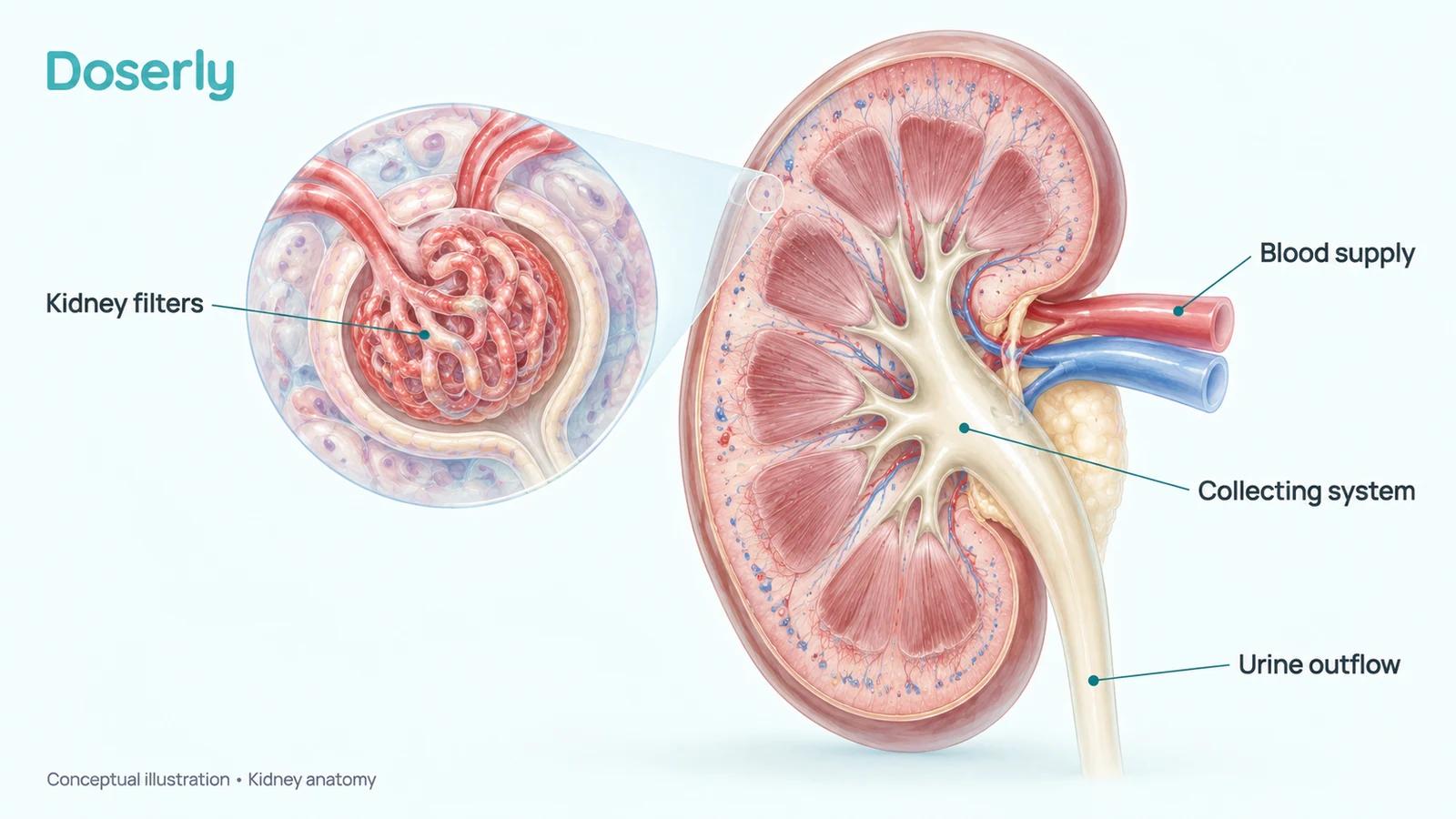
Your kidneys filter blood, keeping substances the body needs while removing waste and excess fluid. Two common tests look at different aspects of that work.
Estimated glomerular filtration rate, or eGFR, estimates how effectively the kidneys filter blood. The “glomerular” part refers to the glomeruli, tiny filtering structures inside the kidneys. The estimate comes from blood measurements; it is not a direct count of healthy filters.
Urine albumin-to-creatinine ratio, or UACR, looks for albumin, a blood protein, in urine. More albumin escaping into urine can be a sign of kidney damage. Comparing it with urine creatinine helps account for how concentrated the sample is. A blood filtration test and a urine protein test therefore answer different questions. NIDDK explanation of kidney testing.
These tests also help explain the different goals of kidney research. A treatment might reduce albumin in urine, slow a decline in filtration or reduce the number of people who develop kidney failure. Those results are related, but they aren't interchangeable. When reading about a new study, it's useful to know which one the researchers measured.
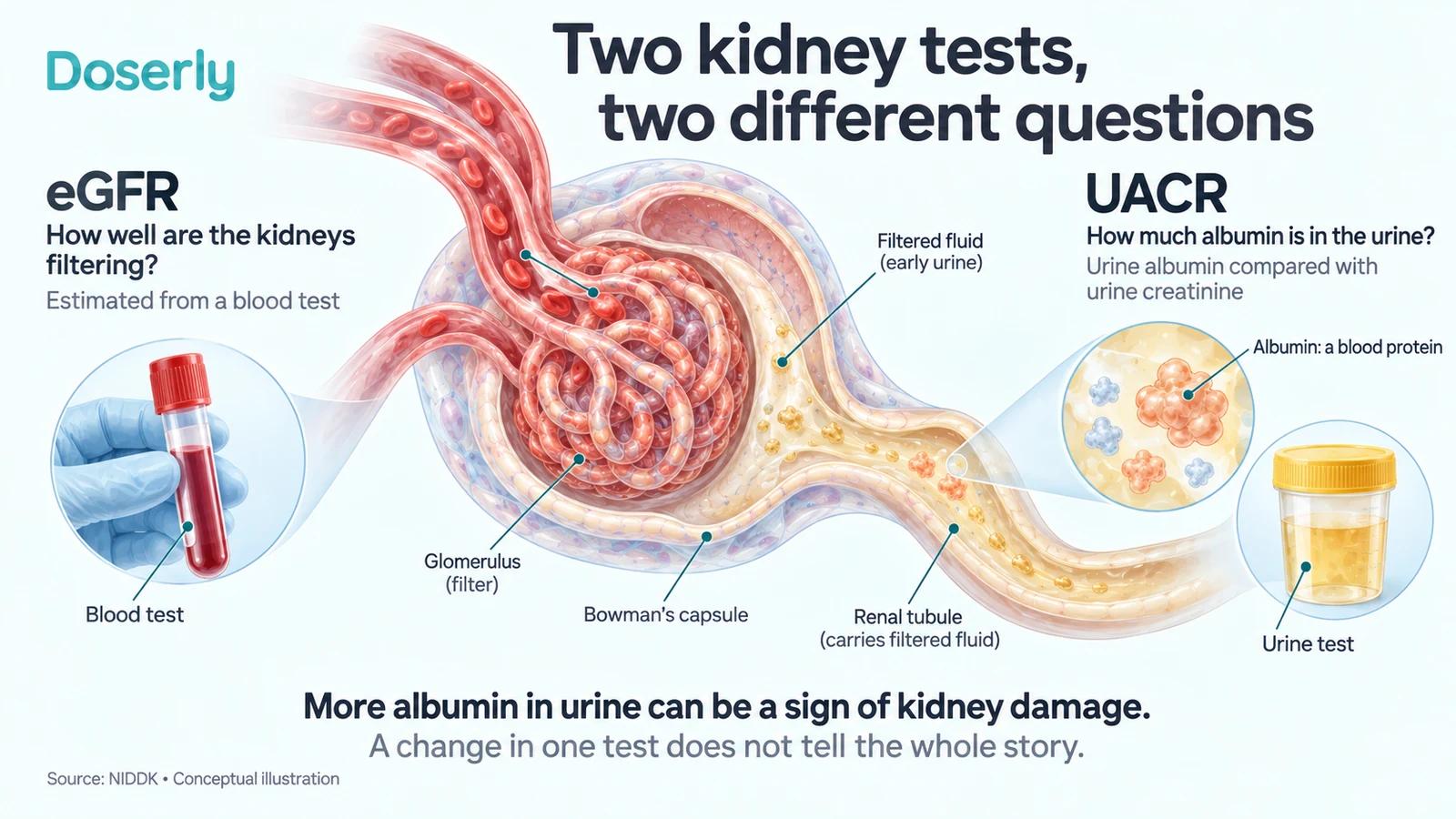
Image sources: Source: NIDDK kidney testing
Who took part in FLOW, and what did they receive?
FLOW studied adults with established type 2 diabetes and chronic kidney disease. Researchers selected people whose test results showed reduced filtration together with substantial albumin in their urine. This made it possible to study whether treatment could reduce serious events in a group already at risk.
The eligibility rules combined reduced filtration with albumin in urine. Participants generally qualified through one of two routes:
Kidney filtration at screening
eGFR 50–75 mL/min/1.73 m²
- Urine albumin-to-creatinine ratio
- Greater than 300 and less than 5,000 mg/g
Kidney filtration at screening
eGFR 25 to below 50 mL/min/1.73 m²
- Urine albumin-to-creatinine ratio
- Greater than 100 and less than 5,000 mg/g
You don't need to memorize these cutoffs to understand the result. They help show how the participants compare with someone considering treatment today. The design report described an average age of about 67, approximately 17 years of diabetes, and an average eGFR around 47. Participants were receiving background care, including a maximally tolerated angiotensin-converting enzyme (ACE) inhibitor or angiotensin receptor blocker unless unsuitable. These medicines affect a hormone system involved in blood pressure and kidney function. FLOW design and baseline report.
Researchers randomly assigned participants to a weekly injection of semaglutide, with a target dose of 1 mg, or a matching placebo. Random assignment helps make the groups comparable; a matching placebo helps reduce the influence of knowing which treatment someone receives. Both groups continued their background care, so FLOW measured what adding semaglutide could achieve.
If you're familiar with semaglutide through weight-loss treatment, you may have come across different doses or formulations. FLOW's results apply to the treatment studied here; they don't establish that another schedule would provide the same kidney benefit. Our semaglutide guide explains the medicine's different uses, formulations and safety considerations.
What did “24% lower risk” mean?
The final analysis included 3,533 people, followed for a median of 3.4 years. The first primary-outcome event occurred in 331 of 1,767 semaglutide participants and 410 of 1,766 placebo participants. The time-to-event analysis produced a hazard ratio of 0.76, with a 95% confidence interval of 0.66–0.88. FLOW primary results.
A hazard ratio compares how quickly events occur over follow-up among people who have not yet had the event. Here, 0.76 is commonly expressed as a 24% lower relative hazard. It does not mean kidney function improved by 24%, or that 24 of every 100 people avoided dialysis.
The raw event counts offer another way to understand the scale:
Treatment group
Semaglutide
- Participants with a first primary-outcome event
- 331 of 1,767
- Crude proportion
- 18.7%
Treatment group
Placebo
- Participants with a first primary-outcome event
- 410 of 1,766
- Crude proportion
- 23.2%
Subtracting those proportions gives a difference of about 4.5 percentage points. Picture two groups of roughly 100 people with the trial's characteristics: about 19 in one group and 23 in the other had an event during the study. That illustrates the reported counts; it is not a prediction for an individual patient.
The percentages and hazard ratio use different calculations. The crude proportions ignore differences in follow-up time; the trial's analysis uses information about when events happened. They should not be treated as interchangeable estimates or used to promise an exact personal benefit.
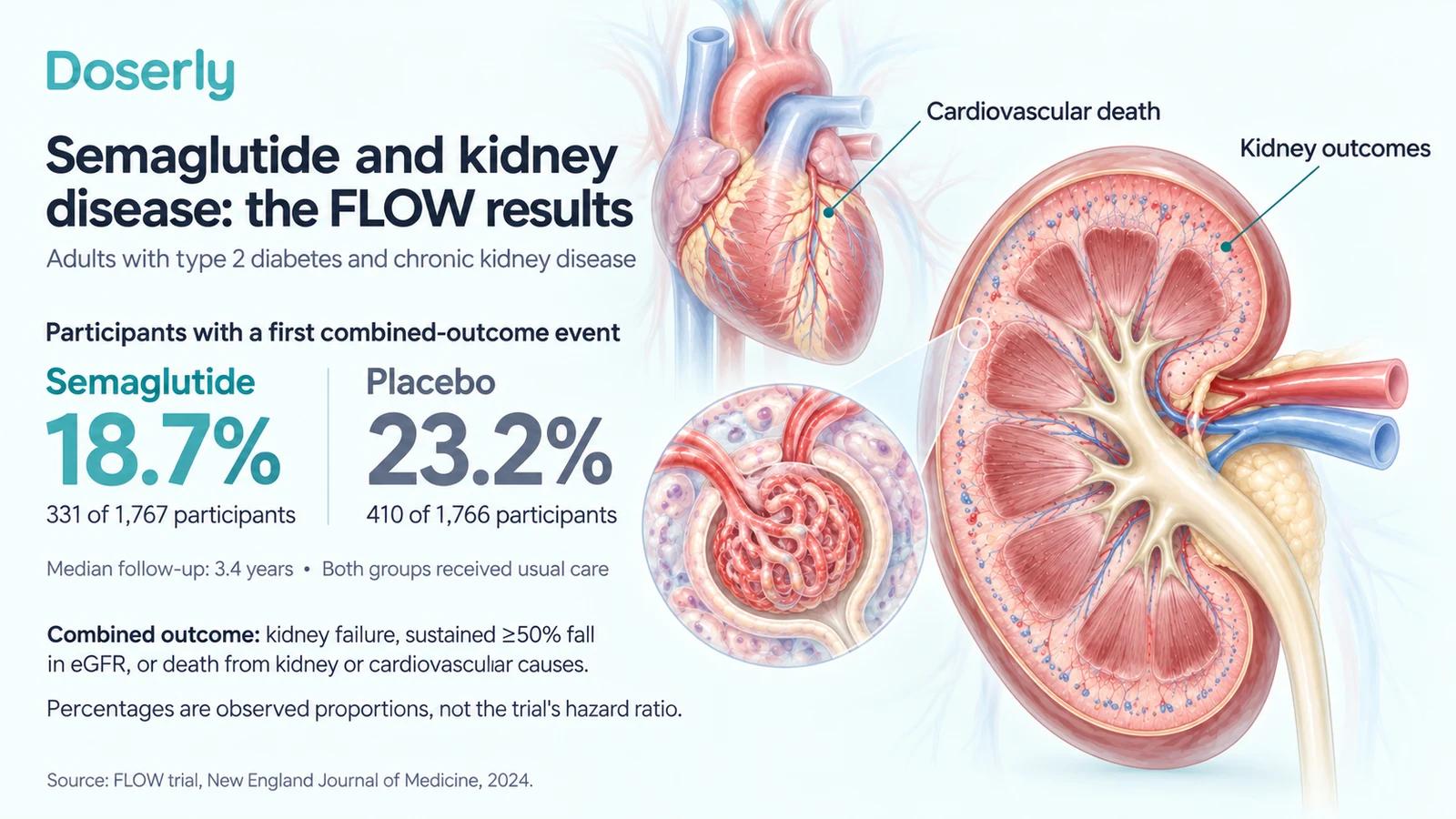
Image sources: Source: FLOW
Did fewer people need dialysis?
The primary outcome was a composite endpoint, meaning that several events counted toward one main result. These included kidney failure, a sustained fall of at least 50% in eGFR, and death from kidney-related or cardiovascular causes. Kidney failure covered ongoing kidney replacement therapy or sustained eGFR below 15 mL/min/1.73 m². Sustained laboratory changes required confirmation at least 28 days apart. Combining events can make a trial more informative, but it also means the headline does not describe just one outcome.
The current US prescribing information breaks the result into its components. For example, chronic kidney replacement therapy occurred in 4.9% of semaglutide participants and 5.7% of placebo participants. Its hazard ratio of 0.84 had a confidence interval of 0.63–1.12, crossing 1, so this component alone did not establish a statistically clear reduction. Other components contributed to the overall benefit. Ozempic prescribing information, Table 10.
So the answer needs some care: fewer participants receiving semaglutide needed chronic kidney replacement therapy, but the uncertainty around that individual result was too wide to establish a clear treatment effect. The stronger finding was the reduction in the combined outcome. It would be inaccurate to describe the 24% figure as a reduction in dialysis alone.
FLOW was funded by Novo Nordisk and stopped early after a prespecified interim analysis, an analysis planned before the trial finished. This shortened the available follow-up. The study tells us about outcomes over the period observed, with a median of 3.4 years, rather than what happens over a person's lifetime. Primary trial report.
What if someone already takes an SGLT2 inhibitor?
Many readers will want to know how semaglutide fits with medicines they already take. Sodium-glucose cotransporter-2 (SGLT2) inhibitors are another drug class used in diabetes and kidney care. They act on a kidney transport system that normally reabsorbs glucose. In FLOW, 550 participants, about 16% of the trial, were taking one at baseline.
In that subgroup, the main outcome occurred in 41 of 277 semaglutide participants and 38 of 273 placebo participants. The hazard ratio was 1.07, with a wide confidence interval of 0.69–1.67. That result did not demonstrate an additional benefit within this smaller group. It also did not establish that combining the treatments is harmful or ineffective. Prespecified SGLT2 analysis.
The statistical test comparing treatment effects between subgroups was not significant (interaction P=0.109). The analysis did not convincingly show that semaglutide behaved differently depending on baseline SGLT2 use. It does not prove that the effects were identical.
If you're already taking an SGLT2 inhibitor, FLOW gives a less precise estimate of how much adding semaglutide might help you. That subgroup was much smaller than the overall trial. Its results leave room for benefit or harm, so they don't settle the question of the combination's added kidney benefit.
Is the benefit simply a consequence of losing weight?
We don't yet know how much of the kidney benefit comes from weight loss or other effects. Changes in blood sugar, circulation and kidney tissue could also contribute. FLOW showed a reduction in important clinical events, but it wasn't designed to separate every possible explanation for that reduction.
The REMODEL trial, published on October 1, 2026, explored that question in 106 adults with type 2 diabetes and chronic kidney disease. It compared semaglutide with placebo over 52 weeks, using kidney magnetic resonance imaging (MRI), paired biopsies in 33 participants, and smaller gene-activity analyses.
The three coprimary imaging outcomes, the main imaging measurements chosen in advance, concerned oxygenation, perfusion (blood flow through tissue) and an inflammation-related measurement. They did not change significantly between treatments. Secondary findings suggested vascular and tissue changes, with molecular clues involving cells lining small blood vessels. The secondary MRI comparisons were not adjusted for multiple testing, which increases the chance of finding an apparently positive result among many comparisons. These are clues to possible mechanisms, not proof that kidneys regenerated or that a particular pathway explains FLOW's benefit. REMODEL trial.
For now, REMODEL helps researchers decide which mechanisms to investigate next. It doesn't give us a complete explanation for why semaglutide reduced serious events in FLOW.
Does the evidence extend to people without diabetes?
A separate randomized trial studied 101 adults with overweight or obesity and chronic kidney disease without diabetes. It compared weekly semaglutide, targeting 2.4 mg, with placebo for 24 weeks. This is useful because it examines kidney effects in people whose condition isn't accompanied by diabetes.
Its primary outcome was the change in urine albumin-to-creatinine ratio, not kidney failure or survival. UACR was reduced by 52.1% relative to placebo, with a 95% confidence interval corresponding to a reduction of 33.4%–65.5%. Gastrointestinal adverse events were reported in 30 semaglutide participants and 15 placebo participants. Trial in non-diabetic kidney disease.
The reduction in albuminuria is encouraging. Remember, though, that UACR measures protein in urine. This six-month study wasn't designed to show whether semaglutide prevented kidney failure or helped people live longer. Those questions need larger studies with longer follow-up.
The participants still had chronic kidney disease and overweight or obesity. Neither this study nor FLOW tells us whether semaglutide would prevent kidney problems in a healthy young adult.
What side effects matter for someone with kidney disease?
Dehydration is an important concern. Nausea, vomiting or diarrhea can cause someone to lose fluid, and the Ozempic label warns about acute kidney injury associated with this fluid depletion. It calls for kidney-function monitoring when adverse reactions could cause dehydration, particularly when starting treatment or increasing the dose. Prescribing information, section 5.6.
This can happen even with a medicine that lowers the longer-term risk of serious kidney events in a trial. Ongoing vomiting, inability to keep fluids down or markedly reduced urination should prompt medical attention.
Your clinician will need to consider how you tolerate treatment alongside your other medicines and kidney test results. Keeping a dated record of symptoms, medication changes and laboratory results can make that conversation easier. A record won't establish what caused a change, but it can help you describe what happened and when.
What does this mean when considering treatment?
FLOW gives people with type 2 diabetes and chronic kidney disease a substantial human trial to discuss with their clinician. How relevant it is to you depends on your kidney function, urine albumin, current treatment and the outcome you're trying to improve.
It also helps to know what FLOW didn't compare. It tested semaglutide against placebo, with both groups receiving background care. It didn't compare semaglutide directly with every other glucagon-like peptide-1 (GLP-1) medicine, a class that mimics a gut hormone involved in blood-sugar and appetite regulation. In February 2026, FDA challenged an Ozempic advertisement for implying benefits beyond the studied population and superiority to other GLP-1 medicines without supporting head-to-head evidence. FDA's letter about the advertisement.
For someone living with diabetes and kidney disease, the most productive questions are specific:
- How similar am I to the people studied? Ask about the cause of kidney disease, eGFR and urine albumin, rather than relying on the diagnosis alone.
- What outcome are we trying to improve? A lower urine-protein result, slower loss of filtration and avoiding kidney replacement therapy are related goals, but they are different measurements.
- How does this fit the care I already receive? FLOW tested an addition to background treatment. Its smaller combination subgroups leave uncertainty about the extra benefit on top of particular medicines.
- What would change the plan? Tolerability, persistent symptoms and trends in kidney measurements matter alongside the expected benefit.
If you want to understand how these findings fit with semaglutide's effects on blood sugar, appetite and weight, continue with our complete semaglutide guide. It covers the broader treatment picture, including uses and safety considerations beyond kidney disease.
Explore the research
- Perkovic and colleagues, FLOW primary trial, 2024: randomized clinical outcomes in type 2 diabetes and chronic kidney disease. Funded by Novo Nordisk; stopped early after a prespecified interim analysis.
- Rossing and colleagues, FLOW design and baseline population, 2023: eligibility, background treatment and study design.
- Mann and colleagues, FLOW analysis by baseline SGLT2 inhibitor use, 2024: the smaller combination-treatment subgroup and its uncertainty.
- Tuttle and colleagues, REMODEL, October 2026: mechanistic imaging and tissue research, including the nonsignificant coprimary outcomes.
- Apperloo and colleagues, non-diabetic chronic kidney disease trial, published online October 2024: a 24-week study of albuminuria in 101 participants.
- Ozempic US prescribing information, revised May 2026: component results, approved indications and safety information.
- NIDDK, kidney testing: blood filtration and urine albumin tests.
- FDA advertising letter, February 2026: why population restrictions and the actual comparator matter in public claims.