
Peptides
October 16, 2026
Selank and stress resilience: what the small human reports leave unanswered
On this page
Stress resilience usually means more than feeling calm for a few minutes. People may use the term to describe coping during a difficult event, continuing to function under pressure or recovering afterward. Those are worthwhile goals, but they are not one interchangeable outcome.
Selank has been studied in small anxiety reports and an acute human brain-imaging experiment. The findings provide reasons for further research. They do not establish that a course of Selank makes healthy people more resilient to everyday stress or prevents longer-term stress-related illness.
The useful question is what kind of resilience someone hopes to improve and whether it was actually measured. Our Selank guide explains the compound's broader evidence. Here, we'll focus on stress, brain connectivity and the difference between an immediate signal and durable function.
Stress and an anxiety disorder are not the same situation
Stress often refers to a response to an external demand or threat. Anxiety can persist even when an immediate external threat is absent. The experiences overlap, but the distinction matters when choosing a study population and outcome.
NIMH describes both emotional and physical symptoms and recommends seeking help when symptoms interfere with daily life or persist. A difficult week and a diagnosed anxiety disorder may require different forms of support. NIMH stress and anxiety fact sheet.
A treatment that reduces symptoms in patients with an anxiety disorder might or might not improve a healthy person's performance during an acute challenge. It might also have a different benefit–risk balance in those settings.
This is why “stress resilience” should be defined before applying the Selank literature. Otherwise, a paper about one condition can be made to sound relevant to almost any situation involving pressure.
What would resilience look like in a study?
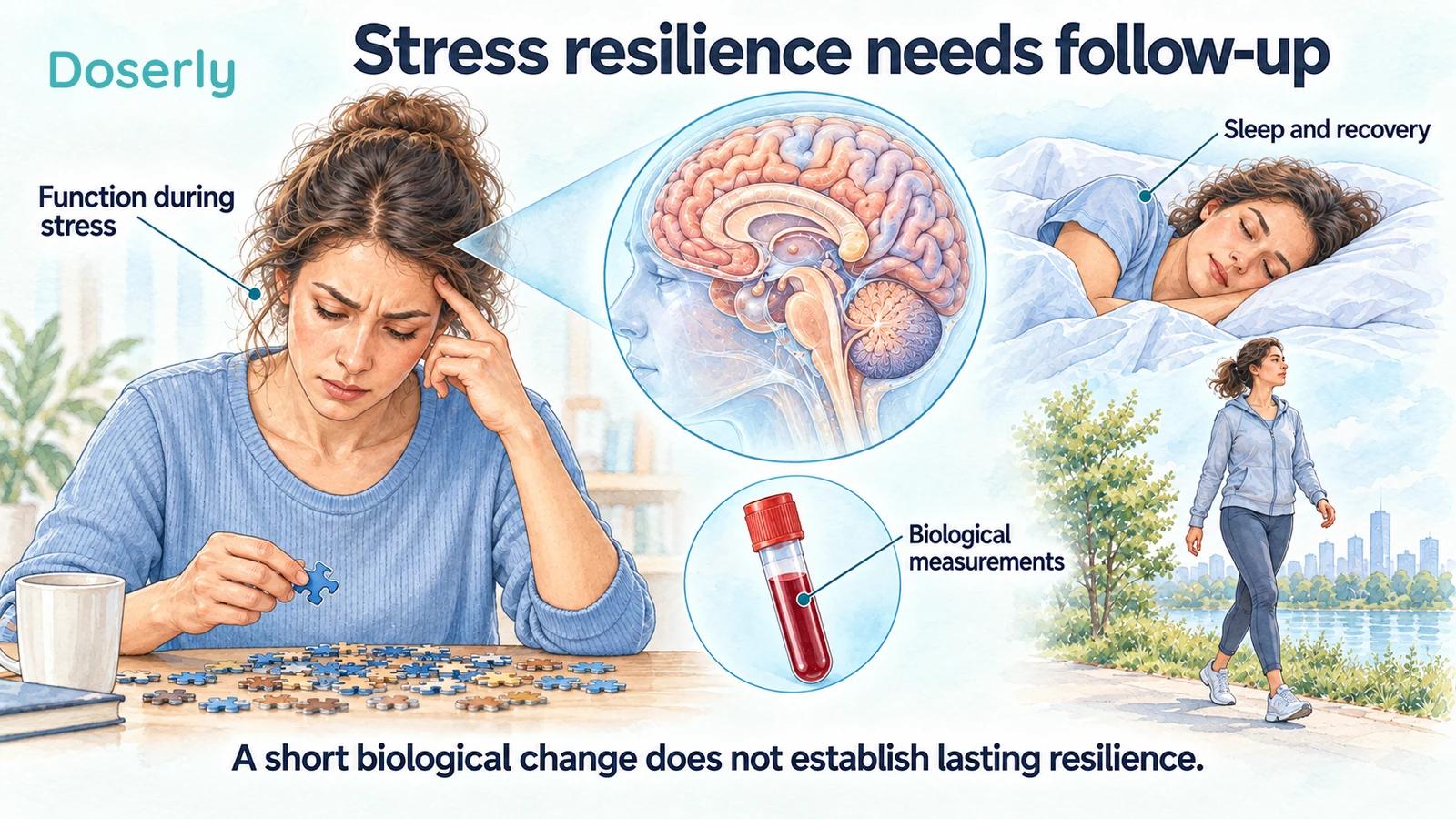
Researchers could measure how someone performs during a standardized challenge, how distressed they feel and how quickly they recover. A longer study could examine functioning during repeated real-life stressors, sleep or persistence of symptoms.
These outcomes can move independently. Someone may feel less distressed but perform no better. Another person may maintain performance while experiencing considerable distress. A treatment intended to help needs an outcome that matches the person's goal.
Biological measurements could add useful information, but they need interpretation. A change in a blood marker or brain signal is not automatically a favorable adaptation. Its relationship to symptoms and function must be demonstrated.
This is a proposed way to make the research question concrete. It is not a description of a completed Selank resilience trial.
What did the human brain-connectivity study do?
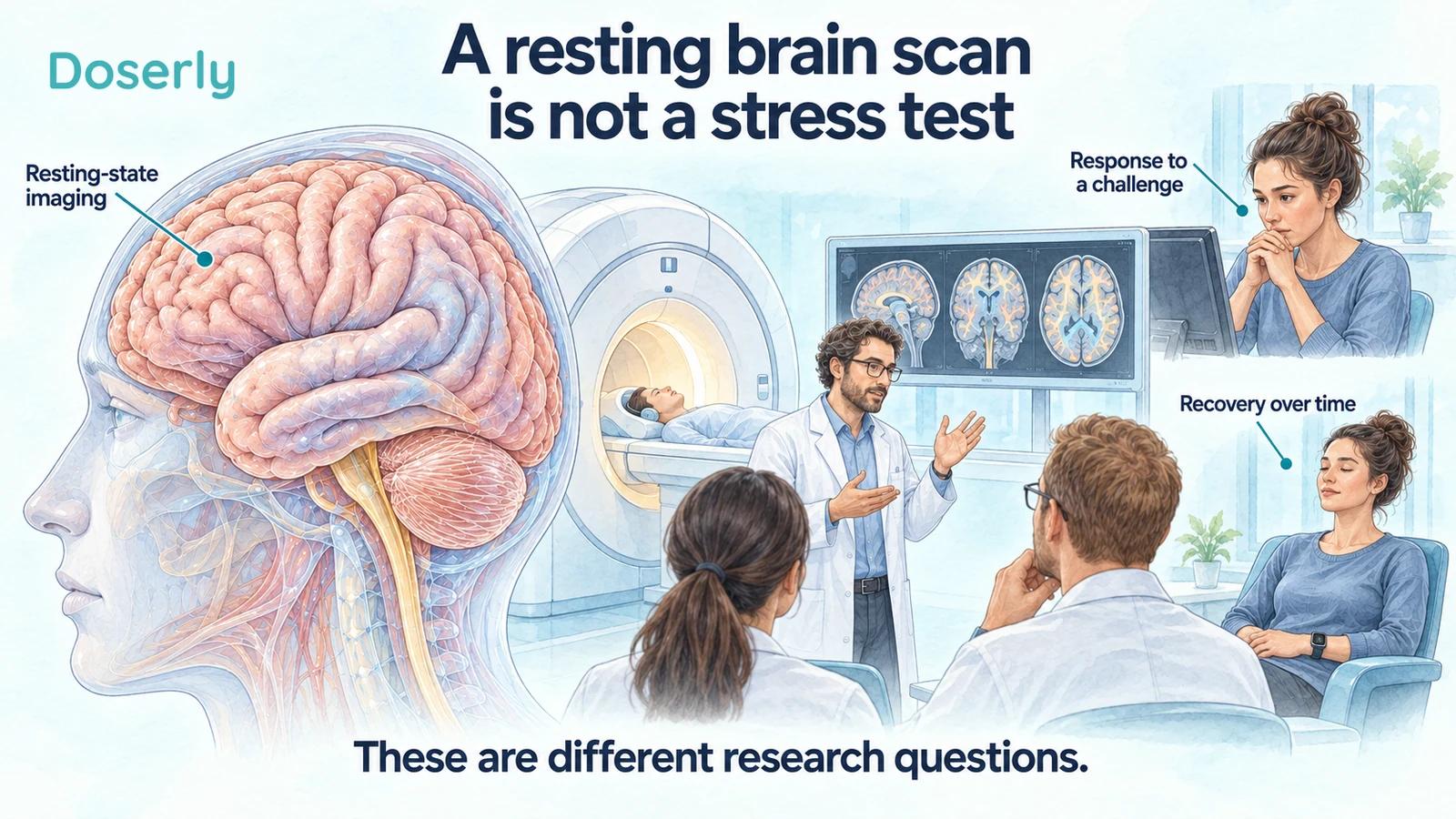
A 2020 report examined resting-state functional connectivity in 52 healthy participants receiving Selank, Semax or placebo. Imaging was performed before administration and at five and twenty minutes afterward. The predefined regions included the amygdala and dorsolateral prefrontal cortex. Original connectomic study.
Functional connectivity describes statistical relationships between activity-related signals in different brain regions. It does not mean that the scan directly shows new nerve connections forming.
The investigators reported differences involving connectivity between the right amygdala and areas of the right temporal cortex. The work is relevant to how these substances may affect acute brain-network measurements.
But 52 was the total across the study, not the number receiving Selank alone. The accessible abstract does not establish a measured improvement in work performance, stress recovery or resilience over subsequent weeks.
The timing also matters. Five- and twenty-minute scans can reveal an immediate signal. They cannot show how someone copes with a major stressor months later.
Why a connectivity change is not inherently better
A brain region can participate in several functions, and a statistical relationship between regions is not a simple meter of emotional health. More connectivity is not universally good, nor is less connectivity universally bad.
The significance depends on the specific network, task, population and clinical relationship. A change might reflect a pharmacological effect without improving the outcome a person cares about.
To connect the imaging finding with resilience, researchers would need to measure resilience-related outcomes and examine whether the imaging change predicts or helps explain them. Ideally, that relationship would be replicated rather than selected after looking through many possible comparisons.
The 2020 report describes post hoc analyses, meaning some comparisons were explored after the initial analysis. Those can identify useful hypotheses, but they should not be presented as a definitive map of how Selank improves stress coping.
For a reader, the study supports an acute mechanistic question. It does not supply a reliable personal prediction of emotional benefit.
What do the anxiety-treatment reports contribute?
A 2008 report compared Selank with medazepam in patients with generalized anxiety disorder or neurasthenia. A 2014 report compared it with phenazepam in a mixed anxiety-related population. Both describe favorable clinical observations. 2008 report and 2014 report.
Those findings are more directly about symptoms than the brain-imaging experiment. However, they still concern treatment of particular clinical presentations, not prevention of stress-related problems in healthy adults.
The 2014 abstract reports persistence of an anxiety effect for one week after the last administration. That is a limited post-treatment observation, not evidence of durable resilience over a season of work demands or repeated life events.
The accessible reports do not provide enough information to estimate how likely an otherwise healthy person is to benefit. They also do not establish that a particular online product reproduces the preparations used in those studies.
The distinction is not a reason to disregard clinical research. It keeps the research connected to the people and outcomes actually studied.
What about the animal social-stress research?
A separate report studied cytokine measurements in male rats exposed to repeated confrontations over twenty days. Selank was investigated under those experimental conditions. Original social-stress report.
This is an animal stress model, not a human workplace or caregiving study. The methods can help researchers explore biological responses under controlled conditions, but the situation and outcomes differ from human coping.
The accessible abstract also contains inconsistent naming, referring to Semax in one results sentence within a Selank report. That inconsistency limits how confidently the summary alone can support detailed compound-specific conclusions. No precise treatment-effect claim should be built on that sentence without checking the full report.
Even a clear cytokine result would still require a connection to clinical benefit. A blood protein measurement cannot by itself establish better emotional regulation, fewer anxiety episodes or preserved daily functioning.
Why durability needs its own evidence
A short-lived biological response and a lasting clinical change are different findings. A substance might alter an acute measure without changing the person's later response to stress.
A study of durable resilience would need a defined follow-up period and repeated assessment. It would also need to account for changes in circumstances, support, sleep and other treatments.
The comparison group is especially important when stress itself changes over time. If an examination ends or a difficult work project finishes, symptoms may improve regardless of an intervention. A before-and-after account alone cannot separate those effects.
The outcome after stopping also matters. Continued benefit, return to baseline and new symptoms are different patterns. The existing short reports do not establish which pattern would occur after prolonged or repeated Selank use for resilience.
What would a more informative human trial look like?
A useful trial would specify the target population. People with generalized anxiety disorder, healthy people facing a brief challenge and people experiencing chronic occupational stress should not be treated as one group.
It would then choose a primary outcome that matches the goal. For performance under pressure, that might be a task measured during a standardized challenge. For clinical anxiety, it would be a validated symptom or functional outcome. For recovery, repeated measurements after the challenge would be needed.
The study should report both favorable and unfavorable effects. Feeling less distressed would have a different practical value if attention worsened or unwanted symptoms led people to stop treatment.
Mechanistic imaging could be included, but the clinical conclusion should stand on the clinical measurements. A larger set of colorful scans cannot compensate for an undefined patient benefit.
What can personal tracking tell you?
A record of stressors, sleep, symptoms and daily functioning can help describe a problem to a clinician. It is more informative than a single overall statement that a product made life feel easier.
The record should include changes in circumstances and other treatments. Otherwise, improvement after a difficult period ends may be attributed entirely to the last product started.
Tracking cannot establish a treatment effect by itself. Expectations, natural fluctuation and repeated testing can influence the pattern. It also cannot detect every safety issue or verify a product's identity.
Its most useful role is to make care more specific: when difficulties occur, what they disrupt and what has changed. It should not become a substitute for assessment when stress or anxiety is interfering substantially with daily life.
How should the evidence shape a decision?
Start with the problem rather than the word resilience. Persistent worry, sleep disruption, avoidance and difficulty functioning deserve a clinical discussion that considers the full situation.
NIMH describes practical coping approaches such as regular sleep, physical activity and identifying unhelpful thought patterns, while encouraging professional help when symptoms persist or interfere with life. These are general supports, not a claim that every problem can be solved through self-care alone. NIMH fact sheet.
If Selank is proposed, ask whether the supporting evidence concerns clinical symptoms, acute brain signals or animal biology. Ask what outcome would be monitored and what evidence supports the intended duration.
FDA separately notes important human safety-information gaps for Selank acetate. A claim of lasting resilience should not obscure those uncertainties. FDA Selank acetate entry.
The reviewed research does not establish a durable resilience benefit. It identifies acute biological and preliminary clinical questions worth testing. The Selank guide gives the broader context for discussing those questions without turning them into a promise.
Sources
- Functional connectomic study of Selank and Semax, 2020.
- Selank and medazepam clinical report, 2008.
- Selank and phenazepam clinical report, 2014.
- Selank and cytokines in a rat social-stress model, 2021.
- NIMH: I'm So Stressed Out!.
- FDA Selank acetate safety-information entry.