
Peptides
October 16, 2026
Selank derivatives and nasal sprays: why similar names do not prove equivalent effects
On this page
Selank is a seven-amino-acid peptide studied in small human anxiety reports and a larger body of laboratory research. Products discussed online may add terms such as acetate, N-acetyl or amidate, or offer a spray instead of the preparation described in a study.
Those words are not interchangeable. Some describe a chemical form; others describe a modified molecule or a delivery system. A product may be related to Selank without having demonstrated the same exposure, clinical effect or safety profile.
If you're trying to decide whether a citation supports a particular product, the first question is identity: what exactly did the researchers administer? The Selank guide provides broader context. Here, we'll examine why the molecule, formulation and evidence need to match.
Start with the peptide sequence
The sequence commonly described as Selank is Thr-Lys-Pro-Arg-Pro-Gly-Pro, abbreviated TKPRPGP. The letters identify the amino acids in order. That sequence is a more precise starting point than a commercial product name.
A primary distribution study explicitly describes this sequence while comparing administration routes in rats. It is evidence about a defined peptide under experimental conditions, not every product that includes “Selank” in its name. Original glyproline distribution study.
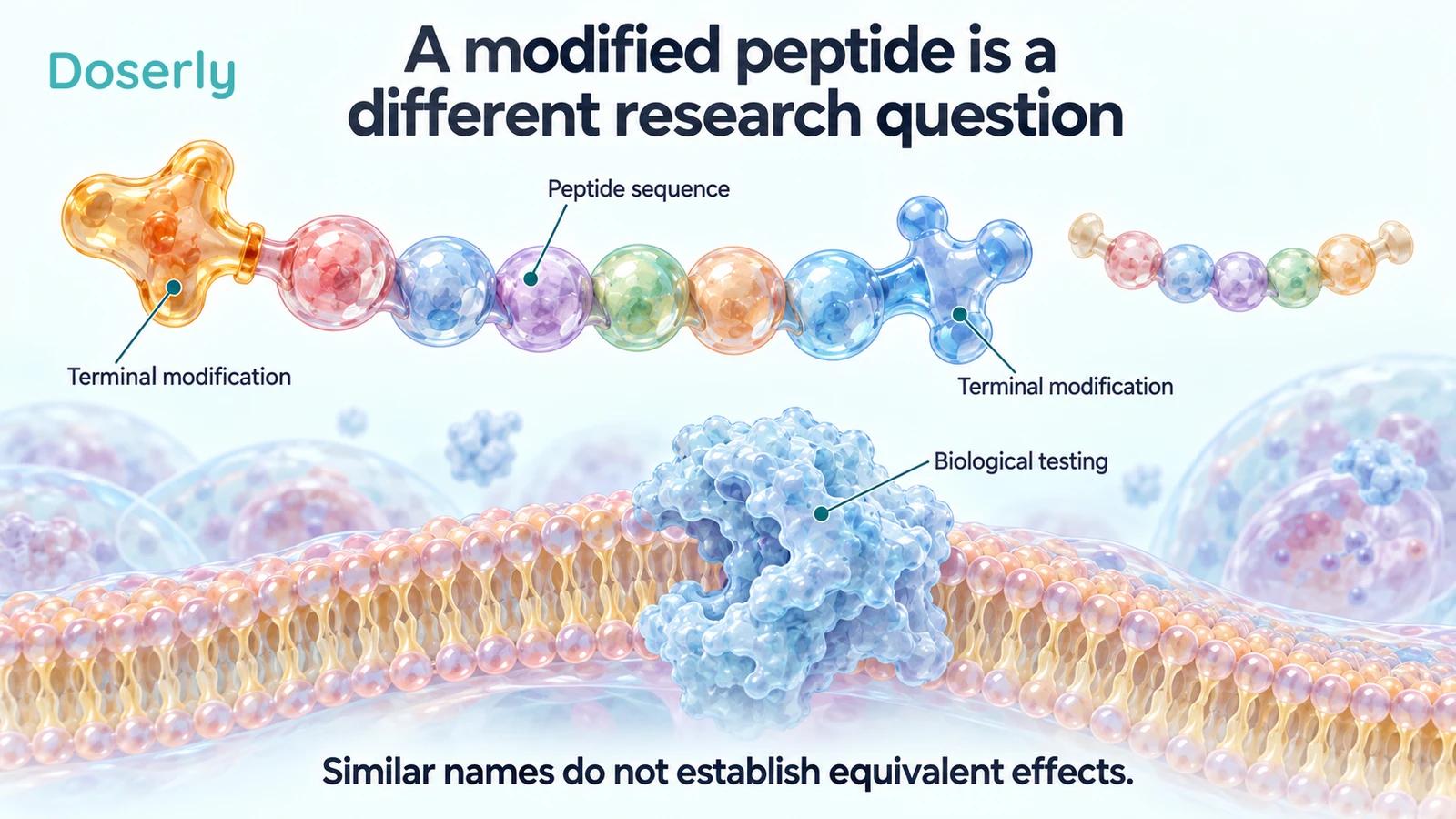
Sequence alone is still not a complete product specification. The ends of a peptide can be chemically modified, and the preparation can contain a particular salt form, solvent and other ingredients.
For a reader, the practical implication is that a familiar base name should not replace the chemical description. If the description changes, the research question may change too.
Acetate and acetyl mean different things
An acetate salt and an acetyl modification are different chemical concepts. A salt form concerns the preparation's associated counterion. An acetyl group covalently attached to a peptide changes its molecular structure.
Similarly, amidation at a peptide's end is a chemical modification. It should not be treated as a harmless naming variation simply because most of the sequence remains recognizable.
Such modifications may be investigated to change stability or other properties, but a design intention is not a demonstrated clinical advantage. The modified molecule needs testing for the property being claimed.
Even a demonstrated improvement in laboratory stability would not, by itself, prove a better anxiety treatment. A longer-lasting molecule could have different exposure, breakdown products or unwanted effects. “More stable” and “more beneficial” are separate conclusions.
What evidence would connect a derivative to Selank?
A useful comparison would first confirm the identity and quality of both substances. It would then examine the claimed difference under appropriate conditions: stability in a relevant medium, exposure in people, or a clinical outcome.
If the claim is “works longer,” the study must specify whether that means the intact peptide remains detectable longer or the desired clinical benefit persists longer. Those outcomes can differ.
If the claim is “works better,” researchers need a meaningful comparison using the relevant patient population and outcome. A laboratory assay cannot establish that someone will feel less anxious or function better.
And if the claim is “same effect at a lower amount,” a direct exposure or clinical comparison is needed. It cannot be inferred from a product label or the shared portion of the sequence.
The original Selank reports do not automatically supply these missing comparisons. A citation can be accurate about the parent peptide while being irrelevant to a modified product's advertised advantage.
What do the human anxiety reports establish about identity?
A 2008 clinical report compared Selank with medazepam in 62 patients. It is a human treatment report, but its accessible abstract does not establish a clinical comparison of an N-acetyl or amidated derivative with the parent peptide. Original clinical report.
That means the study can support discussion of the intervention it names within its methodological limits. It cannot be used as if participants received every later derivative.
The same principle applies to a new delivery system. A reported benefit with one preparation does not establish that another spray delivers a comparable amount of intact peptide or produces the same outcomes.
This does not prove that a derivative is ineffective. It means the connection between the research and the new product has to be demonstrated rather than assumed.
What did the rat route study find?
The 2008 distribution study compared tritium-labeled Selank and Pro-Gly-Pro after several administration routes in rats, including intranasal, intraperitoneal, intragastric and intravenous administration. The authors described intranasal administration as favorable for central nervous system delivery in their experimental comparison. Original distribution study.
That is an animal finding with a defined measurement method. It does not establish the human bioavailability of an online nasal spray or prove a particular device is optimal.
A tracer study also requires attention to what is being detected. Radioactivity can track material derived from the administered peptide, including fragments. Researchers must separate intact substance from breakdown products if they want to describe the intact peptide's exposure.
The study therefore provides a reason to investigate route-dependent behavior. It does not justify a human conversion between nasal and injectable use, and it does not establish equivalence across formulations.
Why breakdown products matter
A 2006 methodological paper used tritium-labeled peptides and chromatographic separation to examine biodegradation. For Selank, it identified several fragments among the products of breakdown, including TKPRP, TKP, RP and GP. Original biodegradation study.
This matters because an administered peptide is not necessarily present in only one form throughout the body. The intact molecule and its fragments may have different distributions or biological activities.
The earlier rat pharmacokinetic report detected the heptapeptide in plasma for a short interval and identified tuftsin as a metabolite. Its detection window should not be rephrased as a validated human half-life or duration of anxiety relief. Original rat metabolism report.
A chemical modification intended to alter breakdown could also alter the mixture of fragments produced. That is another reason a derivative needs its own evidence rather than inheriting the parent peptide's complete profile.
These studies are useful for understanding the scientific questions. They do not provide a dosing schedule for people.
Route changed findings even within mouse experiments
A mouse study compared intranasal and intraperitoneal Selank and examined both behavior and receptor-marker binding. The effects differed by mouse strain and administration route. The investigators reported behavioral effects in BALB/c mice but not the same pattern in C57BL/6 mice. Original route-comparison experiment.
That result illustrates two layers of context: the route matters, and the biological model matters. It should not be simplified to “nasal Selank always works” or “injection is stronger.”
The receptor-marker measurements were also not direct clinical outcomes. A change in binding measured in brain tissue does not tell us how a person will feel or perform after using a product.
The appropriate human follow-up would test a clearly characterized preparation in people with a defined condition. It would measure both the intended benefit and unwanted effects, rather than rely on a favorable animal route description.
A spray includes more than the ingredient
A nasal spray is a delivery system. The concentration in the bottle, volume released, nozzle performance, liquid properties and stability all contribute to the exposure being proposed.
The same concentration does not guarantee the same delivered amount if devices release different volumes. The same delivered amount does not guarantee identical absorption if the formulation or deposition differs.
For a peptide, quality assessment also needs to consider the intact substance and relevant impurities or aggregates. A name and a nominal concentration are not a complete characterization.
FDA's Selank acetate entry identifies potential immunogenicity concerns from aggregation and peptide-related impurities and notes missing important human safety information. FDA compounding safety information.
That statement is not a finding that every spray causes an immune reaction. It explains why product identity and quality remain part of the clinical question.

What can a registry search tell us?
Trial registries can help identify planned or ongoing clinical studies, but a search result needs to be inspected. A name can appear through related terms or elsewhere in a record without being the intervention administered.
On October 15, 2026, the ClinicalTrials.gov search for Selank returned ten records. Inspection of their intervention fields did not identify a Selank administration trial among those returned records. Searches for N-acetyl Selank and TKPRPGP returned no records in that check. ClinicalTrials.gov search.
This is a dated search result, not proof that no research exists anywhere. Registries differ, terminology varies and older studies may not have been prospectively registered there.
It also does not erase the published human reports. A registry search and a literature search answer related but different questions. Neither should be used to manufacture certainty about a derivative's clinical evidence.
A registration, if found, would describe a study plan or record. Clinical efficacy still requires results and an assessment of how the study was conducted.
How to assess a product's supporting citation
Read the intervention description before the conclusion. Check whether it names the parent peptide, a modified analogue or only a broad commercial term. Then check the route, formulation and population.
If the seller claims a modification improves stability, look for a direct stability experiment on that modification. If it claims better human outcomes, look for human outcome data. A chain of citations to animal parent-peptide studies does not answer the second question.
Ask whether the comparison uses the actual finished product. A laboratory sample from a chemical supplier and a consumer nasal spray can differ in more than packaging.
Finally, separate analytical confirmation from clinical benefit. Demonstrating that a substance is present in a bottle does not show that it treats anxiety; demonstrating an effect in a study does not certify the contents of a different bottle.
What information belongs in a clinical discussion?
Bring the exact product name and chemical description, not just the word Selank. Include the route, formulation, other medicines and the outcome you hope to improve.
Ask which evidence applies directly and which parts of the rationale are extrapolations. A clinician may have a hypothesis about a derivative or formulation, but the hypothesis should remain distinguishable from a demonstrated result.
If product identity or quality cannot be established, that is a concrete gap. If identity is clear but clinical benefit is untested, that is a different gap. Both deserve attention.
The studies reviewed here show that Selank's distribution and breakdown are genuine research topics. They do not establish that similarly named derivatives or new sprays share the same clinical profile. The Selank guide provides the wider context for evaluating those claims.
Sources
- Selank and medazepam clinical report, 2008.
- Glyproline distribution by route in rats, 2008.
- Tritium-labeled peptide biodegradation methods, 2006.
- Rat heptapeptide metabolism, 1998.
- Selank route comparison in two mouse strains, 2016.
- ClinicalTrials.gov Selank search, checked October 15, 2026.
- FDA Selank acetate safety-information entry.