
Peptides
October 16, 2026
Selank and anxiety: what a change in a symptom score can tell you
On this page
Selank is a synthetic peptide studied for anxiety-related effects. For someone whose worry disrupts sleep, concentration or everyday activities, the appealing question is whether it can provide meaningful relief. Small human reports describe improvements on symptom measures, but the meaning of those changes depends on what was measured and how the comparison was made.
An anxiety score is useful because it makes an experience easier to describe consistently. It is not a direct measurement of a peptide repairing the brain, and a lower score does not automatically establish recovery. The most helpful interpretation connects symptoms with daily function, adverse effects and how long any improvement lasts.
Our Selank guide provides a broader introduction. This article looks closely at the human symptom reports and explains what information a reader needs before turning a promising description into an expectation of benefit.
Anxiety is more than one symptom
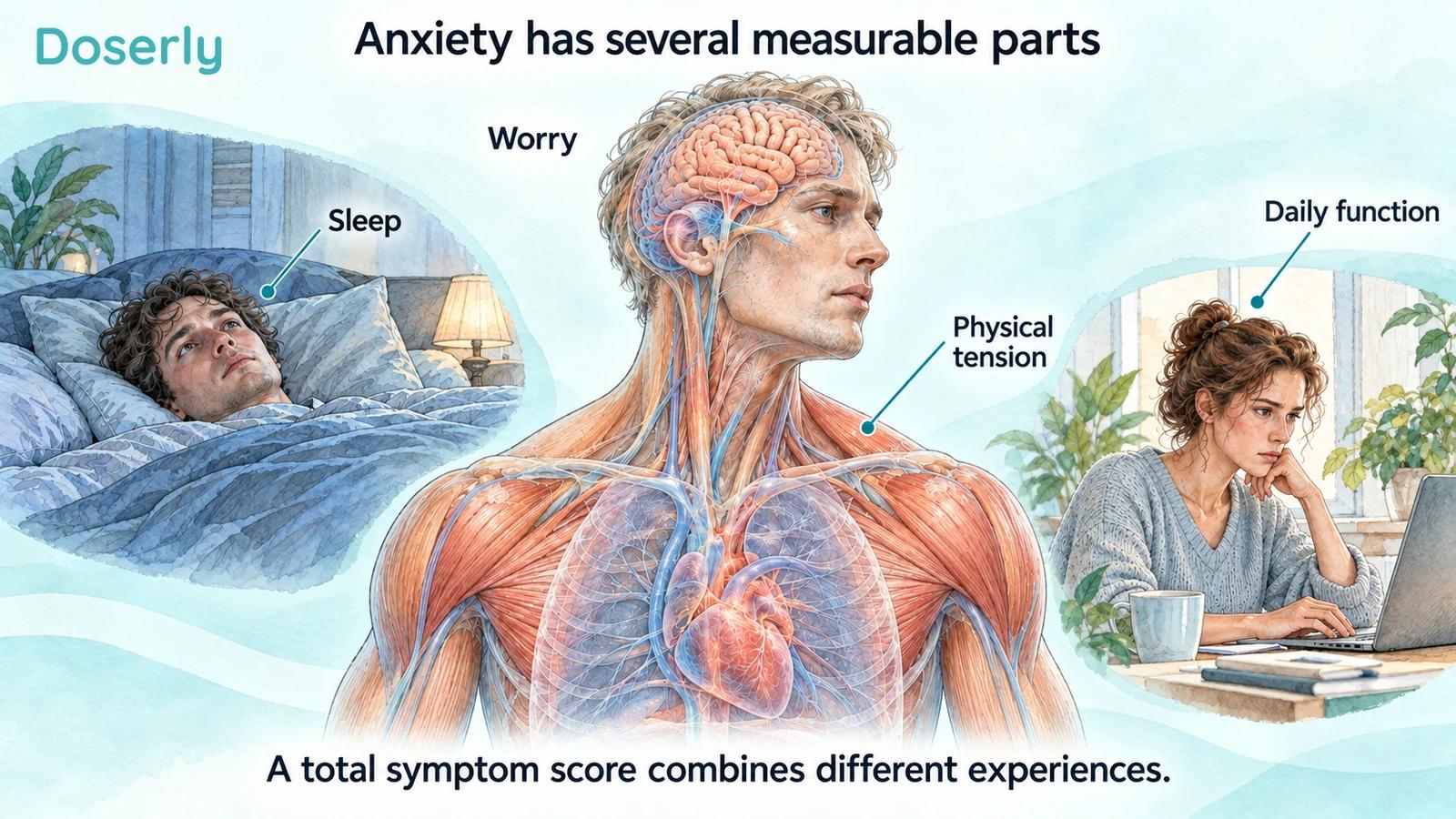
Anxiety can involve persistent worry, physical tension, disturbed sleep, difficulty concentrating and avoidance. Different people may experience different combinations. A total score compresses several observations into one number, which makes comparison easier but can conceal the pattern underneath.
Imagine two people whose total scores fall by the same amount. One is sleeping better but still avoids leaving home. The other is less worried and has returned to work, but still sleeps poorly. Both may have improved, yet the practical meaning of the improvement differs.
This is why the score should be read alongside the individual symptoms and the person's goals. In clinical care, it also sits within an assessment of the condition, other health problems and current treatments. NICE's guidance for generalized anxiety disorder emphasizes assessment of distress and functional impairment as part of the treatment picture. NICE GAD recommendations.
A symptom score can track a change; it cannot establish the cause by itself. People can improve during a study because of treatment, changes in circumstances, other care or the natural course of symptoms. The comparison group helps researchers separate these possibilities.
What did the first comparison measure?
A 2008 report studied 62 patients with generalized anxiety disorder or neurasthenia. Thirty received Selank and 32 received medazepam, a benzodiazepine. Researchers used Hamilton, Zung and Clinical Global Impression measures and also examined an enkephalin-related blood measurement. The abstract describes similar anxiety-relieving effects, with additional effects on asthenia and activation attributed to Selank. Original 2008 report.
Asthenia refers to weakness or lack of energy. Its inclusion matters because the population was not simply a group of otherwise healthy people experiencing ordinary stress. The diagnoses and symptom mix influence which changes are most relevant.
The abstract's description of similarity does not provide a precise estimate of how much better one treatment was than the other. It also does not give the detailed uncertainty needed to establish that the two are clinically equivalent. We should preserve the favorable report without converting it into a stronger conclusion.
This was an active-treatment comparison, not a placebo comparison. If both groups improve, the study still needs a sound design to show how much of that change is attributable to either medicine. The details of allocation, blinding, missing data and other care matter.
What are Hamilton, Zung and CGI scores?
These names refer to different assessment approaches. A clinician-rated symptom measure can summarize an interview and observed signs; a self-report measure records the patient's own experience; a global impression describes overall clinical severity or improvement.
The Selank abstract names the scales without supplying a full item-by-item dataset. That limits how specifically the findings can be interpreted. It would be inappropriate to invent an exact point reduction, a percentage responding or a particular symptom that improved most.
The distinction between instruments also matters when comparing papers. A point on one scale is not necessarily equivalent to a point on another. Different scales can include different items, response options and time frames.
A modern example is the GAD-7, developed as a brief self-report measure for screening and severity assessment. Its original validation study involved primary-care patients and compared questionnaire results with independent clinical assessments. That validation concerns the measurement tool, not Selank's effectiveness. Original GAD-7 study.
The older Selank reports reviewed here did not use the GAD-7 as described in their abstracts. Its relevance is to illustrate why a scale needs validation and a defined purpose, rather than to retrofit modern measurements onto older research.
What did the phenazepam comparison add?
A 2014 study compared Selank and phenazepam in 60 people with phobic-anxiety and somatoform disorders. The abstract reports anxiety-relieving and mild nootropic effects, a favorable quality-of-life observation and persistence of the anxiety effect for one week after the last peptide administration. Original 2014 report.
These are human observations and deserve to be described as such. However, the accessible abstract does not provide a complete numerical between-group effect, confidence interval or detailed adverse-event table. We cannot calculate a reliable chance of individual benefit from it.
The mixed diagnostic population is also important. A result across several anxiety-related and somatic symptom presentations may not describe the effect in each diagnosis separately. It should not automatically be extended to panic disorder, social anxiety or generalized anxiety disorder as though the evidence were identical for all three.
The one-week observation is useful but short. It does not establish permanent remission, prevention of relapse over months, or freedom from problems after prolonged use. “The effect persisted” needs the duration attached to it.
Why the add-on study answers a different question
In 2015, investigators compared phenazepam alone in 30 patients with Selank plus phenazepam in 40 patients. The report used several symptom and global measures, a side-effect scale, cognitive tasks and a quality-of-life questionnaire. Original combination-treatment report.
The investigators reported earlier improvement on one scale and fewer unwanted effects with the combination. That is an add-on finding: what happened when Selank was added to phenazepam under those study conditions.
It does not isolate the effect of Selank used alone. Nor does it establish that a person can safely stop a benzodiazepine and substitute a peptide. The group receiving both drugs still received the benzodiazepine.
This distinction matters when several papers are cited together. A monotherapy comparison, an add-on comparison and a laboratory measurement are different kinds of support. Combining them into a single claim of a proven anxiety treatment loses the actual research questions.
How large was the benefit?
For a patient, this is often the central question. Unfortunately, the accessible 2008 and 2014 comparative reports and the 2015 add-on report do not provide enough numerical detail in their abstracts to give a dependable pooled effect size or a clear absolute probability of benefit.
A useful report would describe starting scores, changes in each group, the difference between groups and uncertainty around that difference. It would explain what counted as a response or remission and how many participants met those definitions.
Response usually means a defined improvement from baseline; remission usually means symptoms have fallen below a specified threshold. The exact definitions must be stated in the study. A person can improve substantially and still have enough symptoms to need ongoing care.
Statistical significance also differs from clinical importance. A small, consistent score change might be statistically detectable without substantially improving someone's life. Conversely, a potentially worthwhile difference in a small trial may remain uncertain. The answer requires both the size of the change and its precision.
For these Selank reports, the honest conclusion is a preliminary favorable clinical signal with important reporting and design questions. A precise benefit estimate would exceed what the accessible evidence supports.
Why within-group improvement is not enough
Suppose a hypothetical treatment group improves by several points during a study. That change may feel compelling, but it does not show how much better the treatment performed than the alternative. If the comparison group improved similarly, the treatment-specific advantage could be small or absent.
Baseline severity also affects interpretation. People selected during a particularly difficult period may improve partly because symptoms fluctuate. A well-designed comparison helps address that issue, but only if the groups are sufficiently comparable and followed in similar ways.
Expectations can influence symptom reporting too. If a treatment has a distinctive administration method or noticeable effects, participants and assessors may guess which group someone belongs to. That can affect ratings even when everyone is acting honestly.
These concerns do not erase the Selank findings. They explain why an abstract's favorable wording is the beginning of appraisal rather than the end. The next useful evidence would make the size, reliability and practical meaning of the benefit easier to assess.
What would count as meaningful relief?
For one person, improvement might mean being able to travel to work without avoiding public transport. For another, it might mean spending less of the evening worrying and returning to regular sleep. These goals can accompany a symptom score without replacing it.
A trial can assess daily function and quality of life directly. It should also ask whether benefit comes with unwanted effects that matter to the participant. Less anxiety accompanied by troublesome sleepiness, for example, may have a different value depending on the person's activities.
The 2014 and 2015 reports mention quality of life, which is relevant to this broader question. Their accessible summaries do not allow us to determine how many people achieved a particular functional goal or whether gains persisted over a substantial period. 2014 comparison and 2015 add-on study.

Does the biological finding explain the improvement?
The 2008 report examined an enkephalin-related measurement as well as symptoms. Enkephalins are signaling peptides, and the researchers were exploring a possible biological connection with anxiety and asthenia. 2008 clinical-biological report.
A relationship between a laboratory measurement and symptoms does not prove that changing that measurement caused the clinical improvement. Both could change alongside another process, and a blood measurement may not directly describe signaling in the relevant brain circuits.
A mechanistic explanation becomes stronger when it is tested prospectively and consistently linked to clinical outcomes. It should not replace the clinical outcome or be used to promise a response in an individual person.
For a reader, the laboratory result is a research lead. It does not provide a validated test for selecting Selank, identifying a deficiency or deciding whether a person needs a peptide.
Where does this leave treatment decisions?
Anxiety that interferes with daily life deserves assessment and a discussion of established options. NICE describes a stepped approach that includes psychological interventions and medication choices according to severity, preferences and previous response. NICE recommendations.
Selank's small reports can be discussed within that conversation, with their actual comparators and limits. They do not establish that a product sold under the name will reproduce the same findings. FDA separately identifies important safety-information gaps and potential immunogenicity concerns for compounded Selank acetate. FDA compounding safety information.
If a symptom questionnaire is used in your care, ask what change would matter, when it will be reassessed and how it relates to your practical goals. A dated record of symptoms and daily activities can support that discussion without turning a score into a diagnosis or proof of treatment effect.
The Selank guide explains the wider evidence. The strongest patient-centered question remains: did people with a similar problem feel and function meaningfully better, for long enough to matter, with an acceptable burden of harm?
Sources
- Selank versus medazepam, 2008.
- Selank versus phenazepam, 2014.
- Selank added to phenazepam, 2015.
- Original GAD-7 validation, 2006.
- NICE generalized anxiety disorder recommendations.
- FDA compounding safety concerns, Selank acetate entry.