
Peptides
October 16, 2026
Selank and tuftsin: related sequences, different clinical questions
On this page
Selank is a synthetic seven-amino-acid peptide related to tuftsin, a naturally occurring peptide studied in immune biology. That connection helps explain why Selank research extends beyond anxiety into inflammatory signaling and immune-cell activity.
It does not establish that Selank prevents infections, treats autoimmune disease or provides a general “immune boost.” A molecular relationship is a starting point for research. The clinical question still has to be tested in people with the condition of interest.
For readers encountering immune claims alongside anxiety claims, the useful task is to separate four things: the peptide's sequence, what immune cells do in experiments, what blood measurements change in people and whether anyone experiences a meaningful health benefit. Our Selank guide covers the wider background.
What is tuftsin?
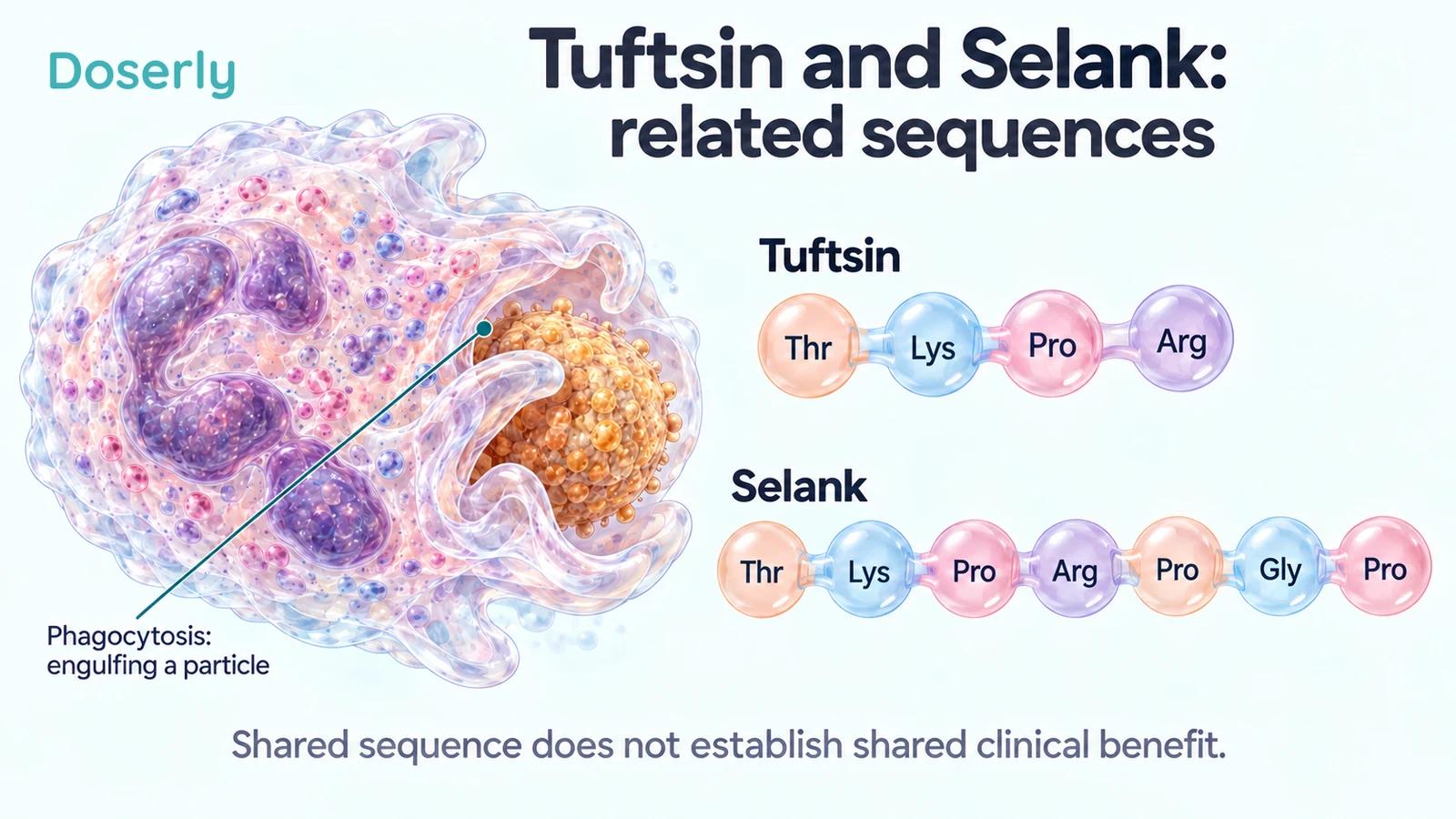
Tuftsin was described in a 1970 report as a peptide associated with stimulation of phagocytic activity in neutrophils. Phagocytosis is the process by which certain immune cells engulf particles. Neutrophils are a type of white blood cell involved in defense against infection. Original tuftsin report.
The historical experiment concerned a peptide fragment derived from a gamma-globulin fraction and its effects in a laboratory system. It did not test Selank as a preventive medicine in healthy adults.
That distinction is useful because the phrase “derived from an immune peptide” can sound like a clinical credential. It describes a biological relationship, not a completed demonstration of benefit.
An immune cell performing more of one activity is also not the same as the whole immune system working better in every circumstance. The value of a response depends on the threat, tissue, timing and balance with other responses.
How is Selank related to it?
Tuftsin's four-amino-acid sequence is Thr-Lys-Pro-Arg. Selank contains that sequence followed by Pro-Gly-Pro, giving Thr-Lys-Pro-Arg-Pro-Gly-Pro. The abbreviations name the amino acids in their order.
A rat metabolism study of the seven-amino-acid analogue identified tuftsin as a metabolite. That supports a chemical and metabolic relationship between the molecules. It does not show that a given Selank product produces a therapeutically useful tuftsin exposure in humans. Original rat pharmacokinetic study.
Adding amino acids can change a peptide's behavior. Researchers need to examine stability, breakdown products, distribution and biological activity rather than assume that the longer peptide simply reproduces the shorter one's effects.
The relationship also does not make Selank a natural supplement. The substance being administered is a manufactured peptide preparation, with product-specific questions about identity, formulation and quality.
What does “immunomodulatory” mean?
Immunomodulation means changing some aspect of immune activity. The term does not specify whether the change is upward or downward, beneficial or harmful, temporary or durable.
Immune responses involve different cells and signals. Cytokines are signaling proteins that help cells communicate. Gene expression describes how actively a cell uses genetic instructions to produce RNA and, through further steps, proteins.
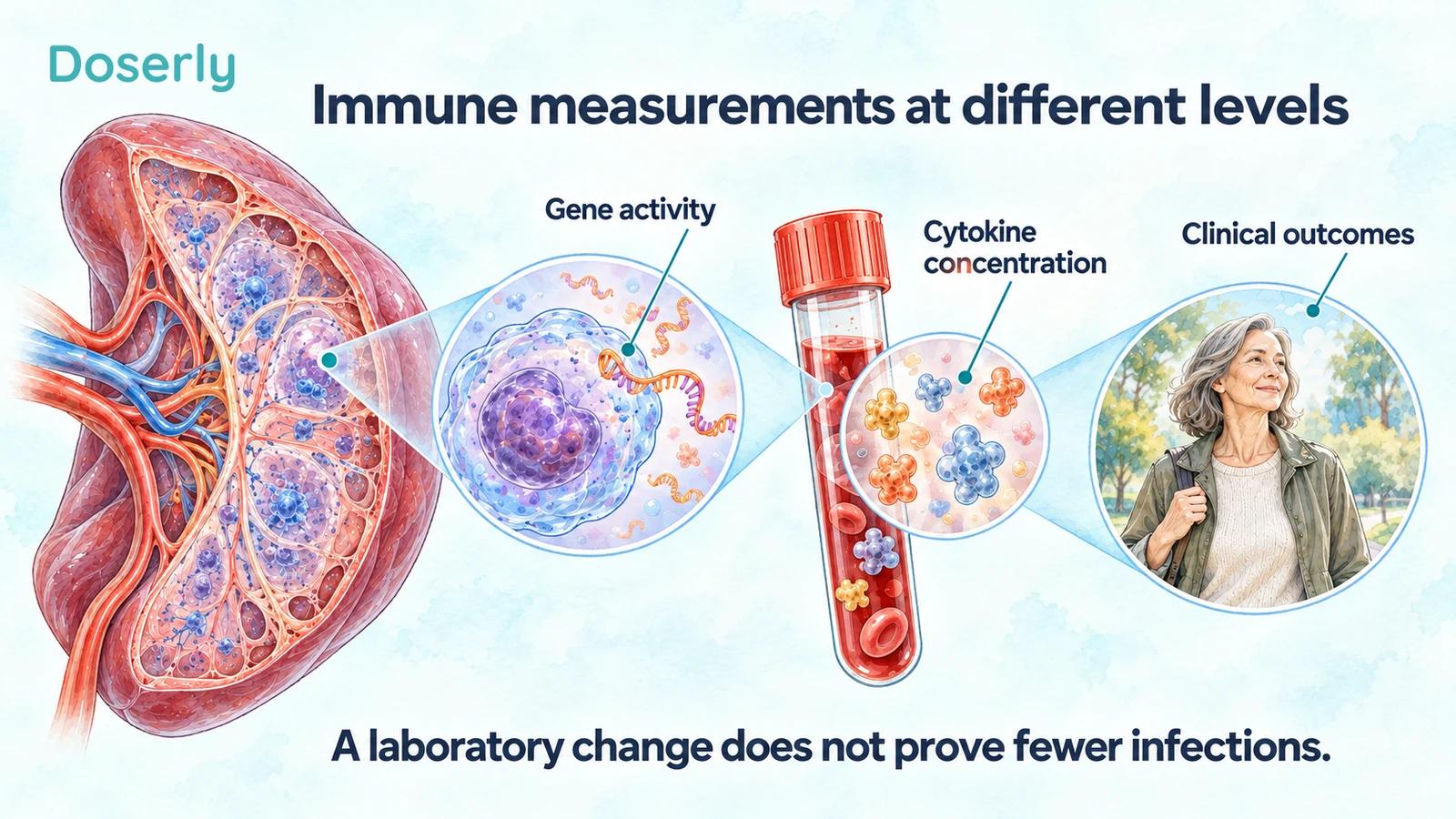
A change in a cytokine-related gene is therefore not automatically a matching change in the cytokine protein. A change in a blood concentration is not automatically a matching change at an infection site. These are different levels of measurement.
This is why “boosting immunity” is often an unhelpful summary of the Selank literature. The experiments investigate particular signals in particular systems. They do not measure a single universal quantity called immune strength.
The clinical question should be more concrete: fewer confirmed infections, shorter illness, reduced inflammatory disease activity or another defined outcome. Each would require its own evidence.
What did the mouse spleen experiment show?
A 2011 study examined inflammation-related gene expression in mouse spleen after a single intraperitoneal administration of Selank or related fragments. The investigators assessed 84 genes at six and twenty-four hours and reported changes involving 34 genes. Original mouse spleen study.
The spleen contains immune cells and is a useful tissue for examining these responses. But the study measured gene activity, not resistance to a human infection. The route also differed from a nasal preparation used by a person.
The finding supports a biological effect in that experimental setting. It does not show that every changed gene moved in a beneficial direction, or that a particular clinical disease would improve.
When many genes are examined, a useful next step is to test the most relevant signals independently and connect them with functional outcomes. A broad pattern can generate hypotheses without yet identifying a treatment.
The numbers should therefore remain attached to their meaning: 34 genes with reported expression changes out of 84 assessed. They are not 34 corrected immune defects or an estimate of treatment success.
What did the human immune report measure?
A 2008 report combined laboratory work on peripheral blood cells with observations in patients with anxiety-related conditions. It described cytokine findings during fourteen days of Selank treatment in people with generalized anxiety disorder or neurasthenia. Original human and cell-culture report.
One detail is especially instructive. In the cell-culture experiments, the abstract describes suppression of IL-6 gene expression in material from patients with depression while also reporting an increase in IL-6 concentration in the culture. These are different measurements and should not be simplified into “Selank lowers IL-6.”
The report also describes changes in the balance of measured cytokines in treated patients. The accessible abstract does not provide enough information to estimate a clinical infection-prevention effect, and it did not establish such an outcome.
The authors proposed broader potential uses. Those proposals need to remain hypotheses. A paper's discussion of possible prevention benefits is not the same as a trial showing fewer infections.
For a reader, this report provides evidence that human biological measurements have been investigated. It does not turn the animal immune work into a proven clinical therapy.
Why the IL-6 distinction matters
It is tempting to treat a named inflammatory signal as a target that should always be reduced. The experiments above show why that can mislead.
Gene-expression assays and protein-concentration assays measure different stages of a biological process. Their results can diverge because of timing, regulation, release, breakdown or the mixture of cells being studied. A source needs to be read at the level of the actual assay.
The population also matters. Cells obtained from a person with depression are not interchangeable with cells from a healthy control, and a culture dish is not a complete person. The same report can contain several experiments with different implications.
A good summary preserves those distinctions rather than choosing whichever measurement sounds most favorable. For Selank, the accessible report does not support a simple clinical claim that it reliably lowers inflammation in everyone.
Nor does it establish a target blood cytokine level for deciding who should use the peptide. A biomarker association requires additional validation before becoming a treatment-selection test.
What about the influenza experiments?
A 2009 study investigated Selank against the influenza strain A/Aichi 2/68, an H3N2 virus, in cell culture and laboratory animals. The abstract reports antiviral effects, with the strongest cell-culture result when Selank was added before viral inoculation. Original experimental influenza report.
This is preclinical research. The accessible abstract does not identify enough animal-method detail to present a species-specific clinical analogy, and it does not describe a human influenza-prevention trial.
Timing is especially important. Giving a substance before exposing cells to a virus is different from treating an established illness in a person. A result in a controlled experimental system cannot establish benefit across circulating influenza strains or other viruses.
The paper's hypotheses about immune signaling may guide further studies. They do not support replacing vaccination, antiviral care or medical assessment with Selank.
The correct inference is that a particular experimental antiviral question was investigated. It is not that an anxiety-related peptide has been shown to prevent respiratory infections in everyday life.
Does immune activity make Selank useful for autoimmune disease?
The reviewed evidence does not establish that use. Autoimmune diseases involve specific clinical processes, and changing an immune signal is not enough to demonstrate an improvement in disease activity, symptoms or long-term outcomes.
A relevant trial would need to name the disease, define the preparation, compare appropriate care and measure both benefit and harm. It would also need to account for other immune-active treatments.
This is particularly important because the phrase “balances the immune system” can hide an undefined direction of effect. Without a clinical endpoint, the word balance does not tell a patient what would improve or what could worsen.
Someone with an autoimmune diagnosis should discuss a proposed immune-active product with the treating clinician. The mechanistic relationship to tuftsin cannot determine compatibility with their condition or current treatment.
This is a limit of the evidence reviewed here, not proof that every possible immune application will fail. It identifies the clinical work still needed before making a treatment claim.
Biological origin does not settle product safety
A sequence related to a natural peptide does not establish the safety of a manufactured preparation. The route, formulation, impurities and actual exposure still matter.
FDA identifies potential immunogenicity concerns for compounded Selank acetate related to peptide aggregation and impurities, alongside important missing human safety information. Immunogenicity means the potential to provoke an immune response against a product or associated material. FDA Selank acetate entry.
That concern is different from the intended immunomodulatory effect discussed in the experiments. A hoped-for change in immune signaling and an unwanted immune reaction are not interchangeable uses of the word immune.
The FDA statement does not provide an incidence estimate for a particular person's risk. It does show why “based on a natural immune peptide” is an inadequate safety argument.
How a useful clinical study would move the question forward
A stronger study would start with a specific human problem rather than a broad claim of immune enhancement. For infection prevention, it would measure clinically defined infections over an appropriate period. For inflammatory disease, it would use validated disease outcomes and relevant background care.
Biological measurements could help explain the result, but they should not replace the result. If a cytokine changes while the number or severity of infections does not, the clinical question remains unanswered.
The study would also need systematic safety reporting. Immune-related findings can be complex, and an intervention intended to help one response may have other effects that matter.
Product identity should be clear enough that another research group could repeat the work. A study of one defined peptide preparation cannot establish the performance of every derivative or nasal spray carrying a similar name.
What to take from the tuftsin connection
Selank's relationship to tuftsin is scientifically interesting and supported by its sequence and preclinical metabolism research. Mouse gene-expression work, cell-culture experiments and a small human cytokine report provide reasons for further investigation.
They do not establish fewer infections, treatment of autoimmune disease or a general improvement in immune health. Those claims require clinical outcomes in the relevant population.
If you encounter an immune claim, identify whether it concerns a sequence, a gene, a cytokine or an actual health outcome. That one distinction often clarifies what the source can support. The Selank guide provides further context for its anxiety research and product limitations.
Sources
- Najjar and Nishioka, original tuftsin report, 1970.
- Rat pharmacokinetics and metabolism of the tuftsin analogue, 1998.
- Selank and inflammation-related genes in mouse spleen, 2011.
- Selank immune measurements in patients and cell cultures, 2008.
- Experimental influenza research, 2009.
- FDA Selank acetate safety-information entry.