
Supplements
October 16, 2026
Saw palmetto and urinary symptoms: what the placebo comparisons found
On this page
Waking repeatedly to urinate, waiting for a stream to start or feeling that your bladder has not emptied can make a familiar prostate supplement appealing. Saw palmetto has been studied more thoroughly than many products sold for “prostate health.” The larger placebo-controlled trials give a useful answer: the tested extracts did not meaningfully outperform placebo for lower urinary tract symptoms, even when the amount was increased.
That does not mean a person who felt better imagined the improvement. Symptoms can change during a study or during everyday life for several reasons. The question is whether the extract adds benefit beyond those changes.
There is also a narrower debate about particular preparations, including a hexane extract discussed in European guidance. Understanding that nuance requires keeping product identity, symptom relief and medical assessment separate.
First establish what the urinary symptoms mean
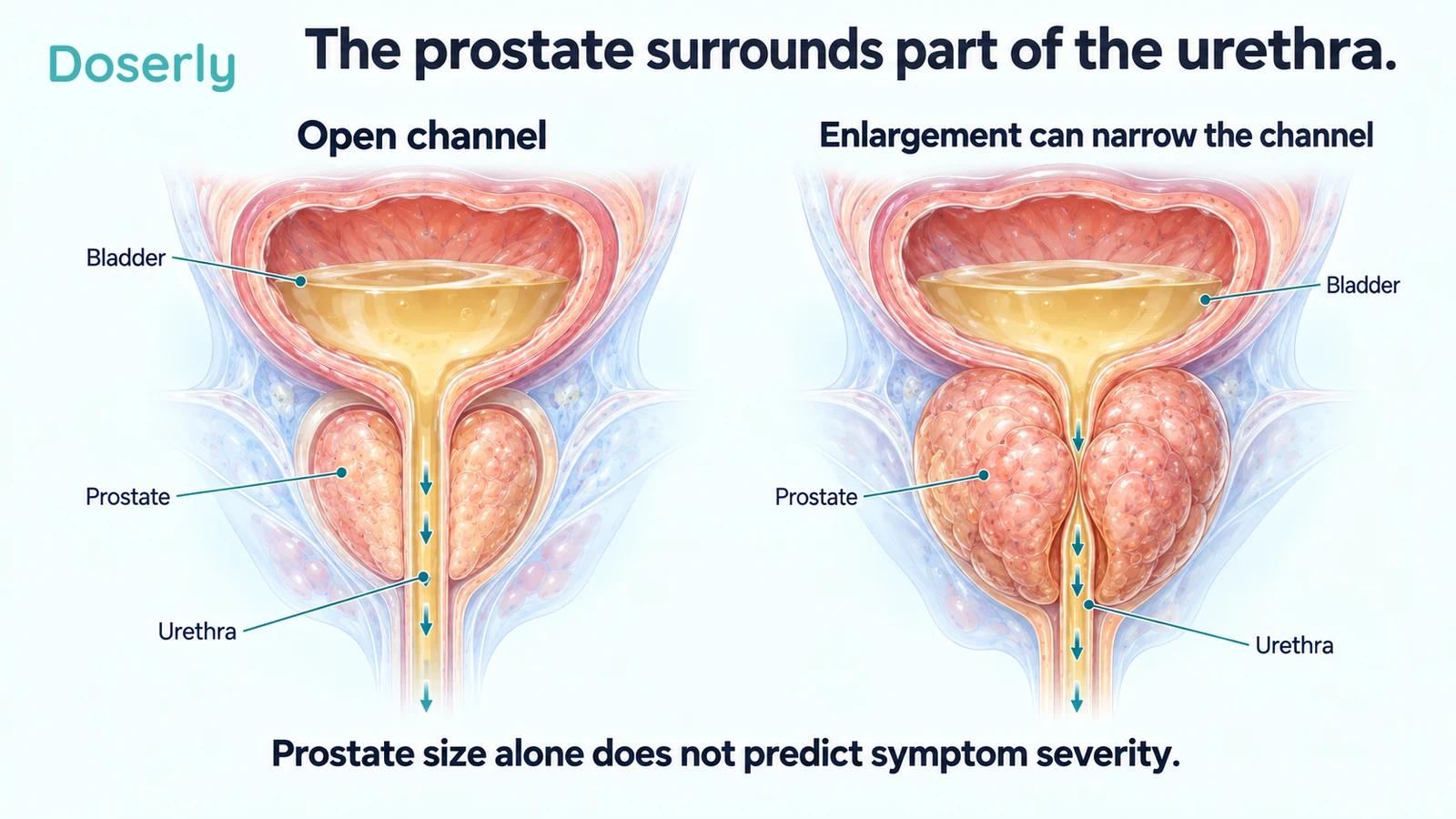
Benign prostatic hyperplasia, or BPH, is noncancerous enlargement of the prostate. The gland surrounds part of the urethra below the bladder, so enlargement can narrow the channel through which urine leaves. Bladder function can also contribute to the resulting symptoms. NIDDK overview.
A larger prostate does not always mean worse symptoms. Nor does a weak stream or nighttime urination prove that BPH is the cause. Infection, other bladder problems and other prostate conditions can produce overlapping complaints.
The term “lower urinary tract symptoms” describes the experience, not a complete diagnosis. That distinction matters before comparing treatments: a supplement trial in selected men with symptoms attributed to BPH cannot establish treatment for every reason someone urinates frequently.
The Doserly saw palmetto guide provides broader ingredient context. This article focuses on the clinical comparisons and how to interpret them when deciding what to discuss with a clinician.
The year-long standard-amount trial found no advantage
A 2006 double-blind trial randomized 225 men over age 49 with moderate-to-severe BPH symptoms to saw palmetto extract or placebo for one year. The tested amount was 160 mg twice daily. Its primary outcomes were a urinary symptom score and maximum urinary flow. Primary trial.
There was no significant difference in symptom-score change: the mean between-group difference was 0.04 points, with a 95% confidence interval from −0.93 to 1.01. The investigators also found no advantage in urinary flow, prostate size, residual urine, quality of life or PSA.
This is more informative than a short uncontrolled observation that men felt better after starting a product. It compared the intervention with a concurrent placebo group over a substantial period and assessed both symptoms and objective measures.
The finding applies directly to the extract and conditions tested. It does not logically prove that every possible botanical preparation is identical. It does, however, make a broad claim that ordinary saw palmetto supplementation reliably improves BPH symptoms difficult to support.
CAMUS tested the “perhaps the amount was too low” explanation
The 2011 CAMUS trial enrolled 369 men aged 45 or older at 11 North American sites. Participants received saw palmetto extract or matching placebo, with the amount increased at 24 and 48 weeks, reaching three times the initial 320 mg daily amount. Follow-up lasted 72 weeks. Primary trial.
The average urinary symptom score fell by 2.20 points with saw palmetto and 2.99 with placebo. The difference was 0.79 points in the direction favoring placebo, with no demonstrated advantage for saw palmetto. Secondary outcomes, including nighttime urination, urinary flow and residual urine, did not show a benefit either.
These results do not establish placebo as a superior treatment. They show that increasing the tested extract did not produce the expected advantage. The dose escalation is an experimental detail, not a suggestion to increase a retail supplement.
CAMUS is especially useful because it tested a common explanation for earlier negative findings. Within that study, “more” did not solve the efficacy problem.
Why people can improve in both groups
A symptom score can fall during a trial even when the active treatment adds little. Symptoms fluctuate, people often enroll when a problem is particularly bothersome, and the attention of a study may change how they observe or manage it.
The placebo group helps account for these influences. It is not a group whose experiences are fake. Participants can feel a real improvement while the comparison shows that the botanical did not contribute a detectable additional benefit.
This is also why a before-and-after testimonial is difficult to interpret. Someone may change evening drinks, caffeine, sleep habits or other medicines around the same time as starting a supplement. Without a comparison, the improvement cannot be reliably assigned to one change.
For an individual, feeling better still matters. The important boundary is what that experience proves. It does not establish that the prostate became smaller, that the bladder empties more completely or that future complications have been prevented.
The broader review points in the same direction
A 2023 Cochrane review included 27 studies involving 4,656 men, covering saw palmetto alone and combinations with other botanical products. The most trustworthy evidence for saw palmetto alone showed little or no difference in urinary symptoms or quality of life compared with placebo. Results were similar over shorter and longer follow-up. Cochrane review.
For short-term symptom scores, the low-risk-of-bias analysis estimated an average difference of about 0.9 points on a 0–35 scale. A statistically detectable small difference is not automatically a worthwhile clinical benefit. The review interpreted the overall effect as little to none.
Combination products had more uncertain evidence. That uncertainty does not establish that adding more ingredients works, and a positive result with a mixture would not reveal which ingredient produced it.
Taken together, the larger trials and the review support a restrained expectation for saw palmetto as a standalone supplement rather than a confident promise of relief.
Why some European guidance treats a specific extract differently
Saw palmetto preparations differ in extraction and composition. The European Association of Urology’s guidance gives a weak recommendation to offer a hexane-extracted preparation to men with urinary symptoms who particularly want to avoid adverse effects related to sexual function. It also says patients should be told that the benefit may be modest. EAU guideline.
This is a specific, preference-sensitive option, not a strong endorsement of every saw palmetto product. The guideline also warns against extrapolating results from one preparation to another.
NCCIH’s overview reaches a more skeptical general conclusion and notes that the Cochrane reviewers did not find a difference in symptom effects when examining hexane-extracted products separately from other preparations. NCCIH overview.
A fair article should preserve this disagreement. It does not justify discarding the negative trials, nor pretending that all professional guidance is identical. If a particular extract is being considered, the discussion should identify it precisely and acknowledge the limited expected benefit.
Symptoms, flow and residual urine answer different questions
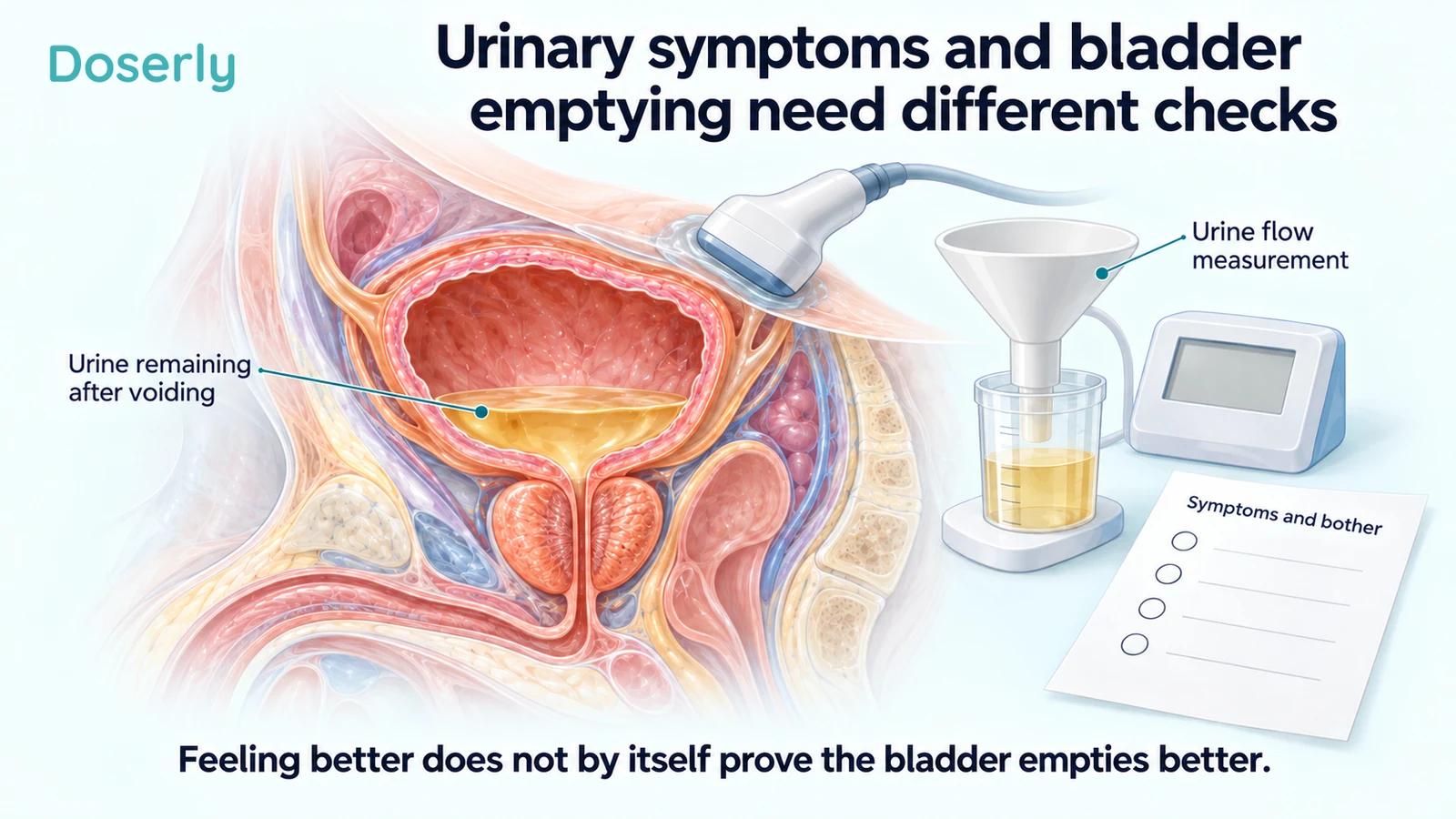
A symptom questionnaire captures frequency, urgency, stream difficulties and how the problem affects life. A flow measurement assesses urine passing over time. A residual-volume assessment checks how much remains in the bladder after urination.
These measurements are related, but one cannot be inferred reliably from another. A person may report less bother without a corresponding change in bladder emptying. Conversely, chronic retention can develop with surprisingly few symptoms. NIDDK urinary retention guidance.
The negative saw palmetto findings are therefore not just a dispute about a questionnaire. The larger trials also looked at measures such as flow and residual urine, without demonstrating the expected benefit.
An evaluation does not require every possible test for every person. Medical history, examination and the pattern of symptoms guide what is useful. NIDDK describes assessment of medicines, fluid intake and symptoms before selecting further prostate or urinary testing. NIDDK prostate tests.
PSA needs its own interpretation
PSA is a prostate-related blood marker; it is not a urinary symptom score. A separate analysis of CAMUS found that changes in PSA did not differ significantly between saw palmetto and placebo, even with the higher amounts tested. Primary PSA analysis.
That finding is useful when discussing supplement use with a clinician. It does not mean a PSA result can be ignored, and it does not establish that saw palmetto prevents prostate cancer.
A normal or unchanged PSA also does not explain every urinary complaint. Decisions about testing and follow-up depend on the broader clinical situation. Tell the clinician about the exact supplement and other medicines so that the result is interpreted with the full context.
Avoid treating saw palmetto as interchangeable with prescription prostate medicines simply because both appear in discussions of hormones or prostate biology. They have different evidence, clinical roles and implications for monitoring.
Tolerability is relevant, but it is not effectiveness
A CAMUS safety analysis included 357 participants with follow-up information. It found no significant differences between treatment groups in serious or nonserious adverse events, vital signs or overall laboratory abnormalities during the study. Primary safety analysis.
That is reassuring for the tested preparation and observation period. It is not proof that every commercial product is risk-free, that interactions are impossible or that a blend containing saw palmetto has the same safety profile.
NCCIH describes adverse effects as generally mild and infrequent, including digestive symptoms, dizziness and headache. It also recommends discussing herbal use with a health professional when taking medicines.
Even a well-tolerated product can have a practical cost if it delays assessment of a problem that needs another approach. The relevant decision combines expected benefit, possible harms, expense and the consequences of waiting—not safety alone.
A symptom record can make the next appointment more useful
Describe what is happening in ordinary terms: difficulty starting, weak flow, urgency, repeated nighttime trips, leakage or a feeling of incomplete emptying. Note when it began, how it affects sleep or daily activities, and whether it changed after a medicine or supplement was started.
A clinician may suggest a bladder diary or a formal symptom questionnaire. The purpose is to understand the pattern and monitor relevant change, not to establish your own diagnosis from a score.
For minimally bothersome symptoms after assessment, observation and self-care may be reasonable. More troublesome symptoms or complications can call for medicines or procedures. The choice depends on the cause, severity and personal priorities, including possible effects on sexual function.
This provides a more useful comparison than “natural versus prescription.” The real question is which option has evidence for the identified problem and a balance of benefits and drawbacks that fits the person.
Some changes should not wait for a supplement trial
Sudden inability to urinate requires emergency medical care. Blood in the urine, severe lower-abdominal or urinary-tract pain, or painful urgent urination with fever and chills also require prompt medical attention. These are not situations in which to wait several weeks to see whether a botanical helps. NIDDK BPH warning symptoms.
For ongoing symptoms without those warning signs, arrange an assessment rather than assuming the prostate supplement label identifies the cause. Saw palmetto’s familiarity does not outweigh its placebo comparisons.
The evidence gives a practical expectation: broad benefit claims for standalone saw palmetto are poorly supported, higher amounts did not rescue the tested extract, and a narrower extract-specific option remains a modest, qualified discussion in some guidance. A clear diagnosis and an outcome that matters to you should come before the purchase.
Sources
- Standard-amount randomized trial, 2006
- CAMUS dose-escalation trial, 2011
- Cochrane review, 2023
- EAU male urinary-symptom guideline
- CAMUS PSA analysis, 2013
- CAMUS safety analysis, 2013
- NCCIH saw palmetto overview
- NIDDK enlarged prostate
- NIDDK urinary retention
- NIDDK prostate tests