
Supplements
October 16, 2026
Saffron for mood: encouraging research is not the same as interchangeable treatment
On this page
Saffron comes from the red stigmas of the Crocus sativus flower. Besides its culinary use, concentrated extracts have been studied for depressive symptoms and low mood. This is an area with genuine human trials, including placebo comparisons and studies against prescription antidepressants.
The results are encouraging enough to deserve a careful look. They are not a reason to replace an effective treatment on your own. The research includes different populations, extracts and outcomes, from diagnosed depression to milder symptoms in otherwise healthy adults. A change on a mood questionnaire does not answer every question about recovery, relapse or long-term safety.
The useful question is where saffron might fit in a particular person's care. Our saffron extract guide explains the ingredient more broadly. Here we'll examine the clinical findings, including newer trials and a study where clinician and participant ratings told different stories.
Why the extract and the diagnosis both matter
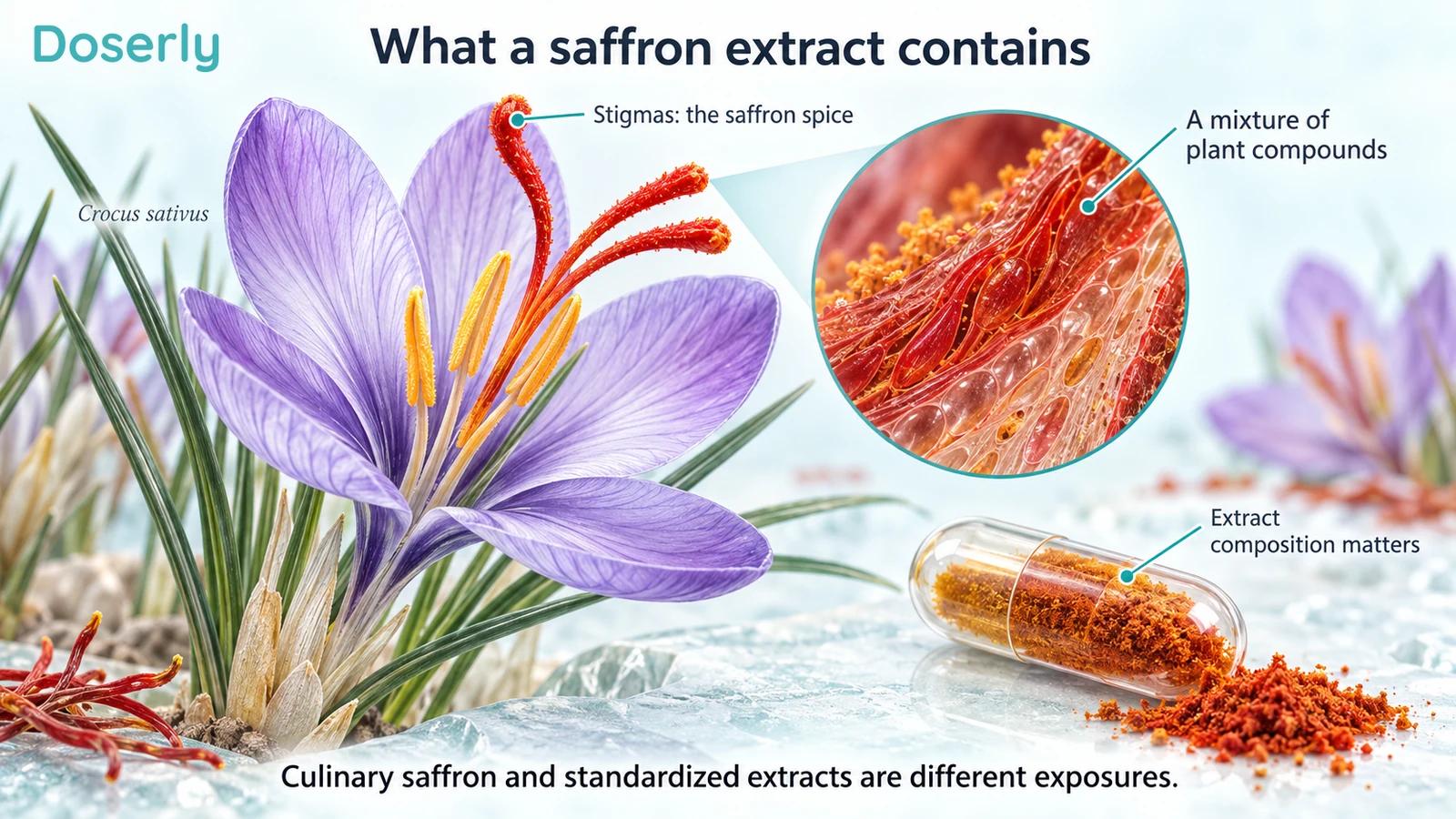
A saffron extract is a mixture of plant compounds, not one purified antidepressant molecule. The manufacturing process and the compounds used to standardize a product can differ. Two labels carrying the word “saffron” therefore don't necessarily describe the same exposure.
The plant part matters too. The stigmas are the threads used as the spice, while other research has examined different plant material. A trial using a particular stigma extract cannot automatically validate every saffron powder or blended mood product. The amounts below describe study treatments rather than a personal dosing plan.
The participants' starting point is equally important. Major depressive disorder involves persistent symptoms and impaired functioning, assessed in a clinical context. “Low mood” or subclinical depressive symptoms may describe a different degree of illness. A study in the latter group cannot establish treatment equivalence for severe or recurrent depression.
What the early placebo-controlled trial showed
A 2005 trial enrolled 40 adult outpatients with major depression described as mild to moderate. Participants had a baseline Hamilton Depression Rating Scale score of at least 18. The trial compared 30 mg saffron per day with placebo for six weeks, using random assignment and blinding.
The saffron group had a greater improvement on the Hamilton scale, with a reported between-group statistical result of p<0.001. Observed side effects did not differ significantly between groups. Akhondzadeh and colleagues
The Hamilton scale is a clinician-rated measure of depressive symptoms. An improvement suggests a treatment signal in that selected population; it does not mean every participant recovered. The p-value also doesn't describe how large the benefit felt or the probability that saffron will work for an individual.
This was a small, single-center trial lasting six weeks. It is more persuasive than an uncontrolled before-and-after report, but it cannot establish uncommon risks or whether improvement persists after the intervention ends. Those limits become especially important for a condition that can recur.
Was saffron as effective as fluoxetine?
Another 2005 pilot randomized 40 outpatients with mild-to-moderate depression to 30 mg daily saffron extract or 20 mg daily fluoxetine for six weeks. Fluoxetine is a selective serotonin reuptake inhibitor, a class of antidepressant medicines. The trial did not detect a significant difference in symptom improvement between the groups; its reported p-value for the comparison was 0.71. Noorbala and colleagues
That is often shortened to “saffron works as well as an antidepressant.” The more precise conclusion is that this small study did not detect a difference. Demonstrating equivalence requires a design that specifies in advance how much difference would still count as clinically similar, with enough participants to estimate that difference precisely.
A nonsignificant comparison is compatible with several possibilities, including similar effects or a difference the study was too small to detect. Without a placebo group in that trial, it also cannot independently show how much improvement each treatment produced beyond nonspecific effects.
The pilot provides a reason for larger comparative research. It does not establish that a patient who responds to fluoxetine can safely substitute a retail saffron product and expect the same outcome.
An older imipramine comparison adds context
A 2004 pilot compared saffron with imipramine, an older antidepressant, in 30 outpatients over six weeks. The treatments were 30 mg daily saffron and 100 mg daily imipramine. The symptom-score difference was not statistically significant, while dry mouth and sedation were observed more often with imipramine. Imipramine comparison
This adds information about short-term tolerability against that particular comparator. It doesn't prove saffron has fewer adverse effects than every modern antidepressant or that it is safe in every combination. Different medicines have different adverse-effect profiles, and a small study is poorly suited to detecting rare events.
Taken together, the early trials show why saffron became a serious research topic. They also show why the specific comparator matters: evidence against placebo, fluoxetine and imipramine answers three related but different questions.
What happens when saffron is added to an antidepressant?
A larger 2019 trial studied adults with persistent depressive symptoms despite antidepressant treatment. Participants continued their medicine and received a standardized saffron extract, 14 mg twice daily, or placebo for eight weeks. Of 160 enrolled participants, 139 supplied usable data.
On the clinician-rated Montgomery–Åsberg Depression Rating Scale, symptom scores decreased 41% with saffron and 21% with placebo. On the self-rated version, scores decreased 27% and 26%, respectively, with no significant difference. Quality of life improved in both groups without a significant between-group advantage. Lopresti and colleagues
The disagreement matters. The trial found a benefit on one primary measure but not the other. It would be misleading to report only the 41% figure as though participants uniformly experienced a major additional improvement.
These are changes in scores, not percentages of people cured. The study also examined adding a specific extract to ongoing care; it did not test stopping an antidepressant and replacing it with saffron.
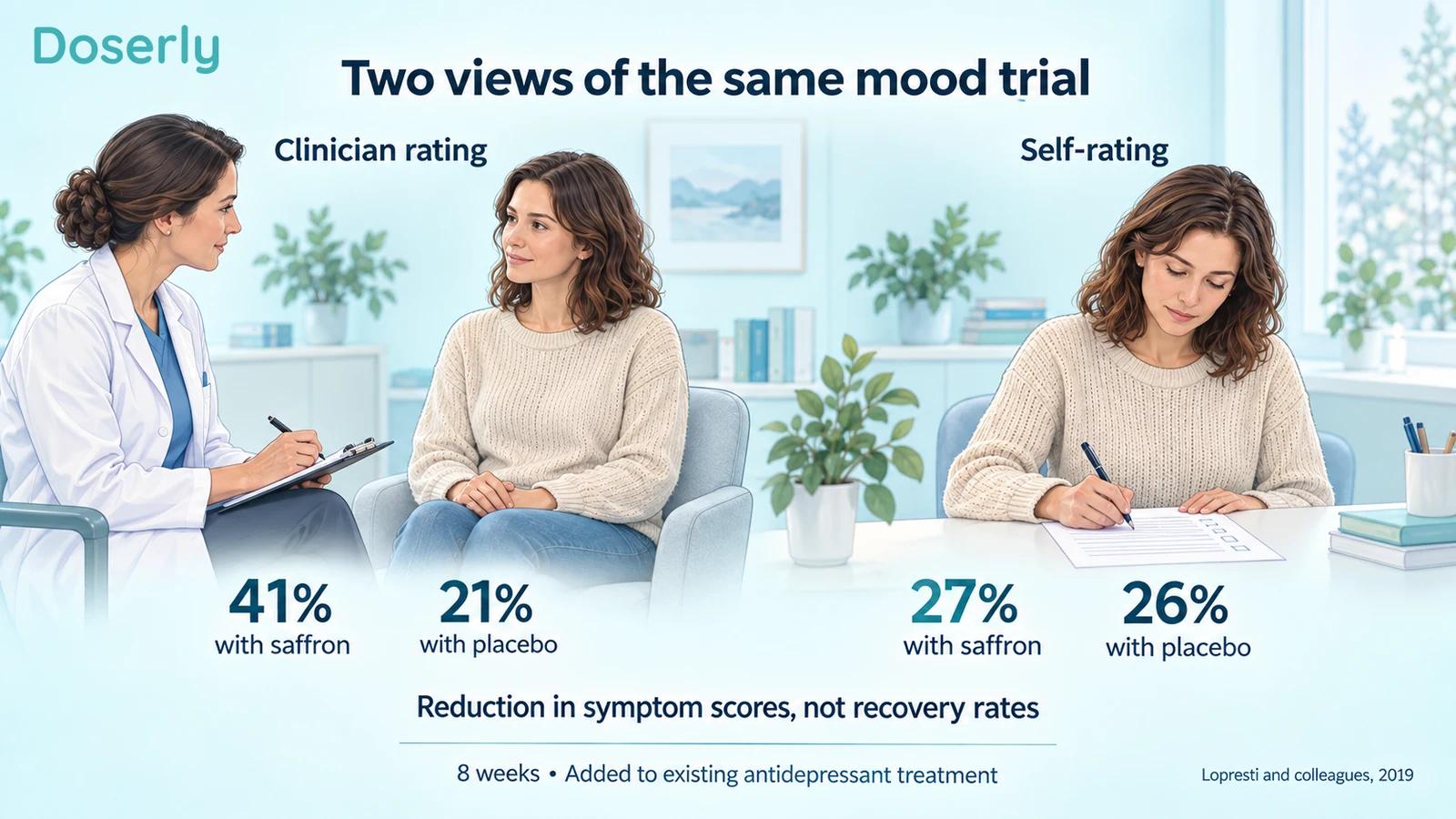
Image sources: Primary report
What the larger 2025 study adds
A 2025 randomized, double-blind trial included 202 adults aged 18–70 with subclinical depressive symptoms. They received 28 mg daily of a standardized saffron extract or placebo for 12 weeks.
On the primary depression subscale of the DASS-21 questionnaire, the estimated difference favored saffron by 2.92 points, with a 95% confidence interval from 0.71 to 5.13 points in the direction of improvement. The standardized effect size was 0.39, indicating a modest average separation between groups. Other secondary outcomes did not show clear between-group differences. 2025 primary trial
The trial also reported that 72.3% of saffron participants and 54.3% of placebo participants reached its defined threshold for clinically significant score improvement. Both groups improved substantially, which is important context for the favorable result.
This strengthens the case for an effect on depressive symptoms in the studied setting. It still doesn't establish equivalence to antidepressant treatment for major depression, and 12 weeks is too short to answer questions about years of use or relapse prevention.
A 2026 trial in women with low mood and poor sleep
A newer trial studied 86 women aged 50–70, comparing 28 mg daily saffron extract with placebo for 12 weeks. The primary depression score improved more with saffron, with an adjusted difference of 2.37 points favoring the extract and a 95% confidence interval of 0.23–4.51 points.
The study also found improvements in self-esteem and sleep-related impairment, but not in the sleep-disturbance score. The authors treated secondary findings as exploratory. No serious adverse events were reported. 2026 trial
This is a useful population-specific addition. It doesn't mean every sleep measure improved, and it doesn't establish that saffron corrects a hormonal cause of low mood. Age, symptoms and a supplement response do not by themselves identify the biological explanation.
For a reader experiencing both poor sleep and low mood, the distinction between sleep disturbance and its daytime impact is helpful. Feeling less impaired during the day can matter even if a questionnaire about the night changes little. Both should be described accurately.
How much confidence should you place in the findings?
The evidence now extends beyond one tiny pilot, and several placebo-controlled studies show favorable mood results. That deserves acknowledgment. The remaining question is how reliably a particular extract helps a particular patient, over a clinically useful period.
The studies use different symptom scales and populations. Their findings cannot be combined casually into one percentage benefit. A clinician-rated depression score, a self-rated low-mood questionnaire and a threshold for improvement each summarize something different.
Several modern studies test a named commercial extract. That makes the formulation identifiable, but it limits the inference to untested products. It also makes transparent funding and independent replication valuable. A branded ingredient name is a description of what was studied, not a recommendation to purchase it.
The research reviewed here does not settle whether saffron prevents recurrent episodes, helps severe depression, reduces hospitalization or replaces psychotherapy. These gaps matter more than whether a supplement is described as natural.
Safety and medication changes belong in the care plan
Short trials generally reported tolerability without a clear serious-event signal. They cannot rule out uncommon harms, establish safety during pregnancy or breastfeeding, or prove that every medication combination is suitable.
NIMH advises discussing supplements and natural products with a health professional because they can interact with medicines. It also advises against starting or stopping mental-health medication without professional guidance. NIMH medication information
An add-on trial is not permission to combine products without review. The clinician needs the exact extract, amount, other ingredients and medication list. They also need to know about prior periods of unusually elevated mood, reduced need for sleep or impulsive behavior, because depressive symptoms can occur in different disorders.
If side effects from an antidepressant are the reason saffron appeals, bring that concern directly to the prescriber. Adjusting the care plan can address tolerability without assuming a supplement has the same protection against relapse.
Making the conversation specific
A useful appointment can start with what hasn't improved: motivation, pleasure, sleep, concentration or ability to manage daily responsibilities. Describe duration and impact, rather than relying on a single good or bad day.
Ask whether the relevant trial studied a similar condition, whether the proposed role is an addition or an alternative, and how improvement would be assessed. Agreeing on a follow-up date and meaningful outcomes is more useful than waiting indefinitely for a vague mood lift.
A simple dated record can include the product, medication changes, sleep and daily functioning. It should support care rather than become another burden. A questionnaire score may help track change, but it doesn't replace discussing how the person is actually doing.
Persistent depressive symptoms deserve assessment and treatment. NIMH describes psychotherapy, medication or their combination as established options selected to fit the individual. If thoughts of self-harm or suicide occur, seek urgent local help rather than waiting for a supplement response. NIMH depression information
Saffron is a reasonable subject for a clinical discussion because its human research contains real positive signals. The strongest decision keeps those signals attached to the preparation, population and outcome studied, while protecting the continuity of effective care.
Sources
- Akhondzadeh et al., 2005: saffron versus placebo.
- Noorbala et al., 2005: saffron versus fluoxetine pilot.
- Akhondzadeh et al., 2004: saffron versus imipramine pilot.
- Lopresti et al., 2019: adjunctive saffron with mixed primary results.
- 2025 randomized trial in 202 adults with low mood.
- 2026 randomized trial in women aged 50–70.
- NIMH: mental-health medication and supplement discussions.
- NIMH: depression assessment and treatment.