
TRT
October 16, 2026
Revisiting the Anabolic Doc’s Blood-Pressure Video After the FDA Update
On this page
A testosterone headline can sound reassuring while leaving an important monitoring question unanswered. In February 2025, FDA moved to remove boxed-warning language about increased cardiovascular outcomes from testosterone-product labeling. In the same action, it required stronger information about increased blood pressure.
Those decisions address different evidence. A cardiovascular-event trial can be reassuring about its primary outcome while dedicated blood-pressure studies identify a treatment-related rise that still deserves attention.
That distinction makes the Anabolic Doc's discussion, Controlling Blood Pressure on Testosterone – Doctor's Analysis, worth revisiting. The useful question is what a patient should carry from a creator discussion into a clinical appointment—and which claims need more than a persuasive explanation.
This article uses the creator's publicly available first-party summary, not a verified video transcript. The medical conclusions below come from regulatory communications, primary studies and professional guidance.
What the public summary contributes
The Anabolic Doc's published summary emphasizes blood-pressure monitoring, delivery method, treatment exposure and coordination with clinicians. It also describes a hierarchy among routes and discusses smaller injections as a way to reduce fluctuations. First-party discussion summary
The strongest practical starting point is the focus on measurement. A patient who feels well may still need blood-pressure assessment; hypertension commonly has no obvious symptoms. American Heart Association explanation
The route hierarchy needs a different standard of evidence. Saying that one delivery method produces different hormone exposure does not, by itself, show that it causes less hypertension than another in comparable patients. A public summary can identify a useful concern without establishing a universal ranking or a treatment protocol.
That is the distinction to retain when returning to the discussion after the FDA update: monitoring has direct support, while route-specific superiority needs appropriately comparative evidence.
FDA made two changes for two different reasons
FDA's February 28, 2025 communication linked removal of cardiovascular boxed-warning language to its review of TRAVERSE. Separately, results from required ambulatory blood-pressure monitoring studies supported product-specific blood-pressure information and a new warning for products without one.
The agency described the blood-pressure finding as class-wide. It did not say that every patient experiences the same increase or that every formulation produces an identical effect. FDA labeling communication
A later June 2026 announcement requested additional label changes concerning age-related hypogonadism and prostate health. That announcement should not be confused with the earlier blood-pressure action or treated as proof that monitoring is unnecessary. HHS requested-label-update announcement
For an individual product, the current prescribing information remains relevant. A headline about “the warning being removed” is too imprecise to tell a patient which warning changed.
Why TRAVERSE cannot substitute for a blood-pressure record
TRAVERSE enrolled 5,246 men aged 45 to 80 with hypogonadism and cardiovascular disease or elevated cardiovascular risk. Testosterone gel was noninferior to placebo for its primary composite of cardiovascular death, nonfatal heart attack and nonfatal stroke over the trial's follow-up.
The study also observed higher incidences of atrial fibrillation, acute kidney injury and pulmonary embolism in the testosterone group. Its result is not a finding that every cardiovascular or related adverse outcome is equally likely. TRAVERSE
More fundamentally, a trial's event comparison does not tell you what your own blood pressure is doing after treatment begins or changes. Those are different measurements at different levels: one describes group outcomes, the other an individual clinical observation.
You can accept the value of TRAVERSE while still taking a rising home or clinic blood pressure seriously. There is no contradiction to resolve by choosing one study and ignoring the other.
What actual blood-pressure studies measured
In a 26-week study of a subcutaneous testosterone-enanthate autoinjector, 133 men with testosterone deficiency received treatment. Average clinic blood pressure increased by 3.4 mmHg systolic and 1.8 mmHg diastolic by week 26. Ambulatory monitoring at week 12 showed average 24-hour increases of 3.7 and 1.3 mmHg, respectively. Autoinjector safety study
An oral testosterone-undecanoate study in 155 men reported average 24-hour systolic increases of 1.7 mmHg at day 120 and 1.8 mmHg at day 180. Oral-product blood-pressure study
These are product-specific observations, not a head-to-head randomized comparison. Differences in participants, baseline treatment, study design and timing prevent simply subtracting the averages and declaring one route safer.
The studies also illustrate why measurement method matters. A clinic reading and a 24-hour ambulatory average are not interchangeable. Reporting the number without its method and time point loses information needed to interpret it.
An average increase is not a personal prediction
An average can be small while individual responses vary. It also cannot tell a clinician whether a specific patient's change reflects treatment, measurement conditions, another medication, an existing condition or several contributors together.
Consider two hypothetical patients with the same apparent increase after a prescription change. One has several comparable readings before and after the change. The other compares a rested clinic reading with a home measurement immediately after exercise. Those records do not provide equally strong evidence of a persistent change.
The first still does not prove causation, but it offers a clearer pattern to investigate. The second first needs attention to comparability.
This is why a useful record includes circumstances rather than just the highest number. It helps the clinician evaluate a possible treatment effect without either dismissing it or prematurely attributing everything to testosterone.
Blood pressure and hematocrit are different measurements
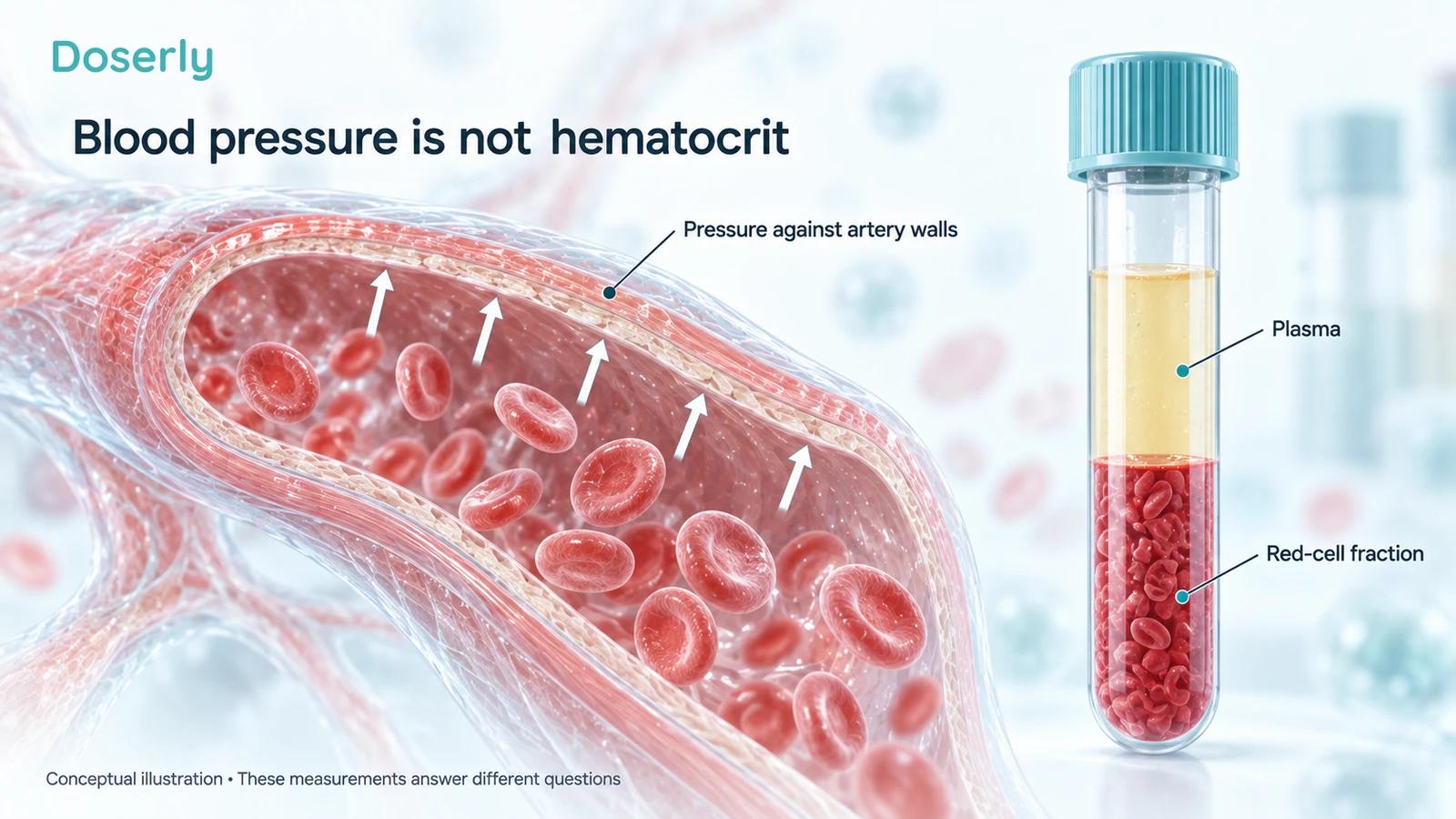
Blood pressure describes pressure against artery walls. Hematocrit describes the proportion of blood occupied by red blood cells. AHA blood-pressure explanation, MedlinePlus hematocrit explanation
Both may appear in a TRT follow-up conversation, but a result for one does not establish the other. A normal hematocrit does not tell you that blood pressure is normal. A high blood-pressure reading does not identify an elevated hematocrit as its cause.
That distinction matters when online advice collapses the problem into “thick blood.” A general blood-donation suggestion is not a blood-pressure diagnosis or an individualized management plan.
Bring the actual measurements to the clinician rather than translating them into one catch-all label. Our TRT blood-work guide explains the laboratory side of monitoring; blood-pressure measurement adds separate information.
Make home readings comparable

The American Heart Association recommends a validated automatic upper-arm monitor with the correct cuff size. Bring it to an appointment so the team can check technique and compare readings.
Before measuring, avoid smoking, caffeine and exercise for 30 minutes, empty your bladder and rest quietly for at least five minutes. Use bare skin, support the arm with the cuff at heart level, and avoid talking. Take two readings one minute apart and record both. Agree with the clinician on how often and when to measure. AHA home-monitoring guidance
A more expensive-looking device does not automatically provide a more useful result. The 2025 blood-pressure guideline emphasizes standardized home measurement and cautions against relying on cuffless devices, including smartwatches, before their precision and reliability are established. 2025 guideline summary
What if home and clinic readings disagree?
A higher office reading is sometimes described as a white-coat pattern, while elevated readings outside the clinic can reveal masked hypertension when office measurements look lower. The NHLBI explains that comparing measurements across settings helps clinicians recognize these patterns. NHLBI diagnosis information
Neither label should be assigned simply because one setting gives the answer you prefer. First check the device, cuff and technique, then bring the full pattern to the care team. A normal office measurement should not automatically dismiss repeated high home readings; one anxious office measurement should not automatically define the entire week.
Ambulatory monitoring, used in the testosterone studies discussed above, gathers measurements over an extended period rather than relying on one chosen moment. A clinician can decide whether that type of assessment would clarify a particular discrepancy.
This is especially useful when discussing a possible medication effect. The question is whether the pattern changed under comparable conditions, not whether a single number can be matched to a dose on a calendar.
Keep the complete record, not the preferred readings
A log is most useful when it preserves the readings that were actually taken. Repeating measurements until a lower number appears and recording only that number can hide the pattern the clinician needs to see.
Include the date and time, both readings, symptoms if present, and any obvious departure from the usual measurement conditions. If there was a prescribed treatment change, record its date rather than relying on memory weeks later.
A clinician may ask about medicines, supplements or other changes around the same period. That is an investigation of context, not proof that any particular item caused the increase.
The aim is a usable account of what happened. Doserly can help organize treatment dates and observations, but a tracking tool does not decide whether a reading is accurate or what medication adjustment is appropriate.
Know when a reading needs prompt action
If systolic pressure is higher than 180 mmHg or diastolic pressure is higher than 120 mmHg and you have chest pain, shortness of breath, weakness, numbness, vision changes or difficulty speaking, call emergency services immediately. Do not wait for an app trend or a routine TRT appointment.
Without those symptoms, repeat an unexpectedly severe reading after at least one minute; if it remains very high, contact a healthcare professional immediately. AHA guidance
Concerning acute symptoms deserve urgent assessment even if a home reading is unavailable. A number should not become a reason to delay help.
For less extreme but repeatedly elevated readings, follow the plan agreed with your clinician. Do not independently stop prescribed blood-pressure medication because a later reading looks better. AHA home-monitoring guidance
A monitoring plan needs a response plan
Collecting readings is only the first part of follow-up. Before leaving an appointment, establish who will review them, how they should be shared and what should prompt earlier contact. Otherwise a patient can faithfully record a worsening pattern while assuming someone else is watching it.
The 2025 guideline emphasizes home monitoring linked to clinical-team interactions and standardized management. A device alone is not the intervention. 2025 guideline summary
A practical plan should also distinguish the question of treating hypertension from the question of continuing or changing testosterone. Those decisions may interact, but they are not identical. The appropriate next step depends on the patient's overall clinical situation rather than on which drug or supplement was mentioned most confidently in a video.
If a treatment change is made, retain the earlier measurements. They provide the comparison needed to assess what happened afterward.
Turn the video into better appointment questions
The most useful response to a creator's discussion is a better clinical question, not a copied regimen. Ask whether the actual product has blood-pressure data relevant to your situation, whether the readings show a persistent change, and what other contributors should be assessed.
If a route change is proposed, ask what evidence supports it and how the response will be evaluated. A different route may offer practical advantages without guaranteeing a lower blood pressure. Likewise, smaller or more frequent injections should not be assumed to solve hypertension simply because the exposure pattern sounds smoother.
The TRT side-effects guide provides broader context for monitoring. The central lesson from the FDA update is more specific: reassurance about one cardiovascular endpoint does not make blood-pressure follow-up optional.
A useful creator discussion starts the conversation. Reliable measurements, product-specific evidence and a clinician's assessment make it actionable.
Sources
- Anabolic Doc first-party discussion summary
- FDA February 2025 labeling changes
- TRAVERSE
- Subcutaneous autoinjector safety study
- Oral testosterone-undecanoate blood-pressure study
- AHA home blood-pressure monitoring
- AHA blood pressure explained
- MedlinePlus hematocrit test
- 2025 blood-pressure guideline summary
- HHS June 2026 requested labeling changes
- NHLBI high blood pressure diagnosis