
Supplements
October 16, 2026
Retinol, beta-carotene and the problem with one vitamin-A headline
On this page
Vitamin A supports vision, immune function and the development and maintenance of tissues. Yet a bottle labeled “vitamin A” can contain different substances, and those differences matter. Preformed vitamin A, such as retinol and retinyl esters, is not the same exposure as beta-carotene, a plant pigment the body can convert into vitamin A.
This distinction becomes especially important when reading a headline about cancer risk, choosing a prenatal supplement or comparing an eye-health formula with a multivitamin. The question is not simply whether vitamin A is good or bad. It is which form, in what amount, for whom and for what purpose.
The human evidence gives useful answers, including important examples where a plausible prevention strategy caused harm. We’ll examine those findings without turning a supplement trial into a warning against vegetables. For a broader introduction to nutritional roles and formulations, see our vitamin A guide.
Two routes to vitamin A activity
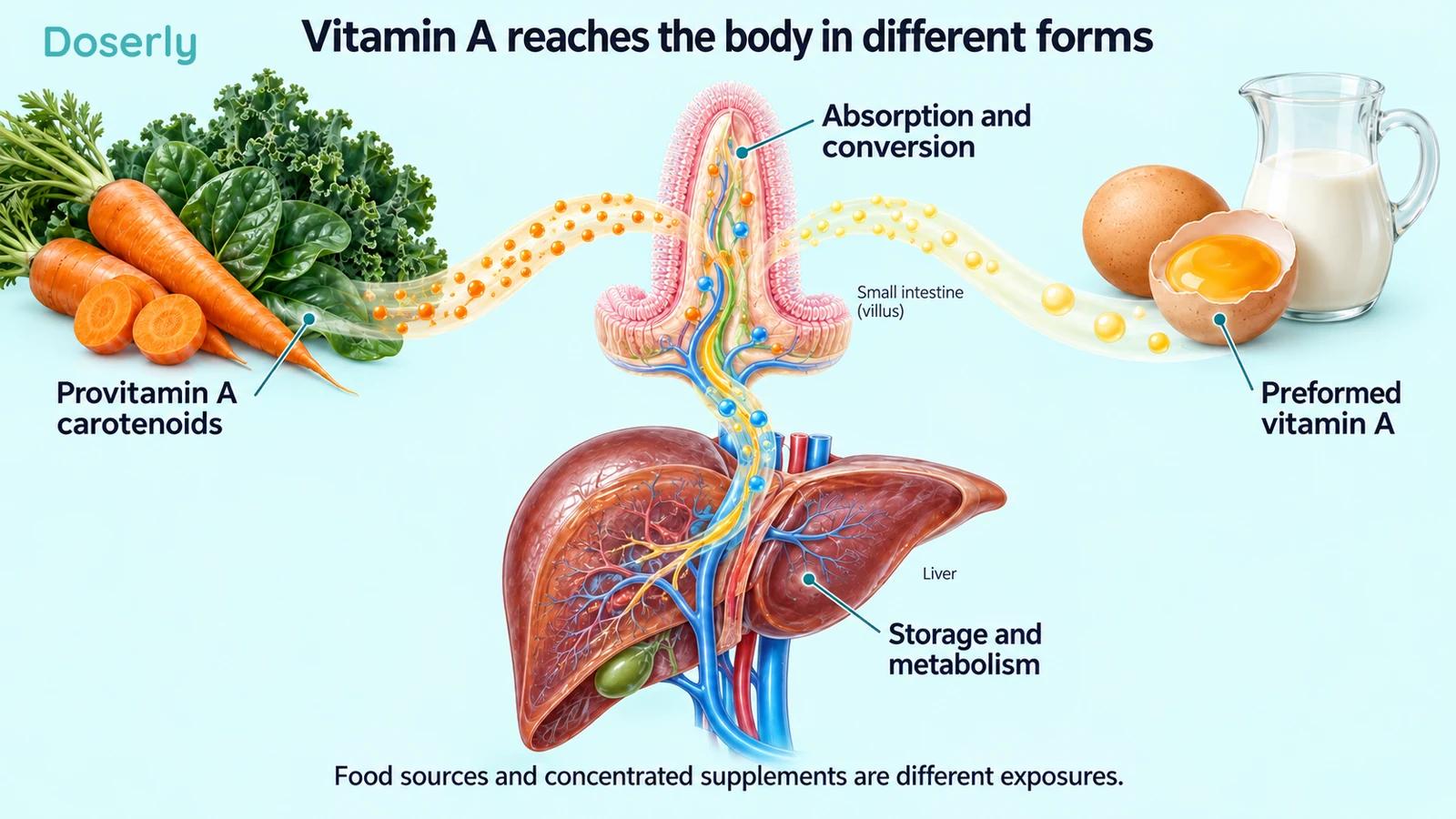
Preformed vitamin A is found in foods such as eggs, dairy products and liver, and in supplements as retinol or retinyl esters. Beta-carotene and some other carotenoids are provitamin A compounds: the body can convert them into forms used for vitamin A functions. Orange and dark-green vegetables are familiar sources.
Not every carotenoid has vitamin A activity. Lutein and zeaxanthin, for example, are relevant to eye-health research but should not be counted as interchangeable vitamin A precursors. The word “carotenoid” describes a broader family than the compounds that supply vitamin A. NIH vitamin A and carotenoids fact sheet.
Absorption and conversion also vary. The quantity printed in milligrams for a carotenoid is not directly comparable with the same weight of retinol. To account for different biological activity, nutrition recommendations use retinol activity equivalents, abbreviated RAE.
Why units can change the interpretation of a label
One microgram RAE corresponds to one microgram retinol. NIH lists different conversion factors for beta-carotene from supplements and from food: two micrograms of supplemental beta-carotene or twelve micrograms of dietary beta-carotene correspond to one microgram RAE. These standardized conversions help compare vitamin activity; they are not precise predictions for an individual meal.
Adult recommended allowances are 900 micrograms RAE daily for men and 700 for women, with different values during pregnancy and breastfeeding. The adult upper limit of 3,000 micrograms RAE applies to preformed vitamin A, rather than all carotenoids combined. NIH intake recommendations and conversions.
This makes a mixed supplement worth reading carefully. If part of its vitamin A comes from beta-carotene and part from retinyl palmitate, the total vitamin activity and the amount of preformed vitamin A are related but different pieces of information. An older label expressed only in international units, or IU, needs the form identified before conversion.
A practical comparison starts by copying the ingredient form and labeled vitamin A amount, not just the front-label percentage. Bring that information to a pharmacist or clinician if you are combining products or have a relevant medical condition.
What CARET actually tested
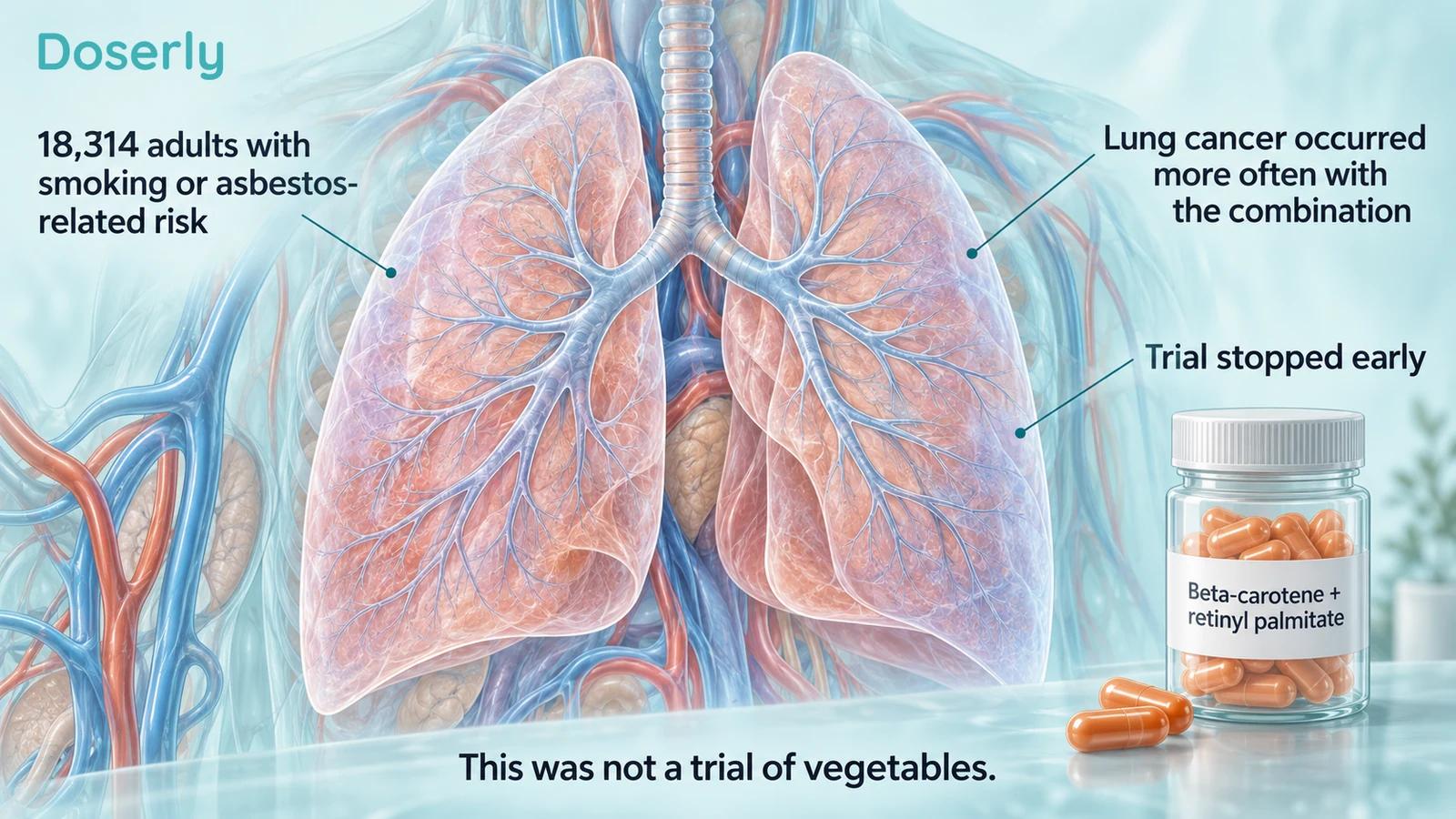
The Beta Carotene and Retinol Efficacy Trial, or CARET, enrolled 18,314 smokers, former smokers and workers with asbestos exposure. Participants received placebo or a daily combination of 30 mg beta-carotene and 25,000 IU preformed vitamin A as retinyl palmitate. These were concentrated supplements, not servings of produce.
After an average four years, lung-cancer incidence was higher with the combination: relative risk 1.28, with a 95% confidence interval of 1.04–1.57. All-cause mortality was also higher, relative risk 1.17. The trial stopped 21 months earlier than planned. CARET primary report.
A relative risk of 1.28 means the incidence was estimated to be 28% higher relative to the comparison group. It does not mean that 28% of supplement users developed lung cancer. Because the active treatment combined two substances, CARET alone cannot determine how much each contributed.
The result directly challenges using that combination for cancer prevention in this population. It does not show that eating carrots or leafy greens creates the same risk.
A separate trial strengthens the beta-carotene concern
The Finnish Alpha-Tocopherol, Beta-Carotene Cancer Prevention Study, usually called ATBC, studied 29,133 male smokers aged 50–69. Its four-group design compared vitamin E, beta-carotene, both or placebo. Beta-carotene was given at 20 mg daily, and follow-up lasted five to eight years.
Lung-cancer incidence was 18% higher among those assigned beta-carotene than among those not assigned it; the confidence interval ranged from 3% to 36% higher. The trial found no lung-cancer prevention benefit. ATBC primary report.
Unlike CARET, this design allowed a beta-carotene comparison across participants receiving or not receiving vitamin E. The concern about beta-carotene in smokers therefore does not depend solely on interpreting a beta-carotene–retinol combination.
The population still matters. These were male smokers, not children being treated for deficiency or a representative sample of everyone who eats carotenoid-containing foods. Preserving that specificity makes the warning more useful, not less serious.
Why another large trial had a different result
The Physicians’ Health Study enrolled 22,071 US male physicians and compared beta-carotene, 50 mg on alternate days, with placebo. Only 11% were current smokers at the start. After twelve years, it found no significant overall benefit or harm for cancer, cardiovascular disease or death. Physicians’ Health Study report.
That result does not erase the findings in smokers. The trials involved different populations and exposure schedules. An overall neutral result in a group with relatively few current smokers cannot establish safety in a higher-risk smoking population.
It also does not support routine beta-carotene for prevention in otherwise well-nourished adults. “No significant benefit or harm” is a different conclusion from “proven beneficial.” The three trials together show why a nutrient name is too broad a basis for predicting a clinical result.
For someone comparing products, the practical question is whether there is a specific indication for the exact formulation. A long ingredient list and a familiar antioxidant claim do not supply that indication.
What about eye-health supplements?
Some people take a specialized formula for age-related macular degeneration, or AMD, after an eye specialist recommends it. This is a disease-specific use, not general supplementation to make healthy eyes stronger.
The National Eye Institute distinguishes the older AREDS formulation, which contained beta-carotene, from AREDS2 formulations that use lutein and zeaxanthin instead. Smoking history matters because beta-carotene increased lung-cancer risk in relevant research, including among former smokers. These formulations are intended for particular stages of AMD; they do not prevent its onset in everyone. NEI AREDS/AREDS2 questions.
Do not assume that an arbitrary “eye support” product reproduces the studied formula. Compare ingredients and amounts, and ask the eye-care clinician which version fits your diagnosis and smoking history.
If you already use a recommended eye formula, include it when reviewing your multivitamin and other supplements. A condition-specific product can be appropriate while still contributing overlapping nutrients to the rest of your routine.
Pregnancy makes preformed vitamin A especially important
Vitamin A is necessary for fetal development, but excessive preformed vitamin A can cause birth defects. This is one reason adding a separate high-dose vitamin A supplement to a prenatal product is not a routine nutritional upgrade. The form and total exposure need review before pregnancy as well as during it. NIH pregnancy and excess-intake guidance.
The adult upper limit is not a recommended target to approach. Nor does being below a population upper limit mean every combination is appropriate, especially when prescription retinoids or significant liver disease are involved. Prescription retinoid medicines have their own risks and monitoring requirements; they should not be treated as ordinary vitamin products.
WHO recommends vitamin A supplementation during pregnancy only in settings where deficiency is a severe public-health problem, to prevent night blindness. That is a targeted public-health use, not a recommendation for all pregnant people to add vitamin A independently. WHO pregnancy guidance.
Bring the prenatal, multivitamin, any liver-derived oil and individual vitamin products to the review. This is a better starting point than asking whether one bottle alone looks safe.
Adequacy and excess are different clinical problems
Deficiency can impair vision, including adaptation to darkness, and affect immunity and tissues. People with disorders that interfere with fat absorption may need assessment because vitamin A is fat-soluble. In that setting, identifying and treating deficiency is a legitimate clinical goal.
Excess preformed vitamin A is a different problem. It can accumulate, particularly in the liver, and chronic high exposure can produce adverse effects. Beta-carotene can cause yellow-orange skin discoloration at high intake, but the absence of classic retinol toxicity does not remove its lung-cancer concern in smokers. NIH deficiency and toxicity discussion.
Neither symptoms nor a food-tracking app can establish the diagnosis alone. Night-vision difficulty needs evaluation rather than an assumption that more vitamin A is the answer. Likewise, a blood retinol result is not a simple measure of all liver stores; NIH notes limitations in using circulating values to assess status.
Treatment for a confirmed deficiency may differ from ordinary daily intake advice. That distinction should remain visible when reading about high-dose interventions in populations with deficiency.
What to do with a vitamin A headline or product label
First identify the form. “Vitamin A” may refer to retinol, a retinyl ester, beta-carotene or a mixture. Then identify the actual goal: preventing deficiency, treating a diagnosed problem or trying to prevent a chronic disease. The evidence differs across those goals.
Next, account for context. Smoking and past smoking are relevant to beta-carotene supplements. Pregnancy or pregnancy planning makes preformed vitamin A exposure particularly important. A specialized eye formula, liver-derived oil or prescription retinoid can change the interpretation of an otherwise ordinary supplement label.
Finally, review the whole routine. Keep a dated record of product names, forms and amounts so a clinician can see overlapping exposures. Recording “vitamin A, one capsule” is less useful than recording the actual formulation and labeled RAE or IU.
The central distinction is straightforward: a nutrient’s essential role does not make every form and concentration interchangeable. You can value vitamin A in a nutritious diet while recognizing that concentrated prevention regimens have sometimes failed or caused harm. Our vitamin A guide offers more background for discussing your own formulation and clinical context.
Sources
- NIH: vitamin A and carotenoids.
- CARET, 1996.
- ATBC, 1994.
- Physicians’ Health Study, 1996.
- National Eye Institute: AREDS and AREDS2.
- WHO: vitamin A in pregnancy.