
Peptides
October 16, 2026
Retatrutide and sensitive skin: how trials describe dysesthesia
On this page
Skin can feel uncomfortable even when there is no obvious rash. A light sleeve may feel abrasive, ordinary touch may hurt, or a person may notice an unpleasant burning or tingling sensation. Those descriptions deserve attention in their own right. They should not disappear inside a generic list of stomach-related side effects.
Retatrutide trials have reported altered skin sensation more often in treatment groups than in placebo groups. That makes the signal worth discussing. It does not establish that every such symptom has the same cause, that it means permanent nerve injury, or that it will always pass without assessment.
The most useful starting point is precise language: what sensation occurred, how the study recorded it, how often it was reported and what remains unknown. That approach is more helpful than either “it is harmless” or “it must be nerve damage.”
What dysesthesia means
Dysesthesia describes an abnormal sensation that feels unpleasant. It can occur without an obvious trigger or in response to something touching the skin. Allodynia is more specific: something that ordinarily would not hurt produces pain. Hyperesthesia describes increased sensitivity to stimulation.
These terms overlap in ordinary conversation, but they are not interchangeable labels for every experience of tingling or pain. They describe what someone feels; they do not, by themselves, diagnose why it happens. The International Association for the Study of Pain explicitly separates clinical descriptions such as allodynia from claims about mechanism. IASP terminology.
For example, “my shirt brushing my upper arm hurts” conveys a different pattern from “my feet feel numb” or “the injection area is red and swollen.” A clinician may need to investigate each differently. Describing the experience plainly is useful even if you do not know which technical term fits.
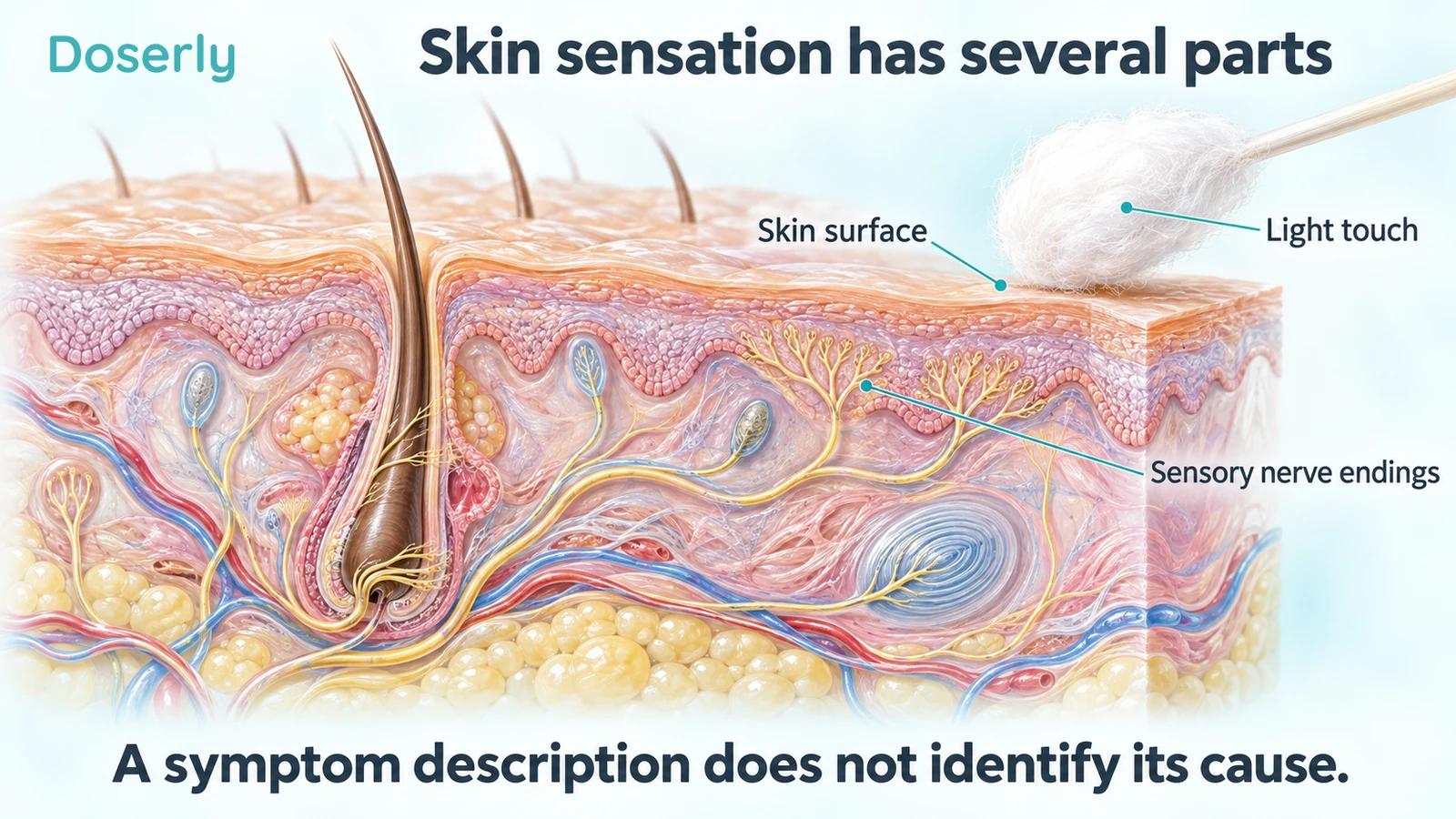
Conceptual skin anatomy illustrates sensation. It does not identify where retatrutide acts or depict nerve damage caused by treatment.
What the original obesity trial actually reported
The 2023 phase 2 obesity trial randomized 338 adults and followed treatment for 48 weeks. Its report describes cutaneous hyperesthesia and skin-sensitivity events in 7% of retatrutide participants versus 1% of placebo participants. In that trial, these events were not severe or serious, were not accompanied by overt skin findings, and did not cause treatment discontinuation. Original trial.
Those details provide useful reassurance about what investigators observed in that particular study. They also place boundaries around the reassurance. The finding does not mean that a rash is required for a symptom to matter, or that every future episode will be mild.
The 7% figure pools retatrutide exposure across trial groups. It is not a universal rate for every dose, population or product. Nor is it a measurement of the percentage of people with confirmed nerve injury. The investigators reported a symptom category.
This distinction is easy to lose when a short online summary turns “reported skin sensitivity” into “developed neuropathy.” The latter is a stronger clinical claim and needs different evidence.
Newer trials add evidence, but the percentages vary
TRIUMPH-2, now published in The Lancet, studied adults with obesity or overweight and type 2 diabetes for 80 weeks. Its safety data report dysesthesia in 13 of 292 people receiving 4 mg, 16 of 284 receiving 9 mg and 21 of 286 receiving 12 mg, compared with 2 of 287 receiving placebo. Rounded percentages were approximately 4%, 6%, 7% and 1%. These are safety-population denominators, not simply the total randomized count divided into four equal groups. TRIUMPH-2 paper.
A different phase 3 study, TRIUMPH-4, enrolled adults with knee osteoarthritis and obesity or overweight, without diabetes. Its sponsor release reported dysesthesia in 8.8% with 9 mg and 20.9% with 12 mg, versus 0.7% with placebo, over a 68-week trial. The company described the events as generally mild and as rarely leading to discontinuation. These particular figures come from a sponsor report. TRIUMPH-4 announcement.
The higher number is not a reason to substitute “one in five” for every retatrutide user's risk. The lower number is not a reason to ignore the higher one. Both describe defined groups under defined study conditions.
TRIUMPH-1's sponsor release supplies another example: 5.1%, 12.3% and 12.5% across the 4, 9 and 12 mg groups, compared with 0.9% on placebo. That variation argues against treating any single percentage as the final answer for everyone. TRIUMPH-1 announcement.
Why a higher trial percentage does not reveal the cause
Different trials involve different populations, treatment durations and reporting processes. The precise adverse-event grouping can matter too. A broad category covering related sensory descriptions may not be directly interchangeable with one particular preferred term.
These factors are reasons to investigate differences, not proof of which factor explains them. It would be speculative to say that knee osteoarthritis itself caused the higher TRIUMPH-4 rate, or that diabetes protected participants in TRIUMPH-2. Neither conclusion follows from comparing separate trial percentages.
Within a randomized study, a higher rate on retatrutide than placebo supports concern about an association with treatment. Identifying the biological pathway responsible would require additional evidence. A trial can detect an adverse-effect signal before it explains the mechanism.
Retatrutide's three receptor targets do not solve that problem by inspection. Knowing that the molecule activates GIP, GLP-1 and glucagon receptors does not establish which target, if any individually, produces a particular sensory symptom. The Doserly retatrutide guide explains the receptor design; it should not be read as a map of a proven skin-pain pathway.
Symptom severity, medical seriousness and stopping treatment are different questions
A symptom may be described as mild, moderate or severe according to its intensity or effect on activity. “Serious” is a separate safety classification concerned with medically important outcomes. Treatment discontinuation is another measure: whether someone stopped the study medicine.
These categories answer different questions. A symptom can disrupt sleep without causing hospitalization. A participant might continue treatment despite discomfort. Conversely, stopping treatment does not automatically mean that an event caused lasting damage.
When a report says an event rarely caused discontinuation, it is describing one consequence of the symptom. It does not tell us that everyone found it trivial. When a paper reports no serious sensory events, that is valuable information about the study, but it should not be expanded into a promise about an unassessed individual.
An overall adverse-event discontinuation percentage also cannot be assigned to dysesthesia alone. People may stop because of gastrointestinal symptoms or other events. The reason-specific result must be reported separately before making that connection.
What is known about timing and recovery?
The TRIUMPH-1 sponsor report says most dysesthesia events resolved during treatment and that most affected participants continued retatrutide. That is a group-level description, not a guaranteed recovery schedule. TRIUMPH-1 safety description.
It leaves practical questions that the accessible report does not fully answer: how long individual episodes lasted, whether symptoms recurred, how timing related to dose changes, and what happened to each person with persistent symptoms. Those missing details should remain missing rather than being filled with a standard “two weeks” rule.
A report that symptoms improved after a change can be clinically useful. On its own, it does not prove the change caused the improvement. Symptoms fluctuate, exposures change and other conditions may be present. Repeated patterns can guide assessment, but deliberate self-rechallenge is not necessary to make a symptom report credible.
This is also why there is no evidence-based self-treatment schedule in this article. Trial dose groups are research assignments. They are not instructions for adjusting an investigational medicine to work around an adverse effect.
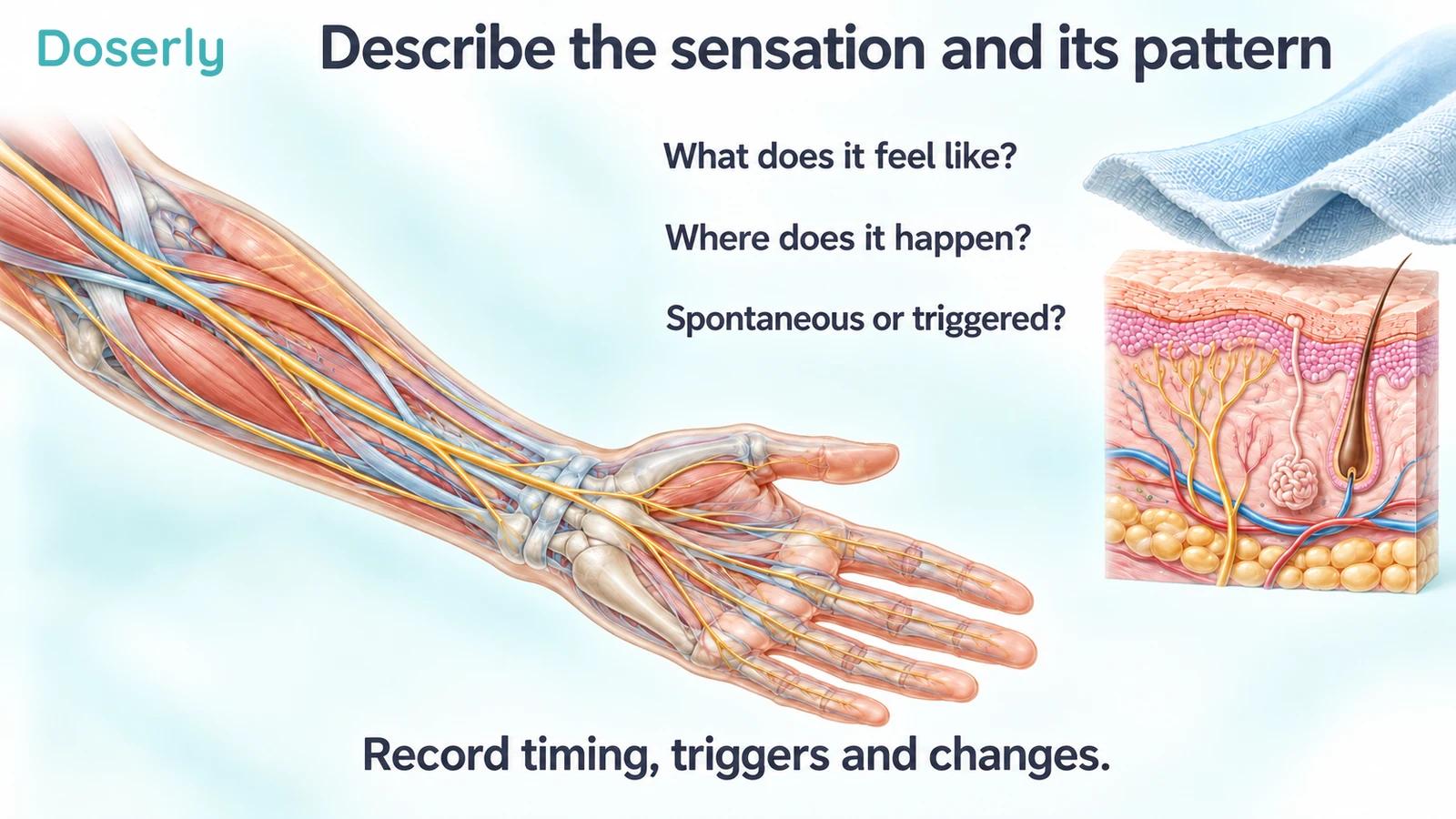
The anatomy is conceptual. Location, triggers and timing help describe a symptom; the drawing does not imply that one named nerve causes the trial signal.
A clear symptom account helps more than a technical label
If you are participating in a trial, report new symptoms to the study team. Outside a trial, a clinician needs an accurate account of every product used, including unapproved products, supplements and recent medication changes. The purpose is to understand the exposure and symptoms, not to judge the person reporting them.
A useful note can include:
- The first day you noticed the sensation and whether it is constant or intermittent.
- Its location, whether it is on one or both sides, and whether the area is changing.
- What it feels like in ordinary words: burning, prickling, numbness, pain with light touch or another description.
- Triggers, visible skin changes and effects on sleep, walking, dressing or other activities.
- The product name, packaging, source, exposure dates and other medicines used.
A photograph can document a visible rash or swelling. It cannot capture how painful normal-looking skin feels. Both the absence of a visible change and the person's sensory experience are worth recording.
The record should support a medical conversation, not become a test that must be completed before seeking care. Worsening or concerning symptoms warrant assessment even when the description is incomplete.
Do not fold every skin complaint into the trial signal
A local injection reaction, an allergic reaction and an unpleasant skin sensation are different clinical possibilities. The presence of a known trial signal does not establish the explanation for a new symptom.
Breathing difficulty, sudden throat or tongue swelling, or collapse requires emergency help. Those are potential features of a serious allergic reaction, not symptoms to watch at home because a trial described dysesthesia as mild. NHS anaphylaxis guidance.
There is also a separate product-quality issue. In June 2026, Victoria's health department reported six cases of acute liver injury associated with unapproved products labelled retatrutide. Possible contaminants were under investigation. Its warning included symptoms such as abdominal pain, dark urine, yellow skin or eyes and unusual bruising, with advice to seek prompt medical attention. Victorian health alert.
That alert does not prove the investigational molecule caused those injuries, and it does not explain the sensory signal in randomized trials. It does show why a new symptom after an unapproved product cannot safely be assumed to match an event recorded with controlled trial supply.
What readers can reasonably conclude
The skin-sensation signal is supported by clinical trial reporting. It deserves precise, respectful attention even when the skin looks normal. The evidence also does not justify diagnosing permanent nerve damage from a symptom term or promising that everyone will recover on a fixed timetable.
As of this article's October 15, 2026 source check, retatrutide remains investigational. The FDA states that it is not a component of an approved drug and is not eligible for compounding under federal law. Products sold online with research-only labels have not acquired the trial medicine's evidence or quality controls. FDA statement.
The useful next step for someone experiencing symptoms is an honest clinical assessment with a clear exposure history. For someone reading the research, it is to keep the symptom category, trial population, dose group and reporting limits attached to every percentage.
Sources
- IASP: definitions of sensory and pain terms.
- NEJM: original phase 2 obesity trial.
- The Lancet: TRIUMPH-2 phase 3 trial.
- Lilly: TRIUMPH-4 sponsor report.
- Lilly: TRIUMPH-1 sponsor report.
- Victoria Department of Health: unapproved-product toxicity alert.
- FDA: concerns with unapproved GLP-1 drugs.
- NHS: anaphylaxis.