
Peptides
October 16, 2026
Retatrutide and muscle preservation: what body-composition data can settle
On this page
Losing a large amount of weight raises a question that the bathroom scale cannot answer: what tissue was lost, and what can the person still do? Retatrutide's body-composition research provides useful evidence about fat and lean tissue. It does not yet justify calling the investigational drug a muscle-preserving treatment.
The clearest published human substudy measured body composition with dual-energy X-ray absorptiometry, or DXA, in people with type 2 diabetes. It found substantial fat-mass reductions at higher studied doses. Its authors also reported that lean-mass loss as a proportion of weight loss was similar to that seen with other obesity treatments. That is a different conclusion from “all the weight lost was fat.” It is also different from showing preserved strength, mobility, or protection against frailty. 1
Retatrutide remains investigational as of October 15, 2026. This article explains the evidence, not a muscle-preservation protocol for an unapproved product. For the broader trial context and regulatory position, see the retatrutide guide. 7
The human substudy actually measured fat and lean tissue
The body-composition paper was a prespecified substudy of a randomized phase 2 trial conducted at 42 US centers. The parent study enrolled adults aged 18–75 with type 2 diabetes and a BMI of 25–50. Its treatment groups included retatrutide, placebo, and dulaglutide, an active glucose-lowering comparator. DXA measurements were used to examine changes over 36 weeks. 1
Of the 281 participants randomized in the parent trial, 189 enrolled in the substudy. That number is useful because it prevents the analysis from being mistaken for a body-composition study of every participant. There were 155 baseline DXA assessments; 103 people completed treatment and had both baseline and week-36 scans. 1
The prespecified primary substudy endpoint was percentage change in total fat mass. At the studied 8-mg and 12-mg doses, reported fat-mass reductions were 26.1% and 23.2%, respectively, compared with 4.5% for placebo. These are trial exposure groups, not prescribing instructions. The study also included lower retatrutide doses and a dulaglutide group. 1
Two denominators matter here. A 26.1% reduction in fat mass means a reduction relative to the participant's starting fat mass. It does not mean 26.1% of their starting body weight disappeared as fat. And the difference between 26.1% and 4.5% is 21.6 percentage points; it is not 21.6 kilograms.
Nor should the numerical ordering of the 8-mg and 12-mg groups be treated as proof that one exposure is better for body composition. This was a relatively small substudy, with incomplete follow-up scans and uncertainty around its estimates. Ranking two point estimates is much easier than establishing a reliable difference between the treatments.
The finding worth retaining is that the higher studied groups lost substantially more fat mass than placebo. Whether an individual retained muscle strength is a separate question.
Lean mass is a measurement category, not a performance score
DXA body-composition reports distinguish fat mass, lean mass, and bone mineral content. A lean-mass result is not a direct measurement of the force a muscle can generate. Even appendicular lean mass, which focuses on the limbs and is more relevant to skeletal muscle than a whole-body value, does not replace strength or physical-performance assessment. 2, 3
That distinction matters when a headline substitutes “muscle” for every occurrence of “lean mass.” A DXA scan estimates tissue compartments; it does not isolate the working contractile machinery of each muscle or establish how effectively someone climbs stairs. A change in a scan result and a change in function can tell related but different stories.
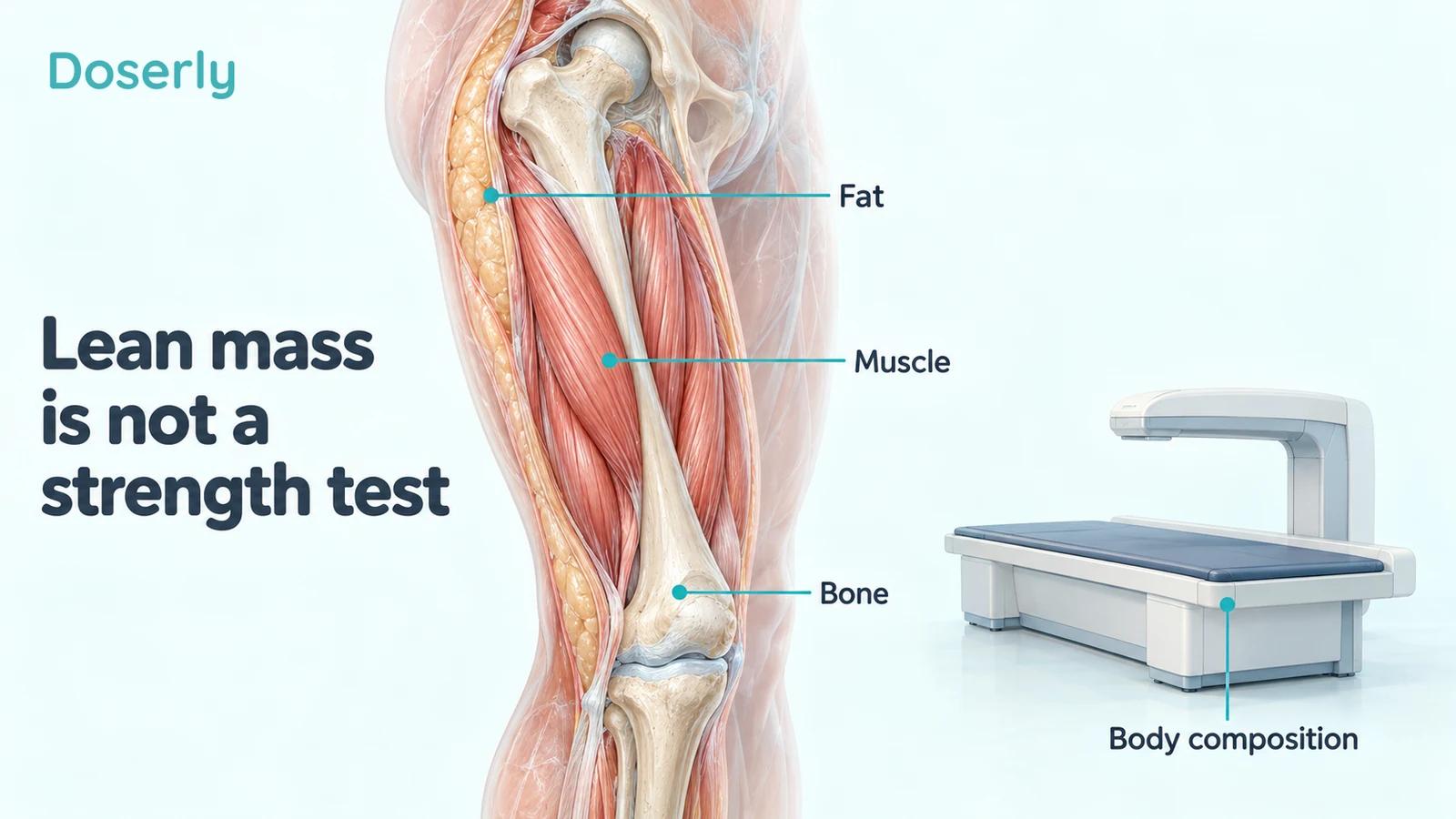
The International Society for Clinical Densitometry recommends consistent preparation and positioning for repeated body-composition measurements. Its guidance addresses matters such as fasting state, clothing, time of day, recent physical activity, and an emptied bladder. It also cautions that comparisons across different manufacturers require appropriate cross-calibration. 2
Those details are not minor bookkeeping. A trend is more interpretable when the measurement process is consistent. Two scans obtained under different conditions or on different systems should not automatically be read as a precise account of tissue change.
A consumer scale's body-composition estimate also should not be substituted into a DXA trial result as though both measurements were the same endpoint. When someone brings a “muscle percentage” from a home device to an appointment, identifying what the device actually measured comes before interpreting the number.
A higher lean percentage can coexist with less lean tissue
Percentages can make body composition sound more reassuring than the absolute amounts justify.
Consider a deliberately simplified example, not retatrutide trial data. Suppose a person has 60 kilograms of lean tissue and 40 kilograms of fat in a two-compartment illustration. After weight loss, those amounts are 56 and 24 kilograms. Lean tissue now makes up 70% of the remaining mass rather than 60%, even though its absolute amount fell by 4 kilograms.
The example omits bone and other reporting details to isolate the arithmetic. Its lesson is straightforward: when fat falls faster than lean tissue, the lean proportion can rise while the lean amount falls.
For that reason, a useful body-composition report should make clear whether it is describing kilograms, percentage change from baseline, or the fraction of total weight loss attributable to a compartment. None of those measures is interchangeable with the others.
The retatrutide paper's conclusion that the proportion of lean-mass loss resembled that of other obesity treatments should be read in this context. It argues against presenting the observed fat reduction as uniquely proven muscle sparing. It also does not, by itself, establish unusually severe muscle injury. 1
A comparison with the wider obesity-treatment literature is not equivalent to a randomized head-to-head trial against every other medication. The actual active comparator in this substudy was dulaglutide. Claims that retatrutide preserves muscle better than semaglutide or tirzepatide require their own direct evidence.
Missing scans narrow the conclusion
The difference between 189 substudy participants and 103 treatment completers with both scans deserves attention. It does not make the results worthless, but it limits how confidently a reader can extend them to everyone who starts treatment.
The analysis described in the primary abstract used available on-treatment measurements before treatment discontinuation. It should not be mistaken for a complete account of body composition after stopping treatment or for a guarantee that people without follow-up scans had the same experience. 1
People who remain in a study and complete assessments can differ from those who stop or miss visits. The available abstract does not resolve every reason for missing DXA data, and a full supplementary-data audit would be needed to inspect all sensitivity analyses. This is an access limitation, not a reason to invent a result in either direction.
The population also matters. These participants had type 2 diabetes. The study cannot automatically settle muscle outcomes in older adults with frailty, people without diabetes, competitive athletes, or those already struggling to eat enough. Each of those groups may begin with different functional reserves and clinical priorities.
Finally, 36 weeks describes the substudy's observation window. Preserving function during years of treatment, maintaining it after substantial weight loss, and recovering after discontinuation are longer-term questions.
Strength and function deserve their own endpoints
Muscle health is not captured by one scan number. The European Working Group on Sarcopenia in Older People places low muscle strength at the center of identifying probable sarcopenia, uses low muscle quantity or quality to confirm the diagnosis, and uses poor physical performance to indicate greater severity. 3
That framework helps explain why a retatrutide body-composition paper cannot settle the whole clinical question. A person may need assessment of strength and movement as well as tissue quantity. The appropriate assessment depends on their health, age, limitations, and clinical setting.
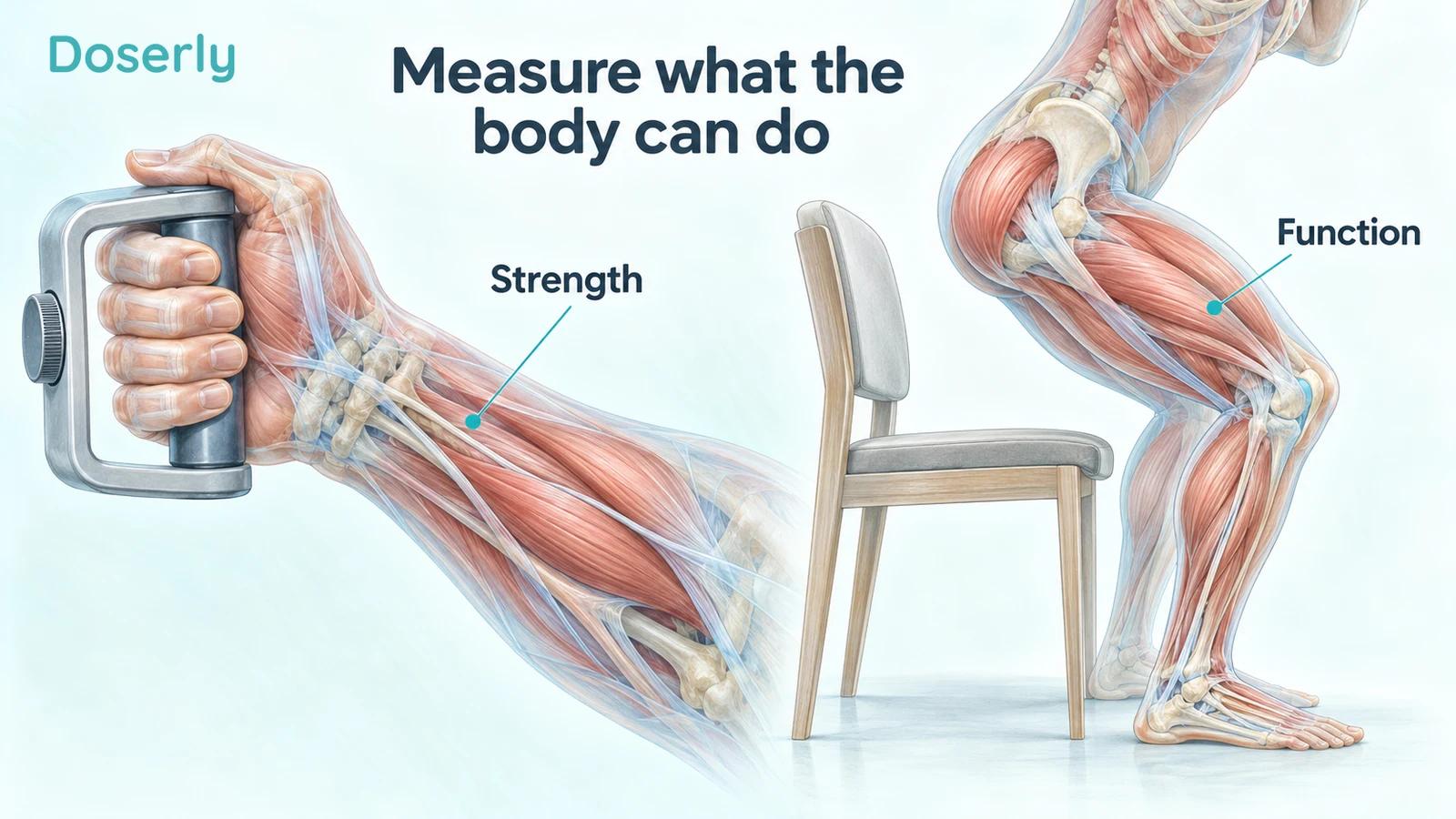
For a future study to make a convincing muscle-preservation claim, readers should look for more than a favorable fat-to-lean ratio. Relevant evidence would include prespecified functional outcomes, a meaningful comparator, adequate follow-up, and results that account for treatment discontinuation and missing assessments.
It would also help to know who benefited. An average result can conceal an important difference between someone with ample functional reserve and someone whose independence depends on retaining a small remaining margin of strength.
These are questions about study design and clinical importance, not a demand that every weight-management trial answer every possible muscle question. The problem arises when a limited body-composition endpoint is promoted as if it already answered them.
What exercise and nutrition evidence can reasonably contribute
There is a useful evidence base for supporting muscle health during weight loss, but it should not be relabeled as a proven retatrutide-specific rescue strategy.
A randomized trial in 160 older adults with obesity compared dietary weight loss combined with aerobic exercise, resistance exercise, or both, alongside a control group. Over 26 weeks, the combined program produced the strongest overall improvement in physical performance, while resistance-containing approaches helped attenuate lean-mass loss. Participants could improve strength and function even when lean mass did not remain completely unchanged. 5
That study supports measuring function alongside composition and including appropriately selected exercise in clinical weight-management care. It was not a retatrutide trial. Its supervised program and selected older population also should not be converted into a universal exercise prescription for people with injuries, cardiac limitations, or different starting abilities.
A 2025 joint advisory from four nutrition and obesity organizations similarly recommends assessing nutrition, muscle strength, function, and body composition when appropriate during GLP-1-based obesity care. It emphasizes dietary adequacy and resistance training as part of preserving muscle and bone health. 4
The advisory offers a clinical framework rather than proof that a particular protein target or supplement prevents lean-tissue loss on retatrutide. Individual needs can differ with appetite, food access, kidney disease, physical limitations, and other conditions. A clinician or registered dietitian can help make those decisions without turning a population-level recommendation into a rigid number for everyone.
For someone noticing reduced strength or difficulty eating enough during prescribed weight-management treatment, describing the change is more useful than focusing only on a device's body-fat percentage. Examples include newly struggling with a familiar daily task, persistent poor intake, or a substantial change in exercise tolerance. These observations give the care team something concrete to assess.
Animal findings do not close the human evidence gap
A 2026 study in diet-induced obese mouse and hamster models reported favorable metabolic and body-composition effects with retatrutide. Such experiments can help researchers investigate why fat and lean compartments respond differently. They cannot establish preserved human strength or independence. 6
Species, experimental diets, study duration, and controlled living conditions all affect what those results mean. A finding in a rodent model of metabolic liver disease should not become a claim that people using an investigational product will lose only fat.
Human DXA data are a more direct source for human body composition. Human functional outcomes are more direct still for questions about strength and mobility. Keeping those levels of evidence separate prevents an attractive animal result from filling a gap that remains open in clinical research.
Reading the next muscle-preservation headline
A useful first question is what the researchers actually measured: total fat, lean tissue, muscle strength, or physical performance. Next come the units, the comparator, and the people studied. Then ask how many participants supplied follow-up data and how the analysis handled those who did not.
The current body-composition substudy supports a substantial reduction in fat mass with retatrutide in people with type 2 diabetes. It does not show that lean tissue is untouched, that muscle function is necessarily preserved, or that retatrutide outperforms all other obesity medications on those outcomes. 1
Those limits leave room for further research without diminishing the value of the data already collected. For patients and clinicians, the practical question remains broader than what the scale or scan says: whether changes in weight accompany adequate nutrition, retained strength, and the ability to keep doing the activities that matter.
Products sold online as “research retatrutide” do not provide a reliable way to pursue those benefits. The FDA warns that retatrutide is unapproved and cannot be used in compounding under federal law. Unknown product quality adds a separate problem that favorable trial averages cannot solve. 7
Sources
- Coskun and colleagues. Effects of retatrutide on body composition in people with type 2 diabetes: a prespecified phase 2 substudy. Lancet Diabetes & Endocrinology, 2025.
- International Society for Clinical Densitometry. 2023 Official Positions: body composition and measurement standards.
- Cruz-Jentoft and colleagues. Sarcopenia: revised European consensus on definition and diagnosis. Age and Ageing, 2019.
- Nutritional priorities to support GLP-1 therapy for obesity: a joint advisory from four professional organizations. American Journal of Clinical Nutrition, 2025.
- Villareal and colleagues. Aerobic or Resistance Exercise, or Both, in Dieting Obese Older Adults. New England Journal of Medicine, 2017.
- Retatrutide Shows Multiple Metabolic Benefits in Diet-Induced Obese MASH Mouse and Hamster Models. Obesity, 2026.
- FDA. Concerns with unapproved GLP-1 drugs used for weight loss.