
Red Light Therapy
October 17, 2026
Red light therapy, testosterone and fertility: separating different claims
On this page
A claim that red light “supports male fertility” can mean several very different things. Perhaps sperm moved more quickly in a laboratory dish. Perhaps a man felt more interested in sex. Perhaps a blood test changed after treatment. Or perhaps a couple became pregnant. Those findings can all be worth studying, but they do not answer the same question.
This distinction matters because the most persuasive-looking images often show the smallest part of the story: a sperm cell, a mitochondrion, or a diagram of testosterone production. It is easy to imagine that improving one component must improve everything downstream. Reproduction is more complicated, and a treatment that changes a laboratory measurement may not improve the outcome a person actually wants.
Human research on light and male reproduction exists. Much of it involves semen samples outside the body, with a smaller clinical literature using quite different interventions. The evidence does not establish direct testicular red-light exposure as a treatment for low testosterone or infertility, and it does not supply a reliable home protocol. Understanding what researchers actually did is the best way to make sense of the appealing claims.
Testosterone, desire and sperm production are separate outcomes
Testosterone is a hormone. Sexual desire is an experience. Sperm production is a biological process, while fertility describes the ability to achieve reproduction within a particular couple and situation. Treating these as interchangeable creates confusion before the discussion of light even begins.
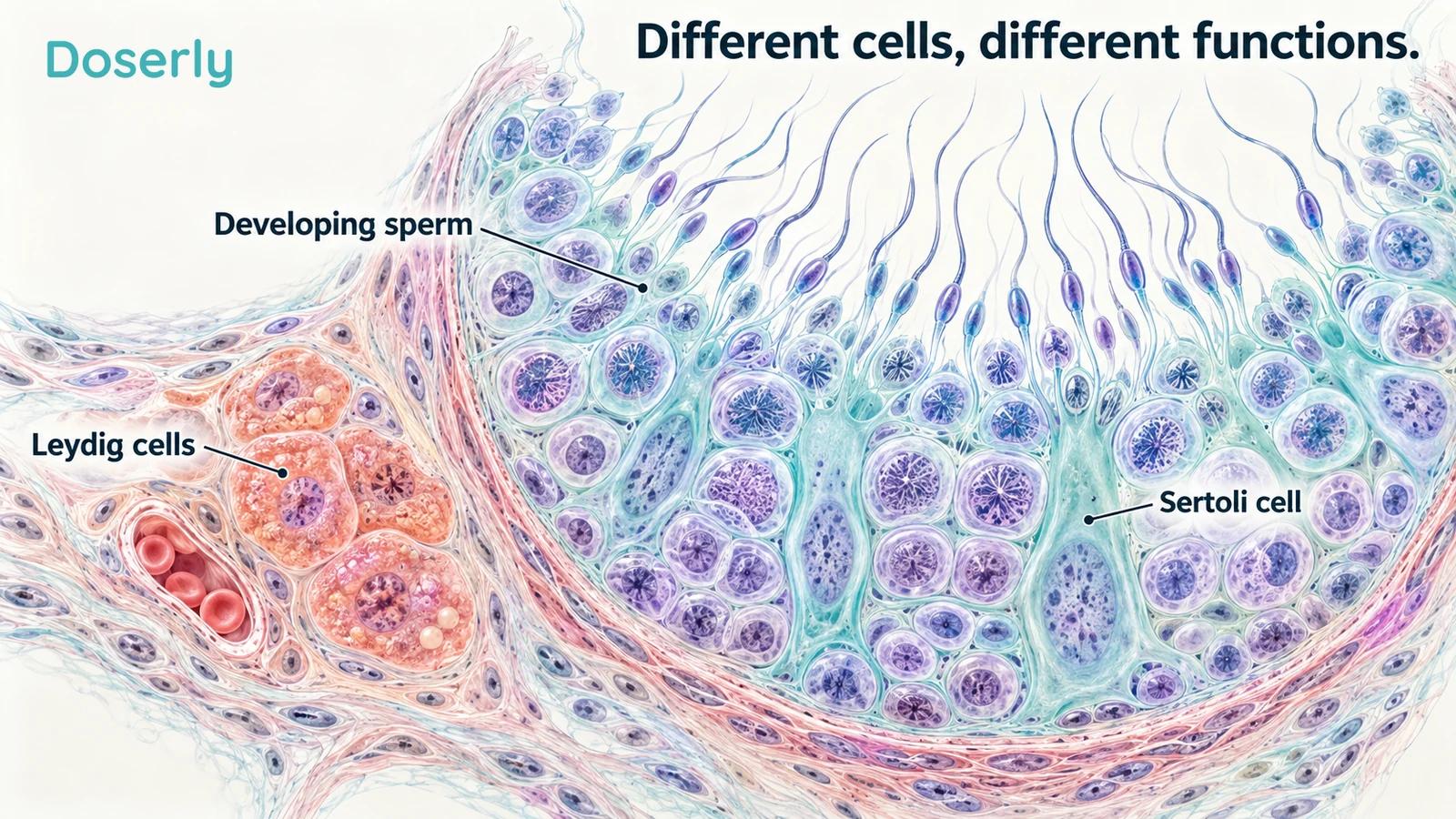
Inside the testes, Leydig cells make testosterone. Sperm develop within seminiferous tubules, supported by Sertoli cells and coordinated hormonal signals. The pituitary hormones LH and FSH contribute to this system. A blood testosterone concentration does not count sperm or reveal whether sperm can fertilize an egg. The AUA/ASRM male infertility guideline explains the clinically important separation between hormonal treatment and preservation of sperm production.
This is why a claim about “male vitality” needs translating into something measurable. Is the proposed benefit fewer symptoms, a repeatable hormone change, more progressively moving sperm, or more live births? A useful study identifies its target before treatment starts and uses an appropriate comparison. A vague promise can move between these targets whenever one measurement looks encouraging.
The distinction also protects against blaming people for infertility. A disappointing semen analysis is a medical finding, not a measure of masculinity, effort, sexual performance, or relationship quality. Couples deserve a careful evaluation of the factors that matter to them, rather than another gadget presented as a test of commitment.
What sperm experiments actually show
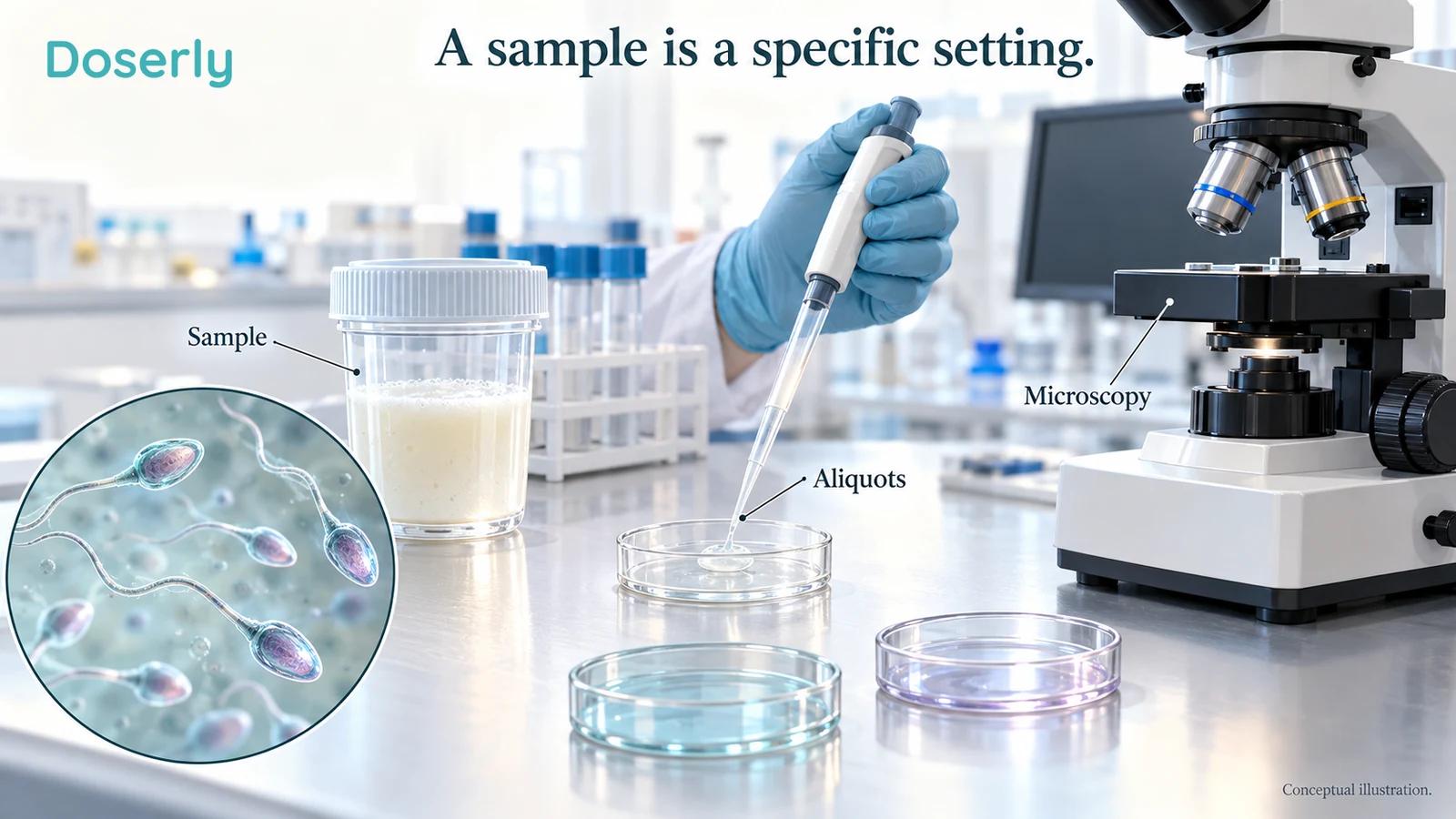
Much of the human PBM literature begins with a donated semen sample. Researchers divide it into smaller portions, called aliquots, so exposed and unexposed portions can be compared. This can be a useful experimental design because the portions share the same donor. It also means the intervention is being applied directly to cells in a controlled laboratory environment, without skin or other tissues between the source and sample.
In a 2023 experiment, investigators studied samples from 20 men with reduced sperm motility, or asthenozoospermia. Prepared samples exposed to red light had more progressive movement than control portions. The difference between the two exposure durations was not statistically significant. This was an in-vitro sperm study, not a trial in which men received treatment and couples were followed for conception. The original report describes the sample preparation and comparisons.
That result is biologically interesting. A reproductive laboratory may eventually find a useful way to handle a particular sample. But saying “human sperm responded” is different from saying “a treatment improved fertility in humans.” The first describes the origin of the cells. The second describes a clinical outcome that has to be measured in people.
An earlier LED experiment illustrates how much the surrounding laboratory conditions can matter. Investigators examined samples from 27 men, including a comparison of washed and unwashed semen in a subset. Progressive motility increased, with a larger increase in washed aliquots. Separate safety-related assays in additional samples did not show changes in the tested membrane and staining measures. The study did not demonstrate improved pregnancy rates or healthy offspring. The 2015 paper provides these preliminary findings.
Washing a sample changes its environment. That detail may sound technical, but it is central to interpretation: a finding dependent on sample preparation cannot automatically be transferred to an intact organ. Nor can a laboratory's direct cell exposure be reproduced simply by choosing a consumer panel with a similar wavelength printed on its label.
Reading a semen result without turning it into a promise
A semen report contains several measurements because there is no single number that captures every sperm function. Concentration describes sperm per unit of fluid; total count also depends on the sample's volume. Motility concerns movement, and progressive motility specifically concerns forward progression. Morphology describes assessed shape. These measurements should be read in their clinical and laboratory context, rather than collapsed into a single “fertility score.” The WHO's semen laboratory manual exists to improve the quality and comparability of this testing.
Before-and-after results also need a reliable comparison. An observational study of users of commercial at-home collection kits found meaningful variation between samples, with greater within-person variability among men with low sperm concentration than among those with normal concentration. It was a selected commercial testing population, not a randomized treatment study. Its findings support caution about attributing a change between two samples to a newly purchased device. The original report describes the sample variability.
The way an improvement is expressed can create another misunderstanding. If a hypothetical measurement rises from 20 to 30, that is a 50% relative increase but an absolute increase of ten units. Neither calculation tells us whether pregnancies became more likely. When a device advertisement presents a striking percentage, the useful next questions are what was measured, where it started, what happened in the comparison group, and whether the change lasted.
These details are not reasons to ignore a semen result. They are reasons to take a complete report to a clinician who can interpret it alongside reproductive history and other findings. A real change may deserve investigation without identifying its cause, and a favorable result may still leave other parts of the fertility question unanswered.
The mitochondrial explanation has limits
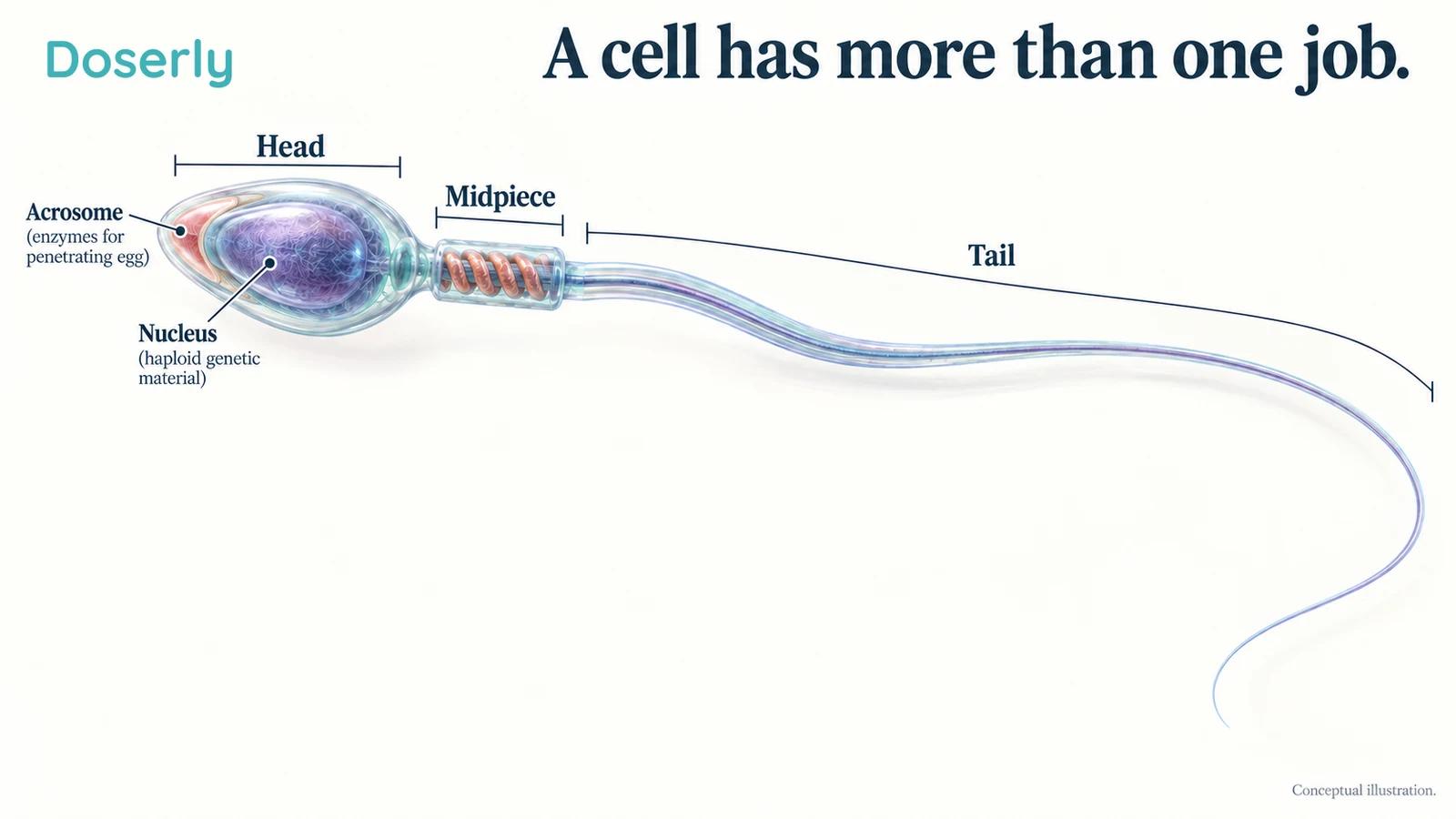
Sperm movement requires energy. Mitochondria are concentrated in the midpiece, just behind the head, and researchers can measure aspects of their respiration and energy production. These measurements help investigate why motility might change. They do not turn every increase in cellular activity into a desirable reproductive effect.
A 2024 study collected 70 samples with reduced motility and 20 comparison samples with normal motility. Near-infrared exposure improved progressive movement in the treated low-motility samples under particular laboratory conditions. The largest effect occurred immediately and diminished over the following hour. Researchers also reported changes consistent with improved mitochondrial energy metabolism. DNA fragmentation testing involved a subset of 25 samples, rather than every sample in the study. The original paper reports the experiments and their timing.
The timing matters if the proposed use is in a laboratory. A brief effect might have a different practical meaning during sample handling than during months of trying to conceive. The study did not show that light increased testosterone in the donors, improved a couple's pregnancy chances, or established long-term reproductive safety.
A 2025 experiment makes the “more energy” story less straightforward. Researchers studied included samples from 20 men with asthenozoospermia and compared several visible and near-infrared wavelengths. Under the tested conditions, 810 nm produced the strongest improvement in the measured energetic state, whereas 635 nm decreased cellular energy measures. The study assessed biochemical responses in prepared sperm, not clinical fertility treatment. Its original methods and results describe the wavelength-dependent effects.
These papers came from related investigators and should not be treated as independent confirmation by unrelated teams. More fundamentally, their findings argue against a simple rule that red light always improves sperm energy. Wavelength, delivered exposure, preparation and timing are parts of the experiment, not optional details that can be discarded when advertising a product.
Moving sperm is not the same as proving safety
A sperm cell can move while carrying other problems. Conversely, a result on one safety assay cannot establish that every aspect of reproductive function is unaffected. DNA fragmentation, chromatin packaging, membrane integrity and eventual embryo development are related but different questions.
A 2024 in-vitro study used 30 fresh semen specimens to compare red light, near-infrared light and their combination. It reported increased motility and no discernible change on the reported DNA-fragmentation testing. Those findings concern the measurements and observation period used in that experiment. They do not establish the safety of illuminating testes or the health of children conceived with exposed sperm. The original abstract describes the sample-level study.
This is an area where “no damage detected” needs its full sentence. No damage detected by which test, in how many samples, and after how long? That wording is not a dismissal of laboratory research. It identifies what has been learned and what remains to be tested before a clinical claim becomes dependable.
For a fertility application, the desired endpoint also depends on where the intervention would be used. Improving sample handling, increasing fertilization in a specific assisted-reproduction procedure, and improving live birth are distinct goals. A future laboratory technique could be useful without ever becoming a treatment people should apply to their own bodies.
There are clinical studies, but they test different interventions
It would be inaccurate to say that every human study is a dish experiment. A randomized trial of 70 men with oligospermia, meaning a low sperm concentration, compared laser acupuncture with a sham procedure. The intervention applied light to selected acupuncture points. It was not a trial of direct testicular illumination.
The investigators reported improvements in sperm concentration and motility, while semen volume and morphology did not differ significantly. No successful conception was observed in either group during the short follow-up. The study therefore supplies a clinical signal about that particular procedure, without demonstrating pregnancy benefit or validating a home testicular-light practice. The full original report explains the intervention and outcomes.
A separate 2019 Russian study did expose the testes of 50 men with nonobstructive semen abnormalities to infrared laser treatment. Its report described improved semen measurements, increases in total and free testosterone after treatment, and pregnancies in 11 of the 50 couples: eight naturally and three after assisted reproduction. However, this was an uncontrolled treatment series, with short follow-up rather than a randomized comparison. The original publication contains the English abstract and study methods.
That report should neither be hidden nor promoted beyond its design. Without an untreated or credible sham group, it cannot tell us how much change was caused by light, how often similar changes would have occurred anyway, or whether the approach is safe over longer periods. Its patients also do not represent healthy people seeking higher testosterone. The reported pregnancies are observations, not a proven treatment success rate.
These differences explain why a long list of “human studies” can look stronger than the answer to a specific question. A list mixing sample experiments, acupuncture and uncontrolled direct exposure does not become a set of replicated trials of one intervention.
Whole-body light has not established a testosterone benefit
A small randomized, double-blind study in 13 young male water-polo athletes compared whole-body PBM with placebo during a tournament. Testosterone and cortisol responses did not show significant treatment interactions. Most other recovery outcomes were also negative, apart from an isolated muscle-damage-marker finding. The original 2020 trial reports the null hormonal results.
The sample was small and the setting was demanding athletic competition. It cannot settle every possible question about PBM and hormones, and it was not a treatment study in men with diagnosed hypogonadism. It does, however, provide a direct human comparison that does not support a general promise of increased testosterone from whole-body sessions.
Claims about a large testosterone “boost” often skip the baseline question. A percentage increase from one blood draw to another may look impressive while reflecting timing, ordinary variation, recovery from illness or a change in another part of someone's routine. A credible trial would need consistent sampling and a clinically relevant population, as well as a comparison group and sustained outcomes.
The relevant goal for someone with symptoms is not winning a laboratory-number contest. It is understanding whether a hormone deficiency is present, why it is present, and whether an intervention improves the problems that led them to seek help.
Bright-light studies are a different conversation
Not every study described as “light therapy” is photobiomodulation. Bright-light treatment used for neuroendocrine or circadian purposes is a different intervention from applying red or near-infrared light to a tissue. Sharing the word “light” does not make their results interchangeable.
A small 2013 randomized study enrolled 24 people with sexual-desire or arousal disorders and compared active bright-light treatment with placebo light. Sexual satisfaction improved in the active group over two weeks. The paper proposed correlating future findings with testosterone measurements; it did not demonstrate a testosterone increase in that reported experiment. The original abstract makes that distinction explicit.
This matters when a headline about sexual satisfaction is used to sell a red-light device. Feeling better sexually would be a meaningful outcome in its own right, but it would not prove improved sperm production or a corrected hormone deficiency. The intervention, outcome and study population all need to match the claim being made.
Heat is a separate reproductive concern
PBM is usually discussed as a light-based biological intervention rather than a heating treatment. That does not mean every consumer device or every way of using it is thermally irrelevant. A wavelength label does not tell you the temperature reached by a particular tissue.
A longitudinal human study followed ten healthy volunteers through repeated sauna exposure and recovery. Sperm count and motility worsened, with changes in sperm DNA packaging and mitochondrial function, while sex-hormone measurements did not significantly change. The measured effects had reversed at the six-month recovery assessment. The original study documents the findings and its small sample.
This was a sauna study, not a trial of red-light panels. It cannot provide a safe distance, session length or temperature threshold for genital light exposure. Its relevant lesson is narrower: sperm-related harm and blood testosterone can move independently, and heat deserves its own assessment.
A home experiment that produces warmth is therefore not validated by a laboratory paper calling its intervention “low level.” Nor would avoiding obvious discomfort establish reproductive safety. Direct testicular irradiation should not be improvised from sperm-dish studies, a panel's marketing specifications or an anecdotal hormone result.
What current research still needs to demonstrate
The field would benefit from well-controlled studies that follow participants long enough to assess meaningful reproductive outcomes and record adverse effects systematically. A study designed around a transient change in motility cannot retrospectively answer whether treatment improves live birth. Likewise, a study designed around hormone concentrations needs to assess symptoms and durability if it is being presented as treatment for deficiency.
Research registrations also need careful reading. A 2026 ClinicalTrials.gov record for the HELIOS study describes light treatment of sibling oocytes, or eggs, during IVF-related laboratory care. At the registry update checked for this article, the study was recruiting and had no posted results. It is neither a completed male-fertility trial nor evidence for testicular exposure. The primary registry record identifies the actual target and study status.
A useful comparison comes from a different intervention. The 2025 SUMMER trial randomized 1,171 men seeking fertility care to an antioxidant supplement or placebo. Ongoing pregnancy within six months was 33.8% versus 37.5%, respectively, without a statistically significant improvement from the supplement. This was not a PBM study, and its result cannot be assigned to light. It shows why plausible cellular reasoning still needs a clinical outcome trial. The original randomized study reports the pregnancy results.
The lesson is not that reproductive research is hopeless. It is that hopeful mechanisms can be tested, and some fail when the outcome is something couples actually care about. That is useful knowledge, even when it is less exciting than an attractive biological explanation.
A more useful starting point for symptoms or fertility concerns

For possible testosterone deficiency, the Endocrine Society's July 2026 statement emphasizes symptoms together with consistently low concentrations measured accurately. It describes confirmation with two early-morning fasting measurements and attention to potentially reversible contributors. A single result, especially without a clear clinical question, does not establish a diagnosis. The current statement explains that approach.
Once deficiency is established, the cause matters. The Society's clinical guideline recommends using LH and FSH to distinguish a testicular problem from a pituitary or hypothalamic problem, with further evaluation as appropriate. Those are different physiological situations. A generalized promise to “stimulate the testes” bypasses the very distinction that helps clinicians decide what care makes sense. The guideline's diagnostic recommendations are available directly from the Society.
Fertility plans need to be part of that conversation before hormone treatment is chosen. Exogenous testosterone can suppress the hormonal signals needed for sperm production, even while increasing testosterone in blood. The AUA/ASRM guideline advises against prescribing it to men interested in current or future fertility. This is not a reason to change prescribed treatment independently; it is a reason to discuss reproductive goals with the clinician managing it.
Doserly's guide to fertility preservation during TRT explains the separate planning questions that arise when testosterone treatment and family building overlap. Light therapy has not been shown to reliably prevent or reverse TRT-related suppression of sperm production. Adding a device should not be treated as insurance against that effect.
Useful questions for an appointment are concrete: What problem are we trying to explain? Which measurements would change the plan? Is a finding repeatable? Does a proposed intervention have evidence for symptoms, semen outcomes or pregnancy? What follow-up would detect an unwanted effect? These questions make room for uncertainty without leaving the person to guess.
Red and near-infrared light remain interesting tools for reproductive research, particularly in controlled laboratory settings. The evidence becomes clearer when each result stays attached to the cells, people, intervention and outcome actually studied. For someone deciding what to do now, that clarity supports proper assessment and informed fertility planning, rather than direct testicular exposure based on a chain of assumptions.