
Red Light Therapy
October 17, 2026
Red light therapy for Parkinson’s disease: encouraging signals and unanswered questions
On this page
For someone living with Parkinson's disease, a little more ease getting out of a chair or walking through a doorway can matter enormously. That is why interest in light-based treatment deserves a thoughtful response. People are looking for useful improvements in ordinary life, often while already doing the hard work of medication management, exercise and rehabilitation.
Photobiomodulation, sometimes called red light therapy, has produced encouraging observations in small Parkinson's studies. However, the controlled human evidence is mixed. Several trials have not found a significant advantage over sham treatment on their main motor comparisons. Some favorable longer-term reports come from participants who chose to keep treating themselves, which makes the results harder to interpret.
The question is therefore more specific than whether light can affect biology. It is whether a particular device adds a worthwhile benefit to Parkinson's care, for whom, for how long and with what burden. As of October 2026, the evidence supports further investigation. It does not establish that a home panel reverses Parkinson's or slows the underlying disease.
Parkinson's involves more than one symptom or brain pathway
Parkinson's disease affects movement, but the lived experience extends beyond tremor. Slowness, stiffness, balance difficulty and changes in walking can coexist with sleep problems, fatigue, constipation, mood changes and other symptoms. The pattern differs from person to person. Loss of dopamine-producing neurons in the substantia nigra is central to the movement disorder, while other systems also contribute. National Institute of Neurological Disorders and Stroke
This matters when interpreting a study. A treatment might change a balance measure without changing tremor, or improve a questionnaire score without preventing falls. “Parkinson's improved” can conceal several very different findings. A useful report identifies the outcome and explains whether the change was large enough to matter.
Diagnosis also matters. Parkinsonism is a broader description of a movement pattern, and disorders that resemble Parkinson's can behave differently. A light treatment study in people with idiopathic Parkinson's disease cannot automatically answer a question about another diagnosis. When symptoms are changing unexpectedly, revisiting the clinical picture is more useful than assuming the device needs a different setting.
The goals of care should reflect the person. Someone with freezing of gait may prioritize safe movement through the home; someone else may care most about dressing, handwriting or sleep. A single total score cannot represent every priority, but choosing one favorable subscore after a trial ends cannot prove a broad treatment effect either.
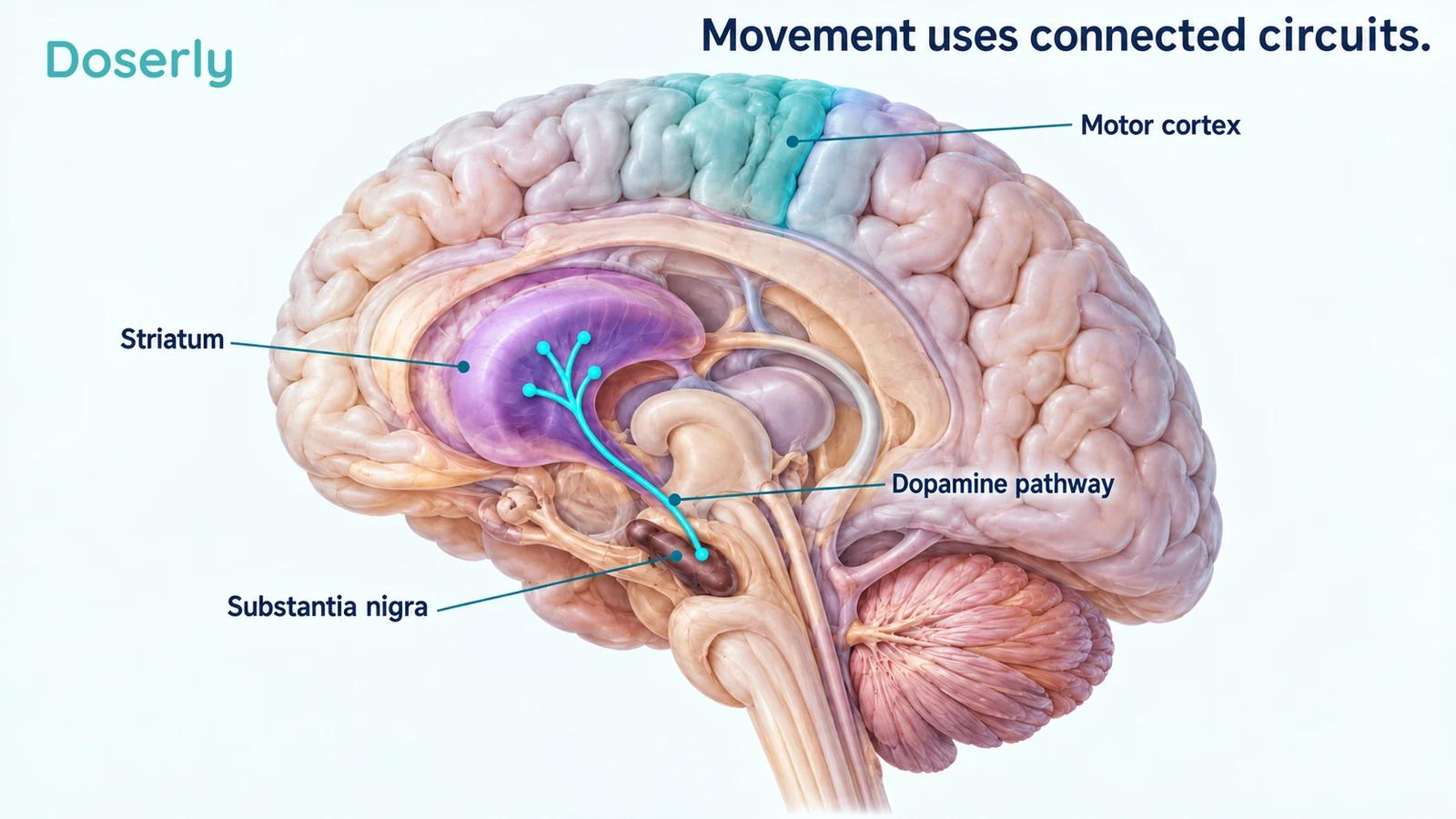
Parkinson's affects interconnected systems. This simplified anatomy illustrates a movement pathway, not measured dopamine levels, neuron recovery or a target map for a light device.
What the light treatment actually is
Photobiomodulation, or PBM, uses light intended to modify biological activity without deliberately heating or destroying tissue. Parkinson's studies have tested several approaches: light delivered to the scalp, combinations involving the head and mouth or nose, and “remote” treatment applied to the neck or abdomen. Remote in this context refers to a body site away from the brain, not simply a video appointment.
Those approaches should not be combined into one interchangeable product category. The wavelength, emitter arrangement, tissue contact, area treated and other delivery features differ. A favorable result with one system would not establish equivalent benefit from a different helmet or a panel intended for the skin.
The substantia nigra is deep within the brain. A drawing of light entering the scalp does not establish that a meaningful dose reaches that structure. Proposed indirect effects through other tissues, circulation or signaling are research hypotheses. They need evidence connecting the intervention to a patient outcome, not just an appealing diagram.
This distinction is visible in the actual studies. The 2023 helmet trial tested a specific transcranial device, whereas a later trial combined head, neck and abdominal treatment with ongoing exercise. These are different clinical questions even when both are described as red light therapy. Herkes and colleagues, 2023, Saltmarche and colleagues, 2025
The largest recent study has an important split result
A 2025 study randomized 63 participants to active or sham PBM while they continued vigorous exercise. During its first stage, participants received eight weeks of active or sham home treatment. Later stages offered active treatment to everyone and then allowed participants to choose whether to continue for up to 48 weeks. Timed up-and-go was the primary outcome. Saltmarche and colleagues, 2025
The randomized comparison did not show a significant difference between active and sham groups. The later comparison favored people who chose to continue treatment on timed up-and-go, with some additional favorable outcomes. Two authors disclosed shareholdings in the device company.
These stages answer different questions. Random allocation helps balance reasons people might improve. Choosing to continue does not: people who feel better, have more support or find the device easier to use may be more likely to remain. The later result is an interesting observational signal, not a rescue of the earlier null randomized result. It also cannot show that PBM, rather than other differences between continuing and noncontinuing participants, slowed Parkinson's progression.
There is a human reason this distinction can feel unsatisfying. If a person reports moving better for months, the improvement may be meaningful to them regardless of its explanation. Clinical research has a different responsibility: estimating what another person can reasonably expect because of the treatment. Respecting the experience and asking for a stronger comparison are compatible.
The 2023 helmet trial did not establish a motor advantage
A double-blind, sham-controlled feasibility study assigned 40 people with Parkinson's to active or sham helmet treatment for 12 weeks. Home sessions were monitored through video conferencing. Safety and a modified MDS-UPDRS motor assessment were central outcomes. The investigators found no significant between-group difference at the assessment points. The study was funded by SYMBYX, and several investigators disclosed shareholdings. Herkes and colleagues, 2023
A related post-hoc analysis of the 40-person helmet study also reported no significant difference in the total motor score. It examined symptom clusters and participants labeled responders, finding favorable patterns in some active-treatment subgroups and changes in some sham subgroups. Occasional minor, temporary dizziness was reported. McGee and colleagues, 2023
These publications should not be counted as two independent confirmations of efficacy. Post-hoc analyses can suggest which symptoms or patients deserve closer study, but selecting people who improved and then describing their improvement does not tell a new patient their probability of benefit. A prospectively defined subgroup tested in another trial would be more informative.
A feasibility trial can still succeed at a useful purpose when it does not establish efficacy. Researchers may learn whether people tolerate the device, complete sessions and attend assessments. Those findings help design the next study. They should be described as feasibility and tolerability rather than converted into proof of symptom relief.
A six-month study adds a more recent comparison
A randomized trial published online in 2025 and appearing in a 2026 journal issue assigned 72 people to aerobic exercise, PBM, the combination or control. Data from 53 participants were evaluated. Exercise showed favorable effects especially on motor scores and a ten-meter walking test; PBM showed effects on posturography outcomes. The combination did not demonstrate additive or synergistic benefit, and some other outcomes did not change. Parkinson's disease, aerobic exercise and photobiomodulation
This study helps resist the assumption that two plausible interventions must work better together. It also illustrates the importance of identifying the measurement: a laboratory balance-platform result is not the same as fewer falls or easier movement at home. Attrition and the multiple outcomes limit how confidently the abstract can support a broad claim. Full methods would be needed to assess missing-data handling and detailed comparisons.
The useful question for practice is whether the added treatment improves a goal that matters enough to justify its time and cost. “Synergy” is a result to demonstrate, not an automatic property of combining exercise with a device. This study does not provide a reason to replace an individualized exercise program with PBM.
Smaller trials provide clues, including negative ones
A 2025 randomized study of 38 people with Parkinson's compared transcranial PBM with standard treatment over 12 weeks. Its abstract reported favorable postural-stability and functional findings. The comparator was described as standard treatment, not an indistinguishable sham. The available abstract does not provide a detailed absolute effect estimate or settle blinding and missing-data questions. Postural stability trial, 2025
A 2021 placebo-controlled pilot enrolled 22 participants and tested combined transcranial and intra-oral treatment. No measured outcome changed significantly, and cognition remained stable across the study. Some task results were considered promising enough for further work, but those signals should remain distinct from demonstrated efficacy. Combined transcranial and intra-oral pilot
Small studies are particularly vulnerable to individual variation. One participant's illness, medication change or unusually good testing day can meaningfully shift a group average. This is not a reason to discard all pilot research. It is a reason to avoid treating the most favorable estimate as the settled answer.
It also matters whether the study asks a question before the data arrive. Investigators can reasonably explore several measures, but a result selected from many possibilities deserves less confidence than a prespecified primary outcome that succeeds in an adequately powered trial. Readers should be able to see which kind of finding they are being offered.
Why the long-term reports are encouraging but inconclusive
An early proof-of-concept study recruited twelve people. Six began a combination of head and remote treatment first; six initially waited. Improvements in several measures were described, and participants could continue treatment at home. The small waitlist design was useful for developing the approach but could not provide the protection against expectation and other differences that a convincing sham-controlled trial would offer. Liebert and colleagues, 2021
At a five-year reassessment, eight of the original twelve were evaluated. Seven had continued treatment; one was excluded from the continuing-treatment group analysis because of a preliminary diagnosis of multiple system atrophy. Among the remaining six, several outcomes improved relative to baseline, while the motor examination score was unchanged. No adverse effects were reported. Five-year follow-up, 2024
Long observation is valuable, but it does not replace a comparison group. The people available and willing to return after five years may differ from those who do not. Treatment, activity, support and disease course can change during that time. These findings cannot establish that light prevented the decline those individuals would otherwise have experienced.
A separate seven-person case series applied PBM to the abdomen and neck. It reported individual improvements in several clinical signs, with some changes lost during periods of home treatment and pandemic restrictions. The design could not isolate a gut-mediated mechanism, establish a reliable treatment effect or show that remote treatment was equivalent to direct head treatment. Remote PBM case series
A 2026 microbiome publication examined stool samples from the same six continuing participants in the five-year cohort. It reported changes in microbial composition, but had no control group and could not control lifestyle changes such as diet. This is a related mechanistic follow-up, not six new patients independently confirming treatment benefit. Stool associations cannot establish that PBM improved symptoms through the gut. The authors disclosed company cofounder or shareholder relationships. Bicknell and colleagues, 2026
The word “remote” can make an indirect biological explanation sound more established than it is. In a study without a credible comparison, improvement after abdominal treatment does not identify which pathway caused it. Establishing the pathway would require measurements and experiments designed for that purpose, alongside evidence of clinical benefit.
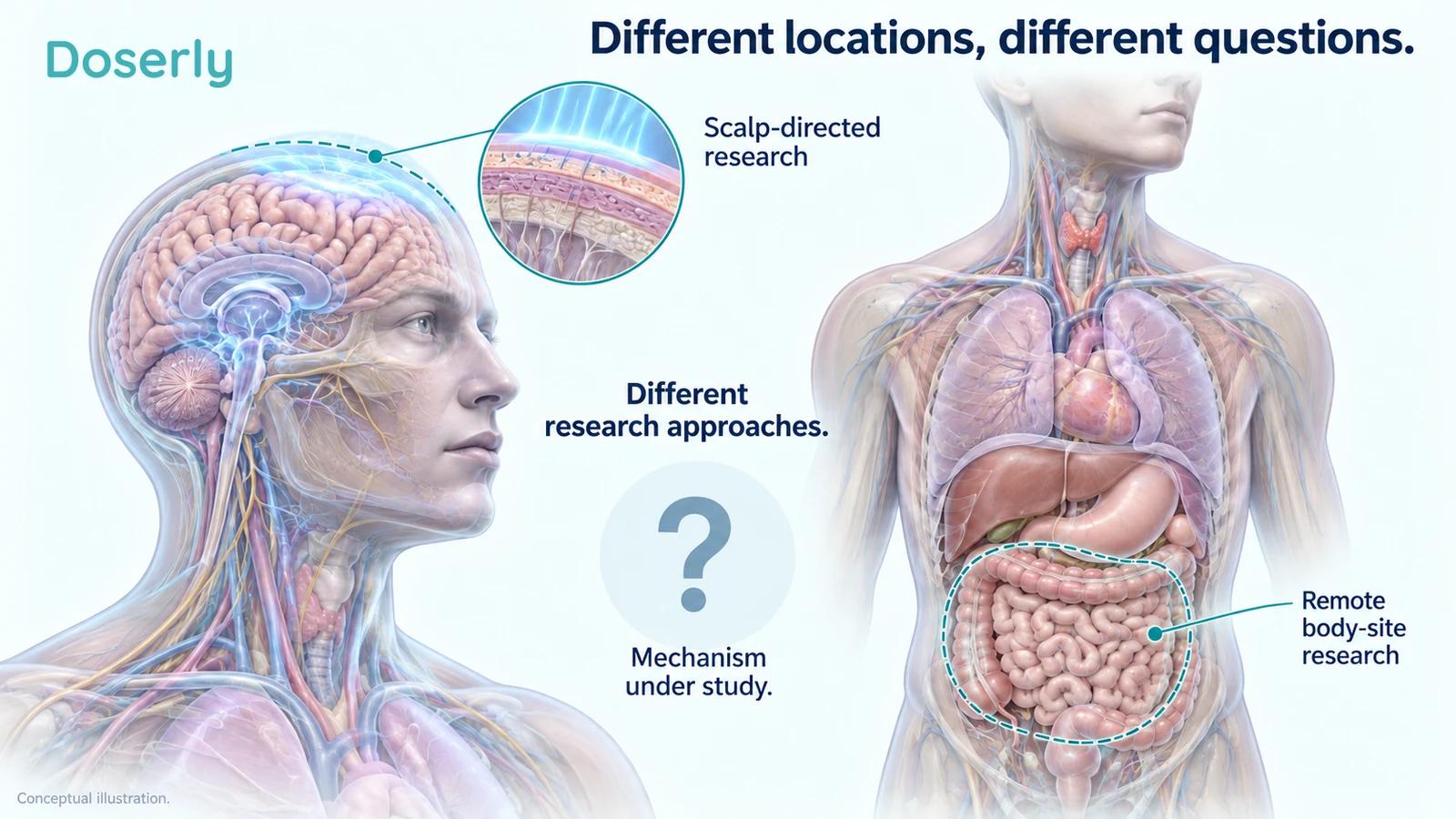
Different treatment locations test different hypotheses. The illustration does not show a proven gut-to-brain treatment pathway, equivalent devices or a home treatment protocol.
How movement outcomes can mislead without context
Timed up-and-go measures a short sequence: standing, walking, turning and returning to sit. A ten-meter walk assesses walking over a defined distance. Posturography examines aspects of balance using a platform. Motor rating scales cover a broader collection of signs. These measurements can complement one another, but they cannot be substituted without changing the question.
For example, a faster short walk might be welcome while freezing at a doorway remains troublesome. A person may score better on a motor examination yet still need the same help with daily tasks. Conversely, an adaptation that makes dressing easier can be valuable even if it barely changes a total motor score. The assessment should connect to the goal.
Medication state is another crucial part of comparison. Someone assessed when their usual medication is working well may perform differently from the same person at another point in their routine. That does not make either observation false. It means a study or clinical follow-up needs to record timing and use comparable conditions.
A home video can be useful to show a clinician a specific problem, but a dramatic before-and-after clip is not a controlled experiment. Walking surface, footwear, instructions, encouragement, fatigue and camera selection can all affect what is seen. A clip that demonstrates a good moment cannot establish how frequently that moment occurs.
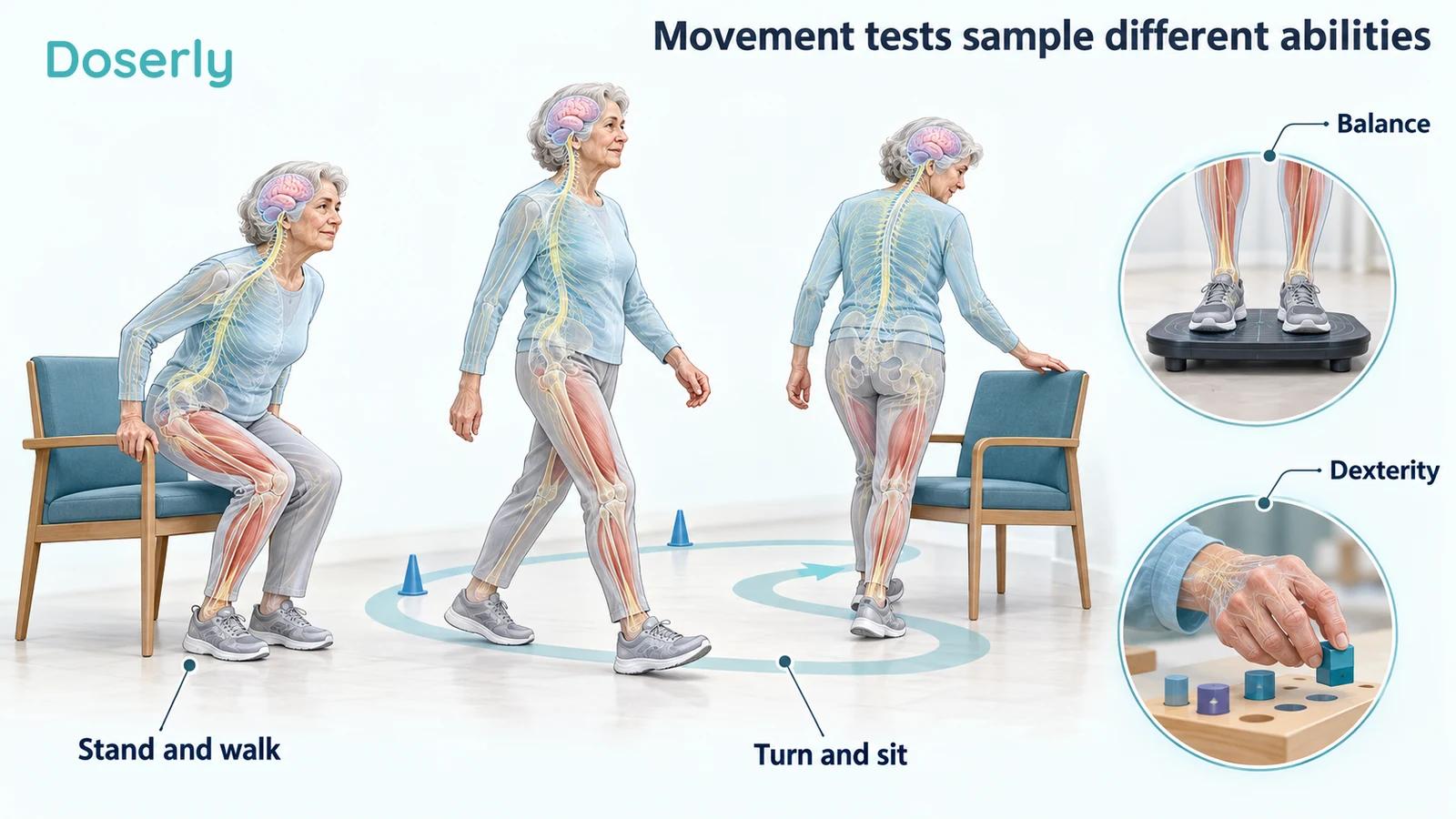
Movement tests sample different abilities. No times, scores or treatment improvements are depicted, and a better test result does not automatically mean fewer falls.
Placebo does not mean a person imagined feeling better
Parkinson's research has a particularly instructive example of expectation. A PET study demonstrated dopamine release in response to placebo in people with Parkinson's. This is a biological observation about treatment context, not proof that all reported improvements are placebo or that a particular PBM effect can be explained that way. de la Fuente-Fernández and colleagues, 2001
It helps explain why a convincing sham matters. Receiving a new device can change attention, hope, daily structure and contact with researchers. Those changes may affect how someone feels or performs. A sham comparison tries to preserve that experience while changing the active component under investigation.
When both groups improve, the appropriate conclusion is not that the study was ruined by people hoping too much. The comparison is doing its job. Researchers then need to determine whether active treatment adds enough beyond the shared experience to justify its use.
This distinction also protects patients from blame. If a device fails to help, that does not mean the person lacked optimism. If they feel better, that does not mean they were gullible. Clinical trials are designed precisely because individual experiences can be real and still leave causation uncertain.
Mitochondria are a reason to investigate, not a treatment verdict
PBM is often discussed through mitochondrial energy metabolism, inflammation and neuronal resilience. Those ideas can justify careful experiments. They do not establish that light preserves dopamine neurons in a person with Parkinson's, and animal models cannot supply that missing human result.
A useful historical comparison is coenzyme Q10, another intervention with a mitochondrial rationale. A randomized trial of 600 people with early Parkinson's found no clinical benefit from high-dose CoQ10. That result does not predict that PBM must fail, because they are different interventions. It does show why a credible energy-metabolism story must be followed by convincing patient outcomes. QE3 trial
Our CoQ10 guide covers that supplement separately. It should not be read as evidence for combining CoQ10 with a light device. A proposed shared pathway does not establish additive benefit, and changing several things together makes it harder to understand what helped or caused a problem.
Disease modification is an especially demanding claim. It means altering the underlying course, not simply making a symptom temporarily easier to manage. Demonstrating that would require an appropriate long-term trial design, careful accounting for medication and other treatments, and evidence that survives plausible alternative explanations. Current PBM observations have not completed that task.
Light through the eyes is a separate research area
Not every Parkinson's “light therapy” study is a PBM study. Circadian light treatments aim to influence the body's timing system through retinal light sensing, with different spectra and devices. Their results should not be used to market scalp-directed red or near-infrared treatment.
A 2025 randomized trial of circadian-effective light enrolled 92 participants and tested a spectral band of 460–545 nanometers. Its primary motor/nonmotor combined endpoint did not reach statistical significance; some secondary findings were more favorable. This was a distinct intervention, and its mixed results cannot validate a PBM helmet. Circadian-effective light trial
The distinction is practical as well as scientific. Directing a consumer red or near-infrared device toward the eyes does not reproduce an appropriately designed circadian intervention. This article supplies no eye-exposure instructions. The exact device, intended use and professional guidance matter more than the shared word “light.”
Keep established care at the center
Parkinson's care is individualized and can include medication, rehabilitation and, for selected people, device-based or surgical treatments. Deep brain stimulation uses implanted electrical stimulation and has its own indications and tradeoffs; it is not the same technology as transcranial PBM. NINDS overview of deep brain stimulation
Exercise also has its own clinical research. A phase 2 trial randomized 128 people with early, untreated Parkinson's to different treadmill-exercise approaches or usual care, examining feasibility, safety and motor outcomes. It supported further study of vigorous exercise in that selected population. It does not mean every person with Parkinson's should copy a trial's intensity without assessment. Schenkman and colleagues, 2018
A physiotherapist can help connect activity to balance, mobility, fatigue and fall risk. An occupational therapist can help with the tasks that matter at home. Those conversations can be useful whether or not PBM is eventually considered. A device should earn its place by adding value rather than consuming the time and energy needed for care already helping.
Medication changes belong with the treating clinician. Feeling better on a particular day is not a reason to independently reduce medication, and a disappointing device response is not a reason to abandon rehabilitation. Keeping treatment context stable enough to interpret is part of a useful evaluation.
What to ask before paying for a device
Bring the exact model and the full study citation to a movement-disorders clinician. Ask whether the participants resembled you, whether the main result beat sham, and whether the claimed benefit came from the randomized stage or an optional follow-up. Ask whether several marketing citations describe the same participants.
Discuss the outcome you want to change. A claim about a balance-platform measurement may have little relevance if your main concern is fatigue, swallowing or freezing. Ask what would count as meaningful improvement for your situation and how it would be measured without creating unnecessary testing burden.
Usability deserves the same attention as efficacy. Can you position the device comfortably? Does tremor, limited reach or cognitive difficulty make the routine hard to complete? Will someone need to help? Include setup, cleaning, appointments, replacement parts and caregiver time in the cost, along with the possibility of no benefit.
Safety should be based on the actual device and the person's circumstances. Small trials that report few adverse events cannot exclude uncommon problems or establish safety for every combination of conditions and treatments. Heat, discomfort, dizziness or new symptoms deserve review rather than being interpreted as a desirable reaction. Do not improvise head, eye or internal exposure with a device studied for another purpose.
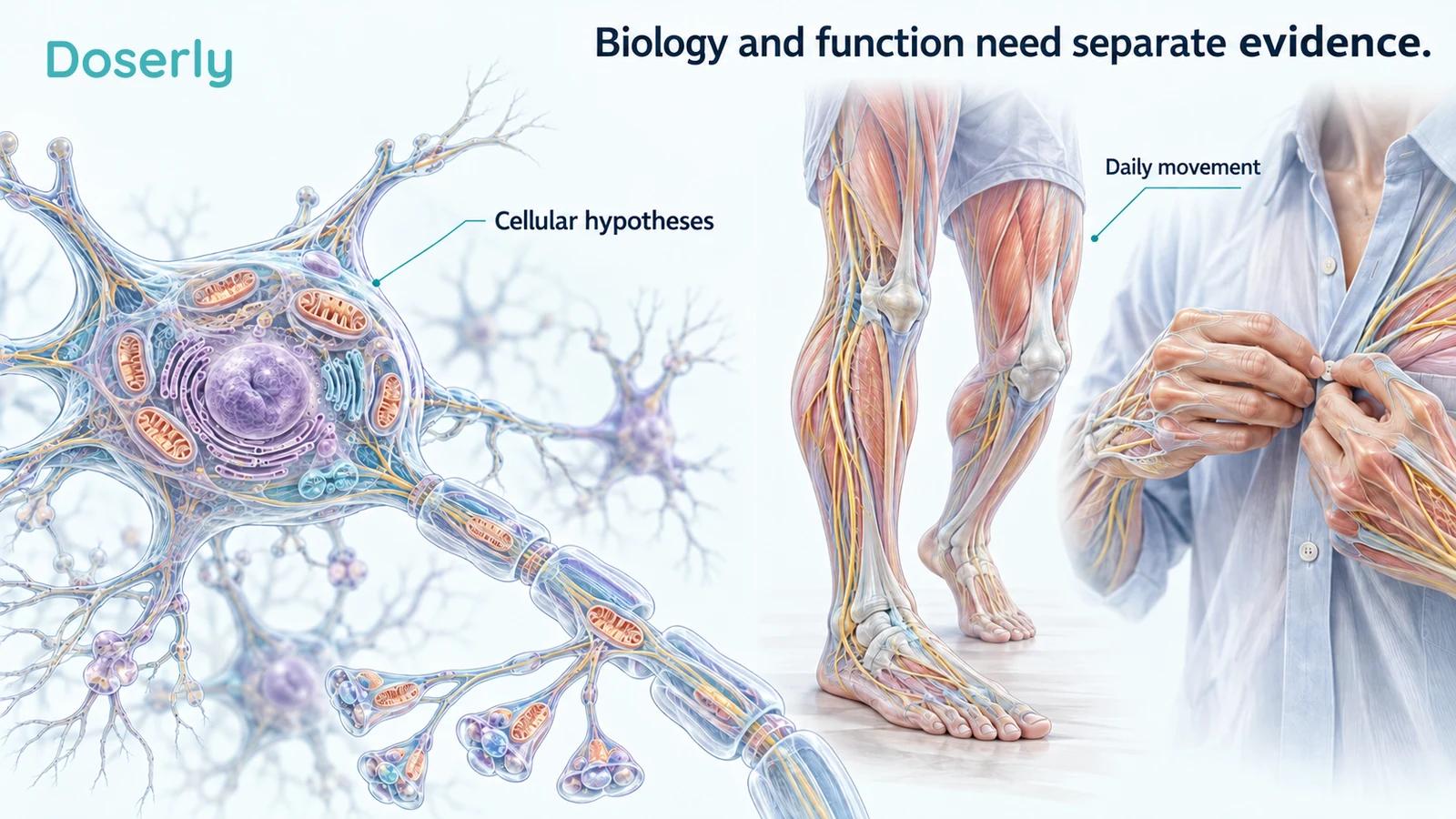
Cellular hypotheses and sustained functional benefit require different evidence. The illustration does not depict neuron regeneration, disease reversal or a measured treatment effect.
The conclusion that helps a decision
PBM for Parkinson's is a plausible research direction with some encouraging human observations. The evidence also includes null sham-controlled comparisons, small samples, related publications from the same trial and long-term follow-up vulnerable to selection bias. Those findings belong in the same conversation.
A person can reasonably be interested while asking for a stronger answer before committing time and money. At present, PBM is best discussed as an experimental possible adjunct, with goals, monitoring and uncertainty made explicit. It should not be presented as a cure, a proven way to preserve dopamine neurons or a replacement for medication and rehabilitation.
The next useful advance will be a reproducible benefit that patients can feel in daily life, shown in a well-controlled study with adequate follow-up. Until then, the most constructive decision starts with the specific symptom, the specific device and a clinician who can relate both to the person's overall care.