
Red Light Therapy
October 17, 2026
Red light therapy for neuropathy: pain relief is not the same as nerve repair
On this page
When your feet burn at night or your fingers feel numb, the promise of repairing nerves with light is appealing. Neuropathy can interfere with sleep, balance, walking and the small hand movements that make daily life easier. Wanting more than temporary symptom relief is entirely reasonable.
Red and near-infrared light treatments have been studied in people with diabetic neuropathy and chemotherapy-induced peripheral neuropathy. Some studies report encouraging symptom changes. Others find no advantage over sham treatment, and newer studies do not remove that uncertainty. The research available through October 2026 supports careful investigation, not a general claim that a light device regenerates damaged nerves.
The distinction matters because pain, sensation and nerve structure can move in different directions. Less burning may be a worthwhile result. It does not automatically mean that a numb foot can now detect an injury, that walking is safer, or that the cause of the neuropathy has been corrected.
Start with the cause, not the device
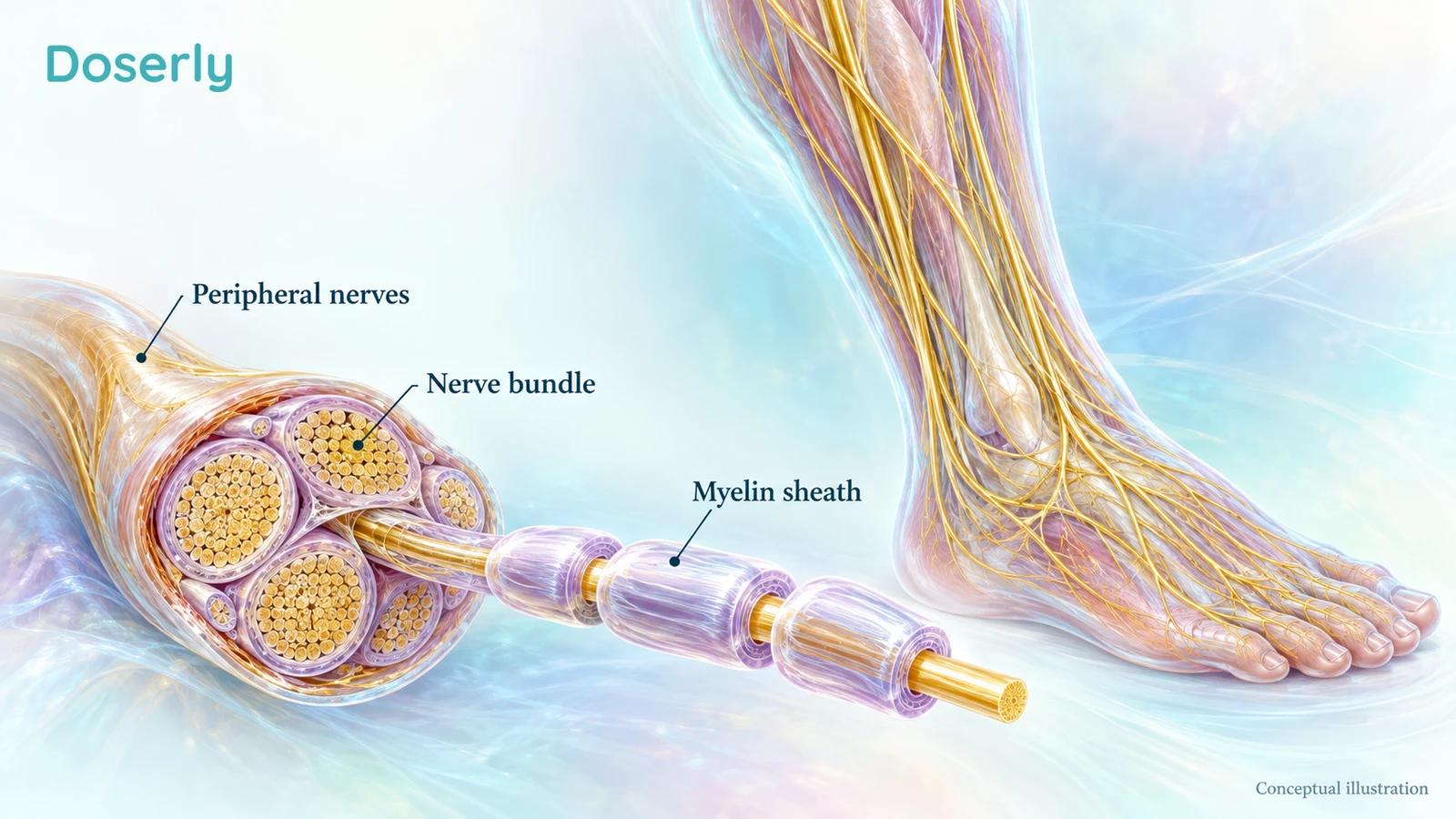
Peripheral neuropathy is a broad term for problems involving nerves outside the brain and spinal cord. Different nerves carry sensation, control muscles or help regulate automatic functions. Damage can produce unwanted signals, such as burning, as well as missing signals, such as reduced awareness of touch or temperature. Several types of nerve fibers can be affected together. NINDS overview
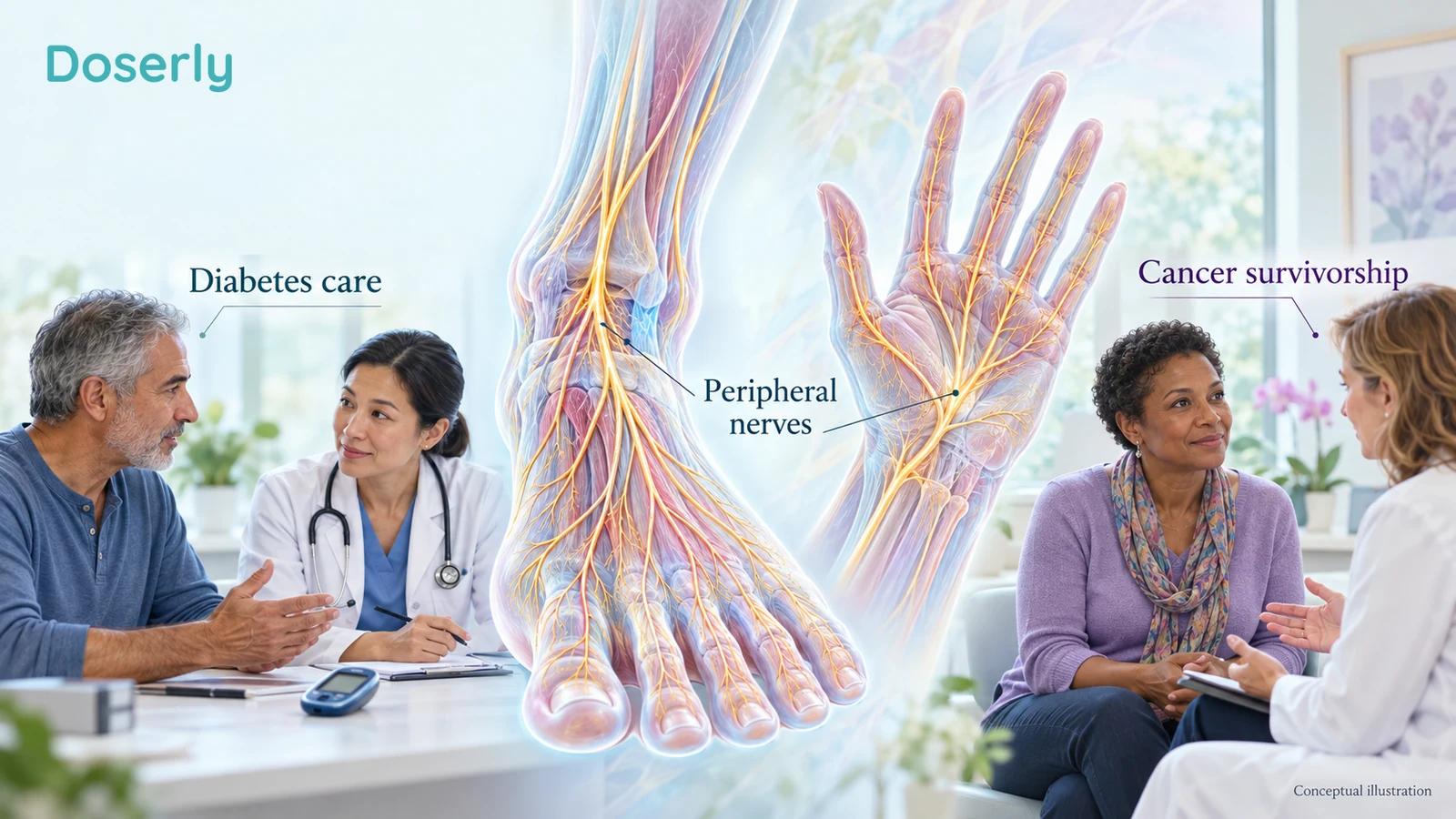
Diabetes is one cause. Certain chemotherapy drugs are another. Nutritional problems, medications, immune conditions and other disorders can also be involved. A treatment studied in one group cannot be assumed to work in another simply because both groups describe tingling.
For someone with diabetes, a clinician may still investigate additional explanations, including low vitamin B12, thyroid disease or kidney disease. A history and examination help determine which tests are useful. The presence of diabetes does not make every new sensory symptom a settled diagnosis. NIDDK assessment information
That is the first limit of a “neuropathy treatment” advertisement. The label describes a clinical problem, not one uniform biological process. A light protocol cannot be selected meaningfully without knowing whose neuropathy was studied and what the researchers were trying to improve.
What counts as improvement?
Consider two people who both report that their feet hurt less after treatment. One also walks more comfortably and has unchanged protective sensation. The other remains profoundly numb and has developed a blister they did not feel. The pain report is real in both cases, but the clinical meaning is very different.
Trials use several kinds of measurements. Pain scales ask about symptom intensity. Questionnaires may combine tingling, numbness, pain and interference with activities. Clinical examinations assess findings such as reflexes, strength and sensation. Walking or balance tests examine performance, which is influenced by more than the nerves alone.
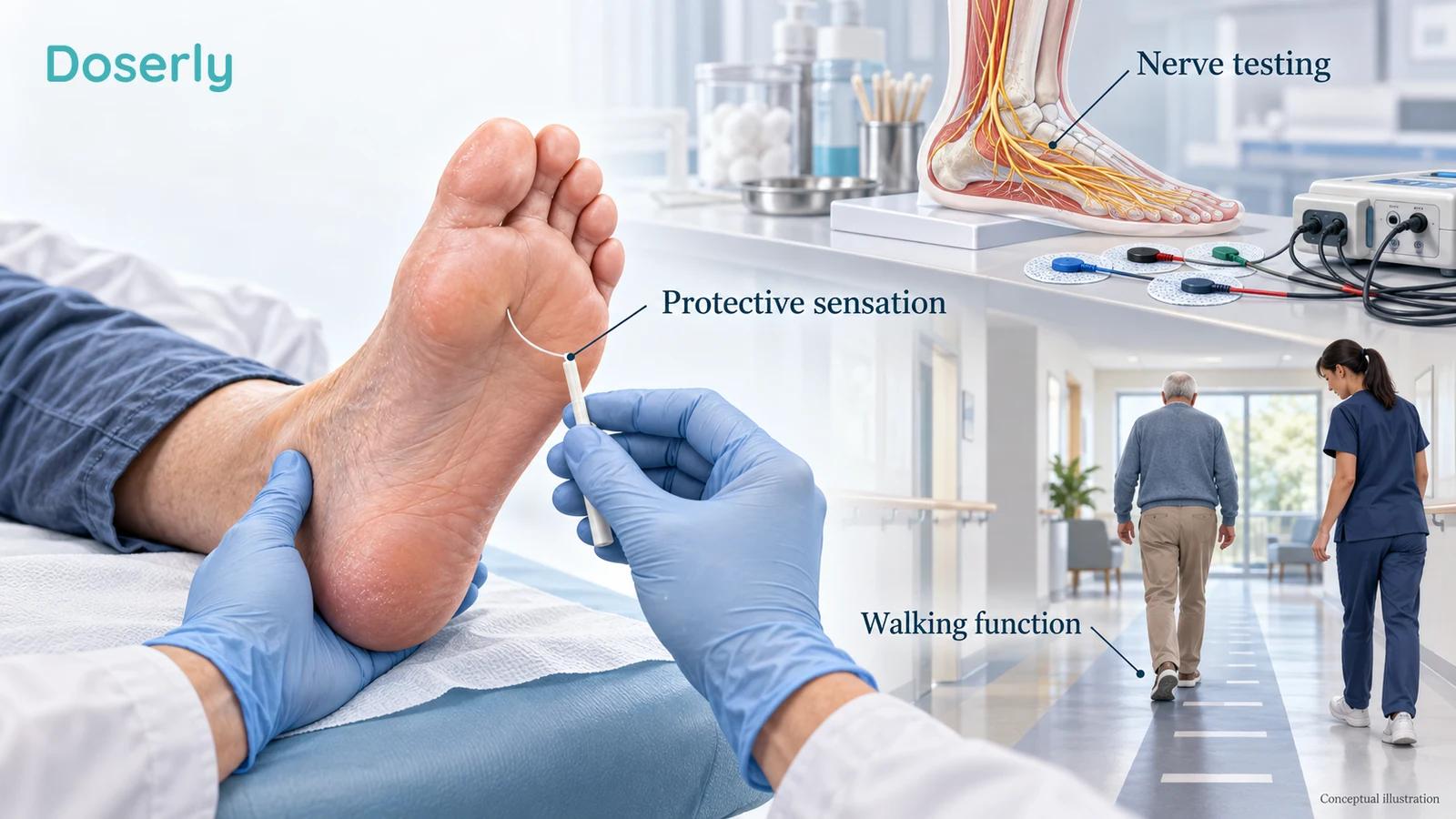
The ten-gram monofilament is a practical tool for assessing loss of protective sensation in diabetic feet. It helps identify risk, particularly more advanced sensory loss. It does not reliably detect all early neuropathy, and it is not a microscopic measurement of nerve regrowth. The 2026 American Diabetes Association standards recommend considering it alongside other examination findings. ADA neuropathy and foot-care standards
Nerve-conduction studies assess electrical behavior in the nerves tested. They can be useful when clinically indicated, but a change in conduction is still different from directly demonstrating restored nerve structure. Conversely, routine conduction testing does not capture every small-fiber problem. No single outcome can stand in for the whole condition.
For that reason, a strong repair claim needs more than a lower pain score. It needs relevant structural or physiological evidence, a credible comparison group and durable clinical benefit. A treatment can be useful for symptoms without meeting that higher standard. Honest language makes room for that possibility.
Older infrared studies include clear negative results
Some of the most informative diabetic-neuropathy studies tested monochromatic infrared energy, often abbreviated MIRE. These are specific infrared-device studies, not evidence about every modern panel. They remain useful because they show what happens when apparent improvements are compared with a sham procedure.
In a 2005 double-blind study, 39 participants completed an eight-week evaluation. The number of foot sites able to detect a monofilament improved in both active and placebo groups. There was no significant difference between the groups at any measurement. Looking only at improvement after active treatment would have produced the wrong conclusion. Placebo-controlled sensation study
A larger home-treatment trial randomized 69 people with diabetes, with 60 completing follow-up. After 90 days, active infrared treatment was no better than sham across measures including sensory testing, nerve-conduction velocity and quality of life. This is directly relevant to claims that repeated home use reliably restores sensation. Home infrared trial
A further randomized study examined 30 feet from 24 people and found no improvement over sham on its neuropathy assessment. The distinction between feet and people matters: two feet belonging to one person are not two independent patients. Additional sham-controlled trial
These results do not prove that all wavelengths and devices must fail. They do rule out treating infrared exposure itself as sufficient evidence of nerve recovery. A newer device needs its own convincing clinical comparison, rather than inheriting a benefit from the general idea of light therapy.
What newer diabetic-neuropathy studies add
A 2025 randomized study enrolled 200 people with type 2 diabetes and peripheral neuropathy. It compared a short course of low-level red laser with sham and assessed symptoms, sensory measures and blood biomarkers four weeks after treatment. The authors reported improvements in the intervention group and changes in neuron-specific enolase and calcitonin gene-related peptide. Nerve growth factor did not change. Biomarker trial
The accessible abstract emphasizes changes within the intervention group and does not provide complete between-group effect estimates with confidence intervals. That limits how precisely the treatment advantage can be judged from the material available. Blood-marker changes also do not establish that lost nerve fibers regrew or that foot-ulcer risk fell. This is a promising study to investigate further, with those distinctions intact.
A separate trial published in December 2025 randomized 55 people to low-power laser, ultrasound or a control group, alongside standard medical care. It found no significant overall between-group difference in post-treatment neuropathy screening scores. An adjusted quality-of-life problem score favored laser over control, while baseline symptom scores were already imbalanced. Laser, ultrasound and standard-care comparison
That mixed result is more informative than either “laser works” or “the trial failed.” A possible quality-of-life benefit deserves attention. It does not turn a nonsignificant neuropathy comparison into evidence of nerve restoration, and the short follow-up leaves durability unresolved.
For a patient, the useful question is which result matches the goal. A modest improvement in daily interference may be worthwhile. A promise of restored protective sensation requires evidence specifically addressing that outcome, and a promise of fewer wounds needs actual wound-prevention data.
Chemotherapy neuropathy is a separate research question
Chemotherapy-induced peripheral neuropathy, or CIPN, can develop during cancer treatment and persist afterward. Prevention during treatment and management of established symptoms are different goals. They involve different timelines, competing risks and opportunities for spontaneous change after chemotherapy ends.
An early randomized sham-controlled study enrolled 70 people with CIPN and reported substantial improvements in a modified neuropathy score after a clinical laser course. The score combines several aspects of neuropathy; it is not a direct nerve-regeneration measure. The paper was published online in late 2016 and appeared in a 2017 journal issue. Early CIPN trial
Its result supports further investigation, but the clinical laser setup should not be equated with an arbitrary home LED panel. Treatment location, delivery and device characteristics are part of the intervention. A positive trial does not establish that any red glow produces the same effect.
The next question is replication. Does a separate trial, with a credible sham and an appropriate statistical comparison, reproduce the benefit? Here, the later literature is more nuanced than a simple collection of success stories.
A sham-controlled phase II study shows why the comparison matters
A 44-person phase II trial studied cancer survivors with established CIPN at least three months after neurotoxic chemotherapy. At six weeks, the reported response rate was 48% with laser and 53% with sham. At 12 weeks, it was 45% and 33%, respectively. Clinical signs, quality of life and function remained stable in both groups. Randomized phase II study
The study was designed as a non-comparative phase II investigation. Its positive statistical test asked whether the response rate in the laser group exceeded a low predefined benchmark, not whether laser beat sham. The six-week sham response is therefore essential context. The results justify a larger comparative trial; they do not establish superiority over sham.
This is a subtle point with practical consequences. A paper can accurately report a statistically significant finding while leaving the patient's main question unanswered. Before accepting a claim of benefit, ask what was compared with what. A treatment group's improvement, or its success against a historical threshold, is not automatically an advantage over the control group enrolled alongside it.
The later separation between groups is interesting, but a small exploratory study cannot resolve it confidently. It should be presented as a reason to test durability and comparative benefit more rigorously, rather than as proof that symptoms will continue improving after a course ends.
Prevention trials should not be described as cures
The NEUROLASER pilot randomized 32 people receiving breast-cancer chemotherapy to PBM or placebo. It found favorable signals in selected patient-reported outcomes and a walking comparison at follow-up. However, the modified neuropathy score increased over time in both groups, indicating worsening on that measure during chemotherapy. NEUROLASER prevention pilot
Those findings suggest a possible supportive-care effect worth studying. They do not mean that neuropathy was eliminated, or that established nerve injury was reversed. The small sample and multiple outcomes also make the pattern less definitive than a large prevention trial with a clearly successful primary endpoint.
A person beginning chemotherapy should not have to interpret this evidence alone. Decisions about prevention, symptom monitoring and treatment changes belong within the oncology plan. Neuropathy symptoms can affect cancer-treatment decisions, so they should be reported promptly rather than hidden in the hope that a light device will compensate.
The practical aim is to preserve both cancer care and function. That requires coordination, not a separate wellness protocol operating without the treating team's knowledge.
The 2025 and 2026 studies are useful, with important limits
A 2025 prospective study treated 47 people with lower-limb CIPN. Sensory symptoms, several balance measurements and walking speed improved after treatment, but a lower-extremity function questionnaire did not. There was no parallel sham group described in the study abstract. Sensory symptoms, balance and gait study
This adds useful information about outcomes that matter in daily life. Its design cannot separate the contribution of PBM from repeated testing, concurrent care, expectations or recovery over time. The unchanged function questionnaire also belongs beside the positive measurements.
The March 2026 NEUROLIGHT trial compared two active laser exposures in about 60 patients. Neuropathy scores and walking performance improved over time, and pain differed between the dose groups. Quality-of-life and neurotoxicity questionnaire scores did not show significant improvement. There was no sham or untreated control. NEUROLIGHT full report
The study also had substantial loss to follow-up and a baseline body-mass difference between groups. It used a class IV clinical laser system, so it should not be used to endorse an unrelated home panel. The authors themselves did not establish an optimal dose. This is dose-comparison research with an encouraging signal, not definitive proof that light caused the observed recovery.
More generally, a follow-up lasting a year is valuable only when interpreted with the design. A long observation period does not supply a missing control group. If people improve after chemotherapy ends, researchers still need a credible comparison to estimate how much additional improvement an intervention produced.
Why “regeneration” is a stronger claim than “relief”
Regeneration is an attractive word because it suggests that the underlying problem is being rebuilt. In a treatment discussion, it should have a clear evidentiary meaning. What structure was measured? How was change distinguished from measurement variation? Did the change translate into safer or easier daily life?
Pain relief alone cannot answer those questions. Neither can a blood biomarker with a name related to nerves. A marker may reflect a biological response without serving as a validated measure of recovered nerve fibers. Correlation with symptom improvement does not establish that the marker explains the improvement.
The same caution applies to photographs of warmer feet, claims of increased circulation or an immediate sensation of tingling after a session. Those experiences are not equivalent to restored protective sensation. A person can feel something during treatment while still being unable to detect pressure or injury reliably afterward.
Useful research would connect several levels of evidence: the patient's symptoms, a relevant examination, objective function and, when appropriate, physiological or structural testing. It would also follow people long enough to determine whether benefits persist and whether important complications change. That is a more demanding standard than showing a favorable short-term questionnaire score.
None of this makes symptom relief unimportant. If a treatment reliably reduces painful nights, that matters. It simply means that the benefit should be named accurately, so people do not stop protective care under the impression that their nerves have been repaired.
A numb foot cannot be its own heat-safety monitor
Reduced sensation creates a specific practical concern. A person may not feel excessive warmth or an early skin injury normally. NIDDK advises people with diabetic nerve damage to protect their feet from heat and avoid heating pads or hot-water bottles. That advice is about preventing injury, not about testing whether a device feels comfortable. Diabetes and foot protection
Nonthermal PBM is intended to act without damaging heat, but devices marketed as red light are not interchangeable. A person should not infer that longer exposure, closer placement or greater power is safe because the foot does not hurt. The absence of pain is particularly unreliable when sensation is already impaired.
This is one reason clinical oversight matters when neuropathy is present. The team needs to know about loss of sensation, skin integrity, circulation problems and other relevant conditions. An open wound, new swelling or a changing foot deserves assessment on its own terms. A neuropathy symptom study does not establish a treatment for an ulcer or infection.
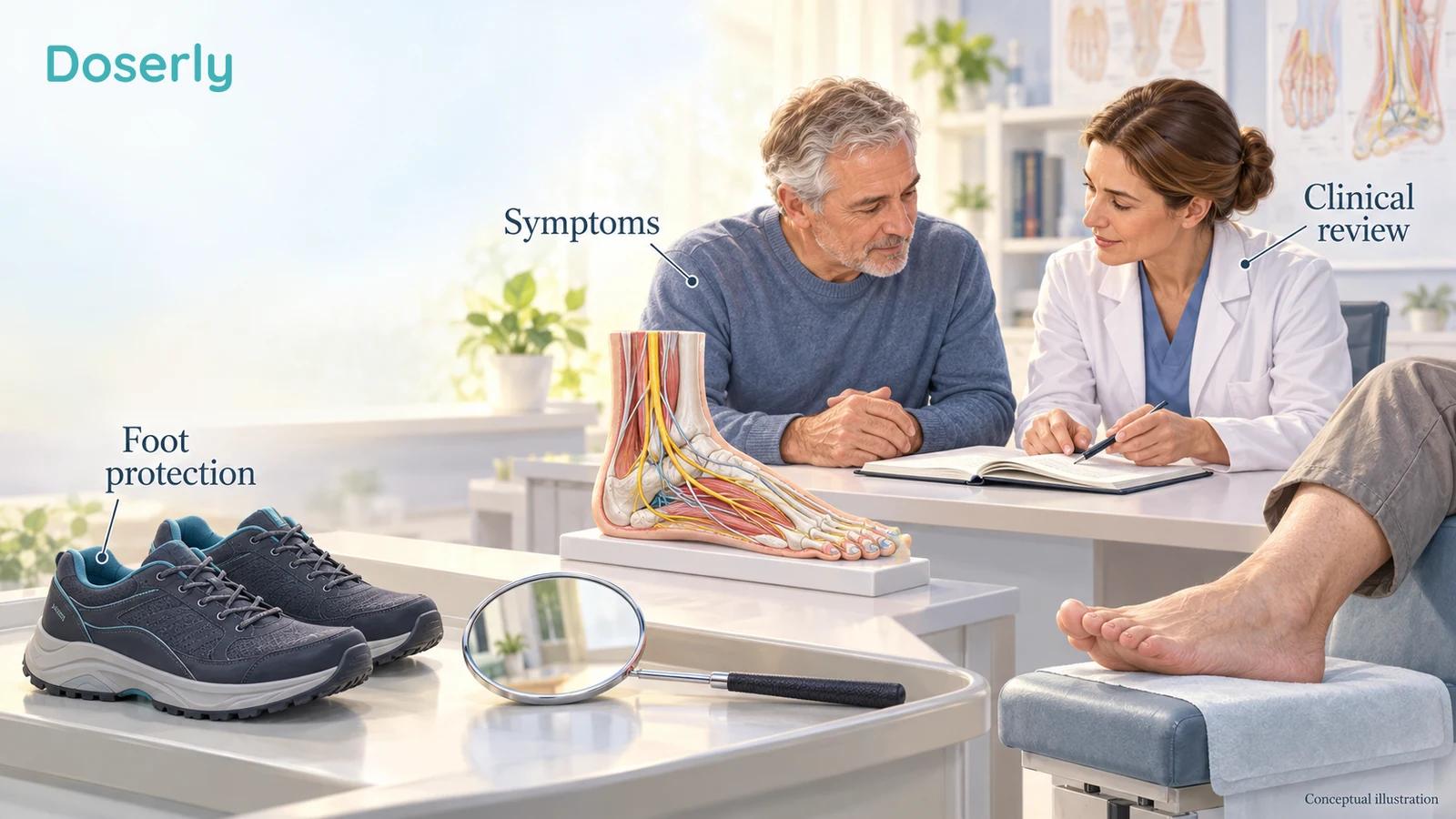
Continue the foot-care plan even if symptoms improve. Checking skin and footwear serves a different purpose from reducing burning pain. A lower symptom score is not permission to abandon protection.
Other care still has a role
Treatment should address the cause where possible, alongside symptom management and support for function. For diabetes, that includes ongoing metabolic care and foot-risk assessment. For CIPN, it includes communication with the oncology team about symptom severity and functional impairment.
ASCO's 2020 guideline update supported duloxetine for established painful CIPN while emphasizing that the benefit is limited. It also advised clinicians to consider appropriate chemotherapy adjustments when neuropathy becomes intolerable or interferes with function. These are individualized medical decisions, not changes to make independently. ASCO guideline
The pivotal duloxetine trial enrolled 231 people. Over the initial five-week comparison, average pain improved by about 1.06 points with duloxetine and 0.34 with placebo on a ten-point scale. The mean treatment difference was approximately 0.73 points. That is a symptom benefit, not a nerve-regeneration claim, and it illustrates how even established options should be described with realistic expectations. Duloxetine randomized trial
A medication and supplement review can also be useful. Vitamin B6 appears in products that may be marketed for general wellness, including some mineral combinations. Australia's TGA has warned that supplemental B6 can cause peripheral neuropathy. This does not identify the cause in an individual, but it makes a complete product list relevant to the assessment. TGA safety information
Our vitamin B6 guide can help you recognize the ingredient while preparing that list. Adding another “nerve support” supplement without reviewing the existing total can complicate the picture. Light therapy should not distract from a potentially correctable exposure or deficiency.
How to make a treatment discussion concrete
Choose the problem you most want help with: painful nights, numb fingers, walking confidence or another specific limitation. Then ask whether the proposed intervention was tested for that problem in people with the same cause of neuropathy. “Neuropathy improved” is too broad to answer that question by itself.
Ask whether the evidence involved a sham procedure, another active treatment or no comparison group. Check whether the device was a low-level laser, an infrared pad, a class IV clinical laser or an LED system. The word PBM sometimes covers very different delivery systems, so the label alone cannot establish equivalence.
Agree on a review point and what would count as a worthwhile benefit. A brief record of pain, sleep disruption, walking difficulty and treatment changes can help the conversation. It cannot prove causation, but it can prevent a vague impression from becoming an indefinite commitment to treatment.
Also discuss what would prompt reassessment rather than another session. New weakness, worsening sensation, falls or skin changes should not be treated as evidence that the device needs more time. The plan should preserve access to the clinician managing the neuropathy and its cause.
What the evidence supports today
Light therapy for neuropathy remains a developing field. Positive studies justify further research, while sham-controlled null trials and mixed newer findings limit broad claims. Diabetic neuropathy and CIPN should remain separate questions, and treatment of established symptoms should remain separate from prevention.
The clearest way to judge a claim is to name the outcome. Less pain is less pain. Better sensation is better sensation. Improved walking is improved walking. None automatically proves nerve regeneration, and none removes the need to address the cause or protect an insensate foot. That precision helps people pursue relief without being asked to believe more than the evidence shows.